Art Bootcamp Notes · 10 · Gesture and space
What Is Gesture Drawing? Energy, Balance and Directional Force
Gesture is energy, not outline. How breaking balance with directional force makes a sphere, a cup or a block feel alive, step by step, before any detail.
 By LIPAI WANG · Chapter 10 of his book Art Is a Puzzle You Can Solve
This part of the book is about gesture drawing. Over the years, browsing through material online and offline, I have run into the word “gesture” a lot. A lot of people treat it very literally: “This is gesture drawing; that is not gesture drawing.” To be honest, at times I even thought it was not what it was made out to be. When people said, “You need to practise tons of gesture drawing,” I thought, “You’re bluffing. This is not the correct way to learn to draw.”
But it turns out that it actually helps. It makes your drawing more alive and makes it make more sense. Think about people drawn with AI: the person is really stiff. They don’t seem to be moving. They’re like a mannequin forced into a certain place, and then someone takes the shot. That isn’t artistic expression. So I think gesture is a topic that needs to be taken seriously, learnt and practised. It is a fundamental part of drawing, and through it you can make your work so much better.
Gesture is energy
I know this may seem like nonsense at first. I thought it was nonsense when I first learnt it. But as you move along it makes sense, because this is how you make things alive.
Everything in this world we can roughly separate into the inorganic and the organic. What we want to draw is organic energy in the subject we are drawing, and to leave the rest still, without that energy. That is what everyone means by gesture. You can simply remember gesture as a kind of energy. Whatever we draw (a person, a cup, anything you want), we want that lifeless thing to have energy, to have some sort of soul.
I taught myself to draw for a long time, and for a really long time I didn’t move forward, because everything I did looked like this: when I did a study, I just drew the outline. That gets a result of a kind, but it is a really childish way of doing things, because an outline alone is not enough.
Say you take a photo of a dancer who is dancing. I’m also a programmer; I’ve developed tons of apps and dabbled a little in AI, so I know you can run an algorithm, the Canny algorithm for example, and get the edges of that dancer mathematically. You print those edges out in ink. Is that a drawing? Does it have the whoosh, the feeling of the dancer’s movement? The anatomy may be correct. The outline may be correct. It’s like tracing round your finger: you get the outline absolutely correct, but it isn’t alive, because you need the energy. You need the gesture. You need to add soul to your work.
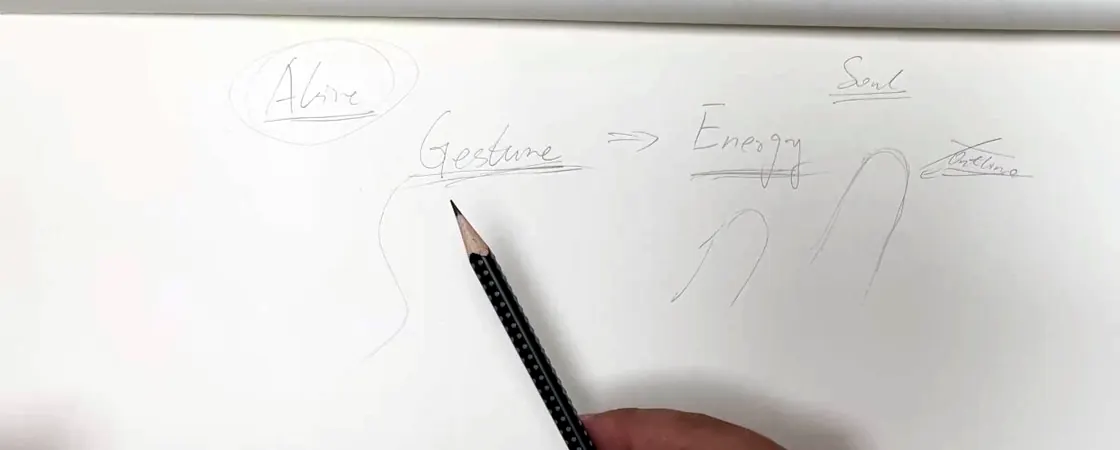
So you want your drawing to be a flow of action. When you draw a dancer from head to toe, you want a flow of energy, not pure anatomy. You do need the basic anatomy correct, and you can twist it to a certain extent for your artistic expression. But you can get the anatomy wrong and the gesture right and it still has artistic value, because what we want to capture is the movement, the energy, the flow, not just the outline of a thing with detail added on top.
That means we completely change the way we work. For a long time I didn’t move forward because I drew the outline and then added detail. That gets a result of a kind, but it will be really, really bad, and it isn’t the correct method. Capture the gesture first; then you can get things wrong and it still gets better. Gesture is the energy. It is the flow of action, the movement, the soul. You use the flow of line, the flow of movement, before any detail comes in. That is the concept of gesture.
Step one: balance and the axis
Let’s start with something very simple and gradually add gesture to it: a circle. Pretty simple. Then I draw the ground the circle sits on, and confirm it by adding edges. Through the circle I draw a centre line, loosely. I want it loose.
Look at it. It is perfectly balanced. Left and right are almost the same around the centre point, and so are top and bottom. You can add several axes, a vertical one and a horizontal one, and they divide the circle into four identical parts: one, two, three, four. That gives you no preference and no reason to look anywhere. You look at it and don’t know where to look. You just acknowledge that it is a sphere.
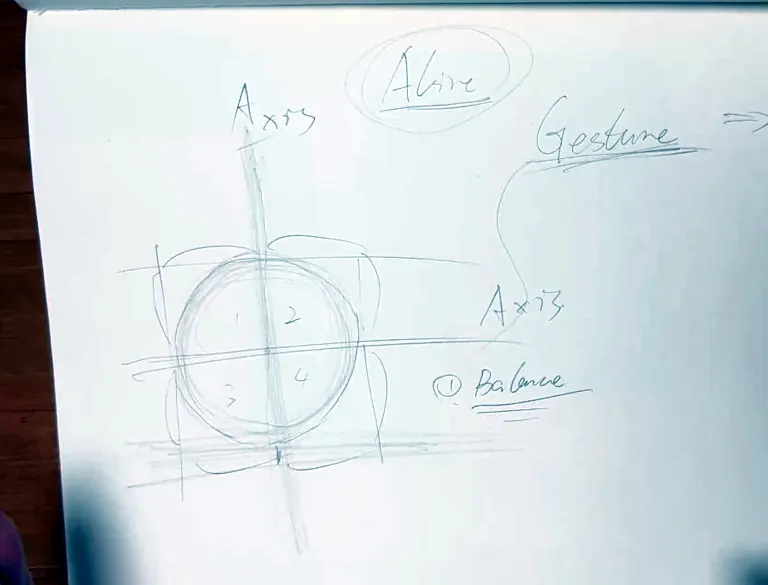
So this is a perfectly balanced drawing, and balance means it isn’t moving. Put this sphere here and it will stay there, because it is perfectly balanced. The axis is at the centre and everything else is in perfect balance, so there is no energy. When you draw, you are playing a mind game with your viewer, because your viewer imagines what will happen in the scenario you describe. Here they think, “This is just a sphere. It will stay there, because it is in balance.”
So that is the first step: understand balance. Next we add a little rhythm.
Step two: break the balance with directional force
If that is perfect balance, we can use shape and size to guide the viewer to a certain area. I still use the basic shape of a circle, but this time I draw a cup. I draw one ellipse a little bigger and one a little smaller as a guide, and then draw the outline.
With the centre line in, left and right are still in perfect balance. But draw a line across it and the top and bottom are no longer balanced, because there is a difference in size: the top is bigger. So now the drawing has a reason. Because it is not in perfect balance, we notice the big thing first, and then our eyes go looking for detail. We have a directional force that takes us from top to bottom, forcing us to go down. That guidance lets us feel energy, feel movement.
As I said, this isn’t about the outline. We are designing a three-dimensional volume, and we are moving everything downwards. Look at the contour, left and right: it gives us a reason to go down. From any point you can feel the energy go from the top, down and down. This is more interesting than the circle. The circle is a little boring; this is an interesting shape. That is an improvement, because we have directional force. The centre axis is still there, and left and right are still perfectly balanced, but top and bottom are not. You break that balance intentionally, to guide everything down.
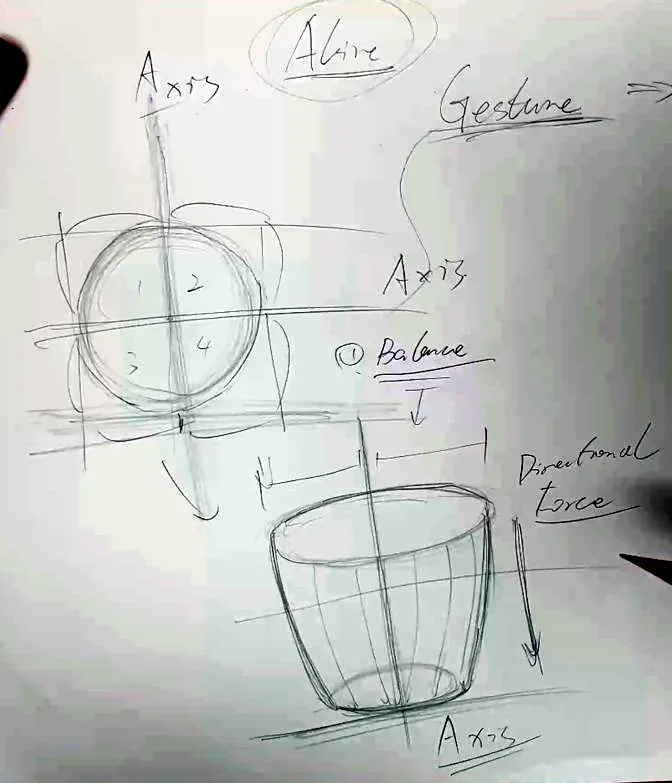
So that is the second step: you add directional force and break the balance. It flows through the body; you add rhythm to the balance, so the thing isn’t just sitting there. It starts to flow.
Directional force can lead anywhere, even to what you can’t see
Directional force isn’t only up and down or left and right. It can go in any direction.
Take a cup that is exactly the same at the top and the bottom. That’s not good if you want gesture, because it’s boring: the axis gives it perfect balance; it is inorganic. I can add directional force by making the top bigger and the bottom smaller, so the force goes down. And I can add a handle.
The handle doesn’t have to go in any fixed place. You can put it strategically anywhere, and as long as you add it at any point on the drawing, you break the balance, because left and right are no longer exactly the same. I want this one to sit really far back, so the handle goes up here and then comes down. (I’ll add a little shading just so it makes more sense.)
The handle carries the viewer’s eye across the centre axis, so the viewer notices this part of the cup, and this becomes the area of interest. There is a directional force from the back all the way to the front. You break the balance by adding something unbalanced, and the viewer thinks, “That’s a force from the back to the front, so I’m looking at the front. This is the handle, I’d grab it here, and this is the front.”
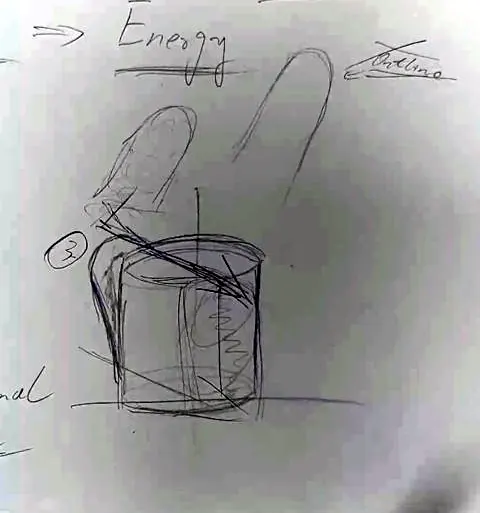
Once you break the balance, you can play around. The two ends don’t need to be the same; the more difference you have, the better, because things get more interesting. I can draw a wider top and a smaller bottom and put the handle here, going round and down. You grab this handle and it shows which way it goes. So you think: this is the handle, I grab it, and that is the front.
You can also break the balance by going from here all the way to the back. That is the back of the cup. You can’t see it, but it is the area of interest. You guide the viewer to imagine what happens behind, where your hand grabs it. Even though something prominent sits in front, you lead the viewer’s eye to the part that isn’t obvious and let their imagination fill it in.
So that is the reason: balance, then directional force to break the balance, leading anywhere, from a visible place to an invisible one.
Try it. Draw a plain cup, the same at the top and bottom. Then draw it again with a bigger top and a smaller bottom, and again with a handle placed so it leads the eye to the back of the cup.
Making it organic, part 1: break the balance of a block
Now let’s apply this, once you know the reasons: gesture, balance, directional force. One of the first things we did when we started learning to draw was to use blocks, basic shapes, to block things out. Most of the time that block looks like this: just the basic shape, “this is a block.” Of course you can do it in proper perspective, but I’ll draw freehand to give you a taste of what I mean.
If you run a line from top to bottom through it, this block seems balanced. You read it as a 3D shape, but there is no force breaking the balance; left and right seem the same. Even drawn in 3D, it’s boring.
So you break the balance. You decide, “I want the right side, or the left side, to be dominant.” If I want the right side dominant, I tilt the block so that side dominates and the rest falls behind, quickly shrinking away. You could set it up with one vanishing point or something like that, but I won’t bother, because I want to draw freehand. You can forget about the perspective, forget about the anatomy, forget about how to block out, and just think: I’m going to break the balance. It has a directional force, and more force on this side, which says, “That’s the dominant part.”
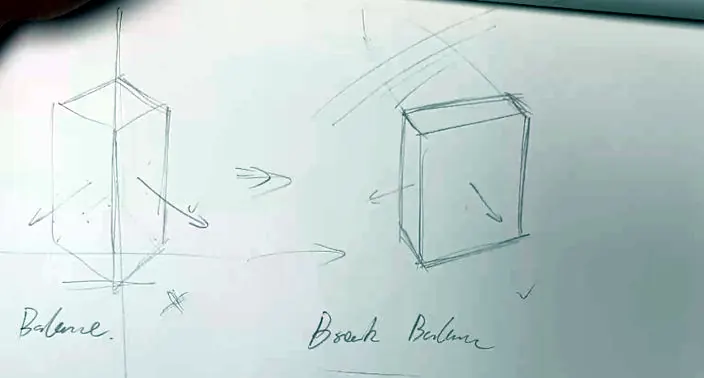
Because I broke the balance and pushed this face more towards us, this is now about design, about composition. There is a directional force from back to front, and we can feel the rhythm of which part is dominant; the eye goes here, then here. Break the balance and you get this kind of gesture. That one is a boring blocking; this one is an interesting blocking. This is the first step to take when you choose the angle of your drawing.
Making it organic, part 2: rhythm instead of straight lines
So far we have used straight lines, and a straight line is the easiest thing to make boring. For rhythm we want organic lines, something like ooh, something that flows. That gives the drawing the flow of the gesture, the rhythm, and it leads the eye: “Ooh, what’s this?”
Do this and you break free from the restriction of vanishing points and rulers and pencils used rigorously, and you can start drawing things more organically. Look at your reference, say a dancer or a model in a specific pose. Draw that organic pose, and then use it as the guideline for your structure. Add volume to it, rather than using it only to block things out.
- Start from the same block, but add rhythm. I connect the dots and add more: boom.
- Find the volume. I add things here and here to find the volume.
- Cut it at any point. I can cut this way or that way: boom, that way; boom, this way. I can cut at any point, and use the rhythm to get the organic shape ready.
- Let the rhythm run through. I can deliberately go down and up; these two connect, and the rhythm goes all the way from the top to the bottom. Where I go wrong, I take the eraser to the lines that aren’t relevant to the structure.
- Add the light and shadow. Now it is organic, going this way and that, and you can use it as a reference and add the light and shadow relationship, a little shadow on the outer side, to make it more organic and 3D.
That is basically how to change a really structured, boring drawing into something organic.
With this method you can do so much more. You can use any line. Take a centre axis and build an organic shape on it from the top all the way to the bottom: rotate it a little, expand it here, find a rhythm, put down a few reference points, and bring it back, boom, and back again, and up. Even where you can’t see it, you get a structure. It makes you think, “Ooh, what’s this?” It is just an interesting, organic, twisted thing, and it adds so much to the basic, boring structure. It is more design, more interesting. Once the rhythm is correct, I add clear cutting points, because you don’t want it vague; you want it more prominent, standing out.
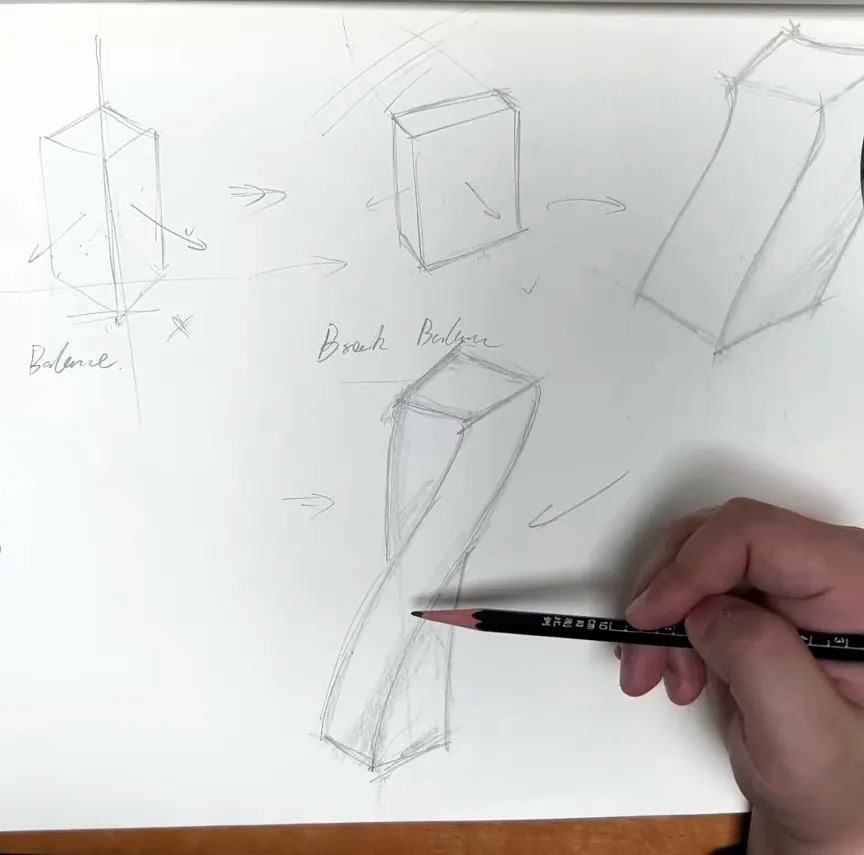
This matters most for organic structure: muscles, the chest, the bones. You block them in with shape, but you use the organic rhythm to block out the bony parts. For what’s in between, I prefer to connect the dots, get the basic shape and the flow down, and then use your logic: “These two should connect; this should be modified; this should be erased.” That way you get a more organic shape instead of a really boring drawing like this balanced block.
Step by step, then: we got more rhythm, we broke the balance, and that is the expression of gesture.
Try it. Draw a plain block, then the same block with its balance broken, then twist it into an organic form with flowing lines, cutting it wherever you like. Finish with clear cutting points and a little shadow.
Key takeaways
- Gesture is energy: the flow of action, the movement, the soul. Capture it before any detail.
- An outline alone is a childish way of drawing. You can get the anatomy wrong and the gesture right, and it still has artistic value.
- Perfect balance means no movement and no reason to look anywhere.
- Break the balance on purpose with directional force (size, a handle, a dominant side) to lead the viewer’s eye, even to a part they can’t see.
- Straight lines are the easiest to make boring; use organic rhythm, then add clear cutting points.
LIPAI WANG
A self-taught artist and teacher, known to his video students as William Jiamin. A former programmer, he teaches drawing, painting, pixel art and 3D the way he learned them: one solvable piece at a time.