A toast in quick strokes
How Frans Hals makes a laughing guardsman feel caught in the moment, with paint that is never smoothed over
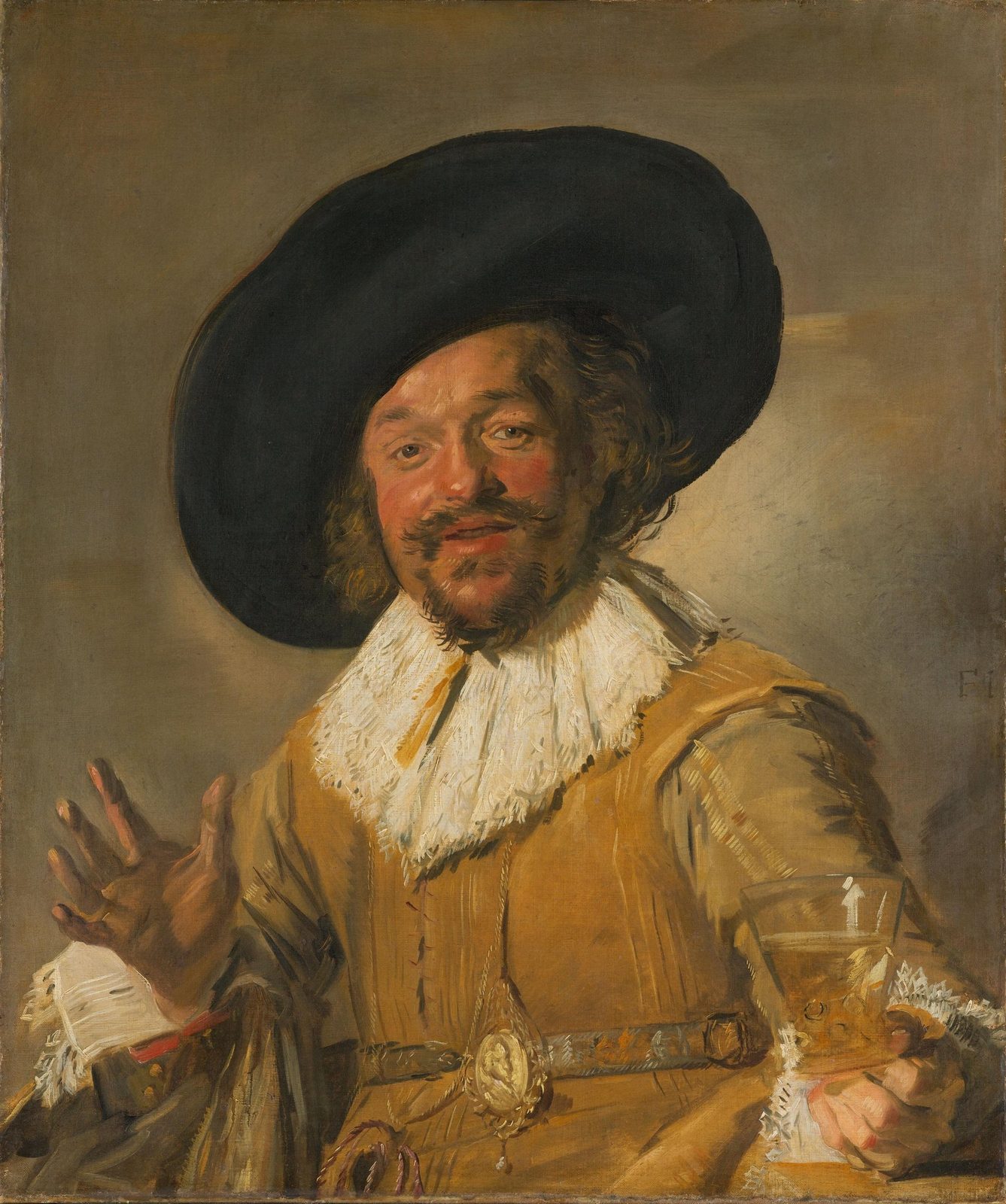
- Artist
- Frans Hals
- Title
- A Civic Guardsman Holding a Berkemeier, known as 'The Merry Drinker'
- Date
- c. 1628 - c. 1630
- Museum
- Rijksmuseum
- Image
- Public domain (CC0)
Open in Simple Art
Watch this story on iPhone and iPad, with offline downloads and a painting every day.
About 4 minutes of looking, in 10 parts.
The Merry Drinker
A man in a huge black hat leans towards us, smiling, one hand thrown up and a tall glass in the other. It feels less like a sitting than a moment snatched from a noisy room. The question is how paint this loose can feel this alive.
Frans Hals, about 1628 to 1630
Frans Hals painted this in oil on canvas around 1628 to 1630, and signed it with a monogram. The museum calls the sitter a civic guardsman holding a berkemeier, the glass in his hand, though he is better known as the Merry Drinker. He seems just about to raise it and toast with us.
A pyramid and a counterweight
His hat, collar and shoulders make a broad pyramid, with the face near the top. The raised hand breaks out to the left, and the glass answers it low on the right. Your eye zigzags between them, face to hand to glass, and back again.
Shadow under the brim
The light falls from the upper left, but the hat brim keeps much of it off his forehead. Look at the band just below the brim. The shadow is made of thin, feathery dark strokes curving over the brow, with lighter flesh showing through, so it softens rather than cuts.
Narrowed, glinting eyes
Down at the face, the eyes look narrowed by the smile, and each carries a tiny bright dot of white. The museum's technical notes say the face was underpainted in a dark olive green, left showing as the shadow. Look for that cooler tone along the shaded side of the nose.
A hand in a few drags
Now the raised hand. The two front fingers catch a warm, salmon-coloured light, while the others sink into brown shadow and nearly vanish into the background. The fingers are long upward drags of the brush, the knuckles short broken touches. Nothing is outlined.
A collar of quick dabs
The collar is made of short, thick dabs of off-white running downward from the throat. Between them, darker paint shows through as the shadows of the lace. The museum notes a grey underpaint here, with the white laid over it and the dark accents added last.
The berkemeier
Lower right is the berkemeier itself. A few white strokes mark its rim and what looks like the level of the drink, and what appear to be small round knobs sit on the glass. Then follow down to the cuff, where jagged white marks dissolve into the shadow of the wrist.
Ochre and a medallion
The doublet is golden ochre, laid in with broad vertical strokes, and darker brown streaks mark the folds. At its centre hangs an oval medallion on a thin chain. The chain is not drawn link by link. It is a string of quick, pale flicks.
The FH monogram
Out at the right, against the background, look for two faint dark letters. This is Hals's monogram, an F and an H joined together. It is only slightly darker than the ground around it, and the weave of the canvas shows through the strokes.
Look closer
9 details, each checked against a close-up of the picture.
-
The Face
The eyes look narrowed by the smile, each with a small bright white highlight.
The crop isolates a man's smiling face framed by a black hat brim above and a thick white-painted collar below. Both eyes are clearly half-lidded: the upper lids descend over roughly a third of the iris, and each pupil carries a small, bright white specular dot positioned in the upper-left quadrant of the iris, consistent with the upper-left light source described in the artwork context. The flesh is built from warm pinks and ochres on the lit planes (forehead, nose ridge, left cheek) layered over cooler, browner half-tones, with a notably saturated rosy patch sitting on the left cheek and a pinky-red bloom on the lower lip/chin. Edges are kept soft throughout: the shadow along the right side of the nose blends into the cheek rather than cutting it, while the mustache and beard read as quick, separate hatched strokes rather than blended masses.
-
Raised Right Hand
The palm is illuminated with a broad, pale highlight contrasting with the dark background.
The crop isolates an upturned, splayed right hand held against a flat, dark olive-grey field. Five digits extend upward; the index and middle catch a strong warm salmon-orange highlight along their leading edges, while the ring and pinky recede into deep umber shadow that nearly merges with the background. The palm reads as a single broad plane of warm ochre with a brighter pinkish-peach smear near the base of the thumb, and a darker reddish-brown crease maps the thenar eminence. Brushwork is loose and visibly directional: long, vertical drags define the fingers, while short, broken touches build the knuckles. At the lower edge a cream-white cuff is laid in with thick, scumbled strokes, and a sliver of the golden-yellow doublet appears at the right with sharper, more opaque highlights.
-
Lace Collar
The white collar is built from short, thick downward dabs, with darker underpaint showing between them as the shadows of the lace.
The crop centers on a broad, falling white lace collar beneath a mustachioed chin. The lace is built from short, vertical, parallel dabs of off-white and cream that radiate downward from the throat, with the paint applied thickly enough to catch light along the ridges. Between these impasto ridges sit thinner, scratched lines of brighter white and shadowed greys that read as the openwork of the lace, terminating in a scalloped, broken edge against the dark background at the right. A warm ochre-yellow of the doublet presses up into the lower edge, while the mustache above is laid in loose, broken dark-brown strokes with visible negative space rather than a solid silhouette.
-
The Monogram
A small, dark ligated FH monogram is painted into the background at centre right.
This crop isolates the right edge where a faint 'Fh' monogram sits against a thinly painted olive-brown ground. The canvas weave is openly visible through the lean paint layer, with horizontal and vertical threads forming a regular grid across the field. The monogram reads as two adjacent glyphs — a tall 'F' with horizontal bars beside a smaller 'h' with a vertical stem and arch — executed in a cooler, greener-brown that sits only a value step or two darker than the surrounding ground. The right margin bears the physical edge of the support, showing craquelure, abraded paint, and a darker notch of exposed substrate near the bottom corner. Light enters from upper-left, leaving the upper-left side of the glyphs fractionally brighter than their lower-right counterparts.
-
Drinking Glass
A few white strokes mark the rim of the glass and what looks like the level of the drink.
The crop centers on the middle of the canvas where a hat brim curves overhead, a gesturing hand pushes forward at lower left, and a small glass sits near the man's hip at center. The glass is rendered with a single elliptical off-white stroke defining the rim, sitting against a mid-ochre background that does little to separate the vessel from its surroundings. A shorter, fainter horizontal white flick just below the rim reads as the liquid's surface line, while the body of the glass is barely more than the negative space between it and the dark fingers at left. Surrounding marks include loose scumbled whites on the hat brim above and a cluster of feathery, lattice-like white strokes at far right, all painted with the same rapid, loaded-brush handling.
-
Golden Doublet
The yellow-ochre fabric contains vertical strokes of darker brown for folds.
The crop isolates the midsection of a yellow-ochre doublet beneath a thick, impasted band of white fringed or feathered trim. The fabric below is built from broad, loose vertical brushstrokes in warm golden-ochre, interrupted by darker brown vertical streaks that read as the troughs of folds. A central seam runs top-to-bottom, marked by small reddish-brown dashes suggesting stitches and flanked by pale vertical piping. The fringed trim above is applied with heavy, calligraphic white strokes that catch strong light from the upper left, casting the recess beneath it into a soft greenish-brown shadow.
-
Hat Brim Shadow
A soft transition of dark brown tones creates the depth under the black brim.
A large expanse of opaque, dark paint dominates the upper portion, representing the underside of a hat brim. Below this solid dark mass, the boundary with the lighter flesh tones is soft and irregular. The shadow on the forehead is formed by sweeping, semi-transparent strokes of dark brown layered over a warmer, lighter base. These darker marks curve gently to follow the convex shape of the head, gradually thinning out as they descend toward the brow.
-
Right Lace Cuff
The cuff edges are jagged and blend softly into the shadow of the arm.
The crop centers on a fragment of white lace cuff at left, painted with short, broken strokes of pale ivory, cool gray, and muted blue-white laid over an ochre ground. The cuff's right edge is irregular: small vertical and diagonal brushmarks step in and out, creating a serrated silhouette against the warm background rather than a clean line. That edge dissolves into a mid-value umber wash where the cast shadow of the arm darkens the cloth, with no drawn boundary. To the right, warm peach and coral flesh tones sit against a deep olive-brown shadow, both applied wet-into-wet in broad horizontal sweeps.
-
Medallion/Jewelry
A small oval medallion with a pale interior hangs from a thin gold chain.
The crop centers on an oval medallion with a creamy, pale interior where figure-like forms are roughly suggested in slightly raised, yellowish-cream impasto. The medallion's outer rim is hinted at with a few broken ochre strokes, while a thin gold chain rises from the top and loops down both sides in quick, comma-shaped touches of pale yellow-ochre. Warm umber and raw-sienna fabric surrounds the jewel, with diagonal drapery folds described in slightly darker brown. White-pale highlights sit on the upper-left of the medallion interior and along the upper chain links, consistent with light arriving from the upper left. Edges are deliberately left soft and unblended, with the chain's links reading as suggestions rather than discrete shapes.
The Merry Drinker in context
A guardsman painting guardsmen
By the late 1620s Frans Hals had worked in Haarlem for nearly two decades, having joined the city's painters' guild in 1610 [1]. He knew civic guard life from the inside. He served as a musketeer in the St George Civic Guard from 1612 to 1624 [1]. In 1616 he was also listed as a friend of the Haarlem chamber of rhetoric De Wijngaardranken, one of the dramatic and poetic societies of the day [1][4].
Alongside commissioned portraits, Hals painted scenes of everyday life, mainly in the 1620s and 1630s [4]. The National Gallery describes these as pictures that let him push the speed of his brushwork, free of the need to please a paying sitter [4]. The Frans Hals Museum adds that his smiling character heads, known as tronies, were very popular and were probably made to sell on the open market [6].
Portrait or character?
Nobody knows quite what kind of picture this is. Jonathan Bikker's 2007 catalogue entry places it in the late 1620s, alongside similarly sketchy works in Schwerin, Kassel and Leipzig [1]. Half-length single figures by the Utrecht Caravaggisti, such as Honthorst's Merry Violinist, have rightly been seen as a possible source, Bikker writes. But Hals's man wears contemporary clothes rather than fanciful costume, which raises the question of whether he's a type or a real sitter [1].
His clothes point to soldiering. The yellow buff coat, a kolder in Dutch, was typical military wear, and medallions were given to civic guardsmen for special service, such as Haarlem's expeditions to Hasselt in 1622 and Heusden in 1625 [1]. The idea that the medallion shows Prince Maurits is hard to check because it's painted so loosely [1].
Other readings exist. Kauffmann saw the figure as the sense of taste, which Bikker thinks ignores the uniform, while Slive suggested he might be a wine merchant and proposed the Haarlem innkeeper Hendrick den Abt [1]. Wikipedia notes that Hofstede de Groot classed the painting as a genre piece in 1910 [2].
Bought in 1816
The painting's known history begins with the sale of the collection of Baroness Hermina Jacoba van Leyden van Warmond at Warmond Castle on 31 July 1816 [1]. The catalogue described a laughing warrior holding a glass, and the picture was bought for 325 guilders on behalf of the museum [1].
Neglect and rediscovery
Hals's reputation faded for much of the eighteenth and nineteenth centuries [4]. Wikipedia records that an English visitor, Lord Dover, called the handling "unfinished" in 1822 while admiring the face, and that Théophile Thoré-Bürger argued in 1868 that the loose strokes were deliberate [2]. The National Gallery credits Thoré-Bürger, together with the Impressionists, with rediscovering Hals in the second half of the century [4].
This picture played a direct part. Édouard Manet painted Le Bon Bock in 1873, not long after a visit to the Netherlands where he saw The Merry Drinker, then on view at the Trippenhuis in Amsterdam [3]. Esmée Quodbach calls Le Bon Bock perhaps the most famous painting inspired by Hals [3]. Neither work could be borrowed for the Frans Hals Museum's 2018-19 exhibition on Hals and the moderns [3].
On show today
The Merry Drinker was one of the Rijksmuseum's own paintings in its Frans Hals exhibition of 2024, organised with the National Gallery in London and the Gemäldegalerie in Berlin [5]. When this was written, the museum's website listed it as on display in the Gallery of Honour [1].
- A Civic Guardsman Holding a Berkemeier, known as 'The Merry Drinker' (SK-A-135): object record, provenance and catalogue entry (Jonathan Bikker, 2007) . Rijksmuseum, Amsterdam
- The Merry Drinker . Wikipedia
- Frans Hals and the Moderns: Hals Meets Manet, Singer Sargent, Van Gogh (exhibition review, Esmée Quodbach, 2019) . Nineteenth-Century Art Worldwide
- The Credit Suisse Exhibition: Frans Hals (press release) . The National Gallery, London
- Frans Hals (exhibition, 16 February to 9 June 2024) . Rijksmuseum, Amsterdam
- Would you like to know more about Frans Hals? . Frans Hals Museum, Haarlem