Caught mid-song
How Judith Leyster catches a lute player between two phrases, using a single light
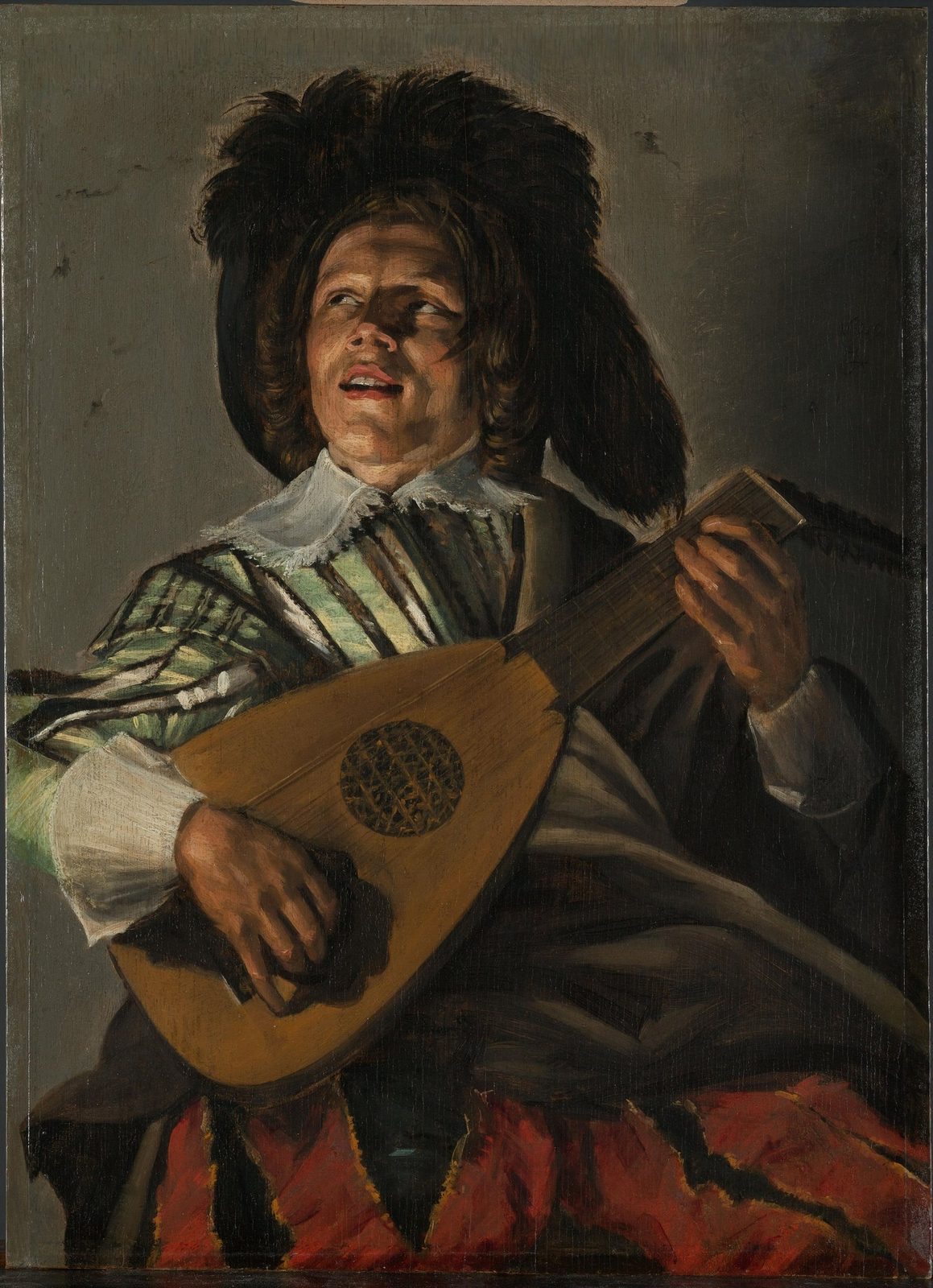
- Artist
- Judith Leyster
- Title
- A Lute Player, known as ‘The Serenade’
- Date
- 1629
- Museum
- Rijksmuseum
- Image
- Public domain (CC0)
Open in Simple Art
Watch this story on iPhone and iPad, with offline downloads and a painting every day.
About 3 minutes of looking, in 9 parts.
A song in progress
A young man with a lute tips his head back and sings. His lips are parted and his eyes are lifted, as if he's already reaching for the next line. His face is the brightest thing here, and almost everything around it slips into shadow.
Judith Leyster, 1629, oil on panel
This is The Serenade by Judith Leyster, dated 1629. It's painted in oil on a panel less than half a metre tall. The museum records her monogram, a small star and the date at the upper right.
A strong diagonal
Look at how the picture is put together. The big feathered cap fills the top, his two hands sit lower down on either side, and the lute cuts across his body on a strong diagonal, its neck rising towards the right.
Light from the upper left
The light comes from the upper left and falls hardest on his face. Notice the shadow the nose throws across the cheek, and how the far side of the face drops into dark brown in one broad mass. The lips look thickly painted, and a thin line of light catches the teeth.
Thick white at the collar
Just below the chin, the collar looks like the thickest paint in the picture. The white seems to stand up in ridges against the thin, dark cloak. Now let your eye slide across to the striped sleeve, where green, cream and brown stripes are laid in loose, broken strokes rather than drawn.
Fingers without outlines
Follow the neck of the lute up to the hand pressing the strings. There are no outlines between the fingers. Each one is separated from the next by a step in tone, and the knuckles carry small creamy highlights from the same light that falls on the face.
The carved rosette
In the middle of the lute is the rosette, the carved sound hole. It's one of the most precise passages in the painting, a criss-cross lattice in light ochre over a very dark ground. Each little bar seems lit on its upper left edge, so it reads as carved rather than flat.
The red breeches
At the bottom is the strongest colour in the painting, the red of his breeches. Saturated reds sit on the raised folds, with deep brown-black in the hollows between them. The museum's own description points out how well this red sets off the greenish background.
Feathers that melt away
Now go back up to the cap. Its feathers have no hard edge against the background. The dark paint seems to be dragged on thinly, so flecks of the grey-green ground show through, and a few stray strokes reach out beyond the main shape.
Look closer
8 details, each checked against a close-up of the picture.
-
The singing face
The lips are parted and the eyes are cast upward toward the light source.
The crop isolates a face rendered with loose, visible brushwork against a near-black background. Warm peachy-cream flesh is laid in broad diagonal strokes across the forehead and left cheek, with the brightest highlights catching the bridge of the nose, the upper lip, and the lower rim of the chin. The right side of the face falls away into a deep umber shadow that reads as a single decisive mass rather than carefully modeled half-tones. The parted lips are painted with thick, saturated coral-red impasto, the upper teeth catching the most direct light as a thin white stroke. Curling dark-brown and black strokes describe the hair mass, and a fine web of craquelure runs across the entire surface, indicating aged oil paint on a relatively rigid support.
-
Lute rosette
The rosette features a complex, symmetrical geometric carved pattern.
The crop isolates a circular lute rosette set into the warm golden-brown soundboard. The rosette is built from a very dark, almost black umber ground, into which a raised lattice of intersecting diagonals is rendered in lighter ochre-cream paint; the carved ridges catch a raking light from the left, so each raised bar is bright on one edge and drops into the dark recess on the other. The surrounding wood is described with long vertical and slightly diagonal strokes that read as both grain and brushwork, with thin scratched highlights tracing the same vertical axis. A larger dark mass sits below the soundhole, its edge against the wood soft and slightly broken, suggesting shadow rather than a hard contour.
-
Striped sleeve
The green and white stripes are rendered with loose, broken, gestural strokes.
The crop isolates a sleeve of diagonal stripes in alternating greens, dark browns, cream whites, and yellow-ochres, with a thick impastoed white cuff/collar at the top edge and a smooth brown form (lute or instrument body) sweeping across the lower right. Each stripe is built from multiple overlapping strokes rather than a single flat band; the dark stripes are thin, dragged lines that leave the green ground visible between them, while the white/cream stripes show thicker, loaded dabs of paint with raised ridges catching the raking light. Edges between colour zones are soft and broken — no stripe has a hard contour, and the transitions rely on hue and value shifts worked wet-into-wet. A consistent vertical streaking runs through every passage, reading as either the wood-grain/ground telegraphing through thin paint or as directional wiping, and it overlays the diagonal fabric pattern.
-
White collar highlight
Bright white paint is applied in thick impasto against the dark under-cloak.
The crop centres on a starched linen collar built up in heavy, ridged impasto that stands proud of the panel, catching raking illumination across its folds. Beneath it lies a dark umber-brown under-cloak applied in thinner, looser strokes, with the dividing edge between white linen and dark fabric kept crisp yet slightly broken by tiny gaps where dark shows between white peaks. The white itself is not single-valued: the lit ridges carry warm cream tones, the shadowed valleys cool to a greenish-grey, and along the lower hem a near-pure lead white is dragged in short horizontal licks that curl the frill. Vertical craquelure runs through the whole passage, and the surrounding flesh (chin) and feathered cap are blocked in warmer browns and cool blue-blacks respectively.
-
Red drapery
Saturated red paint is layered with dark black-brown shadows in deep folds.
The crop isolates a band of red drapery at the painting's lower edge, showing roughly four to five deep triangular folds running vertically against a near-black background. Saturated crimson and vermillion red are blocked in for the lit faces of the cloth, while a very dark brown-black is laid into the recesses between folds. Along the crests of the folds, a thin warm ochre-yellow ridge is dragged across, suggesting a glaze or scumble catching the raking light. Edges are mostly soft and broken rather than sharp, and vertical craquelure lines run through the entire band, confirming aged oil on panel/canvas.
-
Fretting hand
The fingers on the lute neck are modeled with soft edges and blended skin tones.
A cropped detail of the fretting hand gripping the lute's neck. Four fingers curl over the dark fingerboard, their dorsal surfaces lit by a warm light from the lower left, while the thumb wraps behind. Highlights sit on the knuckles and the ridge of the index finger as creamy ochre strokes; mid-tones are blended warm browns; the under-finger shadows merge into a near-black umber ground. Edges between adjacent fingers are soft, with no hard contour line — the separations are achieved by tonal jump rather than drawn outline. The background is a thin, scumbled dark brown with diagonal brush marks and a brighter wedge of lute wood at the top, while a sharp white flick at the lower right reads as a cuff or finger tip catching the light. Vertical craquelure lines run through the whole crop.
-
Feathered cap edge
The edges of the feathers dissolve into the dark background with soft, scumbled transitions.
The crop shows the upper silhouette of a large dark cap, rendered in loose, sweeping strokes of black, deep umber and warm dark brown over a muted grey-green ground. Individual feather shapes are suggested by curved, tapered dabs of slightly lighter brown, while the perimeter where the feathers meet the background is irregular and broken: there is no continuous hard contour. Instead, the dark pigment is dragged thinly over the ground so that flecks of the underlying green-grey show through, and isolated dark hairs extend past the main mass into the surround. Vertical striations of the panel/canvas weave and a few short horizontal drags are visible across the surface, confirming a thin, scumbled application at the edge rather than an opaque fill.
-
Strumming hand
The hand is positioned in a relaxed grip over the lower body of the lute.
The crop isolates a strumming hand resting on the rounded body of a lute. The back of the hand is modeled with warm peach and pinkish flesh tones catching light from the lower left, while deep umber and near-black shadows define the fingers tucked beneath and the shadowed side of the lute on the right. A curved sweep of golden-ochre paint reads as the soundboard's edge, and a dark cluster of brushy marks at top right may be part of the pegbox or a decorative element. The paint surface is fractured by a fine web of craquelure running mostly vertically, and edges between the hand and shadow are soft and blurred rather than crisp.
The Serenade in context
A brewer's daughter in Haarlem
Judith Leyster was baptised in Haarlem on 28 July 1609, the second youngest of nine children of Jan Willemsz, a silk weaver who became a brewer, and Trijn Jaspersdr [2]. Her father had named a house he bought in 1601 De Leystar, the Lodestar, and later took that as his surname [2].
Nobody knows who taught her. In 1628 the writer Samuel Ampzing praised her in his description of Haarlem [2], when she was only 18 or 19 [3]. The Serenade and The Jolly Drinker, both in the Rijksmuseum and both dated 1629, are her earliest signed and dated paintings [2].
Borrowing from Hals, and from Utrecht
Half-length pictures of single musicians first appeared in the northern Netherlands among the Utrecht followers of Caravaggio, with the earliest dated examples from 1621 [2]. Over in Haarlem, Frans Hals painted a lute player around 1623. Jonathan Bikker of the Rijksmuseum thinks Hals's picture, rather than the Utrecht ones, was probably Leyster's main model. He points to the view from below and the upward, sidelong glance [2].
Her handling imitates Hals, but her strokes are generally shorter and the paint goes on in several thick, opaque layers [2]. The hidden light on the face and shoulder didn't come from Hals, who never used it. It was a Utrecht device, and Leyster may have picked it up from the Haarlem painter Pieter de Grebber instead [2]. And while Hals's lute player wears a fool's costume, Leyster dressed hers in fancy contemporary clothes of the kind seen in Haarlem pictures of courting couples [2].
Technical study found no underdrawing. She blocked in the design in dark and light paint, left the figure in reserve and built it up wet into wet, adding the collar, cuffs and highlights last [2]. The green of the doublet is a mixture of smalt and yellow, and the rich red glaze on the breeches has faded considerably [2].
Love teaches music
Music and love were often paired in Dutch writing and pictures of the time. Jacob Cats wrote that love leads to singing, and a 1611 emblem book by Gabriel Rollenhagen illustrated the motto Amor docet musicam, love teaches music [2]. Bikker concludes that it is not too far-fetched to think the young man is smiling up at the person he loves [2].
Master, teacher, wife
Leyster joined the Haarlem Guild of St Luke in 1633, letting her open a studio and take pupils. The Rijksmuseum calls her the first woman in the seventeenth-century Netherlands to become a master painter [1]. Wikipedia is more cautious, noting that some sources call her the first woman registered by the guild, while others give that place to Sara van Baalbergen in 1631 [4].
In 1635 she quarrelled with Hals over a pupil, Willem Woutersz, who left her studio after a few days to join his. She received only partial compensation and was fined for not registering him in the first place [2]. In 1636 she married the painter Jan Miense Molenaer, and her only work dated after the wedding is a drawing of a tulip from 1643 [2]. She was buried in Heemstede on 10 February 1660 [2]. Only about twenty paintings are accepted as hers today [2].
Two centuries as a Hals
The Serenade may be the lute player listed in the vestibule in Molenaer's probate inventory of 1668, though the museum marks this with a question mark [2]. Later it belonged to Pieter van Winter in Amsterdam as a Frans Hals, then to his daughter Lucretia Johanna van Winter and her husband Hendrik Six [2]. In 1908 the Six heirs sold it to the Rijksmuseum with 38 other paintings, with support from the Vereniging Rembrandt [2].
Wilhelm von Bode was the first to question the Hals attribution, though he read the prominent J of the monogram as Jan Hals [2]. In 1893 Cornelis Hofstede de Groot identified the monogram, a J with a star shooting to the right, on this and five other pictures as Leyster's [2]. Wikipedia notes that she had been largely forgotten after her death and dates her rediscovery to that year [4]. In March 2021 she became one of the first three women whose work was added to the Rijksmuseum's Gallery of Honour [4].
- The Serenade (SK-A-2326): object record . Rijksmuseum, Amsterdam
- Judith Leyster, A Lute Player, known as 'The Serenade', 1629: catalogue entry, biography, technical notes and provenance (Jonathan Bikker and Gwen Tauber, 2022), Dutch Paintings of the Seventeenth Century in the Rijksmuseum . Rijksmuseum, Amsterdam
- Judith Leyster, from the series Dutch Masters . Rijksmuseum, Amsterdam
- Judith Leyster . Wikipedia