Through the doorway, into the light
How Pieter de Hooch sets a small moment in a pantry against a brighter room beyond
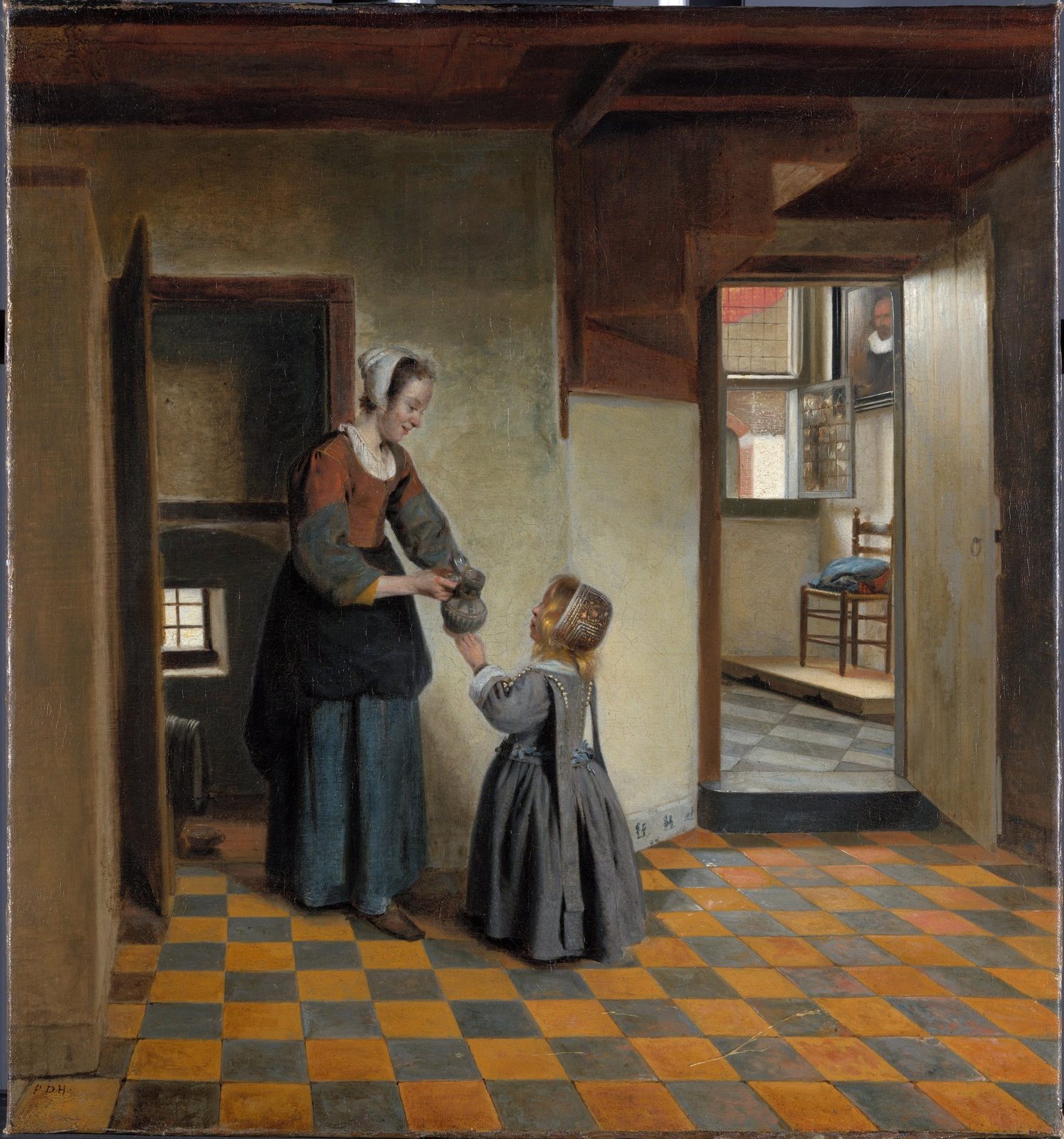
- Artist
- Pieter de Hooch
- Title
- A Maid with a Child in a Pantry
- Date
- c. 1656 - c. 1660
- Museum
- Rijksmuseum
- Image
- Public domain (CC0)
Open in Simple Art
Watch this story on iPhone and iPad, with offline downloads and a painting every day.
About 3 minutes of looking, in 10 parts.
A look inside the jug
A maid bends towards a small boy and shows him what's in her jug. He looks up at her rather than at the jug. Beyond them, a doorway opens onto a second, brighter room.
Pieter de Hooch, about 1656 to 1660
This is Pieter de Hooch's A Maid with a Child in a Pantry, painted in oil on canvas around 1656 to 1660. The museum notes that the boy wears a dress, as all small children did then, with reins to hold him while he learned to walk.
Two views beyond
De Hooch was known for views from one space into another, and here he gives us two. On the left, a door looks through towards the cellar. On the right, the doorway leads to the front room, where the daylight is painted pure white.
White light beyond
Look through that right-hand doorway. A leaded window stands open, and the sunlit wall beyond is so pale it almost glows. The thin dark lines of lead across the panes make the white look brighter still.
Looking up
Back in the pantry, the boy tips his head up towards the maid. His cap is trimmed with tiny pearl-like beads, and its edge stays crisp against the wall, while his hair and jaw are painted more softly.
The maid's smile
She looks down at him with the hint of a smile. It's made with very little: a slight upturn at the corner of the mouth and a small bright touch on the lower lip. Her white cap is modelled in cream and cool grey-green.
Cool dress, warm floor
His grey-blue dress is cool against the warm ochre tiles. The long bands hanging down his back may be the walking reins the museum mentions. The deepest folds read almost black, with thin, lighter strokes along the crests.
One hard edge
The doorpost divides the two worlds. Its edge against the pantry wall is crisp from top to bottom, with no blending, so the dim room and the bright one stay clearly apart.
A floor in perspective
Down on the floor, the tiles make a grid in perspective. Their lines run back into the room and seem to meet at a point beyond the right edge. Each tile is a flat shape of ochre, slate grey or rose, with crisp lines between.
A portrait and a chair
Deep in the front room hangs a small portrait of a man in dark clothes with a white collar. Its frame is sharp, but the figure inside is soft, so it settles into the distance. Below it, a chair with a blue cloth catches the same light.
Look closer
9 details, each checked against a close-up of the picture.
-
Sunlit back room window
Bright white light enters through a leaded glass window pane.
The crop frames an open casement window set in a wooden jamb. Lead cames form small rectangular grids in the upper fixed pane and the lower hinged shutter, which swings inward to the right. Through the open aperture we see a sunlit white plastered wall intersected by a red brick archway and a strip of terracotta brick; the upper register of the back room carries a coral-red field (possibly draped fabric or wall). Crisp white highlights pick out the leading of the open shutter against cooler grey-brown glass tones. The right edge of the crop captures the corner of a dark portrait frame and a sliver of a wooden chair. A web of fine craquelure traverses every passage, most visible across the broad white wall and the leaded panes.
-
Child's upturned face
The child's eyes are directed upward toward the maid's face.
A child's head in three-quarter upward-tilted profile, framed by a patterned brown cap trimmed with rows of small white pearl-like beads and a ruched gold border. Warm pinkish flesh tones model the forehead, nose bridge, and chin, with the eye directed upward and the lips slightly parted. Long reddish-blonde hair falls in soft, wet-into-wet strokes beside the cheek, and a pale grey-blue garment with a white collar and pearl-buttoned edge sits below. The background is a flat cream-beige traversed by an aged craquelure network, providing a neutral field that pushes the lit profile forward.
-
Tiled floor perspective
The lines of the floor tiles converge toward a single vanishing point.
The crop is dominated by a checkerboard floor in oblique perspective, the upper edge cropped by the hems of two figures: a teal-blue apron/skirt at left and a dark slate-gray skirt at center, plus a sliver of doorframe at far left. Tiles alternate between warm ochre-yellow, cool gray-blue, and occasional terracotta-rose squares, each painted as a discrete flat plane with subtly broken internal color rather than uniform fill. Thin, sharp grout lines separate the tiles crisply, and faint diagonal scratch marks cross several tiles in the lower right, reading as surface abrasions or aged varnish. The right-hand grout lines angle upward to the right while the receding lines angle upward to the left, meeting toward an unseen point beyond the right edge.
-
Maid's headgear and expression
The maid wears a white cap with a subtle fold and a slight smile.
A three-quarter portrait of a young maid turned slightly to the viewer's right, gaze lowered. The white linen cap sits on her head with a soft V-shaped fold catching light at the crown; the cap is rendered in cream and pale grey-green shadows that model its volume. Her cheeks carry a flushed rose tone, and the mouth turns up subtly at the corners with a small coral-red touch inside the lips. The bodice is a warm russet brown with loose, visible brushwork and a white linen collar peeking at the neckline. Surface craquelure crosses the entire crop, and the background is an olive-grey wash sitting behind the figure.
-
Child's grey-blue gown
The gown features a cool grey-blue tone contrasting with the warm ochre floor.
The crop shows a child viewed from behind wearing a long, full grey-blue gown with puffed sleeves and a fitted bodice opening at the back, edged with a vertical row of small, pale, jewel-like dots. Two pale blue ribbon bows sit at the waist, one at center-back and one to the right, with long fabric tails descending vertically into deep pleats that pool onto the floor. The right half of the gown catches more light, rendering the grey-blue as a lighter, cooler value, while the left falls into deeper slate-grey shadow. The gown's cool tone sits directly against the warm ochre and charcoal checkerboard floor, and a white ceramic vessel with cobalt decoration intrudes at the right edge.
-
Doorpost threshold
A sharp vertical edge separates the darker pantry from the brighter back room.
A dark umber-brown wooden doorpost runs nearly the full vertical height at roughly x=0.42, separating two zones. To its left sits a cream-buff plaster wall carrying a dense craquelure network; to its right opens the brighter back room, where a pink-red leaded pane reads at the top, a chair with rust cushion appears mid-height, and a cool grey tiled floor slopes toward the lower right. The meeting line between the post and the cream wall is crisp and unbroken from top to bottom, while the post itself shows a subtle value shift - cooler/darker on its left face, marginally warmer on its right face where it catches spill light. At the base a dark rounded ceramic vessel sits on warm timber boards, with a grey wash of floor tile visible past the post.
-
Portrait in the back room
A framed portrait of a man is visible on the wall of the distant room.
The crop isolates a back-wall vignette: a small framed portrait of a bald man in dark clothing with a bright white collar/bib, mounted on a muted olive-grey wall. A dark vertical band at the left reads as the edge of a doorway or door frame, and the lower register shows blurred dark shapes (likely the back of a chair) descending into shadow. The figure's silhouette is soft and slightly smudged against the wall, while the rectangular frame edges are crisp and geometric. A dense web of fine craquelure covers the entire surface, more visible in the mid-tone wall than in the dark frame. The light falls from the right, brightening the right side of the face and collar and leaving the left side of the figure in cooler shadow.
-
Chair in back room
A blue cloth is draped over a wooden chair in the sunlit room.
The crop isolates a wooden ladder-back chair against a cream-yellow wall, with a blue cloth bunched across the upper rail and a small patch of orange-red fabric peeking from behind it. Soft, rounded folds in the blue drapery show glazed mid-tones of cobalt-tinged grey, with deeper shadow pockets in the recesses and brighter specular lifts on the crest. The chair's wooden frame is rendered with crisp, dark linear edges that contrast with the softer fabric, while the horizontal slats are thin and slightly blurred. A network of fine craquelure runs across the entire surface, most visible against the lighter wall and floor areas. The light falls from the right, brightening the right side of the back rail and casting the left side of the chair into soft shadow.
-
Artist's monogram
The letters 'P.D.H.' are painted in the lower-left corner.
The crop shows three dark capital letters 'P D H' with periods, set against an orange-ochre painted surface that reads as a tile or plaster ground. Below and around the letters, faint rows of stippled dots form a regular pattern, suggesting either a decorative tile motif or aged craquelure in the impasto. The dark pigment sits cleanly on the warm ground without bleeding, indicating either a dry-loaded brush or a careful retouch over a more absorbent layer.
A Maid with a Child in a Pantry in context
Building the view-through
The Dutch word for De Hooch's favourite device is doorkijkje, a look through one space into another [1]. The Rijksmuseum calls these views one of his trademarks, a kind of forerunner to virtual reality that guides a viewer's gaze through the house [2]. And the museum's Dutch description of this canvas uses the plural, doorkijkjes, for the openings on both sides [1].
Technical study has shown how such spaces were set up. Peter Sutton, reviewing the 2019 Delft exhibition, reports that pinholes at the vanishing points of De Hooch's canvases reveal his use of central perspective [3]. Particularly around 1658, close to the date of this picture, he sometimes added a second horizon with its own set of converging lines, possibly to cope with views through doors into adjoining rooms [3]. The Rijksmuseum's research project behind that exhibition began with its own six paintings by De Hooch and asked, among other things, how he constructed his interiors in perspective [4].
A painter of perspective
Contemporaries already saw perspective as his strength. Sutton points out that Arnold Houbraken, writing in the eighteenth century, contrasted De Hooch with his fellow Rotterdammer Jacob Ochtervelt, who painted backgrounds without much perspective, a skill Houbraken said required geometric insight and keen observation [3]. The Rijksmuseum adds that, however real these rooms look, they were carefully conceived in the studio and not based on existing interiors [2].
The process wasn't fixed in advance. Hofstede de Groot noted traces of a picture, faintly visible on the wall above the woman's head, that the artist painted out [5]. Sutton remarks that sizeable changes like this are surprisingly common in De Hooch's work [3].
Boy or girl?
The museum's English text calls the child a little boy, and its story on the artist describes the woman offering the young master of the house a jug of beer [1][2]. Its Dutch description, however, speaks of a small girl, and Hofstede de Groot also called the child a little girl in 1910 [1][5]. The National Gallery of Art in Washington, discussing a related De Hooch, warns that young boys and girls are notoriously hard to tell apart because they were dressed so alike [6]. It also notes that De Hooch had a son baptised in 1655 and a daughter in 1656, either of whom could have served as a model [6].
Next to Vermeer
The National Gallery of Art describes calm light, colour and complex perspective as essential elements of Vermeer's style too. They say De Hooch must have had contact with him [7]. Essential Vermeer reports the view that De Hooch influenced Vermeer rather than the reverse, with Vermeer responding to his light and perspective in the late 1650s [8]. And the museum's literature list for this canvas includes the exhibition catalogue Vermeer and the Delft Style [1].
An early purchase
Hofstede de Groot traced the painting through Amsterdam sales from 1712, when it was sold with a pendant, to the sale of the widow A. M. Hogguer in August 1817 [5]. The Rijksmuseum records it as a purchase of 1817 [1].
- Pieter de Hooch, A Maid with a Child in a Pantry (SK-A-182): object record, Dutch description, acquisition and literature . Rijksmuseum, Amsterdam
- Pieter de Hooch: an artist who transformed light and space into poetry . Rijksmuseum, Amsterdam
- Peter C. Sutton, review of 'Pieter de Hooch in Delft: From the Shadow of Vermeer' (Museum Prinsenhof Delft, 2019 to 2020) . Historians of Netherlandish Art Reviews
- Pieter de Hooch: technical research project . Rijksmuseum, Amsterdam
- A Woman with a Child in a Pantry (quoting Hofstede de Groot, no. 1) . Wikipedia
- Arthur K. Wheelock Jr., Pieter de Hooch, The Bedroom, 1658/1660, systematic catalogue entry (Internet Archive copy, 20 May 2026) . National Gallery of Art, Washington
- Arthur K. Wheelock Jr., 'Pieter de Hooch', artist biography (Internet Archive copy, 30 April 2025) . National Gallery of Art, Washington
- Seven Dutch Masters: Pieter de Hooch . Essential Vermeer