Close work
Pieter de Hooch paints a mother's search for lice with the same patient care she brings to it
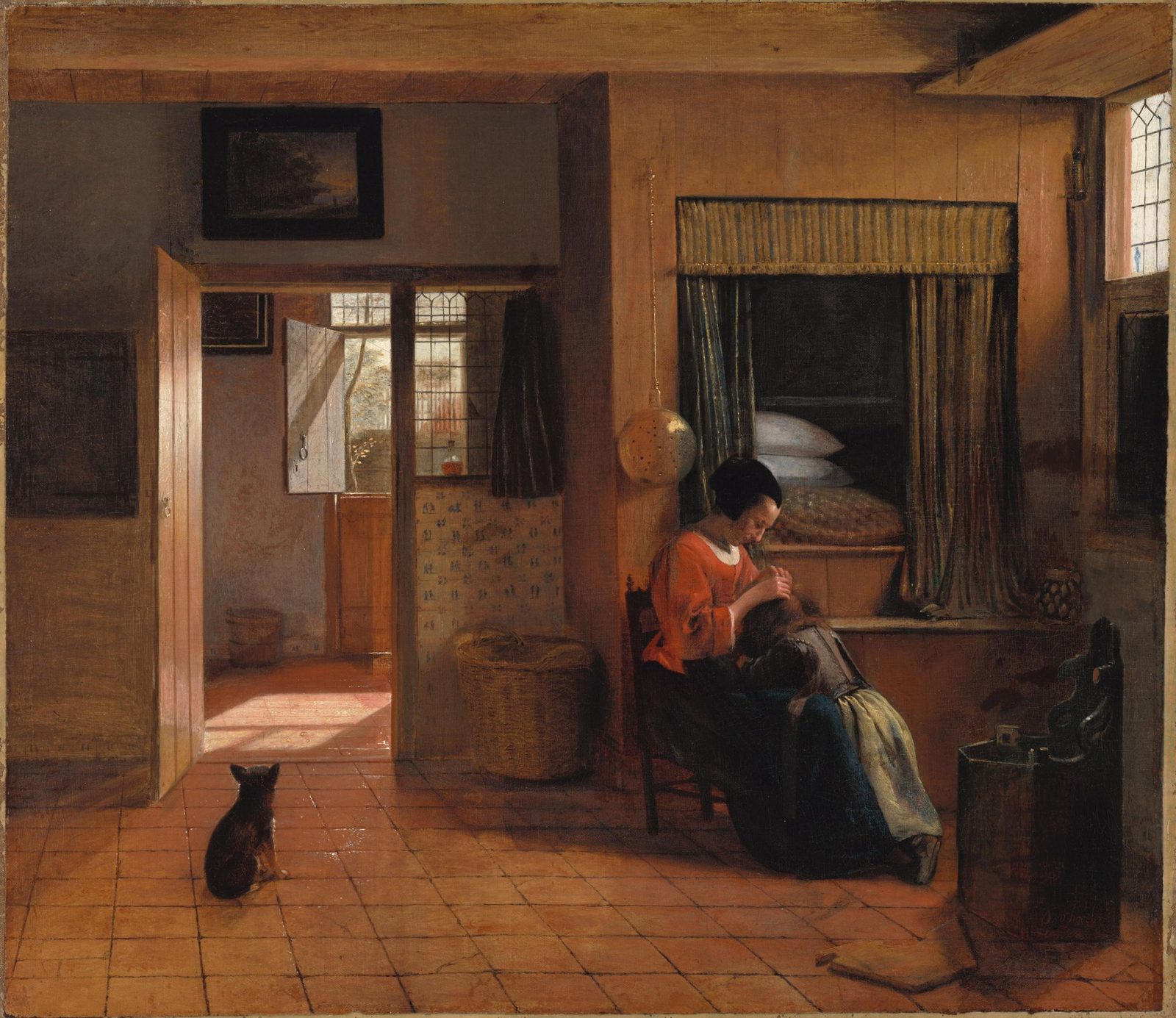
- Artist
- Pieter de Hooch
- Title
- A Mother Delousing her Child’s Hair, Known as ‘A Mother’s Duty’
- Date
- c. 1660 - c. 1661
- Museum
- Rijksmuseum
- Image
- Public domain (CC0)
Open in Simple Art
Watch this story on iPhone and iPad, with offline downloads and a painting every day.
About 3 minutes of looking, in 9 parts.
A Mother's Duty
A mother bends over the child in her lap and works through its hair with her fingers. She's looking for lice. A small dog sits on the tiles with its back to us, paying no attention to either of them.
Pieter de Hooch, about 1660 to 1661
This is Pieter de Hooch's A Mother Delousing her Child's Hair, known as A Mother's Duty, painted in oil on canvas around 1660 to 1661. The Rijksmuseum describes a sober Dutch interior, with Delft blue tiles, a box bed and, in the right foreground, a child's potty chair.
A room in two halves
The room splits into two halves. On the left, an open door leads to a back room. On the right, the mother sits in front of the bed. The tiled floor runs under both, and its lines carry your eye back into the picture.
A patch of sun
Before we reach the mother, glance at the floor of the back room. Sunlight lies there in a sharp rectangle. The step from lit tile to shadow looks abrupt rather than gradual, and that's what makes it read as strong sun.
The dog
The dog sits close to us, almost black, with a little warm brown where light seems to touch its back. Its fur isn't painted hair by hair. A few directional strokes do the work, and its soft edges sink into the warm tiles.
The strongest colour
Now to the mother. Her red bodice is the strongest colour in the room. It runs from a deep, dark red in the shadowed sleeve to a warm orange-red where light catches her shoulder, with crisp white linen at the neck and cuff.
Two hands, one task
Follow her arms down. Both hands meet at the child's bowed head, fingers parting the hair section by section. Her eyes are lowered to the same spot. Her whole pose points at one small patch of hair, and the painting's attention goes there too.
Basket and tiles
Behind her, a large wicker basket stands against the wall. The weave is suggested with short repeated strokes, light on top of each band and dark between, so you read wicker without a single reed being painted. Just above it are some of the blue and white tiles the museum mentions.
The box bed
To the right is the box bed, set into the wall behind her, with white pillows inside. Its curtains are striped in warm yellows and browns, and the deepest folds turn cooler and greyer, which helps them sink back into shadow.
Look closer
10 details, each checked against a close-up of the picture.
-
Mother and Child
The mother's hands are positioned specifically on the child's hair.
The crop isolates a maternal figure in a saturated orange-red bodice leaning over a child's bowed head. The mother's two hands converge at the child's hairline, fingers splayed to grip small sections — directly supporting the verified claim of hands-on-hair grooming. Brushwork on the bodice is loose and visible, with darker red-brown passages in the folds and brighter vermillion highlights catching the warm right-side light. The child's head is a softly blended brown mass against the dark teal-blue skirt, with little detail resolved at this resolution. Edge contrast is highest where the bright sleeve meets the darker background wall; the hand-to-hair contact is rendered with a soft, slightly ambiguous edge typical of 17th-century oil glazes.
-
Back Room Sunlight
The sunlight on the back room floor creates a sharp, high-contrast rectangular patch.
A sharply defined rectangular patch of sunlight falls across a tiled floor in a back room, the lit tiles reading as warm pink with a brighter band along the upper edge where direct sun strikes. The surrounding floor falls into a warm reddish-brown shadow, and a dark vertical door jamb on the left frames the opening. The dog's black ears intrude at the lower edge, while the background recedes into deep umber suggesting a curtained bed. Fine craquelure and a few small losses run across the surface, and the value jump between lit and shadowed tiles is abrupt rather than gradual.
-
Red Bodice
The red of the bodice is the most saturated color in the composition.
The crop isolates a woman's red bodice occupying the central and lower portions, rendered in oil with visible craquelure across the surface. The red shifts from a deep oxblood in the shadowed left sleeve to a warm vermillion highlight along the right shoulder and upper chest, where the cool window light meets the fabric. A crisp white linen edge cuts in at the neckline and at the cuff, providing the highest value contrast against the saturated mid-tones. Brushwork in the red is fairly blended but shows darker vertical drag-marks along the sleeve that read as folded fabric and the cast shadow of the arm.
-
Mother's Face
The mother's gaze is directed downward toward the child's head.
The crop is dominated by a large dark mass occupying the upper two-thirds, rendered in near-black with subtle warm-brown underpainting peeking through where the surface is thin. A soft, slightly cooler highlight travels along the upper-right edge, suggesting the curve of a head tilting forward and downward. Below, a warm reddish-brown zone (the mother's own lowered face) sits lower in the frame, separated from the dark mass by a soft, glazed transition rather than a hard line. A narrow vertical band of mid-brown on the left edge reads as the mother's shoulder or a passage of curtain, and a sliver of warmer flesh-tone appears at the lower-right corner — the only area where a facial plane is legible.
-
Wicker Basket
The texture of the basket is rendered with small, repeating rhythmic strokes of paint.
The crop isolates the upper portion of a wicker basket against a warm dark-brown background. Short, repeating horizontal and slightly curved brushstrokes follow the rounded contour of the basket, creating the woven reed pattern. Highlights catch the top of each weave band in pale ochre, while the recesses between bands are painted in deeper umber, producing a rhythmic alternation of light and dark. Near the top rim, a softer, more diffuse area of paint suggests cloth or hair spilling over the edge, contrasting with the disciplined strokes below. A fine network of craquelure runs across the surface, visible as pale criss-crossing lines in the paint film.
-
Door Frame
The vertical edge of the open door is a crisp, straight line against the interior wall.
The crop isolates the vertical hinge edge of the open door as it meets the interior wall. The door panel on the left reads as warm pale wood (roughly cream-to-ochre) with thin vertical grain strokes and two small dark knots near the lower third. Against this, the wall plane on the right is markedly darker (deep umber/reddish-brown), so the door's silhouette is read by value contrast rather than by a hard painted line. The boundary between door and wall is a near-vertical edge running about three-quarters down the right side of the door, but on close inspection it is not truly crisp: a narrow transition zone of soft mid-tones blends door into wall, and the edge itself wobbles subtly. A horizontal floor seam of warm terracotta tiles crosses the bottom, with the door's bottom corner casting a small triangular shadow into the tile grout.
-
Floor Reflections
The tiles show soft, diffused highlights that mirror the light sources from the windows.
A diagonal expanse of warm terracotta tiles occupies the frame, with a dark, softly brushed form (the dog's leg/body) intruding from the upper left. The tile joints are thin, irregular dark lines drawn freehand, not mechanically straight, with a slight dry-brush quality. Two soft, cream-white highlights sit on the upper-middle tiles, blurred at the edges rather than crisp, sitting on top of the orange ground as thin scumbled passes. Values grade from a brighter ochre near the highlights into a deeper burnt sienna in the upper right and a muted, slightly cooler brown toward the lower left.
-
Small Dog
The dog's coat consists of blends of dark brown, black, and grey tones.
The crop frames a small dark dog seen from behind, sitting on warm reddish-brown tiles divided by dark grout lines. The dog's body is built up from broad, wet-looking strokes in near-black that read as the dominant value, with thinner warm brown and ochre drags along the right flank and tail area where light rakes across the fur. The lower legs and a small paw turning outward at lower right drop into a cooler, slightly grey-brown, soft-edged against the floor. Edges between dog and tile are loose and feathered, especially on the back and tail, while the contour against the right grout line is a touch crisper. A fine web of craquelure runs across the whole surface, more visible on the flat tile than on the dark body.
-
Bed Curtains
The curtains feature a pattern of vertical stripes and golden-yellow tones.
The crop centers on heavy bed curtains hanging in two vertical panels that frame an alcove containing stacked white pillows and a quilted coverlet. The drapery is built from broad vertical bands of warm ochre and mustard yellow, regularly interrupted by thinner stripes of dark brown and deep blue-black that read as woven warp threads. A horizontal valence band at the top carries the same striped pattern compressed into a narrow register, its lower edge picked out with a thin line of lighter yellow. Folding marks descend in long, near-vertical lines, with the deepest folds rendered in cool blue-grays that sit against the warmer yellows to set the volume back into shadow. Edges between stripes are soft rather than crisp, suggesting the pigment was worked wet-into-wet or lightly blended over an underlayer rather than laid down as separate hard stripes.
-
Leaded Window
The back window is divided into small rectangular panes by lead cames.
The crop centers on a back-room window whose upper sash is divided into small rectangular panes by a grid of dark lead cames. The glass behind the leads is rendered in patches of pale blue, warm cream, and ochre, with no two panes identical — the artist suggests uneven glazing and reflected light rather than uniform transparency. To the left, a warm diagonal shadow cuts across a pale wall, terminating against an open wooden door with a dark iron latch. The right edge of the crop reveals a second leaded window above rows of vertically stacked books in red and dark tones, set against a deeply shadowed wall. A fine network of craquelure runs across the entire surface, and the leads themselves are soft-edged brushstrokes rather than crisp lines.
A Mother Delousing her Child’s Hair, Known as ‘A Mother’s Duty’ in context
One room, several pictures
De Hooch used this room more than once. In its catalogue entry on The Bedroom in Washington, the National Gallery of Art notes that the same room appears in two similar but independent works, A Woman Delousing a Child's Hair and Kolf Players. Each shows a different landscape through the doorway [1]. Wikipedia likewise lists The Bedroom as a variation on this composition and suggests the design was a successful one for him [6]. The Washington entry argues that such precise effects of light suggest the room, at least, was painted from life [1]. But the Rijksmuseum takes a different view of his interiors in general. It says they were conceived in the studio rather than based on existing rooms [3].
The dating moves between sources. The museum's object record gives about 1660 to 1661, while its story on the artist and the Washington entry give 1658 to 1660 [4][3][1]. Either way, the picture sits close to his move from Delft to Amsterdam. The National Gallery of Art places that move between mid-1660 and April 1661 [5].
A household ideal
The Washington entry describes the box bed set into the wall of a room with many uses, and morning chores like making the bed and emptying the chamber pot [1]. It notes that the Dutch prided themselves on orderliness and cleanliness, seen as metaphors of spiritual purity, and that the mother's double duty of raising children and keeping house was set out as an ideal in the writings of Jacob Cats [1]. But it adds a caution. Reality may not have matched these images, although foreign travellers often remarked on Dutch cleanliness and gentle child rearing [1]. The Rijksmuseum reads this picture more warmly, as a study in domesticity where the sunlight is as palpable as the mother's love [3].
Family models?
De Hooch and Jannetje van der Burch had seven children [5]. Wikipedia reports that he turned to domestic scenes after the first were born in the mid-1650s, and that these may show his own family, though his scenes of mothers and babies might also reflect his accompanying his mother, a midwife, on her rounds [2]. The Washington entry records the art historian Bode's attempt to identify the recurring woman as his wife, but treats such identifications cautiously [1]. Jannetje died in 1667, at 38 [2].
A signature in doubt
The museum reads the signature on the canvas as 'Pr. de. hooch.' [4]. Cornelis Hofstede de Groot found it on the chair. He complained that the Rijksmuseum's 1887 catalogue had wrongly given the painting to Esaias Boursse, and that the 1905 catalogue wrongly called the signature doubtful [6]. Boursse is one of several painters whose work has been confused with De Hooch's [5]. Hofstede de Groot, by contrast, counted it among the finest De Hooch pictures in Holland [6].
He also traced its sales: in the Gerard Braamcamp sale in Amsterdam in 1771, then the collection of J. L. van der Dussen, later Amsterdam sales in 1833 and 1838, and finally the collection of Adriaan van der Hoop [6]. It is on loan to the Rijksmuseum from the City of Amsterdam, from the Van der Hoop bequest [4].
- Arthur K. Wheelock Jr., Pieter de Hooch, The Bedroom, 1658/1660, systematic catalogue entry (Internet Archive copy, 20 May 2026) . National Gallery of Art, Washington
- Pieter de Hooch . Wikipedia
- Pieter de Hooch: an artist who transformed light and space into poetry . Rijksmuseum, Amsterdam
- Pieter de Hooch, A Mother Delousing her Child’s Hair, Known as ‘A Mother’s Duty’ (SK-C-149): object record and inscription . Rijksmuseum, Amsterdam
- Arthur K. Wheelock Jr., 'Pieter de Hooch', artist biography (Internet Archive copy, 30 April 2025) . National Gallery of Art, Washington
- A Mother's Duty (quoting Hofstede de Groot, 1910, no. 71) . Wikipedia