A real castle on an invented hill
How Ruisdael sets a castle that still stands on a steep, imagined rise and gives it a sky to match
- Artist
- Jacob Isaacksz van Ruisdael
- Title
- Bentheim Castle
- Date
- 1650 - 1682
- Museum
- Rijksmuseum
- Image
- Public domain (CC0)
Open in Simple Art
Watch this story on iPhone and iPad, with offline downloads and a painting every day.
About 3 minutes of looking, in 9 parts.
Half recorded, half made up
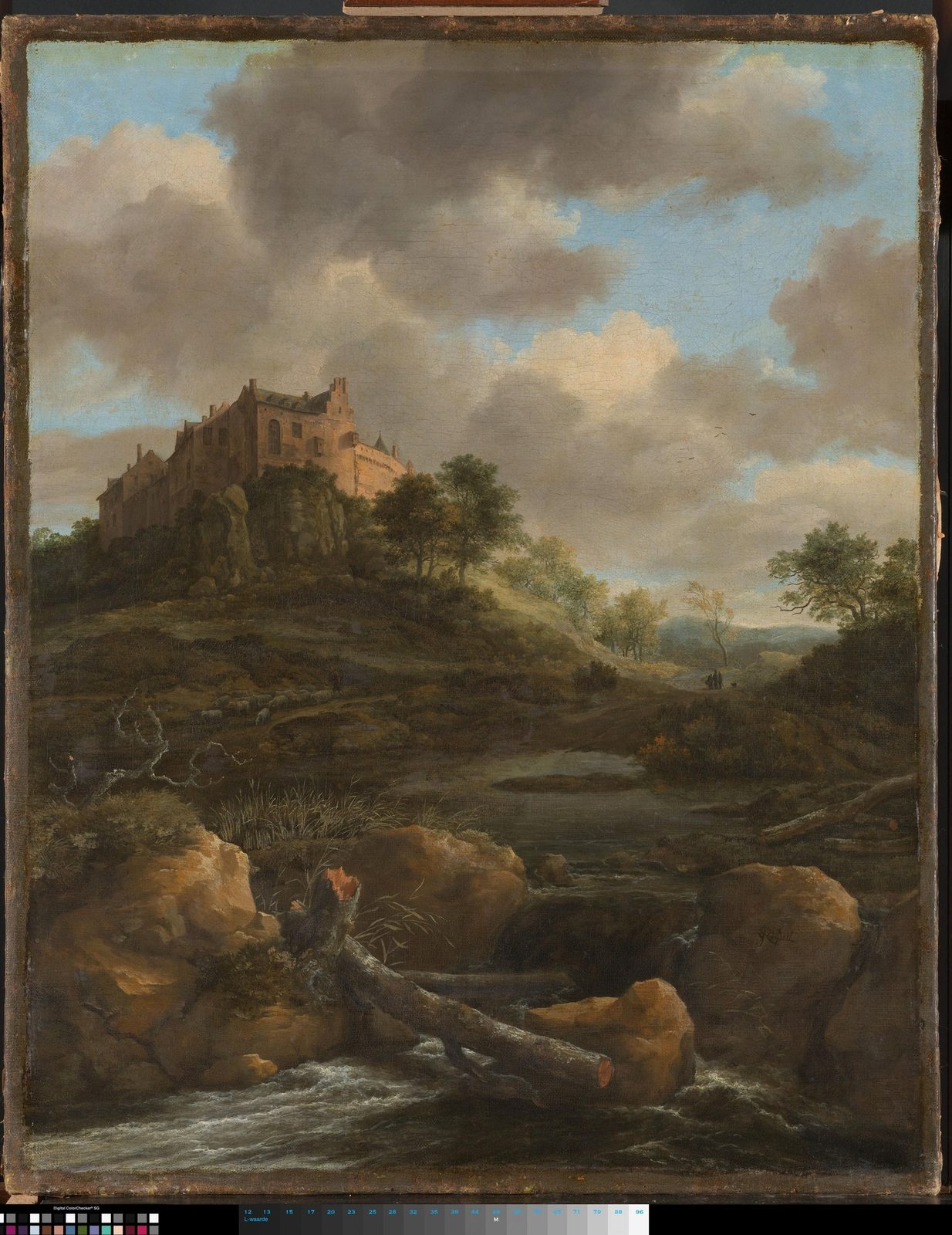
This castle still stands, near the border between the Netherlands and Germany. The steep, rocky hill it sits on here, though, isn't to be found there. Keep that in mind as you look. Part of this view is recorded, and part is made up.
Bentheim, one of a dozen
This is Bentheim Castle by Jacob Isaacksz van Ruisdael, oil on canvas, which the Rijksmuseum dates only to between 1650 and 1682. The museum says he painted the castle a dozen times, each in a different mountain landscape, weaving fantasy and reality together. Goethe, it adds, called Ruisdael a poet.
Up to the castle, down to the stream
The picture is a triangle with the castle at its peak, high on the left. From there a long diagonal runs down through the hillside, the rocks and the fallen log to the lower right. The horizon sits about halfway down, so the sky has the whole top half.
Crisp walls on rough rock
Here is the castle. Its lit face is a warm ochre, with dark rectangular windows, stepped gables and chimneys set down with fairly crisp edges. The rock and bushes beneath are softer and broader. That difference in handling makes the building feel built and the hill feel grown.
A sky to match the hill
Above it, the clouds shift from near-white cream through neutral greys into a deep brownish core, with patches of blue showing through. The edges are soft and blended. The brightest cloud mass sits to the right of the castle and balances its weight.
Walkers on the path
Far along the path on the right are two or three tiny walkers. They're near-black silhouettes, perhaps with a hat on one, and the brushwork around them overlaps their edges, so they settle into the ground instead of floating on it.
A log shaped by its strokes
In the foreground, a fallen log runs diagonally towards the stream. Its highlights seem to be dragged along its length, broken white and grey on top and deep umber beneath, so the direction of the strokes helps it read as round.
Light from the upper left
The boulders at the lower left show where the light comes from. Their upper and left-facing planes catch a warm ochre, while the other sides fall into deep brown shadow. Between them is only a narrow band of mid-tone, so the light feels strong and directional.
Softer with distance
Now compare the trees at different distances. The furthest, on the right, melt into the pale sky with no hard contour. Nearer ones have firmer silhouettes, and the foreground slope gets the most decisive marks of all. Edges soften as things recede.
Look closer
8 details, each checked against a close-up of the picture.
-
Hilltop Castle
The castle's facade shows precise masonry and architectural details contrasted against organic rock.
The crop centers on an intact hilltop castle whose right-facing facade is bathed in warm ochre light while its left side recedes into deep umber shadow. Dark rectangular window openings puncture the masonry, and the roofline shows stepped gables and chimneys rendered with relatively crisp edges. Beneath the structure, boulders and shrubs are handled with softer, broader passages of dark green-brown, producing an organic counterpoint to the architecture above. A fine craquelure network webbs the entire paint film, and the sky transitions from pale grey-blue at upper right to warmer cream tones near the lit masonry.
-
Walking Figures
Two or three tiny figures are rendered as dark silhouettes with minimal brushstrokes on a path.
The crop isolates three tiny silhouetted figures standing on a roughly textured earthy ground. The figures read as near-black shapes against a mottled mid-brown field, with the middle figure slightly taller and showing a small protrusion at head-height that suggests a hat or cap. Edges are soft and broken rather than crisp, with the surrounding brushwork's vertical and diagonal drags partially overlapping the figure contours. A faint lighter band curves from upper-right toward lower-left between the forms, suggesting a path. Values are compressed into a narrow dark range; no clear cast shadows or modeled flesh tones are visible at this scale.
-
Foreground Log
The texture of the fallen log is created with thick, directional brushstrokes and highlights.
The crop shows a fallen log cutting diagonally from upper-left to lower-right, with a dark shadowed recess behind it and warm ochre rock faces to the right. The log's upper edge carries broken, scumbled white-and-grey highlights that read as bark catching raking light from the upper-left. The lower body of the log sits in deep umber and olive-shadow, with the edges between light and shadow left soft and irregular rather than blended smooth. At the bottom-left, short, agitated white strokes suggest turbulent water, while the upper-left reveals fine, dry twigs painted with thin, calligraphic lines.
-
Rock Highlights
Bright ochre highlights on the foreground rocks correlate with the light source from the upper left.
The crop centers on a cluster of boulders whose upper and left-facing planes catch a warm ochre highlight, while their right and lower faces fall into deep umber shadow. The brightest passages sit along the ridgeline of the dominant central rock and on a small ledge in the lower foreground, both rendered with broken, dry-looking touches that leave darker tone peeking through. Surrounding foliage is brushed in short, slightly flick-like strokes of olive and brown-green, fusing into the shadow areas without hard outlines. Fine craquelure threads the entire surface, confirming aged oil medium, and the rock edges transition from warm light into cool dark through a narrow band of mid-tone ochre rather than an abrupt shift.
-
Cloud Transitions
The clouds blend from brilliant white highlights into muted grey and blue-grey tones.
A square sky-and-cloud crop dominated by a large warm-grey cloud body running across the upper third, with a wedge of pale blue sky showing at the upper left and again at the lower right. The cloud mass shifts from near-white cream highlights (lower center) through neutral grey mid-tones into a deep brownish-grey core. Soft, blended edges separate the cloud bodies, while a fine network of crackle runs uniformly across the entire paint film, and a dark horizontal line at the very top edge suggests a ledge, roofline, or stretcher shadow. Visible diagonal brushwork appears as soft, smudged streaks within the grey cloud, rather than crisp strokes.
-
Water's Edge
White, choppy brushstrokes represent the churning water flowing around the rocks.
A horizontal band of pale, choppy marks sweeps across the middle of the crop, sitting between a dark, nearly black mass above and a brown earthy band below. The pale marks are short, comma-shaped, and curved, layered over a mid-gray underlayer with bits of cream and ochre showing through. Edges between the white foam-like strokes and the darker passages are soft and broken, while the lower boundary against the brown bank is a fairly crisp, slightly ragged line. The upper edge dissolves into the dark above through scumbled, semi-transparent strokes rather than a hard contour.
-
Distant Foliage
The trees in the mid-ground are painted with softer, more blurred edges than the foreground.
The crop shows a hillside with a warm ochre castle wall in the upper left and a cluster of trees descending toward the right. The trees on the far right (most distant) have edges that melt into the pale grey-blue sky with no hard contour; their foliage is built from soft, dappled dabs of sage green and warm ochre that read as a unified mass. Moving left and down, the central trees have slightly more defined silhouettes where darker branches puncture the canopy, but their outer edges still blur into the surrounding atmosphere. The foreground slope, by contrast, is rendered with crisper, more decisive marks of dark brown-green and umber that retain hard transitions against the lighter grass behind. Cracking (craquelure) runs across the entire surface, but the paint itself clearly differentiates three zones of edge sharpness.
-
Craquelure Detail
Fine networks of cracks are visible in the paint surface in the dark foreground areas.
The crop isolates the lower foreground of a landscape, dominated by a deep, near-black mass occupying roughly the bottom 40% of the frame, with a rocky outcrop and streambed above it. Across the dark areas, fine craquelure is clearly visible: pale, hair-thin lines form an irregular polygonal network, densest in the lower-left quadrant where the paint film appears thickest. The cracks read as slightly lighter than their surrounding paint, suggesting the lower ground layer or ground-impregnation shows through. Along the seam where the dark foreground meets the streambed and rocks, a softer, more broken edge of cracking appears, with shorter, more directional fissures following the contours of the painted forms.
Bentheim Castle in context
A castle that still stands
The Rijksmuseum notes that Bentheim Castle still exists in the German-Dutch border region, but that the high mountains in this painting are not found there [1]. It adds that Ruisdael painted the castle a dozen times, each time in a different mountain landscape [1]. This version is an upright canvas of 68 by 54 centimetres, signed 'JVRuisdael' at lower right, and the museum acquired it by purchase in 1810 [1].
Slive describes Bentheim as a small town about ten kilometres from the Dutch border and only about 175 kilometres from Haarlem as the crow flies [3]. The Rijksmuseum indexes the site under Lower Saxony [1].
The journey of the early 1650s
No written document records Ruisdael's trip to the border region [3]. But a painting of the castle dated 1651 shows he had been there by that year, and a 1650 drawing of the castle by his friend Nicolaes Berchem, now in the Städel Museum in Frankfurt, supports the idea that the two travelled together a year earlier [3]. The Thyssen-Bornemisza museum and the National Gallery in London both place the journey around 1650, and the Thyssen adds that he saw the castles of Bentheim and Steinfurt [5][6].
Slive lists three things Ruisdael brought back from the region: the castle itself, the half-timbered cottages with clay-and-straw facades typical of western Westphalia, and the discovery of hills with fast streams that could drive water mills [3]. He also notes that most of the sandstone for Amsterdam's new Town Hall, begun in 1648, came from Bentheim's quarries [3].
Raising the hill
The best-known version is the large canvas dated 1653 in the National Gallery of Ireland, 110.5 by 144 centimetres [4]. The gallery says Ruisdael made drawings on the spot and painted the fortress some 14 times after his return, exaggerating the height of the hill to make the castle look more impressive [4]. Slive makes the same point, describing how Ruisdael turned Bentheim's unimposing low hill into a wooded mountain [3]. So the counts vary between sources, from a dozen to some 14 [1][3][4].
Citing the nineteenth-century cataloguer John Smith, the Irish gallery's provenance notes record that the Dublin picture was painted for the Count of Bentheim [4]. But no comparable early history is published on the Rijksmuseum's page for this smaller version [1].
Why the date is so wide
The Rijksmuseum dates the canvas only to 1650-1682, the span from the trip to the painter's death [1]. Slive explains why such ranges are common: five Ruisdael paintings bear the date 1653, after which he virtually stopped dating his work, and no painting carries an authentic date from the 1670s or 1680s [3]. Since he went on using the Bentheim motif over the course of his career, the subject alone cannot fix the date [3].
One detail in the museum's English text needs correcting. It says Goethe called Ruisdael a poet in 1861, but the Dutch version of the same text gives 1816 [1][2]. Goethe's essay on Ruisdael as a poet was published in 1816, so the English figure appears to be a transposed date [7].
- Jacob Isaacksz van Ruisdael, Bentheim Castle (SK-A-347): collection page and object data . Rijksmuseum, Amsterdam
- Linked Art data record for SK-A-347, including the Dutch catalogue description, inscription and credit line . Rijksmuseum, Amsterdam
- Seymour Slive, Jacob van Ruisdael: Windmills and Water Mills (Los Angeles: J. Paul Getty Museum, 2011), free PDF edition (archived copy) . J. Paul Getty Museum, via Internet Archive
- Jacob van Ruisdael, The Castle of Bentheim (NGI.4531): collection record . National Gallery of Ireland, Dublin
- Jacob Isaacksz. van Ruisdael: artist biography . Museo Nacional Thyssen-Bornemisza, Madrid
- Jacob van Ruisdael (1628/9? - 1682): artist biography . The National Gallery, London
- Seymour Slive, 'An old master comes into his own', Harvard Magazine 84, no. 3 (January-February 1982), pp. 26-30 . Harvard Magazine