Music for a reluctant dancer
How Jan Steen turns a cat, a loud little shawm and a barking dog into a chain of household mischief
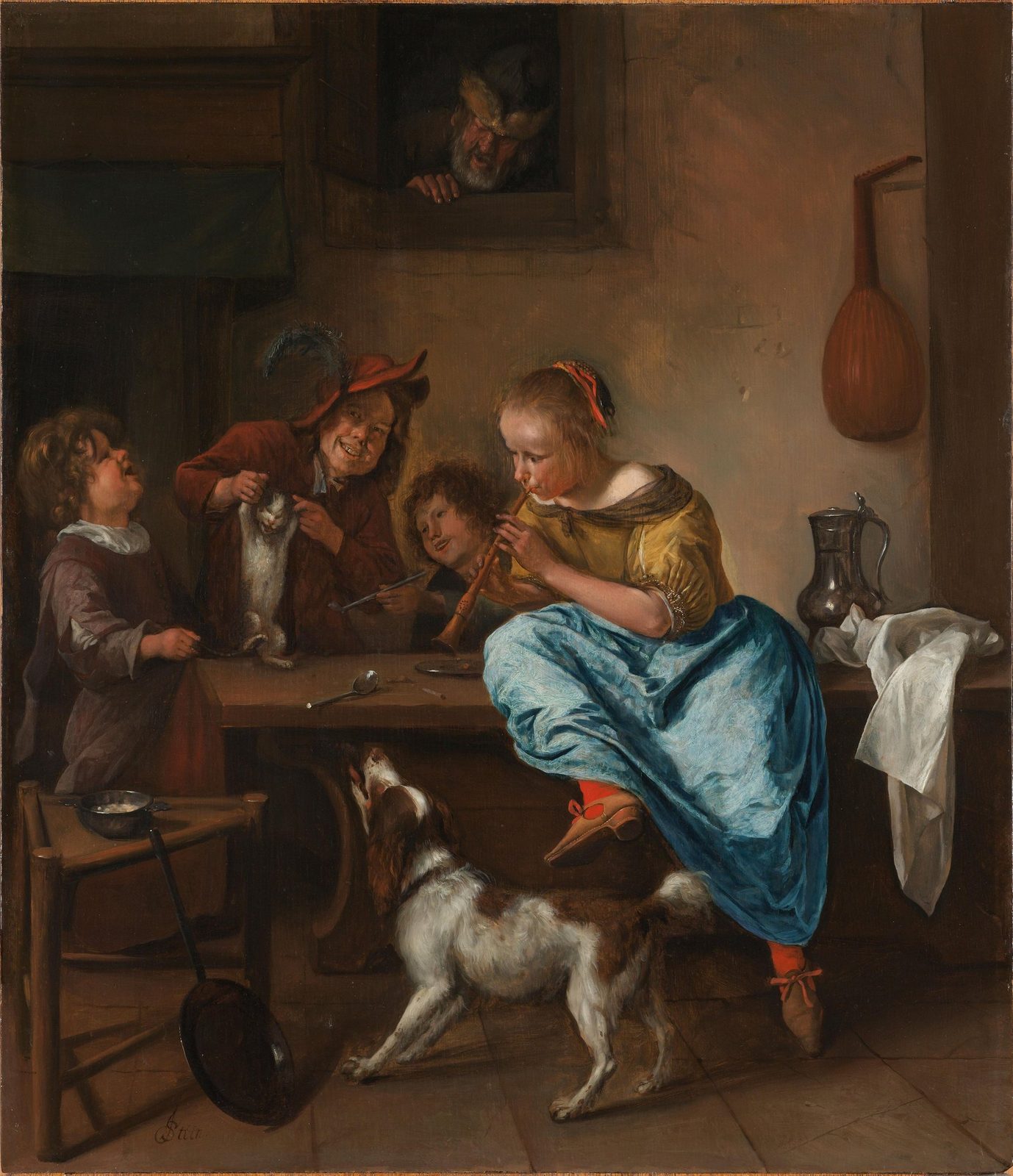
- Artist
- Jan Havicksz. Steen
- Title
- Children teaching a cat to dance, known as 'The dancing lesson'
- Date
- 1660 - 1679
- Museum
- Rijksmuseum
- Image
- Public domain (CC0)
Open in Simple Art
Watch this story on iPhone and iPad, with offline downloads and a painting every day.
About 4 minutes of looking, in 10 parts.
Children Teaching a Cat to Dance
A boy in a feathered red hat holds a cat up on its hind legs, and a girl plays a pipe at it. The cat is supposed to be dancing. Hardly anyone in this room is behaving, and Steen wants you to enjoy every bit of it.
Jan Steen, 1660 to 1679, oil on panel
This is Jan Steen's Children Teaching a Cat to Dance, known as The Dancing Lesson, painted in oil on panel some time between 1660 and 1679. The Rijksmuseum's note on it is short and to the point. These children are up to mischief.
The ringleader
Start with the boy in the red hat. His eyes have squeezed into slits and his mouth is wide open. The teeth are only three or four pale dabs, yet you read them at once. Just below, the cat hangs by its front paws, looking rather less amused.
A small shawm
Now the girl on the right. It looks like a recorder, but the museum identifies it as a small shawm, an ancestor of the oboe, used for dance music and admired for its loud tone. So the cat's lesson has a soundtrack, and probably a shrill one.
Blue satin in two tones
Her skirt is the coolest, brightest thing in the room. Look at how it's built. Pale, almost chalky blue sits on the crest of each fold, near-black navy fills the hollows, and there's very little in between. That abrupt step is what makes the cloth shine like satin.
The objector
Below her, the spaniel joins in, head tipped up towards the commotion, apparently barking. Its coat is made of short, broken strokes of white and brown. They curve over the ribs and pull straight down the front leg, so the brush follows the body.
A face at the window
Look up to the small window at the top. An old man in a fur hat leans on the sill and watches, mouth open. Whether he's laughing or about to shout, Steen leaves to you. The children don't seem to have noticed him.
The lute on the wall
On the right-hand wall a lute hangs, unplayed. Its rounded back is a warm, ribbed orange against the pale plaster. Beside all that shawm music, it's the one instrument in the room keeping quiet.
Metal and linen
Below it, a metal jug stands on the table. Most of the jug is barely lighter than the wall, but a few sharp white dabs on the rim, lid and shoulder make it read as metal. Then let your eye drop to the white cloth hanging over the edge, crisp against the dark.
Signed JSteen
Down in the lower left corner, look for a thin, dark signature on the brown floor. The museum records it as JSteen. It's a single fluid line, easy to miss.
Look closer
7 details, each checked against a close-up of the picture.
-
Blue Satin Skirt
The blue fabric contains high-contrast white highlights and deep navy shadows in its folds.
The crop is dominated by a voluminous blue skirt built from broad, gestural strokes that travel along the form rather than crossing it. Highlights are placed on the convex crests of every fold as pale, almost chalky blue-white passages (approaching #b8d0dc), while the recesses collapse into near-black navy (around #142a44), creating a value step of roughly eight tones across the fabric. The transitions between light and shadow are largely abrupt, with only narrow transitional mid-tones; this gives the satin its characteristic faceted, 'scrunched' appearance. Edges along the outer silhouette of the skirt are soft and broken against the dark background, whereas the inner fold edges where highlight meets shadow are crisp and angular.
-
The Spaniel's Coat
Short, thin white and brown brushstrokes create the texture of the dog's fur.
The crop centers on a white and liver-brown spaniel standing on a brown floor, its head tilted sharply upward toward a red-stockinged foot and a heavy blue drapery. Short, broken brushstrokes in cool white and warm brown describe the fur, with the strokes curving along the ribcage and running downward along the foreleg. Bright opaque white marks sit over a slightly off-white underlayer on the chest, while the brown patches are scumbled with thin, dragged strokes that allow the darker ground to show through. Edges between fur and background are softened rather than crisp, except along the silhouette of the back where a thin half-tone rim lifts the dog from the dark surround.
-
Boy's Grinning Expression
The boy in the red hat has an open-mouthed smile with squinted eyes.
Crop centers on the boy's face framed by the brim of a vermillion-brown hat, with the upper teeth visible as small pale dabs between parted lips. The eyes are nearly closed into narrow slits with thickened lower lids; the surrounding skin is bunched into radiating creases that ride up the cheek. Flesh is built from warm pink-tan strokes on the lit (viewer's left) plane that transition abruptly into a darker olive-brown along the shadow side of the nose and jaw. The teeth are not individually drawn so much as suggested with three or four loaded ivory notes against the red of the mouth interior. A second child's curly head and a sliver of a recorder intrude at the edge, and a cat's white-and-tabby muzzle sits at lower left.
-
Silver Jug Highlights
Sharp, bright white specular highlights appear on the curved shoulder of the metal jug.
The crop isolates a dark metallic jug set against a warm umber-brown wall, with deep blue drapery entering at lower left and folded cream linen at lower right. Sharp, near-white specular accents sit on the upper rim, the lid finial, and most prominently on the swollen shoulder of the body, where a small irregular dab reads as the brightest note in the field. The handle is defined by a thin cream edge on its outer curve and a darker shadowed inside, indicating strong left-side raking light. Edges are soft and slightly broken throughout, with the jug's contour lost in places against the brown background; only the highlights crisply articulate the curved metal form.
-
Lower Left Monogram
There is a dark, partially legible script or monogram in the bottom left corner.
The crop isolates a roughly triangular wedge of warm, mid-value brown ground (a lean, earth-toned imprimatura or exposed ground) meeting a large, deep umber-to-near-black mass that sweeps in from the upper right as a soft, slightly feathered edge. In the lower-left quadrant, a thin, dark calligraphic inscription reads as a partially legible monogram—likely a cursive initial with looping flourishes, consistent with a 17th-century artist signature. The mark sits on top of the brown ground, slightly darker than the surrounding field, with no impasto or visible brush texture beyond a single fluid stroke. A thin horizontal band of lighter, raw wood-toned material is visible along the very bottom edge, suggesting the physical support (panel) ending.
-
White Cloth Drapery
The edge of the white cloth on the table shows crisp folds against the dark background.
The crop centers on a white linen cloth draped over a dark wooden table edge, the fabric falling in a triangular cascade. The lit side of the cloth is rendered with thick, opaque off-white and pale cream strokes, while the shadowed side cools into warm grey and tawny beige mid-tones. The right and lower edges of the cloth read as a crisp, almost calligraphic contour against the deep umber background, with the highlight ridges catching the raking left-hand light. At top, a copper-toned vessel (jug or ewer) reflects a small hot highlight, and a saturated blue drapery occupies the left margin, providing a chromatic counterweight to the neutral fabric.
-
The Lute
A lute hangs on the wall at the right, above the table.
The crop isolates a lute hanging by its neck on the pale plaster wall. The body reads as a warm, ribbed orange-brown pear-shaped mass with a single crisp specular highlight at roughly (0.78, 0.38) where light catches the varnished surface, and a softer secondary glint near (0.95, 0.22). Its contour is soft against the warm plaster, and the long neck and pegbox rise above it toward a nail in the wall.
Children Teaching a Cat to Dance in context
A brewer's son in Leiden
Jan Steen was born in Leiden in 1626, the eldest son of Havick Steen and Elisabet Capiteyn, the daughter of a town clerk [2]. The family was Catholic. From 1629 his father worked in the family-owned brewery, the Red Halberd [2]. Piet Bakker, writing for the Leiden Collection, notes that the parents' will of 1632 put their capital at an estimated 10,000 guilders, which places Steen in an upper middle-class milieu [2].
In November 1646, aged 20, he enrolled at Leiden University [2]. But Bakker cautions that this doesn't mean he actually studied there. Enrolment brought privileges like exemption from taxes on beer and wine, which were useful to a brewer's son, although it does suggest he had been to the Latin school [2]. The National Gallery in London connects this schooling with the literary and theatrical references in his paintings [3].
Learning the trade
On 18 March 1648 Steen registered as a master painter in Leiden's recently founded Guild of St Luke, probably after some years of working as a painter [2]. Arnold Houbraken named Jan van Goyen as his teacher, and Jacob Campo Weyerman added earlier training with Nicolaus Knüpfer in Utrecht and Adriaen van Ostade in Haarlem [2]. Both writers relied on the Leiden painter Carel de Moor, a good friend of Steen, so these accounts are second-hand rather than documented [2]. In October 1649 Steen married Van Goyen's daughter Margriet [2].
Coming home
Over the next two decades Steen lived in The Hague, Delft, Warmond and Haarlem, though he kept up his links with Leiden [2]. In 1670, after both his parents died, the family house on the Langebrug passed to him and he returned for the third time [2]. He rejoined the painters' guild as an established artist and was at once made headman. He held this post three times, and later became dean [2]. He was buried in the family grave in the Pieterskerk on 3 February 1679 [2].
In 2026, four hundred years after his birth, Museum De Lakenhal in Leiden held an exhibition on his personal surroundings and the part his native town played in his work. His grave in the Pieterskerk was also made clearly visible again for the anniversary [4].
Children and friends
The Lakenhal stresses how prominent children are in Steen's work. It suggests that, as the father of a large family, he found plenty of models at home, with his own relatives often posing [4]. Its exhibition page illustrates that theme with this painting [4]. The museum also points to his Leiden friends Frans van Mieris and Ary de Vois, who painted minutely finished pictures. It notes that Steen could paint in that refined manner as well as with a looser touch [4].
The Rijksmuseum holds 22 of his paintings, more than any other museum. It uses this panel to illustrate its view that Steen is the most humorous of Dutch artists [5].
A bequest and a modern echo
The panel came to the Rijksmuseum in 1880 with the bequest of Jonkheer J.S.H. van de Poll of Amsterdam [1]. Because of the shawm, it also has a place in the history of the oboe. The museum lists Bruce Haynes's 1988 article on the rise of the oboe in works of art and a 2019 report on its acquisition of the Han de Vries collection of oboes, both of which reproduce it [1].
During a two-week trip to the Netherlands in the spring of 1928, Joan Miró bought postcards of this painting and of Hendrick Sorgh's The Lute Player of 1661. That summer he used them as the starting point for his three Dutch Interiors [6]. In Dutch Interior II, now in the Peggy Guggenheim Collection in Venice, he enlarged the figures and animals and put the cat at the swirling centre of the composition [6]. The exhibition Miró: The Dutch Interiors opened at the Rijksmuseum and travelled to the Metropolitan Museum of Art in 2010. It was the first to hang the three canvases beside their Dutch sources [6].
- Jan Havicksz. Steen, Children Teaching a Cat to Dance, Known as The Dancing Lesson (SK-A-718): object record . Rijksmuseum, Amsterdam
- Piet Bakker, 'Jan Steen' (2017), in The Leiden Collection Catalogue, ed. Arthur K. Wheelock Jr. (archived PDF, 2020) . The Leiden Collection, New York
- Jan Steen (1626-1679): artist biography . The National Gallery, London
- Thuis bij Jan Steen: 400 jaar leven in de brouwerij (exhibition page, 2 April to 23 August 2026) . Museum De Lakenhal, Leiden
- Jan Steen (Dutch Masters series) . Rijksmuseum, Amsterdam
- Miró: The Dutch Interiors (exhibition listing, from the museum press release of 4 August 2010) . CODART