Rich and poor on the same ice
How Avercamp fills a frozen waterway with small scenes of work and play
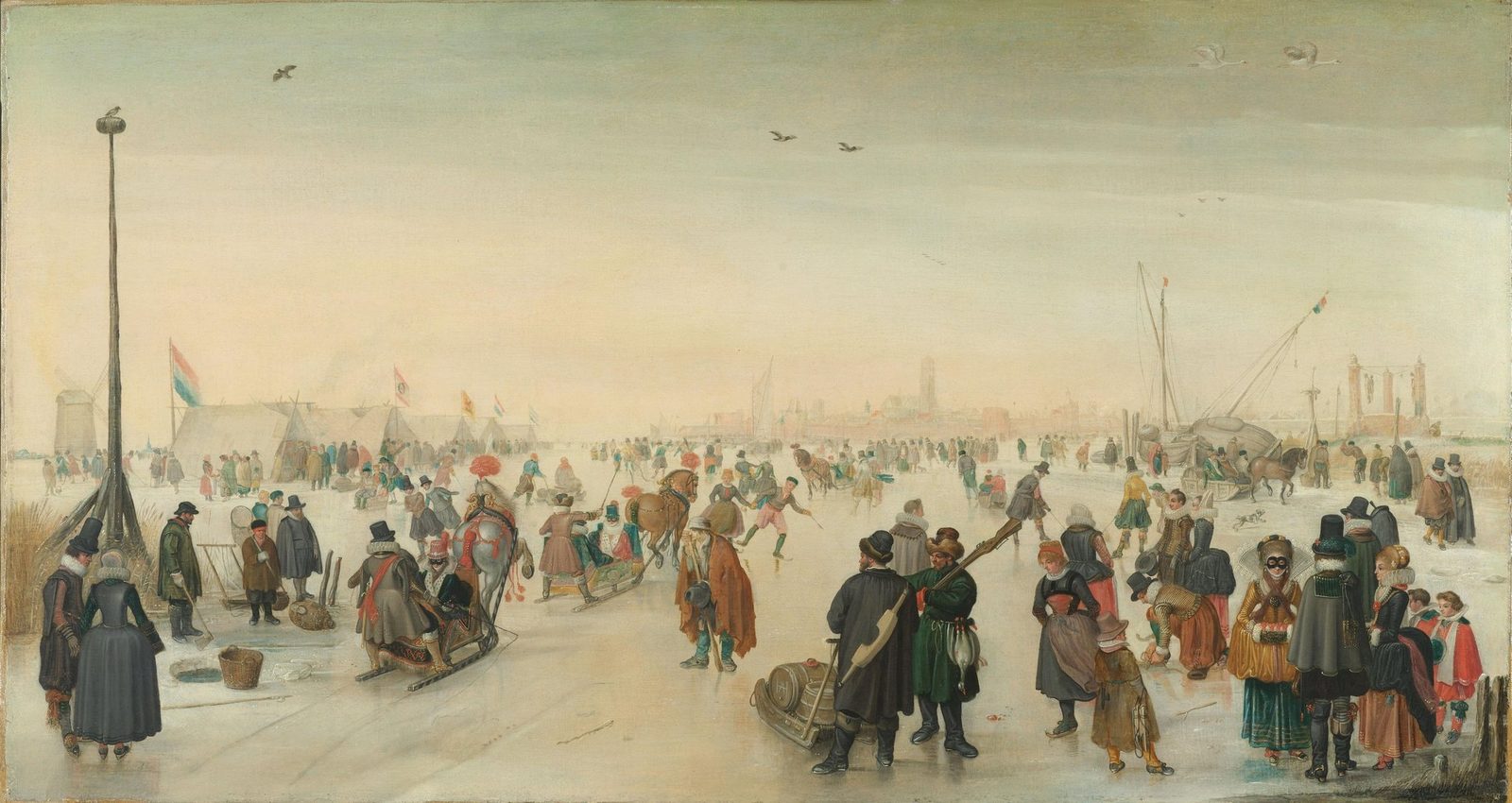
- Artist
- Hendrick Avercamp
- Title
- Enjoying the Ice near a Town
- Date
- c. 1620
- Museum
- Rijksmuseum
- Image
- Public domain (CC0)
Open in Simple Art
Watch this story on iPhone and iPad, with offline downloads and a painting every day.
About 4 minutes of looking, in 9 parts.
Enjoying the Ice near a Town
A frozen waterway stretches right across the picture under a huge pale sky, and it is crowded. People skate, pull sledges, chat and stand about in their best clothes. A tall pole rises on the left, and a town fades into the haze in the distance.
About 1620, oil on canvas on panel
Hendrick Avercamp painted this around 1620, in oil on canvas glued to a panel. The Rijksmuseum reads it as a picture of a whole society. The needy toil for a living on the ice, the better off amuse themselves, and the richest simply stand and look on.
A long, low frieze
The horizon sits about halfway up, so sky and ice share the picture almost equally. The figures spread out in a long band across the ice, with no single star. One tall vertical, the pole on the left, holds that side steady while the town's skyline answers it far away.
Soft shadows on the ice
The day looks overcast. There's no strong sun, and you can tell from the ground. Under these boots the shadow is barely there, just a slightly cooler, darker patch that fades out with no edge. Bright sky and pale ice carry the picture, and the figures supply the darks.
A bird on a pole
Look up the pole on the left. At the very top sits a flat nest with a small bird on it, probably a stork, painted as one dark dab against the sky. The pole itself is dark, with short, paler touches down its right side that help it read as round.
A barrel on a sledge
In the middle of the ice, a man seen from behind stands beside a barrel on a low sledge. Next to him, a man in a bright green coat holds what looks like a long gun over his shoulder. His green isn't flat: yellowish lights on the folds, cool brown-green in the shadows.
A ragged red coat
Just to the left is the loudest colour in the picture, a tattered orange-red coat whose hem breaks into ragged points. The man holds his hat in his hand. He is probably the beggar the museum describes, trying to scrounge a little money among the skaters.
The richest look on
Now the right foreground, where the best-dressed people stand and watch. One woman wears a black mask. Their faces are tiny, made from a few dabs of flesh colour with one dark touch for the mouth, and the lace ruffs are clusters of minute cream dots rather than drawn shapes.
The ice itself
Finally, the ice near the lower left. It looks like one pale cream surface, but fine light strokes cross it diagonally, like scratches or cracks. Just above and to the left, a man stands by a hole cut in the ice. The museum says he hopes to catch fish.
Look closer
7 details, each checked against a close-up of the picture.
-
Central Social Hub
A group of figures includes a man pushing a barrel on a sled and another in a green coat.
The crop centers on a cluster of standing figures on pale, mottled ice. A man viewed from behind wears a deep charcoal-blue coat with a fur-edged cap; the coat's hem breaks into soft, blurred touches where it meets the boots. To his right, a man in a saturated green coat (with a brown wide-brimmed hat) holds a long musket that angles across the upper right; opaque yellow-green highlights sit on the sleeve folds, while the darks read as cool brown-greens rather than pure black. A wooden barrel stamped with the monogram 'HA' sits on a runner sled beside a small bucket, and a tiny red cap rests on the barrel head. Background skaters in pink breeches and grey cloaks are reduced to thin, summary strokes against the warm cream-white ice.
-
The Stork and Pole
A small bird is perched atop a thin, dark vertical pole.
A slender, near-vertical pole dominates the crop, running nearly edge-to-edge with a slight leftward drift near the top. At its summit sits a flattened circular nest of dark brown and grey, on which a small bird is silhouetted as a single dark dab with a short tail and faint beak break. The pole's surface shows a soft, irregular right edge where lighter grey and ochre dabs break into the dark mass, while the lower shaft reveals small notches and knots built from lighter dabs over the dark ground. Below, fragmented figures, reeds, and a fragmentary red-white-blue flag appear along the horizon line, painted with summary touches that read as distant detail rather than foreground mass.
-
Miniature Face and Costume
The facial features and lace collars are rendered with tiny, precise brushstrokes.
The crop isolates three costumed figures at near 1:1 magnification, revealing that facial features are built with single-millimetre dabs of pale flesh tone over a slightly warmer pink underlayer, with a darker stroke defining the mouth on the masked woman at left. The lace ruffs are not painted as continuous shapes but as clusters of tiny cream and white spots with darker grey-green shadow dots between them, creating the illusion of openwork texture. Costume fabrics are blocked in flat colour (the grey-olive cloak, deep black bodice, warm gold skirt) then topped with separate flecks for the metallic gold trim, hair ornaments, and beading. Edges between figures and the pale ice ground are crisp and unblended, suggesting confident one-stroke placement rather than soft modelling.
-
Red Costume Accents
A figure wears a bright red coat that contrasts sharply with the pale ice.
A central figure dominates the crop, wrapped in a tattered orange-red coat whose lower hem breaks into ragged, pointed tongues against the pale ground. The red is not flat: warmer rust tones sit along the folds while cooler, slightly desaturated passages read as shadow within the drapery. Vertical, slightly tapered brushstrokes describe the hanging weight of the fabric, and torn edge silhouettes show underpainting (warm brown-ochre) peeking through where the red layer thins. A dark hat hangs from one hand, green-teal hose and pale sandals ground the figure, and a fragment of another figure's pink-and-green hose appears at upper right.
-
Diffuse Shadow on Ice
The shadows beneath the figures are soft, greyish-blue, and lack sharp edges.
The crop shows the lower halves of two standing figures flanking a hanging plucked bird, with their dark boots and hemlines set against a flat, neutral grey-beige ground representing ice. The 'shadow' under the left figure's boots is barely a value shift—a marginally cooler, slightly darker wash that bleeds outward without a defined contour, and it terminates well short of any crisp terminator line. A small reddish-brown smudge (a dab of red earth or similar pigment) sits isolated on the ice, reading as a discrete mark rather than a cast shadow. Edges where the black boots meet the ice are softened by a thin lighter halo, suggesting the painter used a half-step lighter underlayer showing through scumbled darks, rather than a hard shadow edge.
-
Distant Town Skyline
The buildings in the distance are rendered as pale, hazy silhouettes with minimal detail.
This crop captures the right-hand horizon where the distant town dissolves into pale atmospheric haze. The buildings read as low, blocky smudges of warm grey-brown set against a creamy beige ground, with no sharp roof or window detail surviving at this scale. Three tall vertical posts rise through the haze; their edges feather where they contact sky and water, and their bodies are barely warmer than the background. A small patch of cool teal at the base of one post is the only saturated local colour in the frame, and the dark hat-tops of foreground figures along the lower edge are the most resolved shapes anywhere in the crop.
-
Ice Texture Edge
Thin, white linear strokes define the cracks and variations in the frozen surface.
The crop is dominated by a broad, flat expanse of ice in warm cream and pale beige tones, broken by faint tonal shifts that imply a subtle plane change near the upper third. Thin, pale linear strokes run diagonally across the surface from upper left toward lower right, reading as cracks or scoring marks in the frozen ground. At the upper edge sit small dark accents: a curved brown basket-form on the left, a dark structural edge (likely a sled or boat gunwale) on the right, and a slim rope or cord with a small loop. Value contrast is extremely low across the ice; modeling is carried by warm-cool hue shifts and these hairline lighter marks rather than by shadow.
Enjoying the Ice near a Town in context
A late ice scene
In a 2010 note, P. Roelofs calls this one of Hendrick Avercamp's most representative late ice scenes [1]. He explains that around 1620, Avercamp's bird's-eye views crowded with tiny figures, like the Rijksmuseum's Winter Landscape with Ice Skaters, gave way to broad frozen waterways and flooded fields where trees, buildings and banks play a minor part [1]. Tents, a gallows and an unidentified town in the distance set the scene. But the emphasis is on the figures, which are far more detailed than in his earlier work [1].
Roelofs also points out how the depth is built. The relatively large figures in the immediate foreground look harder and more sharply drawn than the lighter, softer figures further back. Avercamp moved his groups across the ice along diagonal lines that lead the eye into the distance [1]. The picture is painted on canvas glued to a panel and measures 47 by 89 centimetres [1].
Masks, tents and borrowed figures
The Rijksmuseum explains that a few well-to-do women wore velvet masks to protect the delicate skin around their eyes from the cold [1][2]. The masked woman was a figure Avercamp used more than once. The National Gallery of Art in Washington notes that he based his figures on studies from life and then recombined them, and that a masked woman in the foreground of his Winter Scene on a Frozen Canal of about 1620 reappears in Skaters and Tents along the Ice [3].
That second picture, also of about 1620 and also on canvas, shows a similar social mix: vendors who moved their businesses into tents on the ice, along with a beggar and fishermen watching elegant figures pass in horse-drawn sleighs [3]. The Rijksmuseum adds that Avercamp often reused figures without updating their clothes to changing fashions. He drew on a large store of sketches and studies made from life [2].
Cold without snow
It never snows in Avercamp's paintings, the Rijksmuseum observes. And unlike some contemporaries, he didn't try to evoke a harsh winter of sleet and freezing wind [2]. The National Gallery of Art makes the same point, adding that he suggested cold through atmospheric effects instead [3].
A long trail of owners
The museum's provenance begins with a sale in Berlin on 18 March 1930, where the Amsterdam dealer J. Goudstikker bought the painting [1]. It was in his collection in 1932, when it appeared in his gallery's exhibition of seventeenth-century Dutch winter landscapes held for the benefit of the Crisis Committee [1]. In 1938 a private collector in Zuid-Holland lent it to an exhibition in Rotterdam of old masters from Dutch private collections marking Queen Wilhelmina's forty-year reign [1].
After passing through the hands of A.J.M. Lips in Dordrecht and the Utrecht dealer J.H. Borghouts, it belonged by 1953 to Johannes Carl Hendrik Heldring of Oosterbeek, and was sold with his collection at Sotheby's in London on 27 March 1963 [1]. Later owners included Mr and Mrs John Goelet of New York and the Amsterdam collector Anton Caspar Rudolph Dreesmann, and the dealers K. & V. Waterman had it in 1982 [1]. The heirs of a private collector lent it to the Rijksmuseum in 2010 [1].
The museum cautions that this provenance was compiled with a special focus on the years 1933-1945 and may be incomplete, and it invites information about that period [1]. In 2011-2012 it was lent to the exhibition Wintermärchen at the Kunsthistorisches Museum in Vienna and the Kunsthaus Zürich, and it now hangs in the museum's seventeenth-century galleries in a room on specialisation in painting [1].
- Hendrick Avercamp, Enjoying the Ice near a Town (SK-C-1705): object record, provenance and explanatory note (Pieter Roelofs, 2010) . Rijksmuseum, Amsterdam
- Hendrick Avercamp (Dutch Masters series) . Rijksmuseum, Amsterdam
- Hendrick Avercamp: The Little Ice Age (exhibition pages, 2010; archived copy) . National Gallery of Art, Washington