A lemon in the shade
Pieter de Hooch sets a lemon, a pipe and two busy maids in one sunny courtyard
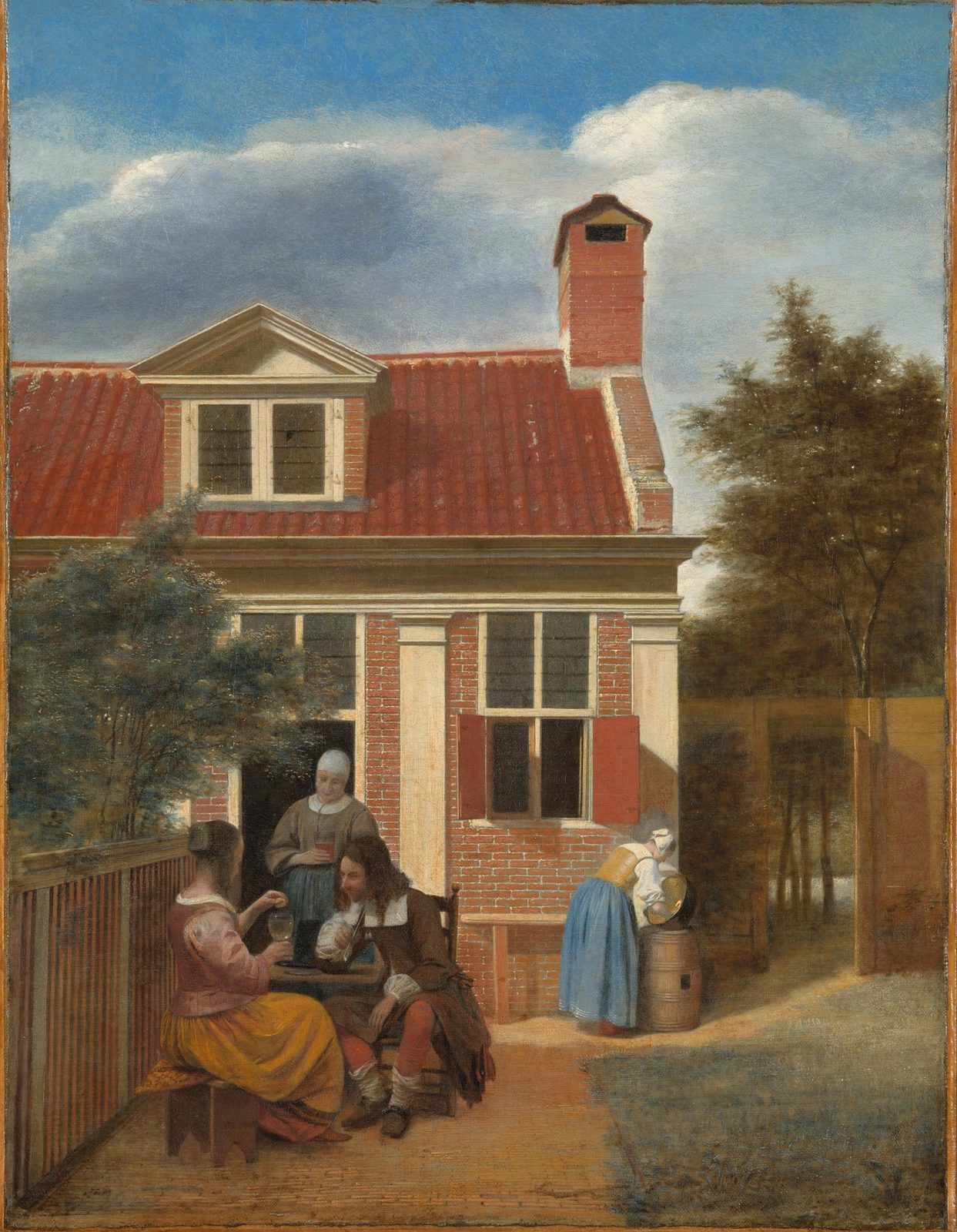
- Artist
- Pieter de Hooch
- Title
- Figures in a Courtyard behind a House
- Date
- c. 1663 - c. 1665
- Museum
- Rijksmuseum
- Image
- Public domain (CC0)
Open in Simple Art
Watch this story on iPhone and iPad, with offline downloads and a painting every day.
About 3 minutes of looking, in 9 parts.
Figures in a Courtyard behind a House
A woman lifts something small and yellow over her wine glass. Beside her, a man with a pipe leans in close. It's a quiet afternoon in the courtyard behind a brick house, and that little yellow thing explains the whole scene.
Pieter de Hooch, about 1663 to 1665
This is Pieter de Hooch's Figures in a Courtyard behind a House, painted in oil on canvas around 1663 to 1665. The Rijksmuseum reads it simply. A woman squeezes lemon juice into her glass, while her companion tries to catch her attention.
A tall house, a low group
The house fills the top half of the picture: red roof, a tall chimney, big summer clouds. The people are kept low. The couple and the standing maid cluster on the left, and a second maid on the right balances them across the open courtyard.
A cool head
Now look at her hand. In the seventeenth century, the museum explains, lemons were believed to calm intense infatuation. So perhaps she wants to keep a cool head. Her yellow skirt glows where the folds catch the light, and it looks brighter still against his dark brown coat.
Trying to catch her eye
He leans forward with his elbow on his knee, a long white clay pipe in his hand. His eyes are on her and her glass. The pale stem crosses his white shirt, and its edges look softened rather than drawn, so the pipe seems to sit in the air in front of him.
A maid in the doorway
Behind them, a maid stands in the open doorway. The museum says one of the maids is serving drinks, and its catalogue gives her a glass of beer. Notice how dark the doorway is. It's nearly one flat brown, while the sunlit bricks beside it are full of small changes of colour.
A white cap against the dark
Look closer at her white cap. It looks cool and greyish on its shadowed side and warm cream on top, and set against that dark doorway it catches the eye at once.
Scrubbing a kettle
Across the courtyard, the other maid is hard at work. The museum says she's scrubbing a kettle, and you can see the round copper shape tipped over the top of a wooden barrel. Her back makes one long curve, with the blue skirt kept broad and simple.
Brick by brick
Between the two maids, look at the wall. Each brick appears to be its own small rectangle of red, a touch lighter or darker than its neighbour, with thin pale lines of mortar between them. Up close it's a patchwork. From a step back it reads as one solid wall.
Look closer
7 details, each checked against a close-up of the picture.
-
The Seated Couple
The woman's yellow skirt reflects bright light on its lit folds while the man's dark coat absorbs it.
The crop centers on the seated couple, with the woman's bright yellow skirt occupying the lower left and the man's dark brown coat dominating the right. The right-facing ridges of the skirt's folds read as a luminous golden-ochre (around #D4A02C) while the left-facing and recessed folds drop to a darker mustard-brown (around #7A5418), as the folds turn toward and away from the light. The man's coat is rendered in deep, near-black browns (around #3D2817) with only minimal warm halftones along the shoulder and back; the white linen collar and cuffs supply the highest local contrast against that dark mass. The value jump across the boundary where the skirt meets the man's red-stockinged leg is abrupt, and the brushwork on the skirt appears broader and more loaded than the tighter, more blended handling on the coat.
-
The Bending Servant
The maid leans forward over a wooden barrel, working at a large round copper kettle.
The crop centers on a female figure bent nearly double over a wooden barrel, her head lowered so the white cap nearly touches the barrel rim. Her right arm plunges downward into the dark cavity between the barrel's mouth and the dark interior, the sleeve catching the strongest highlight in the composition. The blue skirt reads as a broad, simplified mass with only three or four vertical fold accents, while the yellow bodice is a flat plane interrupted by a sharp shadow line where the torso folds. Behind her, a brick wall is built from horizontal, slightly irregular strokes in terracotta tones, and a saturated red painted wall fills the upper register. Craquelure runs through the entire surface as a fine web of pale lines.
-
The Pipe
The man holds a small white clay pipe in his right hand.
The crop centers on a male figure's torso where a long, slender white pipe stem runs diagonally from the lower-left bowl toward the upper-right, crossing in front of a softly modeled white linen shirt. The hand cradling the pipe is built up with warm ochre and umber tones that lift out from the surrounding dark brown coat, with a small highlight catching the knuckle. The shirt's folds are rendered with cool grey-blue shadows against warm cream mid-tones, creating volume without hard lines. Heavy craquelure and vertical age cracks run across the entire surface, particularly visible in the blue drapery at left and the wooden ledge below.
-
Doorway Contrast
The interior of the open door is a deep, dark brown compared to the sunlit brick exterior.
The crop centers on an open doorway where a servant in a white cap, olive-brown jacket with cream collar, and muted blue-gray skirt stands holding a glass of reddish liquid. The doorway interior reads as a near-uniform very dark brown-black field with only faint tonal variation, while the brick column on the right edge breaks into warm reddish-orange, ochre, and cream mortar tones that are visibly brighter. The crackle pattern (craquelure) runs uniformly across both zones, confirming a continuous paint film on the same support. Edges between figure and door are softly blended with no hard contour, whereas the figure's outline against the brick is relatively crisper where light falls.
-
Brick Texture
Individual bricks and mortar lines are painted as distinct, small rectangles of varying red tones.
The crop shows a close-up of a brick facade beside a white pilaster with a molded capital, a dark window opening, and a reddish shutter. Individual bricks read as small, distinct rectangles laid in a running bond, each painted with a slightly different red-orange tone ranging from bright terracotta on lit faces to deep oxblood in shadow. Mortar courses are crisp, narrow lines of pale cream-gray, applied as both horizontal bed joints and vertical head joints. Subtle dark dabs at brick corners and edges create a small undercut shadow, giving each unit a hint of three-dimensionality. A network of fine craquelure covers the entire surface, most visible across the pale column where the lighter ground makes the cracks read as dark hairline lines.
-
Roof Line Against Sky
The edge of the red roof meets the blue sky with a sharp, clean line.
The crop captures a junction where a blue sky meets a red-orange tiled roof on the left, and a brownish chimney or pediment mass descends from the upper right. The sky reads as a cool, slightly desaturated blue with visible fanning brushstrokes that radiate outward, suggesting broad, loaded application rather than thin wash. The red roof shows patchy, layered warm tones (vermilion over deeper brick) with small flecks of bare ground or lighter scumbling. A cream-colored horizontal molding runs across the lower right, separating the roof plane from a darker brown fascia. The red-to-sky boundary on the left is a relatively crisp painted edge, though not a hard geometric line—small irregularities and the craquelure network soften it. The entire surface is covered in fine, web-like age cracks and a few vertical scuffs.
-
The Servant's Cap
The standing figure wears a white cap that catches the light from the courtyard.
The crop isolates the head and shoulders of the servant figure framed by a pale vertical doorjamb on the right and dark foliage/doorway on the left. The white cap dominates, modeled from a cool blue-gray shadow along its left edge into a warm, near-cream highlight on the upper crown; a fine crease of pinker flesh tone suggests where the cap meets the brow. The face beneath reads as warm ochre and terra-cotta flesh, with the nose and cheekbone catching more orange-red than the recessed eye sockets, which lean toward olive-gray. To the right, the brick wall is built from small rectangles in varied reds and oranges with pale mortar, and the doorjamb is a single flat warm-white plane with a faint warm shadow on its left side. A network of fine craquelure runs over every surface, breaking edges but not values.
Figures in a Courtyard behind a House in context
A Delft subject, an Amsterdam date
The Rijksmuseum dates this canvas to about 1663 to 1665 and records the signature 'P.D. Hoog' [1]. Its own story on the artist presents it among the courtyards De Hooch painted in Delft, where he began his career, and calls it one of the most beautiful [2]. The dates complicate that picture. According to the National Gallery of Art in Washington, De Hooch settled in Amsterdam sometime between mid-1660 and April 1661, and apart from a visit to Delft in 1663 he seems to have stayed there [3]. So this is probably a Delft type of picture painted, or at least finished, after the move. Cornelis Hofstede de Groot, cataloguing it in 1910, placed it a little earlier, at about 1660 to 1665 [4].
Real bricks, imagined places
Courtyards had been one of De Hooch's main subjects in Delft. Wikipedia, drawing on Peter Sutton's 1998 monograph, notes that some resemble the yards behind old houses around the Binnenwatersloot, where his wife lived [5]. In his review of the 2019 Delft exhibition, Sutton reports that a close study of the topography found most of the early courtyards to be imaginary, though they include real buildings, especially near the house of his in-laws on the north side of the Binnenwatersloot [6].
The same review explains why the brickwork in such pictures can look so convincing. De Hooch experimented with different ways of painting brick, tiles and mortar, using exposed ground layers, underdrawing and incised lines [6]. Sutton also suggests his interest in perspective may first have come from his father, a master bricklayer [6].
A lemon and a glass of beer
The museum reads the lemon as a clue: in the seventeenth century lemons were believed to calm intense infatuation, so the woman may want to keep a cool head [1]. Hofstede de Groot gave the picture the alternative title 'The Lovers' [4]. His description adds that the gentleman holds his pipe in his right hand, that the woman behind the couple is older and carries a glass of beer, and that the servant on the right stands on a tub to scour a brass pot [4]. The museum's Dutch description calls the pot a large copper kettle above a wooden vat [1].
Such scenes of a couple drinking in a sunny yard grew out of De Hooch's earlier work. Wikipedia, again following Sutton, says that his courtyards revisit the merry companies of his soldier paintings, but replace dim stables and taverns with sunlit middle-class spaces [5].
Through English hands
Hofstede de Groot records that the painting was imported into England by someone named Chaplin, was in the O'Niel collection in 1832, and had reached the Amsterdam collection of Adriaan van der Hoop by 1842 [4]. That route fits a wider pattern. Wikipedia notes that De Hooch's prices only rose in the early nineteenth century, when English collectors such as George IV, Sir Robert Peel and the Duke of Wellington bought his work [5]. Sutton observes that the first catalogue of his paintings was compiled by the English dealer John Smith in 1833, and that much early scholarship on him was done outside the Netherlands [6].
The canvas came to the city with the Van der Hoop bequest and is on loan to the Rijksmuseum from the City of Amsterdam [1].
- Pieter de Hooch, Figures in a Courtyard behind a House (SK-C-150): object record, description and inscription . Rijksmuseum, Amsterdam
- Pieter de Hooch: an artist who transformed light and space into poetry . Rijksmuseum, Amsterdam
- Arthur K. Wheelock Jr., 'Pieter de Hooch', artist biography (Internet Archive copy, 30 April 2025) . National Gallery of Art, Washington
- Company in a Courtyard Behind a House (quoting Hofstede de Groot, 1910, no. 286) . Wikipedia
- Pieter de Hooch . Wikipedia
- Peter C. Sutton, review of 'Pieter de Hooch in Delft: From the Shadow of Vermeer' (Museum Prinsenhof Delft, 2019 to 2020) . Historians of Netherlandish Art Reviews