The one in violet
How Jan Steen uses light and colour to pick one woman out of a busy, crowded room
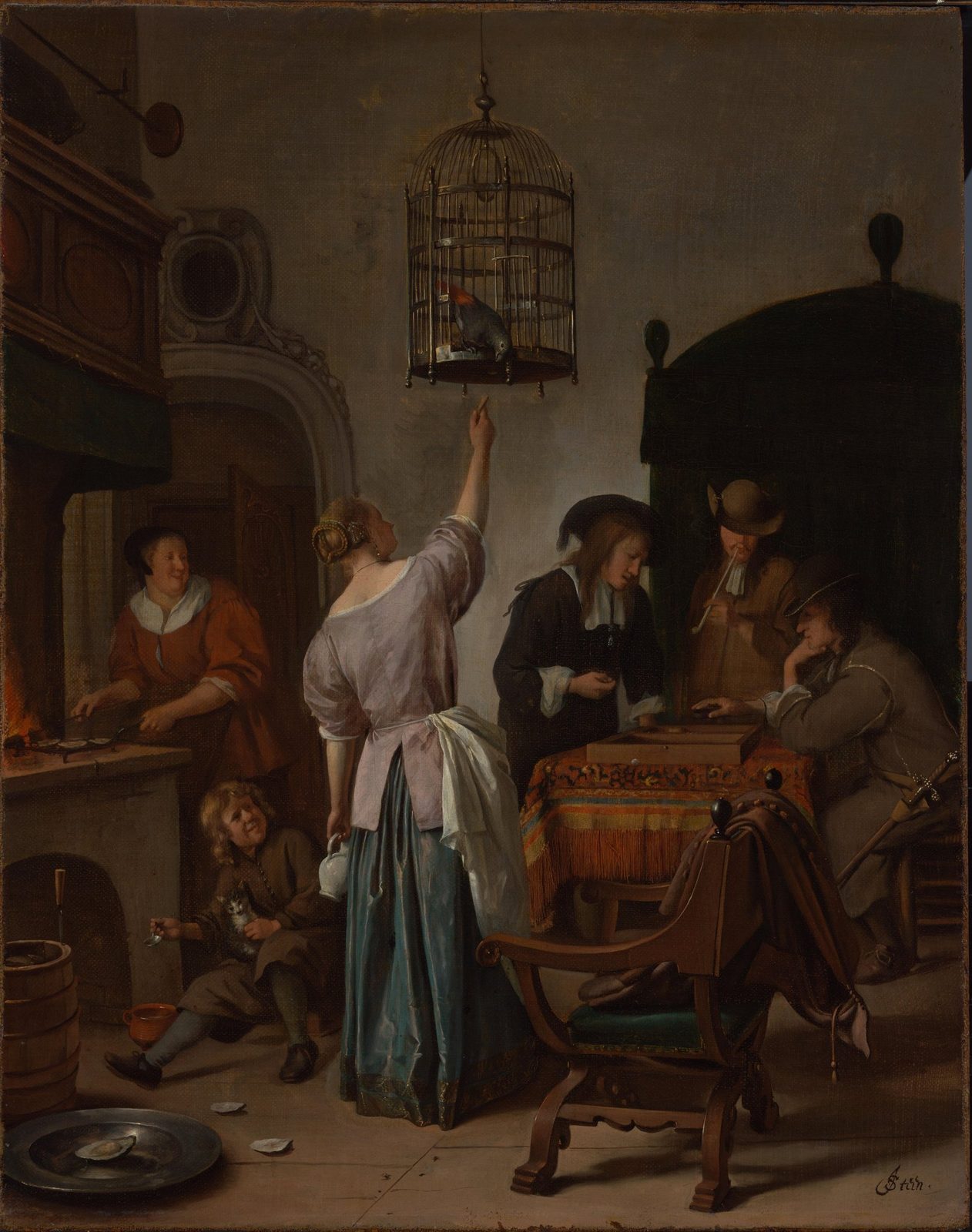
- Artist
- Jan Havicksz. Steen
- Title
- Interior with a woman feeding a parrot
- Date
- c. 1660 - c. 1670
- Museum
- Rijksmuseum
- Image
- Public domain (CC0)
Open in Simple Art
Watch this story on iPhone and iPad, with offline downloads and a painting every day.
About 3 minutes of looking, in 9 parts.
Interior with a Woman Feeding a Parrot
In the middle of a crowded room, a young woman stretches her arm up towards a hanging birdcage. Between her fingers is something small for the bird. Around her, people cook, play and smoke, and yet she's the one you see first.
Jan Steen, about 1660 to 1670
This is Jan Steen's Interior with a Woman Feeding a Parrot, known as The Parrot Cage. He painted it around 1660 to 1670, in oil on canvas laid on panel. The Rijksmuseum sums it up in five words. This scene bursts with life.
One raised arm
Follow her arm. It's the strongest upright line in the picture, running from her shoulder straight to the cage. The cage hangs on its own against a plain grey wall, so once your eye gets there, nothing pulls it away.
A grey parrot
Here's the bird. It's a grey parrot with a bright red tail, leaning down from its perch towards her hand. The museum says she's giving it a biscuit, pinched between finger and thumb. Notice too that the little door of the cage stands open.
Green and violet
Now look at what she's wearing: a pale violet bodice and a long blue-green skirt with a soft sheen. The museum points out that this is how Steen directs you to her. The light falls on her, and these colours set her apart from the drabber figures all around.
Oysters at the fire
On the left, by the fire, a woman is frying oysters, and she seems to be laughing as she works. Her face is warm and flushed. Just below her sits a boy with a cat and a spoon, and a few empty oyster shells lie on the floor.
A game of trictrac
On the right, two men play trictrac, a kind of backgammon, while a third stands behind them smoking a long clay pipe. One player props his cheek on his hand. Their coats are browns, greys and black, close in tone to the wall.
A patterned table cover
Their table is covered with what looks like a patterned carpet, with a broad stripe of teal and gold and a dense orange fringe hanging straight down. It's the one strong patch of colour on this side, and it sits low, below the faces.
Signed JSteen
In the bottom right corner, on the floor, look for the signature. The museum records it as JSteen, written with a looping flourish.
Look closer
5 details, each checked against a close-up of the picture.
-
The Birdcage and Hand
A grey parrot with a red tail sits in a brass cage, leaning towards a hand that holds up a small titbit.
A domed brass birdcage dominates the frame, constructed of thin vertical bars joined by horizontal rings, hanging from a short finial at top center. Inside, a small bird with dark grey-black head and a vivid reddish-orange back/tail leans downward, its beak pointed toward a pale hand rising from the lower edge that pinches a tiny offering between thumb and forefinger. The cage catches warm light along its right-facing curves, while its left side and interior fall into deeper olive-brown shadow, creating a clear volume. The background is a uniform, softly mottled umber-olive wall, and a small hinged door is visible partway down the cage on the right. Edges between cage bars and background are crisp on the lit side and softer in the shadowed interior.
-
Artist Signature
The letters 'Steen' are visible in the bottom right corner of the floor.
A dark calligraphic inscription reading 'Steen', prefaced by an ornate S-flourish, occupies the center-right of the crop on a warm umber ground that functions as floor. A horizontal band of darker brown crosses the upper portion, sharply separated from the lighter ground below by a crisp, slightly uneven edge. The signature strokes vary in thickness, with the swirl swelling at its lower curve and the terminal 'n' tapering to a fine point; small dry-brush gaps within the letters reveal the ground tone beneath. A few faint diagonal scratches and pinpoint losses interrupt the otherwise continuous brown field.
-
The Cook's Expression
The woman cooking at the fire has a flushed, smiling face lit from the fire side.
The crop isolates a seated cook whose flushed, ruddy face turns toward the right edge of the frame, mouth open in a broad laugh that creases the cheek into a warm pocket of pink-orange flesh. A broad white collar with soft, broken lower edges sits against a rust-red sleeve painted in thick, dragged strokes that show the weave of the canvas through thinner passages. The dark hair is blocked in with cooler brown-black, while the right side of the face catches a cool grey shadow that contrasts with the firelit left cheek. Behind her, a dark passage resolves into the faint ornamental crest of a mirror or frame at upper right, set against a deep umber background broken by horizontal craquelure.
-
Table Group Interaction
Three men gather at a game board: two play while a third stands behind smoking a long clay pipe.
Three figures converge over a wooden game board at center: a long-haired young man in a black coat and hat tilts his face down toward the table, his white linen collar and cuff forming the brightest shapes in the left half; a central man in a tan coat and broad-brimmed hat blows a long white clay pipe, its stem cutting a sharp diagonal through the midground; a right-hand man in grey-brown coat and dark hat props his cheek on his hand, his profile catching the cool light. A Turkey-work carpet in saturated orange, red, and dark blue stripes wraps the table edge, and a turned chair finial with a dark globe tops the lower right. Dense craquelure covers the surface, and edges on the faces are soft while the white linen and pipe stem read as crisp.
-
Table Decoration
The table is covered with a patterned cloth or carpet with a teal and gold stripe and a red-orange fringe.
The crop centers on a heavily draped table whose covering dominates the upper half: a red-orange textile with a scrolling foliate embroidery band (dark, near-black motifs against warmer red and ochre grounds) and a thick horizontal stripe of teal and gold that catches the light. Below this band, a dense fringe of vertical red-orange threads hangs straight down, each filament legible as a thin parallel mark before dissolving into shadow. To the right, a turned chair back with a black finial and beaded spindle rises in front of a dark, loosely painted mantle or cloak, the chair's silhouette crisp against the patterned ground behind it. The lower register shows the wooden table edge and stretcher in cool dark browns, with a small curved leg profile in the lower-left corner. Networked craquelure runs across the entire surface, and the highest-value gold band sits roughly along a diagonal that recedes from foreground-left to background-right.
Interior with a Woman Feeding a Parrot in context
What the catalogue records
The Rijksmuseum's catalogue describes a young woman feeding a parrot, two trictrac players and other figures, pointing out that the birdcage hangs from the ceiling with its little door open [1]. On the left a woman cooks oysters on a stove, and on the floor a boy feeds a cat with a spoon [1]. The picture is painted on canvas laid down on panel, measures 50 by 40 centimetres and is signed 'JSteen' [1]. The museum dates it only broadly, to about 1660-1670, and records that it was bought in 1809 [1].
Parrots in Dutch interiors
Steen was not the only painter of his circle to show a woman feeding a parrot. His good friend Frans van Mieris painted a Young Woman Feeding a Parrot in 1663, now in the Leiden Collection [2][5]. In his catalogue entry on that panel, Quentin Buvelot explains that parrots were kept as pets in the seventeenth century and could simply signal a luxurious household [5]. He adds that in images of the Virgin and in marriage portraits parrots often alluded to virtue or marital chastity, and that the bird, which can be tamed and taught to mimic speech, was also read as a sign of eloquence and eagerness to learn [5].
Buvelot reads Van Mieris's parrot as a sign of the young woman's good upbringing [5]. The Rijksmuseum does not offer a reading of the parrot in Steen's picture; its text concentrates on how light and colour pick out the woman at the centre [1]. Whether Steen meant the bird to carry any of these associations in a crowded, noisy room is therefore an open question.
A painter who brewed
Steen came from a family of brewers, and his father leased a brewery in Delft for him from 1654 to 1657 [3]. Bakker records that in 1654 Steen left The Hague, where he had built up a reputation, and settled in Delft, where he rented the brewery called The Snake [2]. He suggests the move may have been prompted by the ruinous state of the art market during the First Anglo-Dutch War, but the war also hurt brewing, and Steen was soon in serious financial difficulty [2]. Bakker also notes that the gunpowder explosion in the Delft arsenal on 12 October 1654 badly damaged the local economy [2].
His lease was due to run until 1 November 1657, but four months before that he was already calling himself a 'gewesen brouwer', a former brewer [2]. The Rijksmuseum still sums him up as a hard-working figure who ran a brewery for many years and produced hundreds of paintings [4].
Haarlem years and an inn called The Peace
The museum's date range for this picture coincides largely with Steen's time in Haarlem, where he joined the Guild of St Luke in 1661 and spent what Bakker calls the most productive years of his career [1][2]. The Second Anglo-Dutch War, which began in March 1665, again hit the art market, and his first wife died in 1669 [2].
After returning to Leiden in 1670 he was still short of money [2]. In 1672, the Year of Disaster, when the art market was at its worst, the city council licensed him to run an inn called The Peace, or De Vreede [2]. Bakker writes that Steen regularly received other painters there, among them Van Mieris, with whom he often drank too much [2]. The National Gallery records the 1672 licence too, though it says only that he obtained permission to keep an inn [3].
- Jan Havicksz. Steen, Interior with a Woman Feeding a Parrot, Known as 'The Parrot Cage' (SK-A-386): object record . Rijksmuseum, Amsterdam
- Piet Bakker, 'Jan Steen' (2017), in The Leiden Collection Catalogue, ed. Arthur K. Wheelock Jr. (archived PDF, 2020) . The Leiden Collection, New York
- Jan Steen (1626-1679): artist biography . The National Gallery, London
- Jan Steen (Dutch Masters series) . Rijksmuseum, Amsterdam
- Quentin Buvelot, 'Young Woman Feeding a Parrot' (FM-112), in The Leiden Collection Catalogue, ed. Arthur K. Wheelock Jr. (2017) . The Leiden Collection, New York