The keeper of the key
In Pieter de Hooch's linen-cupboard interior, a small key in a lock tells you who runs the house
- Artist
- Pieter de Hooch
- Title
- Interior with Women beside a Linen Cupboard
- Date
- 1663
- Museum
- Rijksmuseum
- Image
- Public domain (CC0)
Open in Simple Art
Watch this story on iPhone and iPad, with offline downloads and a painting every day.
About 3 minutes of looking, in 9 parts.
Interior with Women beside a Linen Cupboard
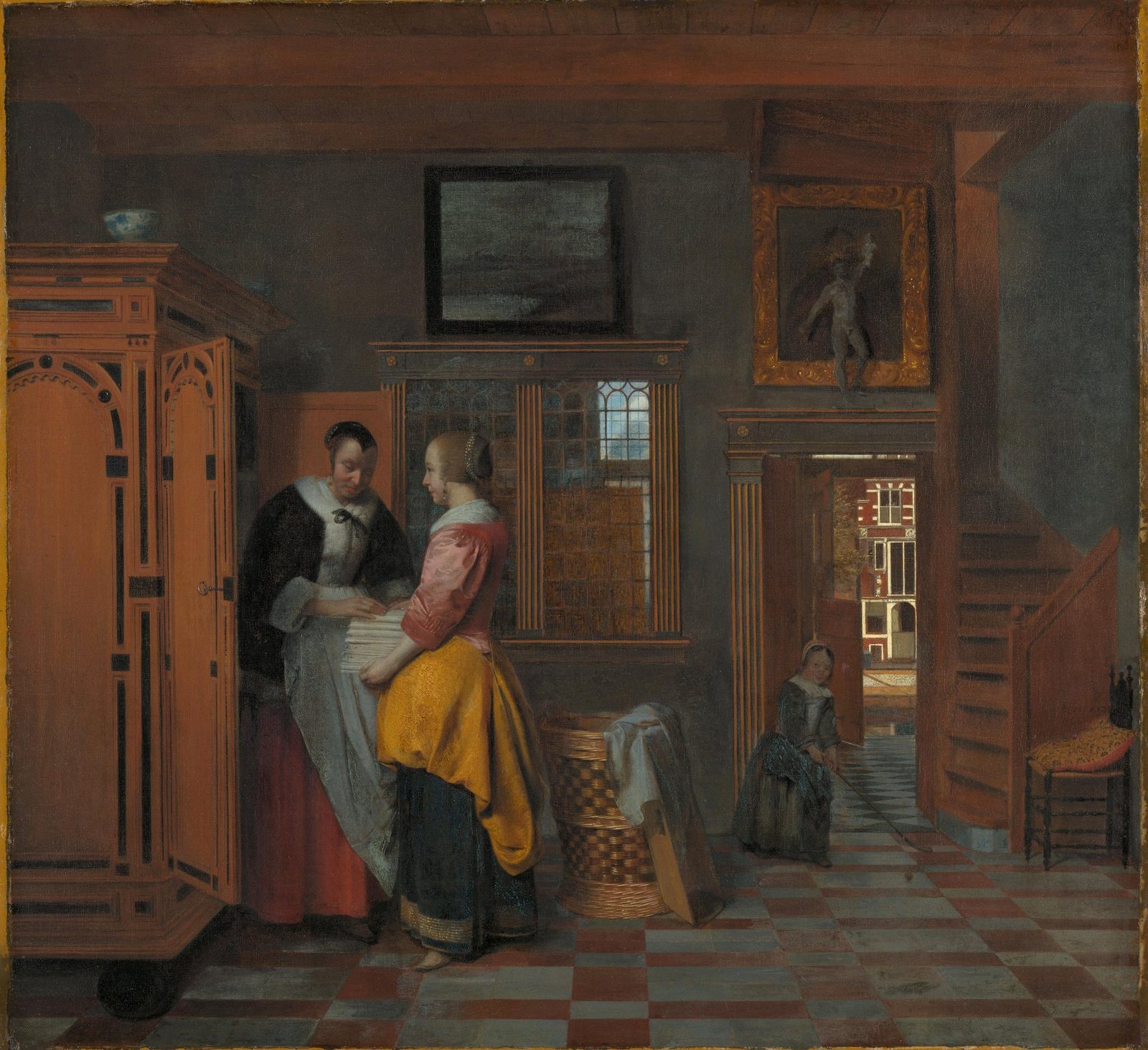
Two women stand by a tall open cupboard with a stack of white linen between them. The one in the black jacket looks down at the pile. The younger one, in pink and yellow, holds it against her apron. A little further off, a girl is busy with a game of her own.
Pieter de Hooch, 1663
This is Pieter de Hooch's Interior with Women beside a Linen Cupboard, dated 1663 and painted in oil on canvas. The Rijksmuseum says the women are stacking freshly pressed linen in the cupboard, and that the linen cupboard had an important place in the home.
Cupboard, window, door
See how the room is built. The tall cupboard closes the left side, a window sits in the middle of the back wall, and on the right an open door leads out. The two women stand close together just left of centre, right beside the cupboard.
A dim room, two bright things
The room itself is fairly dim. Most of the window is leaded glass, and only a small pane near the top shows bright sky. Against all that brown and grey, the white linen and the yellow skirt become the brightest things here, and your eye goes straight to them.
Freshly pressed
Here's the linen itself. Each fold seems to be made of just two values, a near-white crest and a deep, slightly bluish grey pressed right against it, with almost no blending between. That hard break is what makes the cloth look crisp and freshly pressed.
The warmest colour
The younger woman's yellow skirt is the warmest colour in the picture. It runs from pale gold on the raised folds to a deep brownish ochre in the hollows. The lights are softly blended, while the shadows end in firmer, darker edges.
A key in the lock
Now look back at the cupboard door. Halfway down its edge, a small key sits in the lock. According to the museum, the lady of the house carried that key with her and handed out the sheets. She was the one in charge of the household.
A game of kolf
Over on the right, a young girl stands near the door holding a long stick. The museum says she's playing kolf, a kind of hockey. Her stick makes one long line across the tiles. Outside, the museum notes, the sun lights up the canal houses.
Red and grey underfoot
Down at our feet, the floor is a checkerboard of muted red and cool grey tiles. The two colours are kept close in lightness, so the pattern comes more from warm against cool than from light against dark. It stays orderly without shouting.
Look closer
9 details, each checked against a close-up of the picture.
-
Linens exchange
The white linens are rendered with high-contrast highlights and deep grey shadows in the folds.
The crop centers on a stack of folded white linens held between two hands — a cool grey-blue hand at left and a warmer flesh tone emerging from a crimson sleeve at right, with a saffron-yellow skirt filling the lower right corner. The linens are built as a series of horizontal ridges: the crests are nearly pure off-white while the recesses drop abruptly to a deep, slightly bluish grey, giving each fold a knife-sharp shadow line. Background architecture on the left recedes into near-black, throwing the central textile into high contrast. A network of fine craquelure runs across the entire surface, and the edges where the hands meet the cloth are soft and slightly blended, while the fold-edges of the linen themselves are crisp.
-
Hands on cloth
The fingers of both women are delicately positioned, barely gripping the edge of the white fabric.
Two hands rest on a stack of folded cream-colored linen, with fingertips barely curling over the topmost fold. The fabric is rendered as a series of parallel horizontal ridges, each ridge defined by a thin shadow line below and a slightly cooler highlight along its crest. A warm rose-pink sleeve enters from upper right, its folds described with short directional strokes that catch a brighter highlight along the turned edge. The lower right corner introduces a saturated ochre-yellow plane, while the upper left drops into a deep brownish-black. Skin tones are warm and modeled with soft transitions from pinkish highlights on the knuckles to cooler umber shadows in the recesses between fingers.
-
Yellow skirt fold
The yellow fabric uses a range of ochre and gold tones to define the heavy folds of the apron.
The crop isolates the lap and apron of a woman, dominated by a large passage of yellow drapery. Tonal range runs from a warm pale gold (~#D4A02C) on the raised crests to a deep brownish-ochre (~#5A3A14) in the fold troughs; the transitions in the highlights are softly blended while the shadow valleys terminate in firmer, darker edges. A hand at upper left pinches the cloth, and a jagged, slightly wavering contour separates the yellow from the dark blue-grey skirt below. Surface craquelure runs across the entire passage, and a vertically descending fold on the right carves a deep shadow that disappears off the right edge near a wicker basket.
-
Glass cabinet reflection
The glass panes show subtle white vertical streaks suggesting light reflecting off a smooth surface.
The crop frames a tall vertical slice of an interior, dominated by a warm brown wooden surface (cabinet face or paneling) that fills roughly the bottom 60 percent, with a Gothic-arched leaded window occupying the upper third. The window glass reads as a cool blue-grey divided by thin dark lead lines, with trefoil/quatrefoil tracery visible at the arch crown. Flanking left and right are pilasters with vertical reeded/banded detailing in alternating dark and lighter brown stripes. A distinct vertical band of paler, warmer ochre-cream runs down the right-center of the wood panel, edged softly against the deeper umber surround; this is the only significant value break in the otherwise even wood field. Horizontal grain striations and dense craquelure texture the wood surface throughout.
-
Cupboard orthogonals
The edges of the open cupboard door are rendered as sharp, clean lines against the wall, and a key sits in the door's lock.
The crop isolates the right edge of a tall open cupboard door with Gothic cusped tracery at top, rendered in a warm orange-brown wood tone against a deeply shadowed wall recess. The door surface is articulated by dark vertical bands defining recessed panels, with small dark rectangular iron hinges and a circular metal ring pull set into a horizontal black bar near mid-height. To the right, a figure in dark outer garment and pale bluish-grey linens stands in front of a lower opening that reveals a reddish floor tone of the antechamber. The door's right vertical edge reads as a fairly crisp boundary, but close inspection shows a 2-4 pixel transition zone where the orange-brown door tone steps down into the deep umber-black of the recess rather than a single knife-edge line. Subtle value modulation along the edge suggests the wood sits fractionally proud of the wall plane.
-
Doorway light
A girl holds a long stick whose shaft runs diagonally across the floor tiles near the doorway; the floor beyond the threshold is brighter than the main room's floor.
The crop isolates a doorway threshold where a dark umber doorframe (left and right jambs) frames a receding tiled antechamber. The main-room floor at the lower edge is rendered in deep, low-chroma brown-grey with broad, soft-edged brushwork, while the rear-room floor shows a regular grid of blue-grey rhombic tiles whose values step up noticeably brighter toward the vanishing point. A slender dark shaft (the kolf stick) cuts a long diagonal from lower-right to mid-left, crossing several tile seams. At the top, a small rectangle of warm ochre/cream with a hatched, scaley texture suggests a back-lit window or panel, flanked by deeper orange-brown wall tones.
-
Framed painting details
The figure within the painting is rendered with looser, more sketch-like brushstrokes than the main scene.
The crop isolates an ornate gilded frame surrounding a dim painting of a standing nude figure. The frame's carved scrollwork reads as crisp, layered gold-brown tones with defined positive and negative shapes, while the figure inside dissolves into the dark ground with feathery, indistinct edges — the head, raised hand, and limbs are suggested by pale scumbled highlights rather than drawn contours. A network of craquelure crosses both the frame's ornament and the dark painting equally, indicating a single continuous paint film rather than a physically inset panel. Below the frame, a narrow shelf/ledge runs horizontally with a small rosette at lower left, painted in muted brown-black.
-
Tiled floor pattern
The floor tiles alternate between muted terracotta red and cool grey-white squares.
A receding tiled floor occupies most of the crop, laid in a diagonal checkerboard running from lower-left to upper-right. The 'red' tiles are a muted, slightly chalky brick-brown, while the alternating tiles read as a cool, dusty blue-grey rather than true white; the two values are kept quite close in lightness, so the pattern depends on hue contrast more than tonal contrast. Scuff marks, scraped paint, and thin scraped highlights along the upper edges of several tiles suggest wear and raking light. At the top of the crop the curved base of a wicker basket, the corner of a wooden object, and the dark hem of a figure's garment with a pale inner lining sit on the tiles, anchoring the floor. The grout is not drawn as a separate line but emerges as the darker tone of the red tile next to the lighter grey-blue tile.
-
Wicker basket
The weave of the basket is indicated by small, repetitive diagonal strokes of light brown.
The crop is dominated by a cylindrical wicker basket whose body is built up in a regular over-under checkered pattern: dark brown squares alternate with warm tan squares, and each tan square contains a short diagonal stroke running from upper-left to lower-right. A pale blue-grey cloth spills over the rim at upper right, its folds described with soft, blurred edges that read as wet-into-wet blending rather than crisp lines. A flat ochre-olive plank leans against the basket at right, its top edge slightly stepped where it meets the cloth. Below the basket the floor is paved in alternating rust-red and slate-blue square tiles seen in steep perspective, and the upper-left background dissolves into near-black.
Interior with Women beside a Linen Cupboard in context
An early Amsterdam picture
The canvas is signed and dated 'P.D. Hoogh 1663' [1]. By then De Hooch had left Delft. Essential Vermeer places his move to Amsterdam around 1660 or 1661, presumably in search of wealthier clients [2]. Peter Sutton, reviewing the 2019 Delft exhibition, notes that the artist's own circumstances when he first arrived there were straitened, and that his lodgings outside the city walls were probably deplorable [3]. The same year, 1663, is also when the National Gallery of Art records his one return visit to Delft after the move [7]. The Rijksmuseum stresses that De Hooch's interiors were carefully conceived in the studio rather than based on real rooms, so the comfortable household shown here need not reflect his own [5].
Through the door, the museum notes, the sun lights up canal houses outside, while the interior is darker [1]. Essential Vermeer describes his Amsterdam work as darker in colour, with grander settings replacing simple domestic rooms [2]. With its plain dim room and bright street, this picture could be read as an early step in that change [1][2].
Linen, keys and authority
The Rijksmuseum explains that the linen cupboard had an important place in the home. The lady of the house carried its key and 'handed out the sheets', a phrase meaning she was in charge of the household [1]. The museum's subject terms for the work include household management and the housewife at work [1].
Hofstede de Groot, who catalogued the picture in 1908 under the title 'The Good Housewife', describes a great oak press inlaid with ebony [4]. He took the younger woman, judging by her fine clothes, to be the housewife's daughter, helping by taking linen from a large basket [4]. The museum's own description simply speaks of two women [1].
People as still life
The Rijksmuseum observes that with their serene atmosphere, many of De Hooch's interiors resemble still lifes. In this painting, it says, the figures serve as accessories and are as important as the furniture: the cupboard, the wicker laundry basket and the chair with a cushion [5]. Among the museum's subject terms is also a piece of sculpture showing Perseus with the Gorgon's head [1].
The girl at the door plays kolf, a kind of hockey [1]. In a note on another De Hooch, the National Gallery of Art in Washington points out that while most pictures of kolf show boys and men, everyone enjoyed the game [6].
From Rotterdam to the Six family
Hofstede de Groot lists a long history of owners. The painting was sold in Rotterdam in 1726 from the collection of Baron Lockhorst, and in the Joachim Rendorp sales of 1793 and 1794 [4]. It passed through a Scottish owner to the English dealer John Smith [3]. It failed to sell at his 1828 sale, and by 1833 was in the collection of Six van Hillegom in Amsterdam [4]. It was exhibited in Amsterdam in 1872 and 1900 [4].
Smith admitted it lacked the brilliant light most prized in De Hooch, but judged it among his best works for its truth and finish [4]. Today it is on loan to the Rijksmuseum from the City of Amsterdam, and the museum notes that it was formerly titled with a linen chest rather than a cupboard [1]. Wikipedia gives slightly larger measurements than the museum's 70 by 75.5 cm [4][1].
- Pieter de Hooch, Interior with Women beside a Linen Cupboard (SK-C-1191): object record, description, subject terms and inscription . Rijksmuseum, Amsterdam
- Seven Dutch Masters: Pieter de Hooch . Essential Vermeer
- Peter C. Sutton, review of 'Pieter de Hooch in Delft: From the Shadow of Vermeer' (Museum Prinsenhof Delft, 2019 to 2020) . Historians of Netherlandish Art Reviews
- Two Women Beside a Linen Chest, with a Child (quoting Hofstede de Groot, 1908, no. 25, and John Smith) . Wikipedia
- Pieter de Hooch: an artist who transformed light and space into poetry . Rijksmuseum, Amsterdam
- Arthur K. Wheelock Jr., Pieter de Hooch, The Bedroom, 1658/1660, systematic catalogue entry (Internet Archive copy, 20 May 2026) . National Gallery of Art, Washington
- Arthur K. Wheelock Jr., 'Pieter de Hooch', artist biography (Internet Archive copy, 30 April 2025) . National Gallery of Art, Washington