Sunlight before the storm
Rembrandt lets one beam of light through a dark sky, and the whole landscape turns on it.
- Artist
- Rembrandt van Rijn
- Title
- Landscape with a Stone Bridge
- Date
- c. 1638
- Museum
- Rijksmuseum
- Image
- Public domain (CC0)
Open in Simple Art
Watch this story on iPhone and iPad, with offline downloads and a painting every day.
About 3 minutes of looking, in 9 parts.
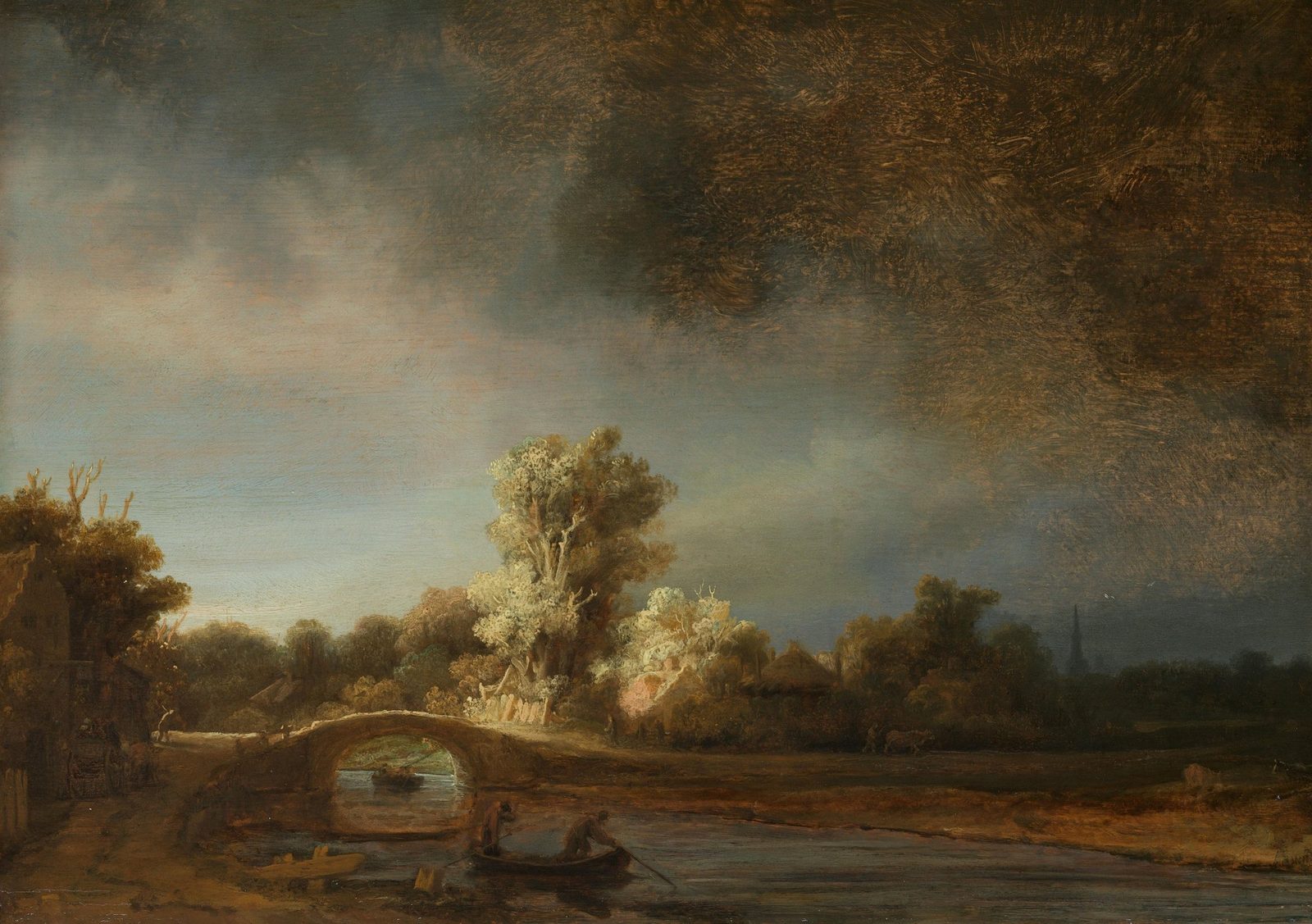
Landscape with a Stone Bridge
A storm is gathering. Dark cloud fills most of the sky, yet sunlight has broken through and caught a clump of trees and a stone bridge below. Beneath it, two men pole a small boat across the water.
Rembrandt, about 1638, oil on panel
Rembrandt painted this around 1638, in oil on a small panel, less than half a metre wide. The Rijksmuseum suggests the place is probably imaginary, assembled from real things: a river, a bridge, a barn among trees and a church tower in the distance. The museum also points out how that beam of sunlight makes the coming storm look all the more threatening.
Weight on one side
The balance is lopsided on purpose. The heaviest dark sits in the upper right, while the light gathers low on the left, around the trees and the bridge. A band of water and land runs across the middle and ties the two halves together.
Cool sky, warm cloud
Look up at the sky. On the left it is a thin, cool blue-grey, with something warmer showing through. Towards the right it turns dark umber, and the paint seems dragged in long, curving strokes that leave little ridges. There is no line between the two. The cool simply fades into the warm.
A tower on the horizon
Far out on the right horizon is a single thin, dark upright stroke, the church tower the museum mentions. Among the soft, broken marks around it, that one crisp accent helps tell you how far away it is.
Dark trees, lit trees
Compare the trees on the far left with those in the centre. The left-hand mass is almost black, with no detail, and its edges dissolve into the background. Next to it, the lit trees keep their greens, ochres and russet highlights, and thin bare twigs stand out sharply against the sky.
Where the sunlight lands
This is where the sunlight lands. The foliage looks built from loaded dabs of pale yellow and cream, thickest on the left-hand edges of the crowns. In the gaps, a darker olive-brown shows through, so the outline flickers rather than running smooth.
Light under the arch
Drop down to the bridge. A thin, broken line of warm cream runs along the arch, and in the water below a pale band seems to answer it. The rest of the water is laid in with dark horizontal strokes, so that small vertical break stands out.
Two boatmen
In the foreground, the two boatmen are little more than dark silhouettes, each leaning on a long pole. There is a hint of warmer red-brown on one shoulder and almost nothing else. Their edges soften into the water, yet they read at once as people at work.
Look closer
8 details, each checked against a close-up of the picture.
-
Illuminated central trees
The foliage consists of thick, opaque dabs of pale yellow and cream paint.
The illuminated central trees are built from clustered dabs of opaque pale yellow and cream paint, heavily loaded on the brush, with the brightest, thickest impasto sitting on the left-facing foliage edges where raking light catches the crown. These light dabs float over a darker, cooler underlayer of olive-brown and umber that shows through the gaps, giving the mass a broken, flickering silhouette rather than a continuous contour. Edges are soft and smudged, with a few crisper, brighter flick marks along the upper-left crown where fresh, wet-looking paint sits highest. The lower-right introduces a small cluster of warm pinkish-peach dabs against dark umber, a color shift that separates the right-hand tree group from the central mass.
-
Fore-ground boatmen
The figures are rendered as dark silhouettes with minimal internal detailing.
The crop reveals two boatmen rendered as near-silhouette dark masses against a paler band of water. The left figure bends forward at the waist with a pole angling down toward the lower right; the right figure is hunched more deeply, also driving a long pole. Internal anatomy is barely indicated—just a hint of a warmer reddish-brown shoulder on the left figure and a thin sliver of lighter tone marking the right figure's back. Edges where the bodies meet the water are soft and partly dissolved by the surrounding horizontal streaks, and the boat itself is only implied by a curved dark contour along the lower margin. The water around them is built from dragged horizontal strokes of cool blue-grey laid over warmer brown underlayers, so the figures sit on a slightly lighter shelf that pushes them forward.
-
Bridge arch and reflection
A bright line of light marks the underside of the arch and its reflection in the water.
The crop centers on a heavy stone arch whose underside is traced along the top by a thin, broken highlight of warm cream-ochre that runs from the upper-left keystone area across to the right springer. Inside the arch, mid-value greenish-grey strokes suggest reflected light on the inner stonework and the trees beyond. A small boat with a pole occupies the middle ground, and directly below it a near-vertical band of pale green-grey reads as the arch's mirror. The water surface is built from horizontal strokes of dark brown interrupted by this lighter vertical break. A hunched figure in the lower-right corner is modeled in warm reddish-brown against near-black water.
-
Sky transition
The sky shifts from a cool blue-grey on the left to a dark brownish-umber on the right.
The crop shows an upper-canvas sky band dominated by warm umber on the right and a quieter blue-grey haze on the left. On the right half, the paint is dragged in long, slightly curved horizontal strokes that catch the light in raised ridges, producing a coarse, almost combed texture with visible directional breaks. The left half is comparatively flat and atmospheric, with a thin cool tint settling over the warmer ground, and small scattered lighter specks (likely dust or minute age cracks) pepper both areas. The transition between the two zones is gradual rather than hard-edged: the cool tone thins out and becomes veiled by the advancing umber rather than meeting it at a clean boundary.
-
Turbulent cloud texture
The clouds are created with broad, scumbled strokes of darker paint over a lighter ground.
The crop is dominated by warm, dark brown tonalities with a band of slightly cooler, grayish-brown in the lower left. Across the field, broad sweeping marks run on diagonal axes, curving from upper-left toward lower-right and back. The lighter passages read as a base layer peeking through, while thinner, ridged striations of darker pigment sit on top, with broken edges where the dark drags and skips over the underlying tone. Faint linear streaks suggest bristle tracks, and the surface reads more scumbled than blended, with soft, irregular transitions between light and dark rather than crisp contours.
-
Shoreline blending
The edge between the land and the water is soft and blurred rather than a sharp line.
The crop shows three horizontal strata: a near-black band at top (shadowed foreground figures), a dark olive-brown mid-band with horizontal streaks indicating water, and a warm ochre band below that reads as a bank or shore. The transition between the ochre bank and the lower reflective band is gradual—brown values step down through intermediate tones, and a thin pinkish-orange streak of reflected light sits at the seam rather than a crisp contour. The water's edge is built by neighbouring darks and warms of similar value, so the boundary reads as a tonal event, not a drawn line. Horizontal brush marks dominate, reinforcing a wet, low-contrast meeting of land and water.
-
Distant spire
A thin, dark vertical stroke represents a spire against the horizon.
A thin, near-black vertical stroke rises through the center of the frame, slightly tapered and darkest at its base where it meets a band of warmer brown mid-tone. The surrounding field is built from broken, horizontally-oriented grey-brown marks that suggest water surface or atmospheric haze; two small pale flecks sit high and right of the spire, reading as distant birds or light glints. Below the spire the value deepens into a darker mass of choppy, scumbled strokes occupying the lower third, with no hard edge between water and reflected shadow.
-
Left-side foliage
The trees on the far left are darker and more loosely defined than the central trees.
The crop is dominated by a large, very dark foliage mass on the left that reads as near-black-brown with no internal detail resolved—edges dissolve into the background rather than crisply separating from it. To its right, the central tree cluster shows mid-value greens, ochres, and warm russet highlights where the raking light catches individual leaf clusters and bare broken branches. The bare twigs at top are painted with thin reddish-brown strokes that sit crisply against the pale blue-grey sky, whose horizontal scumbled brushwork is clearly visible. The value jump between the left mass and the central trees is abrupt, with the dark zone losing almost all chroma while the lit zone retains hue variation.
Landscape with a Stone Bridge in context
Success in Amsterdam
By the late 1630s Rembrandt was well established in Amsterdam. He'd moved there from Leiden at the end of 1631, lodged at first with the art dealer Hendrick van Uylenburgh, and found great success as a portraitist [3]. In 1634 he married the dealer's cousin, Saskia van Uylenburgh [3].
The couple moved more than once. In 1637 Rembrandt took a house on Vlooienburg, and in May 1639 they bought a recently modernised house in the Breestraat for 13,000 guilders, a mortgage that later contributed to his money troubles [3]. Prosperity did not spare them grief: three of their children died within weeks of birth [3].
A rare kind of picture
Landscape was a small part of Rembrandt's painted work. The Rijksmuseum says he painted only a few, mostly imaginary mountain scenes [1], and the Vereniging Rembrandt counts just eight known landscape paintings [2]. Wikipedia gives a sense of the balance: about two hundred of his drawings and about thirty of his roughly three hundred etchings have landscape subjects [3].
By the late 1630s, according to the same article, he'd made a few landscape paintings and many etchings, often full of natural drama, with uprooted trees and ominous skies [3]. It cites Cottages before a Stormy Sky, of about 1641, and The Three Trees, of 1643, as examples [3].
Making a Dutch view
The Vereniging Rembrandt finds the scene unmistakably Dutch in character, but thinks Rembrandt painted at most parts of it from life [2]. It also points to a deliberate choice in the sky, where much of the roughly brushed brown underlayer was left uncovered to suggest turbulent weather [2].
The date is given in slightly different ways. The Rijksmuseum has about 1638 [1], while Wikipedia's article opens with 1637 [4]. Hofstede de Groot, cataloguing it in 1915, placed it about 1637-38 and noted it was painted almost entirely in brown and grey [4].
A close relative hangs in Berlin. Landscape with Arched Bridge in the Gemäldegalerie is the same size and manner and was long thought to be a later copy by the pupil Govert Flinck. But Wikipedia reports tree-ring dating has shown the Berlin panel to be older than the Amsterdam one [5].
From Paris salerooms to an English house
The Rijksmuseum tentatively identifies the painting with a picture sold in Paris in 1806 for 250 francs [1]. It's on firmer ground with the Lapeyrière sale of 14 April 1817, whose catalogue noted the main light fell on a cottage and a clump of trees while the rest was kept in half-shadow [1]. It sold there for 1,505 francs, bought on behalf of the dealer W. Buchanan, and that catalogue text survives on a label on the back of the panel [1].
By 1824 it belonged to Edward Gray of Harringay House in Middlesex [1]. By 1850 it was at Bowood House in Wiltshire, the home of the Marquesses of Lansdowne [1]. The writer Waagen saw it there that year and, in a book published in 1854, described "the rays of the evening sun falling upon a bridge" [1]. It stayed in the family until the 5th Marquess sold it in 1883 [1].
The Rijksmuseum's first Rembrandt
The painting came up again at the sale of James Reiss at Christie's in London on 12 May 1900 [1]. The Rijksmuseum bought it for 2,200 guineas with support from the Vereniging Rembrandt and Dr Abraham Bredius [1].
The purchase mattered on both sides. According to the Vereniging Rembrandt, it was the museum's first painting by Rembrandt, since every Rembrandt it had looked after until then was on loan from the city of Amsterdam [2]. It was also the first time in the society's seventeen years it had helped to acquire a painting by its namesake [2]. The society quotes the museum's director Barthold van Riemsdijk as saying this was perhaps the last chance to obtain a Rembrandt landscape [2].
- Landscape with a Stone Bridge (SK-A-1935): object record and provenance . Rijksmuseum, Amsterdam
- De stenen brug . Vereniging Rembrandt
- Rembrandt . Wikipedia
- The Stone Bridge . Wikipedia
- Landscape with Arched Bridge . Wikipedia