Growth and decay
How Ruisdael sets a broken birch, a fallen log and a full oak around rushing water
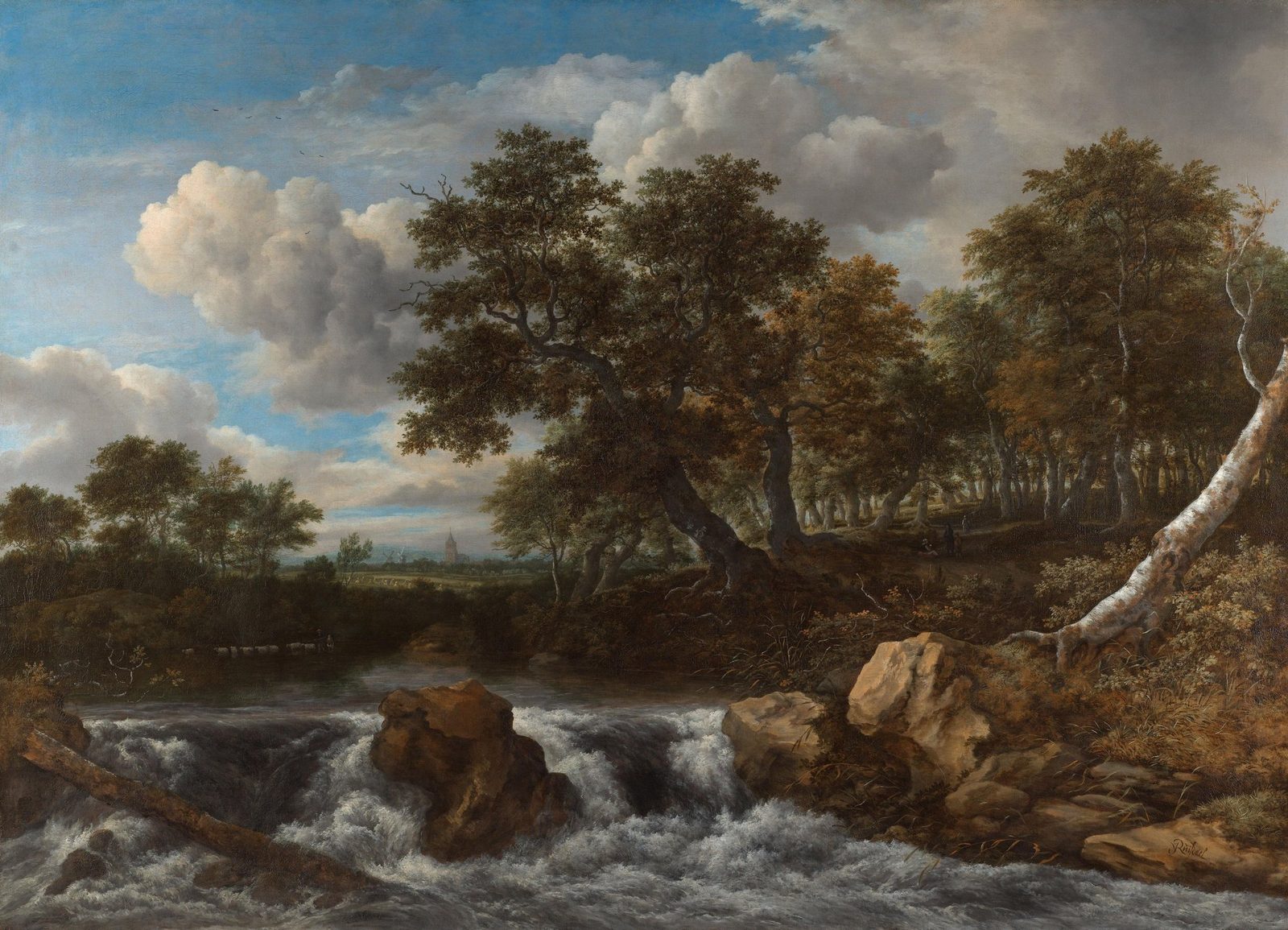
- Artist
- Jacob Isaacksz van Ruisdael
- Title
- Landscape with waterfall
- Date
- c. 1668
- Museum
- Rijksmuseum
- Image
- Public domain (CC0)
Open in Simple Art
Watch this story on iPhone and iPad, with offline downloads and a painting every day.
About 4 minutes of looking, in 9 parts.
A dead tree and a living one
Start at the right edge, with the pale trunk leaning out over the water. It's bare and broken, and looks long dead. Now look left, to the big oak in the middle, heavy with leaves. Life and decay sit side by side here, and the water runs between them.
About 1668, a large canvas
This is Landscape with Waterfall by Jacob Isaacksz van Ruisdael, oil on canvas, from around 1668. It's big, nearly two metres wide. The Rijksmuseum describes a scene dominated by gnarled trees, barren trunks and roiling water, where nature's cycle of growth and decay feels almost tangible.
Three heavy shapes
The design rests on three big shapes. The oak makes a dark, rounded mass in the upper centre, the birch cuts a diagonal at the right, and the falls spread across the bottom. On the left, the land opens out into a flat distance a little below the middle.
Leaves made of dabs
Up in the oak, the canopy is built from small dabs: commas, dots and quick flicks of olive, ochre and brown. The clumps towards the upper left are paler, and the rest sink into darker greens. From a distance they read as one mass. Close to, they become leaves.
A tower in the haze
Far off in the flat land is a church tower with a pointed spire, which the museum calls a beacon of peace. It's only a few soft, pale strokes against the haze, with no hard edge anywhere. That low contrast is what pushes it so far away.
Figures almost lost
Under the trees on the right are a handful of figures, almost lost, as the museum puts it. One seems to sit in dull red, another stands in black, and there may be a rider further back. Each is little more than one or two strokes of the brush.
Light on a dying birch
Back to the birch. The light seems to come from the right, so the trunk's right edge carries a bright, creamy band while the rest falls into grey-brown. Short dark marks across the pale bark keep it reading as bark, and the near-black wood behind pushes that lit edge forward.
White water over dark
Down to the falls. The deepest water is near-black, and over it sit short, broken dabs of white, cream and pale blue-grey. Only the brightest crests look really thick. Elsewhere the paint stays thin, which keeps the foam from turning into a flat white sheet.
A trunk in the stream
At the lower left, a dark log lies diagonally in the current, its upper edge crisp against the foam, its underside dissolving into shadowed water. It's another dead tree, this one already fallen, and its slant leads your eye back into the falls.
Look closer
8 details, each checked against a close-up of the picture.
-
Main Cascade
The white water is composed of thick, impasto-like dabs of white and pale blue paint.
The crop shows a turbulent cascade funneling between two large brown boulders. The water is built from short, broken dabs of bright white, cream, and pale blue-grey paint that sit up from the surface, while deeper passages are filled with dark, near-black glazes. The central boulder reads as a warm umber mass with a roughly modeled left contour that softens where spray laps at it. The right-hand rock is smaller, partly cropped, and shows a more sunlit ochre face; spray leaps up behind it. Edges are not crisp: foam dissolves into dark water in soft transitions, and only a few highlights have sharp, buttery ridges.
-
Sunlit Birch Trunk
The upper edge of the white birch trunk features bright, high-value highlights contrasting with a grey-brown shadow side.
A diagonal birch trunk sweeps from lower-left to upper-right, its upper edge carrying the brightest values in the crop: warm off-white highlights that read as sunlit against a grey-brown shadow body. The trunk's surface is broken by short, dark horizontal lenticel marks laid over the lighter base, and the highlight band is not uniform but modulated by small grey interruptions and a couple of reddish-brown knots near the middle. The background is a dense, near-black forest mass with a few slimmer trunks silhouetted against a slightly lighter mid-distance, while the lower foreground carries loose, scumbled foliage in ochres, umbers, and olive-yellow. A fine network of craquelure runs across the whole surface, most visible against the dark passages.
-
Distant Church Spire
The spire is rendered as a small, vertically oriented pale silhouette against the distant horizon.
A tiny vertical silhouette of a church tower with pointed spire sits against a hazy horizon, rendered in muted blue-grey and warm brown tones. The form is roughly 30 pixels tall in the crop, built from soft, broken strokes that barely resolve a recognizable architectural shape. Above it, a thin band of pale blue-grey sky transitions into warmer cream-grey cloud tones; below it, a low band of dark olive-green vegetation forms a hedgeline. The right side is dominated by encroaching tree foliage in warm umbers and ochres, with one branch extending diagonally into the sky. Edges are softened throughout, with no hard contours on the spire itself.
-
Oak Foliage Detail
The leaves are created using small, repetitive dabs of varying greens, ochres, and browns.
The crop is filled with dense oak canopy, built almost entirely from tiny, stippled dabs of paint applied over a mid-toned ground. These marks cluster into roughly circular leaf-clumps, with the upper-left clusters catching more light (paler yellow-greens and ochres) and the right side and lower masses sinking into darker olive-greens and warm umber browns. The dabs are not uniform: some are short comma-shapes, others are near-circular dots, and a few read as quick flicks. Edges between light and shadow foliage are softened by intermixed dabs rather than hard contours, and a few slender twigs cross negative spaces of pale grey-blue sky. The repetition creates a shimmering, all-over texture that reads as mass at distance and as individual leaves at close range.
-
Figures on Path
A handful of tiny figures are depicted as small vertical strokes of paint on the forest path.
The crop shows a dim woodland clearing where five small figures are scattered along and beside a faint path. In the lower left, a seated figure in dull red and a companion with a pale cream head covering form a low cluster; slightly right of center stands a taller figure in near-black with a small dark cap, casting no discernible shadow. A second smaller upright figure in a russet-brown garment stands just right of the central figure, and at the upper right a mounted rider appears as a tiny vertical accent in pale grey-white against the trees. The figures resolve as single or paired brushstrokes — there are no modeled faces, hands, or drapery folds, only a few millimeters of paint carrying the entire form. Edges between figures and ground are wet, soft merges rather than contours, and the whole group sits within a value band of mid-to-dark browns, lifted only by the head-cloth and the horseman's pale coat.
-
Rock Textures
The foreground rocks use a palette of deep burnt sienna and dark umbers with sharp, light-colored highlights on the edges.
A cropped view centered on a single massive boulder emerging from churning white water. The rock's mass is built from large, faceted planes of warm brown and umber, with the top-left ridge catching a thin sliver of lighter ochre light and a strong diagonal highlight streak running across the lower-middle face from upper-right to lower-left. Edges between planes are softened rather than hard, and the surrounding foam is rendered in cool grey-whites that push the warm rock forward. Cracks and a vertical fissure on the right side are suggested with short, dark dragged strokes rather than drawn lines.
-
Cumulus Cloud Edges
The edges of the clouds are softly blended, with a distinct transition from bright white tops to greyish-blue undersides.
The crop isolates the cumulus formations where light enters from the left. The cloud's left side reads as warm cream-white, while the broad undersides and central bulk shift into cool grey-blue, producing a clear value and temperature drop across each volume. Edges between light and shadow are softened by blended transitions rather than hard contours; the silhouette against the blue sky shows a slightly feathered, hazy boundary. The paint surface carries a network of fine craquelure, but the working strokes remain visible as soft, rounded scumbled passes that build cloud mass gradually.
-
Fallen Log in Stream
The log shows a diagonal alignment and rough, dark textures where it meets the frothy white water.
The crop centers on a thick, dark log descending diagonally from upper-left to lower-right across churning white water. The log reads in warm umber to near-black browns (roughly #4a2a1a through #2a1810), with crisp upper edge against pale foam and a softer, broken lower edge where it merges with shadowed water. Foam is built from short, comma-shaped and hooked strokes in cool off-white and pale gray (around #d4d2c4 and #8e8e86) layered over a darker olive-gray ground (near #4e544c). Where water meets the log's underside, paint is dragged into thin tendrils; on top, the foam breaks into scattered droplets that read as bright dabs against the dark bark.
Landscape with Waterfall in context
A large canvas from a banker's bequest
The Rijksmuseum's Dutch catalogue describes a broad waterfall over rocks with tree trunks to left and right, a wood behind, and in the distance a church tower and the windmills of a village [2]. The canvas is large, 142.5 by 196 centimetres, and the museum dates it to about 1668; it is signed 'JVRuisdael' at lower right [1][2].
It is on loan from the City of Amsterdam as part of the bequest of Adriaan van der Hoop [1]. Slive records that Van der Hoop, who died in 1854, left the city more than two hundred Dutch paintings, which have been on loan to the Rijksmuseum since it opened in 1885 [5].
Goethe's poet
The museum reads the picture as a drama of growth and decay in nature [1]. That kind of reading goes back to Goethe, whose essay Ruisdael as Poet appeared in 1816 [3]. Slive quotes Goethe's verdict that Ruisdael shows himself to be a poet and achieves a perfect symbolism [3]. German Wikipedia records that Goethe, who visited the Dresden gallery several times, described Ruisdael's Jewish Cemetery there in 1813 in this essay, calling the picture devoted solely to the past [4].
Slive was careful about how far such readings go. He called the Jewish Cemetery one of the rare works by Ruisdael painted with deliberate allegorical intent [3]. Whether the dead trees in the Amsterdam waterfall were meant in the same way is therefore an interpretation rather than a documented intention [1][3].
A reputation that grew slowly
Slive wrote in 1982 that Ruisdael's standing as the greatest landscape painter of the heroic age of Dutch painting had gone unchallenged since Goethe, yet the first retrospective of his work was held only then, three centuries after his death, at the Mauritshuis and Harvard's Fogg Art Museum [3]. About seven hundred of his paintings were known, but his contemporaries left not a word about him or his art [3].
Pupils and followers
Meindert Hobbema is Ruisdael's only documented pupil [5]. On 8 July 1660 Ruisdael testified before an Amsterdam notary that Hobbema had served and studied with him for several years [5]. The National Gallery in London dates the start of the apprenticeship to 1655 [6]. Slive found that Hobbema's earliest pictures owe more to Salomon van Ruysdael and Cornelis Vroom, and that Jacob's influence becomes clear only around 1662 [5]. Ruisdael was a witness at Hobbema's wedding in 1668, the year Hobbema took a post as a municipal wine-gauger and painted much less [5][6].
Other painters may also have trained with him. The National Gallery calls Jan van Kessel probably Ruisdael's pupil. It notes that a torrent landscape in its collection was once disputed between the two before being accepted as Ruisdael's own [7].
- Jacob Isaacksz van Ruisdael, Landscape with Waterfall (SK-C-210): collection page and object data . Rijksmuseum, Amsterdam
- Linked Art data record for SK-C-210, including the Dutch catalogue description, inscription and credit line . Rijksmuseum, Amsterdam
- Seymour Slive, 'An old master comes into his own', Harvard Magazine 84, no. 3 (January-February 1982), pp. 26-30 . Harvard Magazine
- Der Judenfriedhof . Wikipedia (German)
- Seymour Slive, Jacob van Ruisdael: Windmills and Water Mills (Los Angeles: J. Paul Getty Museum, 2011), free PDF edition (archived copy) . J. Paul Getty Museum, via Internet Archive
- Meindert Hobbema (1638 - 1709): artist biography . The National Gallery, London
- Jacob van Ruisdael, A Torrent in a Mountainous Landscape (NG987) . The National Gallery, London