Manet's Madame Michel-Lévy in Pastel
A close walkthrough of the 1882 portrait's averted gaze, sketch-like edges, and turquoise fulcrum
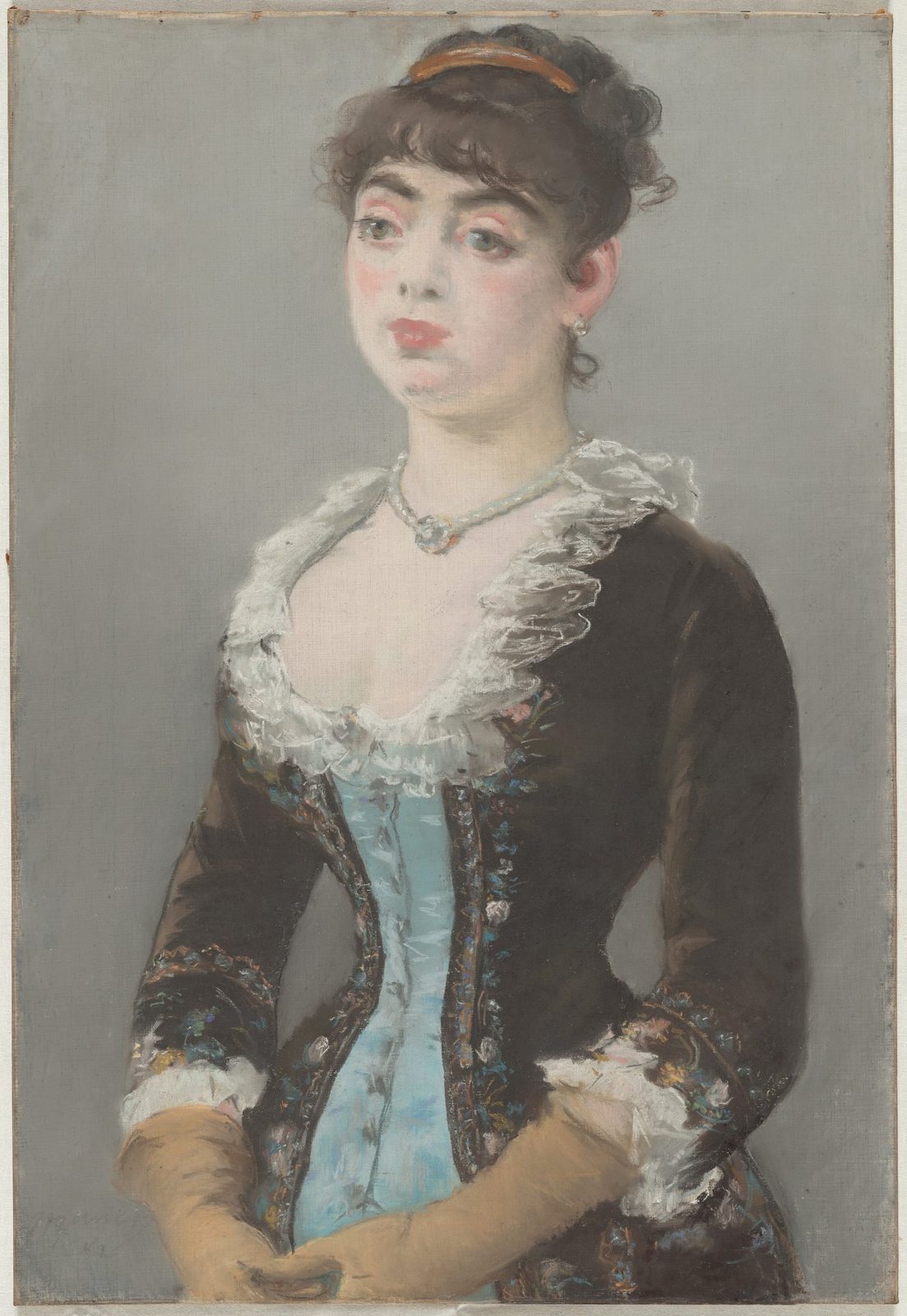
- Artist
- Edouard Manet
- Title
- Madame Michel-Lévy
- Date
- 1882
- Medium
- pastel on canvas
- Image
- Public domain (CC0)
Open in Simple Art
Watch this story on iPhone and iPad, with offline downloads and a painting every day.
About 6 minutes of looking, in 12 parts.
A sitter caught mid-thought
We are looking at a half-length portrait in pastel, and the sitter refuses to look back. Her dark hair is swept up, her hands are folded in her lap, and her gaze is turned firmly off to the side, caught, it seems, in a private thought rather than a posed moment. Manet has left the marks of his hand everywhere; the figure feels momentary, almost unfinished, as though we have interrupted her.
Manet, 1882, pastel on canvas
This is Madame Michel-Lévy, painted by Édouard Manet in 1882, late in his career when he had largely abandoned oil for the speed and softness of pastel on canvas. That medium matters: it lets him leave edges unresolved, keep marks visible, and let the sitter feel like a thought rather than a monument.
A vertical pyramid, eyes at the cross
Step back and the figure reads as a vertical pyramid: broad dark shoulders tapering up to the head, then narrowing again to the clasped hands at the very bottom edge. The face sits almost dead center horizontally, a quiet anchor above the saturated band of the bodice. Follow the center-cross and you will see the focal point resting on the sitter's averted eyes.
Soft frontal light, cool shadow
The light is soft and frontal, falling from the sitter's right, our left, with no hard cast shadows, the diffuse salon light that flatters flesh without dramatizing it. As we drift down to the left cheek and temple, watch the skin cool and desaturate into a soft mauve shadow; the face's roundness is built by that temperature shift, not by any drawn contour.
Averted gaze, blended flesh
Here is the emotional center, the face, built from soft pink and peach pastels with deeper rosy patches on the cheekbones. The eyes are turned up and to the sitter's right, refusing us, and small bright catchlights sit in each iris. The edges around the jaw, temple, and neck are deliberately soft; the warm gray canvas shows through in places, and the unfinished perimeter is what makes the portrait feel alive.
Reserved highlight, positioned pupil
Zoom into the right eye and the economy is startling. The iris is a turquoise note set with darker blue-green and ochre accents, a single crisp white highlight reserved on the upper-left, and crucially, that highlight is bare support rather than added white. The pupil sits high in the iris, and that placement alone tells you where she is looking.
Lace as gesture, not detail
Drop to the neckline and the pastel handling becomes most overt. The white lace frill is not drawn; it is implied by broad, sweeping white and grey strokes laid in scalloped gestures, the canvas weave breaking every mark. No eyelets, no threads, just value notes that read as lace from across the room and break into pure mark-making up close.
A single saturated accent
Below the lace, the turquoise bodice is the color fulcrum of the whole painting, the single saturated note against a palette otherwise built from warms, cools, and near-blacks. The edges against the jacket are crisp and irregular, with small broken bits of turquoise and warm ochre peeking into the dark. It is a beautiful example of resisting the urge to blend boundaries.
Calligraphic color on black
On the jacket trim, short pastel dashes of blue, ochre, rose, and even a touch of mint scatter across the dark ground. Each stroke sits beside its neighbor rather than blending into it, leaving slivers of the black showing through. This calligraphic handling keeps the jacket from feeling heavy; the colored accents animate it like scattered light.
Two ochre planes, three finger marks
The eye finally settles on the clasped hands at the very bottom edge, the warmest passage after the face. Manet reduces them to two broad ochre planes, then finds the interlaced fingers with just a handful of darker brown and terracotta strokes. The cool turquoise of the dress pushes in behind, and that temperature shift does more work describing the form than any outline could.
An edge that dissolves
Before we leave, look at the right shoulder where the jacket meets the background. There is no contour line; the dark mass simply stops short, then bridges the gap with shorter, lighter strokes dragged outward into the untouched grey. This dissolved edge is what gives the figure its momentary, atmospheric quality, the sitter breathing the same air as the wall behind her.
Same warmth, two languages
Now compare the face and the hands. Both are warm, both anchor the eye, but they are built in two completely different languages: the face is blended, modeled, layered, a finished focal point. The hands are abbreviated, two ochre planes with a few linear marks. Manet gives the eye what it needs to rest, and trusts you to complete the rest.
Look closer
11 details, each checked against a close-up of the picture.
-
Face and averted gaze
The sitter's face is modeled with soft pink and peach pastels, her gaze directed upward and to her right with a small highlight visible in each eye.
The crop shows a head-and-shoulders view of a woman rendered in pastel. Her face is built from soft, blended pink and peach tones, with deeper rosy patches on the cheekbones and a warm coral cast around the lower eye sockets. The dark hair is blocked in with broad, hatched strokes of near-black charcoal-brown, broken by the orange-amber band of a headband and loose wisps of curl that soften the hairline. Both irises carry a small bright catchlight, and her pupils are positioned up and to the viewer's left, giving a sidelong, averted glance. Edges are deliberately soft—around the jaw, the temple, and the neck—the pastel sits on a warm gray ground that shows through in the background and in the unfilled passages of the lace collar.
-
Turquoise bodice
The dress front is a saturated turquoise accent, applied with horizontal strokes that remain distinct from the black jacket and white lace.
The central band of turquoise reads as a cool, slightly desaturated cyan-blue (roughly 60–70% value) set between two dark vertical flanks of blackish-brown jacket. Edges along the jacket are kept crisp and irregular, with small broken bits of turquoise and warm ochre peeking into the dark, while the interior of the bodice is built from broad horizontal smudges interrupted by a darker vertical fold running top to bottom. A bright white lace frill sits only at the very top edge of the crop, kept visually separate from the blue by a thin mid-tone transition rather than blended in. A pale grey oval on the left (background seen between arm and waist) reads as the lightest non-lace mass, but its value is still lower than the brightest turquoise highlights, so the blue still advances forward.
-
Lace frill
The white neckline is built from broad, gestural white and grey strokes that leave the canvas weave visible and avoid tight description.
The crop frames the sitter's bare chest meeting a broad, loose treatment of the white lace frill. The pale peach flesh tone in the upper right is read by the canvas weave showing through, with no hard contour separating skin from the white collar below. The frill itself is built from sweeping, broad strokes of opaque white and cool grey laid in scalloped, undulating gestures; no individual threads, eyelets, or pattern motifs are drawn, only value notes. Below the white sit a band of turquoise blue (the dress) and at the lower left a dark passage (the jacket) flecked with tiny touches of orange, pink and green. Edges are intentionally absorbent, with the white bleeding irregularly into the surrounding pink and turquoise.
-
Right eye
The right eye contains a turquoise iris, a dark pupil, and a single unblended white highlight, surrounded by softly blended flesh tones.
The crop centers on a right eye rendered with sketchy, unblended pastel marks over a visible woven support. The iris reads as turquoise with darker blue-green and ochre accents, surrounding a small dark pupil near center; a single crisp white highlight sits on the upper-left of the iris, indicating the implied light source. Flesh tones around the socket are loosely scumbled in pinks, peach, and pale ochre, with a soft reddish smudge at the inner corner and brow, and dark vertical/diagonal flicks describing lashes and a faint brow. Edges of the upper lid are lost into the socket shadow, while the lower lid melts into the cheek without a hard contour.
-
Jacket trim embroidery
The left sleeve trim consists of multicolored pastel dashes—blue, ochre, and rose—laid over the dark ground with minimal blending.
The crop isolates the diagonal lapel and right edge of a black jacket against a grey-blue background. Over the deep umber-black ground, short pastel dashes trace an embroidery motif: a turquoise-cobalt cluster sits at the upper-left edge, ochre and lemon touches punctuate the upper diagonal, while rose-pink, terracotta and small mint-green strokes scatter along the descending right-hand trim. The marks are discrete—each dash sits beside rather than into its neighbour, leaving slivers of dark paper showing between them and producing a crisp, almost beaded read. Edges of the embroidery contour are soft; the trim itself has no hard outline, it is implied by the accumulation of colour against the void of the jacket. A pale triangular wedge on the right reads as a fold or opening revealing a lighter blue-grey interior, framed by the densest concentration of coloured dashes.
-
Shadow on left cheek
The sitter's left cheek and temple show cooler, slightly darker flesh tones that form a soft shadow on the side of the face turned away from the light.
The crop captures the sitter's left eye, temple and upper cheek, with the bridge of the nose and far edge of the right eye creeping in at right. The iris is a cool turquoise over a warm umber pupil, set against a pearly white sclera touched with a small red flourish at the inner canthus. The skin is built from warm pinks and peaches that cool and desaturate as they move toward the left edge, where mauve and grey-violet half-tones form a soft shadow falling away from an implied light at the viewer's left. Diagonal pastel strokes, mostly running from upper-right to lower-left, ride over a slightly scumbled underlayer, and the woven canvas support is visible where the pigment is thinnest.
-
Clasped hands
The gloved hands are simplified into broad, warm ochre planes with only a few darker pastel lines to suggest interlaced fingers.
The crop shows clasped hands rendered as broad, warm ochre planes that read more as volumes than as anatomical detail. The fingers are indicated by just a few darker brown and terracotta pastel strokes at the center where the hands meet, with loose, broken edges rather than firm contours. A soft turquoise blue field (the dress) sits between the two halves of the hands, its edges bleeding into the warm tan of the gloves. The dark jacket above has flecks of white, ochre, and a touch of pink, while a small white lace frill appears at the upper left. Light falls from the viewer's left, leaving the right-hand plane slightly cooler and darker.
-
Mouth
The lips are shaped by warm red strokes with a brighter highlight on the lower lip and no hard contour line separating them from the surrounding skin.
The crop isolates the mouth on a pale, woven support whose tooth reads clearly between and through the strokes. The upper lip is built from a warmer, slightly deeper crimson-pink, while the lower lip carries a brighter, more salmon highlight along its crest; both notes are short, dragged marks that let the canvas weave interrupt them. There is no drawn outline — the red sits directly against the surrounding cool, greyed flesh and the edge is read purely by the temperature/value jump. A faint pink bloom descends onto the chin and a soft warm grey defines the shadow between the lips.
-
Right shoulder silhouette
The right edge of the black jacket dissolves into the grey background with soft, uninflected transitions and no contour line.
The crop shows the right shoulder mass of a black jacket pressing against a cool grey ground. The boundary is not drawn as a line; instead, the dark mass thins through a band of short, hazy strokes that taper off into the grey (x≈0.55–0.75, y≈0.10–0.55), producing a fuzzy dissolve rather than a hard silhouette. Scattered bright specks dot both the dark field and the grey, consistent with dry pastel dust rather than intentional detail. Along the edge the black reads warmer and slightly translucent, with hints of brown showing through where the pigment is thinner, while the interior of the mass is a denser near-black that partially covers the canvas weave. No continuous contour stroke separates jacket from ground; the transition is built from overlapping, broken marks.
-
Hair ornament
An orange-yellow shape at the crown of the head is applied with two or three brisk strokes against the dark hair, its edges left undefined.
The crop isolates a curved orange-yellow band that arcs horizontally across the upper third, sitting within a field of dark grey-black pigment read as hair. The warm shape is laid down as a single broad gesture, with one or two paler cream streaks running along its length where the support or a lighter stroke shows through. The boundary between the orange and the dark mass is not a drawn line but a scumbled transition, with dark strokes overlapping and crossing the upper edge of the orange so the ornament appears embedded in the hair rather than laid on top. Below the band the dark pigment deepens and becomes more uniformly applied, with only faint directional smudges suggesting the sweep of the coiffure.
-
Necklace
A loosely sketched grey-blue strand with a dark pendant lies across the throat, fading where it meets the white lace on either side.
A diaphanous necklace rendered in cool grey-blue and teal traverses the warm pinkish-beige ground, broken into short, dabbed strokes that read as beading without describing individual beads. The strand curves from upper-left toward lower-right, then swings back up to the right edge, dipping into a clustered pendant near the bottom-center where denser, slightly muddier strokes of cool grey, white, and a small rust-orange fleck accumulate. Edges are deliberately soft and broken, with the necklace simply tapering off into raw paper where it meets the white-lace passage on the left and a fainter touch on the right. The warm ground shows through every gap, unifying the cool strand and the warm support rather than letting the jewellery feel tightly drawn.
Madame Michel-Lévy in context
A commissioned pastel
The National Gallery's provenance begins with the sitter herself, named as Madame Lucie Michel-Lévy of Paris, who commissioned the portrait [1]. The museum gives no further details of her life. The work measures 74.2 by 51 centimetres and is drawn in pastel on canvas [1].
The museum's visual description reads some passages differently from a first glance. It sees a powder-blue front to the dress with coffee-brown sides and sleeves, edged with loosely drawn flowers in pink, blue, yellow and green, and long tan gloves reaching back to the cuffs [1]. And it notes a string of pearls, a gold band in her hair and a small curl at the nape of her neck [1].
Pastel in the last years
Wikipedia says the 1975 catalogue by Rouart and Wildenstein lists 89 pastels by Manet, against 430 oil paintings [2]. The Metropolitan Museum's pastel of George Moore, of 1879, was made in a single sitting, and critics mocked it as a drowned man fished out of the water when it was shown in 1880 [3]. Wikipedia adds that Méry Laurent posed for seven pastel portraits in the early 1880s, and that after A Bar at the Folies-Bergère, shown at the Salon of 1882, Manet limited himself to small formats [2].
The National Gallery describes pastel as a fragile medium whose works are seldom shown [4]. This sheet was included in its exhibition The Touch of Color: Pastels at the National Gallery of Art in 2019 to 2020 [1].
Illness and honours
Wikipedia says that in his mid-forties Manet developed severe pain and partial paralysis in his legs, and in 1879 began hydrotherapy near Meudon for what he thought was a circulatory problem; it was in fact locomotor ataxia, a known effect of syphilis [2]. The Metropolitan Museum's essay says that in the summer of 1880 he rented a villa at Bellevue for a cure [5].
In the spring of 1881 he won a second-class medal at the Salon for his portrait of Henri Rochefort, and that autumn he was made a Chevalier of the Legion of Honour [5]. Wikipedia credits pressure from his friend Antonin Proust for the award [2]. Then in April 1883 his left foot was amputated because of gangrene, and he died eleven days later, on 30 April, in Paris [2].
After 1883
Within a year a posthumous exhibition of 179 paintings, pastels, drawings and prints was held at the École des Beaux-Arts [5], and this portrait was number 124 [1]. The museum records that it was sold in 1913 to Paul Rosenberg and then to the collector Gottlieb Friedrich Reber in Lausanne, was with the Galerie Barbazanges in Paris by 1926, and was sold by Étienne Bignou on 5 April 1927 to Chester Dale of New York [1]. It came to the National Gallery with his bequest in 1963 [1].
- Edouard Manet, Madame Michel-Lévy, 1882 (1963.10.161): object record, provenance, exhibition history and bibliography (read via an Internet Archive copy) . National Gallery of Art, Washington
- Édouard Manet . Wikipedia
- Edouard Manet, George Moore (1852-1933), 1879 (object 436953) (read via an Internet Archive copy) . The Metropolitan Museum of Art, New York
- The Touch of Color: Pastels at the National Gallery of Art, exhibition page (read via an Internet Archive copy) . National Gallery of Art, Washington
- Rebecca Rabinow, 'Édouard Manet (1832-1883)', Heilbrunn Timeline of Art History (read via an Internet Archive copy) . The Metropolitan Museum of Art, New York