A grand costume, a tired face
How Rembrandt lets a towering turban and glints of gold frame the real subject, an old man's lined face
- Artist
- Rembrandt van Rijn
- Title
- Man in Oriental Dress
- Date
- 1635
- Museum
- Rijksmuseum
- Image
- Public domain (CC0)
Open in Simple Art
Watch this story on iPhone and iPad, with offline downloads and a painting every day.
About 3 minutes of looking, in 9 parts.
Man in Oriental Dress
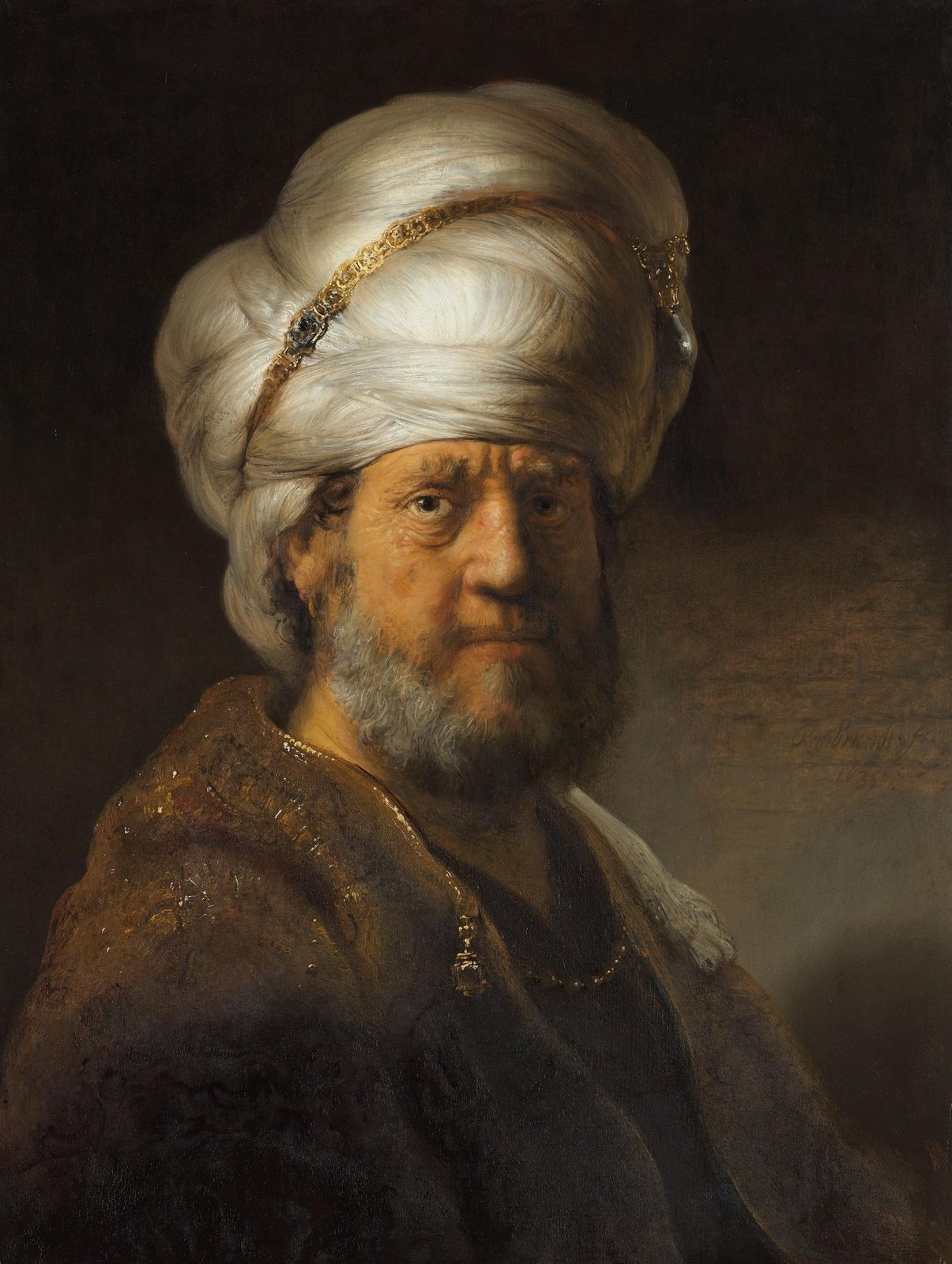
An old man in a towering white turban looks straight back at us. His brow is furrowed and his eyes seem a little tired. The costume is grand, but the longer you look, the more the face takes over.
Rembrandt, 1635, oil on panel
Rembrandt painted this in 1635, in oil on panel. The Rijksmuseum calls it a tronie, a character study rather than a portrait of a named sitter. Pictures of this kind were widely copied at the time.
A triangle with a bright peak
The figure makes a broad triangle. The turban is the peak, and the shoulders spread out towards the bottom corners. Almost everything bright sits in the upper half, so your eye drops from the white cloth straight onto the face.
One light, from the upper left
The light comes from the upper left. It catches his forehead, the bridge of his nose and the cheek nearest us. The far side of the face turns away into shadow, but look how warm that shadow is. It stays brown, never black, so the head still feels round.
Thick white, broken gold
Now the turban. The white looks laid on thickly, in long curving strokes that follow each fold, with thinner, darker paint in the hollows. Across it runs a gold chain with a large pearl. Up close, the gold isn't a line at all, just small broken dabs of yellow and white over brown.
A single point of light
Come down to his eyes. In the eye on our left there's a tiny point of white, probably one of the last touches. It's enough to make the eye look wet and alive. Notice, too, that the upper lid has no hard line, only a soft band of brown shadow.
A drier brush for the beard
The beard is handled quite differently from the skin. The grey hairs look dragged on with a fairly dry brush, so darker paint shows between the strokes. That broken texture reads at once as coarse hair. Just above, there's a warm reddish touch on the lip.
Gold thread, and an edge that melts
On the coat, the trick of the gold chain returns. Small touches of ochre and pale cream sit on dark brown and read as gold thread catching the light. Now follow the coat out to the right. Its edge simply melts into the background, with no outline to stop it.
Rembrandt f.
In the background on the right, he signed it in thin, dark, flowing strokes, Rembrandt f., with the date beneath. You'd hardly notice it unless you went looking. It sits quietly in the brown, a mark to be found rather than shown off.
Look closer
8 details, each checked against a close-up of the picture.
-
The Face
The light creates a strong highlight on the forehead and bridge of the nose, while the side of the face on the viewer's right falls into warm shadow.
The crop isolates the face and upper beard of an elderly bearded man in three-quarter view, with a large white turban filling the top of the frame. Thick impasto, laid in directional dabs that follow the plane of the skull, builds the brightest lights across the upper forehead, the bridge of the nose, and the left cheekbone; the turban behind is constructed from broad, sweeping passes of cool grey-white that curve around its folds. Edges along the lit side are firm but not hard, while the terminator running down the right side of the nose and across the right cheekbone is soft and gradual. The shadow half (viewer's right) is rendered in warm umbers and deep reddish-browns rather than black, so form continues to read through subtle warm-to-cool transitions in the mid-tones. The beard is built from broken, wiry strokes in mixed greys and ochres over a darker ground, with reddish accents on the nostril and lower lip catching the same upper-left light source.
-
Turban Impasto
The ridges of the turban appear to be built with thick white paint that catches the light.
A close crop of a painted white turban crossed by a diagonal gold and jeweled ornament. The white fabric is built from broad, curving brushstrokes that sweep from upper-left toward lower-right, with the raised strokes catching more light than the recessed ones. Visible thick paint sits along the crests of the folds, while the valleys between folds are dragged thinner and read as warm gray-brown. The ornament band is rendered with finer, more intricate dabs of ochre, dark brown, and white pinpoint highlights, contrasting the loose handling of the cloth.
-
The Eyes
A small, bright white point of light sits in the eye on the viewer's left.
The crop isolates the figure's right eye (viewer's left) and the bridge of the nose. A small, crisp white catchlight sits in the upper portion of the dark iris/pupil, slightly off-center toward the inner side. Surrounding the eye, warm ochre flesh is built with broken, scumbled strokes that leave thin lines of darker ground visible in the creases; the upper lid cast-shadow is rendered as a soft umber band rather than a hard line. The lower lid is puffy and warmer, with pinkish vermilion touches in the caruncle and a soft lost edge where it meets the cheek. Highlights along the brow ridge and on the nose are laid in with thicker, lighter impasto that holds a visible ridge against the deeper mid-tones.
-
Gold Ornament and Pearl
The gold band appears to be made of small, broken dabs of yellow and white paint, suggesting shimmering metal.
A diagonal band of gold ornament crosses the upper-left to mid-left, built from small, broken touches of saturated yellow-orange and chalky white that sit on top of a darker brown underlayer; the edges are irregular and granular rather than continuous. To the right, the white pearl or fabric is rendered with broad, sweeping brushstrokes that follow a curved contour, with the brightest cream-white highlight occupying the upper-center and the paint darkening into warm umber and then near-black shadow toward the right edge. A second smaller gold cluster sits at the right margin, again constructed of discrete dot-like dabs of yellow, ochre and white against a dark ground. The transitions from light to dark across the white form are achieved by softening stroke edges and letting the warm-brown mid-value bleed between highlight and shadow.
-
Gold Embroidery on Coat
The embroidery uses a palette of deep ochre and bright yellow highlights against a dark brown background.
A diagonal band of dark brown fabric dominates the crop, crossed by a raised seam running from upper left to lower right. Along this seam and scattered across the field, small dabs of yellow-ochre and pale cream pigment suggest gold thread embroidery catching the light. The background is built from loose, scumbled dark brown and near-black strokes with visible directional drag, while the highlights are applied as thick, discrete touches that stand physically proud of the underlying paint. Edges of the decorative elements are softened by surrounding darker glazes, with a few sharper pale accents at upper left indicating the strongest point of illumination.
-
The Beard
The white hairs of the beard look painted with thin, dry-brush strokes over a darker layer.
The crop centers on the lower lip, chin, and beard, dominated by a mass of curling white-grey hair on the left and a deep brown-black void on the right. The white beard hairs are rendered as thin, broken, slightly translucent strokes that curve down and to the right, with the dark underpainting clearly visible through the gaps between strokes. The skin of the chin glows with warm orange-ochre impasto in the upper left, while the moustache under the nose catches a hot red-pink highlight. Edges between the white strokes and the dark background are crisp yet irregular, with occasional paint flecks and specks of dry pigment sitting proud of the surface.
-
Shoulder Transition
The edge of the coat on the right side blends softly into the dark background without a hard line.
The right side of the shoulder shows a soft, feathering edge where the dark coat loses itself into the deep olive-brown background. There is no crisp contour; instead, the dark paint thins and scumbles outward in short, broken strokes that share value with the surrounding ground. The lighter diagonal band running upper-left to center is built of warm gray-brown impasto with looser, dragging marks at its lower edge, suggesting a fur or fabric turn. Two or three tiny pale touches (likely button highlights) sit in the lower left, isolated against the very dark coat. The rightmost passage is nearly monochrome, a low-contrast blur of umber and bone-black.
-
Artist's Signature
The text 'Rembrandt f.' is visible as dark, thin strokes integrated into the background glaze.
The crop shows a cursive signature reading 'Rembrandt f.' rendered in thin, dark, slightly translucent strokes across a mottled warm-brown ground. The letters are formed with single fluid passes — tapered entry, swelling mid-stroke, and a lifted exit — sitting on top of (rather than being absorbed by) the surrounding paint. Below the word, a fainter line of numerals gives the date 1635, applied in the same dark medium. The background is a variegated field of umber-to-raw-sienna tones with horizontal drag-marks and subtle scumbling, so the signature reads by value contrast against the lighter passages rather than by line weight alone.
Man in Oriental Dress in context
New in Amsterdam
In 1635 Rembrandt was still fairly new to Amsterdam, where he'd worked since 1632 [4]. The Rijksmuseum says that after moving there in the early 1630s he became the city's leading portraitist almost overnight [7]. The dealer Hendrick Uylenburgh helped him win commissions, and in 1634 Rembrandt married Uylenburgh's cousin Saskia [4]. Wikipedia adds that the couple rented a fashionable lodging overlooking the Amstel in 1635, and that his pupils by then included Ferdinand Bol and Govert Flinck [5].
Heads for the open market
The panel isn't a portrait of a named sitter but a tronie, or character head [1]. The Rijksmuseum says such heads were extremely popular in the 17th century, were widely copied and imitated early on, and were known as 'Turkish tronies' [1]. Wikipedia describes tronies as studies of a type or expression, such as an old man or an 'Oriental', usually sold on the open market rather than ordered by the person shown [6].
There was a wider fashion behind them. Writing about Rembrandt's much larger Man in a Turban of 1632, The Met notes that imaginary Persian or Ottoman princes were popular partly because new Dutch trade with the Middle East brought international visitors to Amsterdam [3]. It adds that the model for that picture may well have been a Dutchman [3].
Rembrandt or his workshop?
The attribution has moved back and forth. RKD says the painting was always regarded as Rembrandt's own until the Rembrandt Research Project doubted it in 1989 and classed it as a workshop product [2]. Sumowski gave it to Govert Flinck, a view others did not follow; in 1997 it was reattributed to Rembrandt or his workshop; and the final Corpus volume of 2015 lists it as Rembrandt [2]. RKD currently records it as attributed to Rembrandt or his studio, while the Rijksmuseum catalogues it simply as Rembrandt [1][2].
Technical study offers some clues. According to RKD, the oak panel came from the same tree as panels used for a landscape in Braunschweig and for self-portraits in Berlin and in the Wallace Collection in London [2]. Handwriting experts judged the signature probably authentic [2].
From Ketelaar to Kapelle-op-den-Bos
The early history is patchy. An 18th-century mezzotint by Pieter Louw records the original in the collection of a Mr Ketelaar in Amsterdam, probably Huijbert Ketelaar [1][2]. The painting was first recorded with the Vane family at Raby Castle near Darlington in 1857, and it passed by descent to Christopher William Vane, 1st Baron Barnard [1].
At his sale in London on 30 March 1922, the dealer De Bruin bought it for 6,200 guineas on behalf of Dominicus Kessler and his wife, A.C.M.H. Kessler-Hülsmann, of Kapelle op den Bosch near Mechelen [1]. RKD notes that the price comes from an annotation in a copy of the sale catalogue [2]. In 1940 Mrs Kessler-Hülsmann gave it to the Rijksmuseum with 83 other objects [1].
Travels and imitators
Since then it's travelled widely in Rijksmuseum loan exhibitions, including shows in Adelaide in 1998, Phoenix and Portland in 2007, Vancouver in 2009 and Paris in 2009-10 [2]. Liedtke observed that most Rembrandt-like paintings not by Rembrandt date from his own lifetime, a sign of how widely his manner appealed, above all in Amsterdam [4]. The Rijksmuseum's remark that tronies like this one were copied early on fits that picture [1].
- Man in Oriental Dress (SK-A-3340): object record and provenance . Rijksmuseum, Amsterdam
- Bust of a man in oriental dress, dated 1635 (RKDimages 36699) . RKD – Netherlands Institute for Art History
- Rembrandt, Man in a Turban, 1632 (20.155.2) . The Metropolitan Museum of Art
- Rembrandt (1606–1669): Paintings, Heilbrunn Timeline of Art History (Walter Liedtke, 2003) . The Metropolitan Museum of Art
- Rembrandt . Wikipedia
- Tronie . Wikipedia
- Rembrandt van Rijn: Rebel with a cause (Dutch Masters series) . Rijksmuseum, Amsterdam