The river comes to meet you
How Ruisdael fills a tall canvas with falling water and lets two castles keep watch over the valley
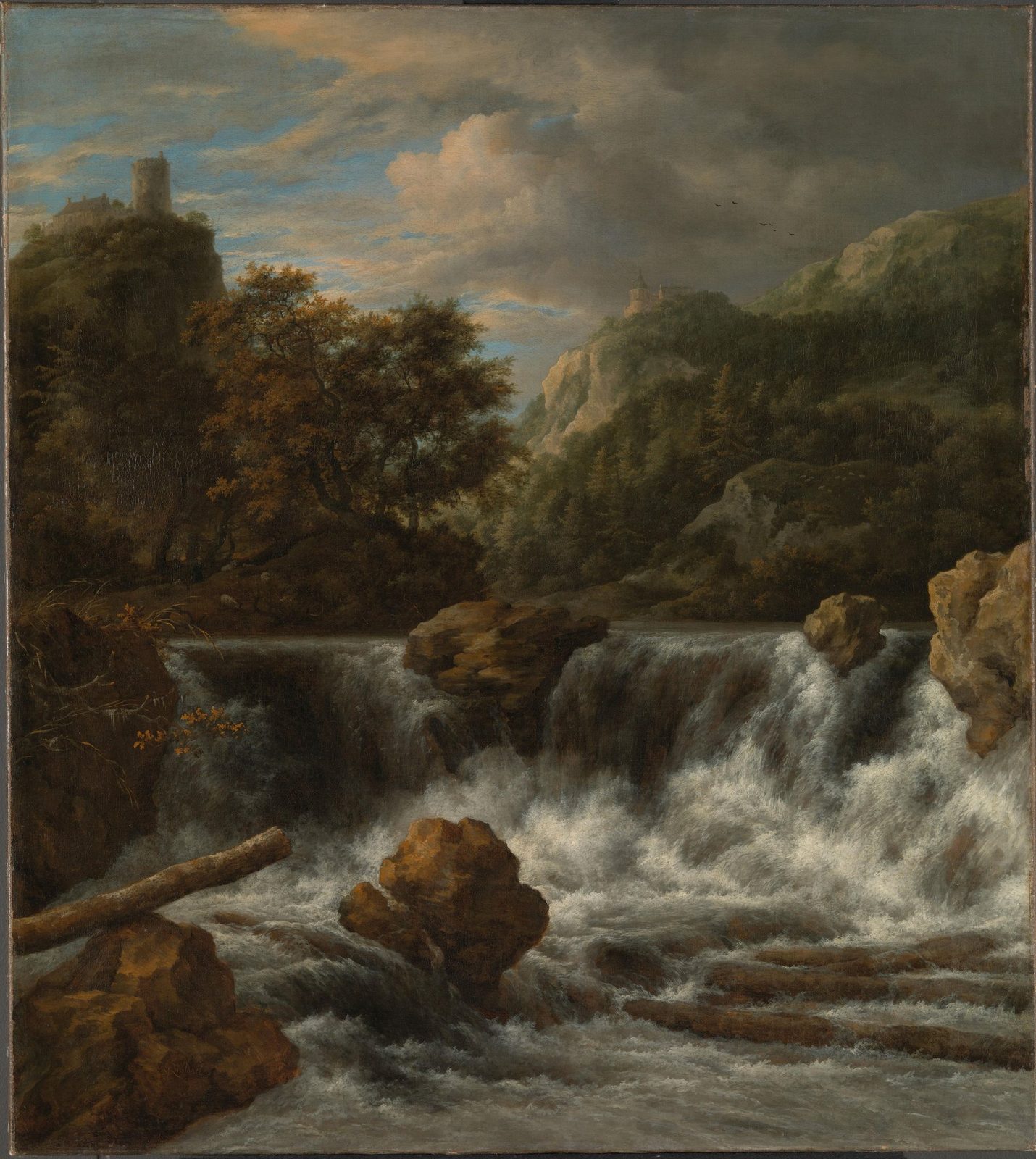
- Artist
- Jacob Isaacksz van Ruisdael
- Title
- Mountainous Landscape with Waterfall
- Date
- 1650 - 1682
- Museum
- Rijksmuseum
- Image
- Public domain (CC0)
Open in Simple Art
Watch this story on iPhone and iPad, with offline downloads and a painting every day.
About 4 minutes of looking, in 9 parts.
Water coming towards you
This water is coming straight at you. The river spills over a broad ledge that spans almost the whole picture, then breaks into foam in the foreground, round rocks and a fallen trunk. There's very little dry ground down here, only a few stones.
Two mountains, two castles
This is Mountainous Landscape with Waterfall by Jacob Isaacksz van Ruisdael, oil on canvas, a little over a metre high. The Rijksmuseum dates it only broadly, between 1650 and 1682. It describes a waterfall between rocks and tree trunks, and a river running through a valley between two mountains, each topped by a castle.
A valley stacked upwards
The canvas is taller than it is wide, and the picture is stacked to suit it. Foam fills the bottom, dark woods and rock the middle, and the hills slope in from both sides towards a gap in the valley. Your eye climbs from the water, through that gap, into the sky.
Warm light from the upper left
The light comes from the upper left. Here the sunlit face of the big cloud turns cream and soft peach against a greyish blue. That warmth is rare in this picture, and it probably helps the white water below look cold and bright by comparison.
The first castle
High on the left is the first castle, a round tower and a lower building on a wooded hill. The masonry is built from short, controlled dark strokes, with a thin warm line down the left of the tower where the light catches it. Against the soft clouds, those firm marks make it feel solid.
The second, further off
Across the valley sits the second castle, paler and much smaller. It's set down with very thin, light touches and seems to sink into the haze. Compare it with the first. The drop in darkness and sharpness is what tells you how far away it is.
Raised white on the crests
Now the falls. The brightest whites sit on the crests, in short curving strokes that follow the roll of the water, and they look thickly loaded, standing up from the greys beneath. The deepest dark is tucked under the lip of the ledge, which makes the foam above it look brighter still.
A trunk across the current
At the lower left, a fallen trunk lies across the current. It reads first as a simple shape, light along the top and dark underneath. A few dry, broken strokes along its upper edge suggest bark, while the foam around it stays soft and swirling.
The water spreads out
Down at the bottom right, the water changes character. Instead of curving crests, the strokes sweep sideways in white and grey over a dark brown underlayer, as if the current were spreading out. Some of the long dark bands may be more trunks lying in the stream.
Look closer
9 details, each checked against a close-up of the picture.
-
Main Waterfall Crest
Thick white impasto paint creates high-contrast highlights on the churning water.
The crop centers on a broad, diagonal cascade of water crashing between two warm-brown rock masses. Heavy, raised white paint marks the crests and foam lines, built up in short, curving strokes that follow the rolling motion of the torrent. Beneath the white, mid-value greys and cool browns describe the body of the falling water, with the deepest darks tucked into the recess under the upper lip of the falls at roughly u≈0.20, v≈0.35. The edges where foam meets rock are mostly soft and broken, while the silhouette of the upper crest against the dark distant landscape is comparatively crisp. Highlights cluster on the right-hand wave where light from the upper-left sky grazes the swelling water.
-
Hilltop Castle
The castle architecture is rendered with fine, linear brushstrokes against the soft clouds.
A cylindrical stone tower rises from a wooded hilltop, flanked by a lower building to the left. The architecture is built from short, controlled vertical and slightly diagonal strokes in dark sepia-brown, with a thin warmer ochre highlight along the left edge of the tower's cylinder where light strikes it. The tower's right edge reads as a soft but legible contour against a pale cream-pink cumulus bank, while its left edge dissolves more into the building mass and tree silhouette. Below, foliage is massed in dense, broken dabs of dark olive, umber, and near-black, with a small cluster of golden-ochre autumn leaves in the lower right set as warm accents against the cool blue sky. The sky itself transitions from warm cream at upper left to greyed blue at right, painted with soft, horizontal scumbled strokes that contrast with the firmer linear touches on the masonry. Fine craquelure runs across the whole surface, slightly more visible in the thinner sky passages than in the thick darks of the hill.
-
Foreground Fallen Log
The bark of the log is rendered with a series of dry, textured brown strokes.
A diagonal fallen log dominates the crop, running from the lower-left toward the upper-right, rendered in warm browns and ochres with a roughened, scumbled surface. Its upper edge catches a thin line of lighter tan, while the underside and lower half sit in deep umber shadow, creating a clear dark/light axis. The water around the log is built from broad, swirling strokes of off-white, pale grey, and blue-grey, with feathered, soft edges that contrast against the harder, more linear treatment of the bark. Warm rust-orange rock forms break the foam at the right edge and bottom-center, glazed over a darker ground so the underlying tone shows through.
-
Cloud Light Transition
Warm cream and ochre tones blend into a cool blue sky.
The crop centers on a luminous cumulus cloud mass whose sunlit face reads as pale cream and soft peach, set against a muted, slightly greyish blue sky. The right flank of the cloud dissolves into deeper olive-brown shadows that grade toward a near-neutral warm grey at the right edge. Cloud edges are not hard: the lit side feathers into the blue through soft, broken transitions, while the shadowed underside shows cooler, greenish tints. A pervasive craquelure network runs across all passages, confirming a single aged oil film. At the very bottom, a sliver of distant foliage in muted ochre-greens and a small architectural fragment anchor the sky to the landscape.
-
Distant Tower
A small, pale building is barely visible on the far ridge line.
The crop is dominated by a dense mass of dark wooded slopes in the lower two-thirds, built up with short vertical strokes of near-black, olive, and dark umber that read as tree trunks against foliage. In the upper third, a soft warm-grey sky carries a thin haze, and along the ridgeline at roughly u≈0.30 a small pale tower with a faintly pointed cap is visible; a second, even fainter pale block sits a little to the right at u≈0.45, almost absorbed into the mist. A bright luminous streak runs up the lower-left edge — the edge of the cascade catching the upper-left illumination. Craquelure is pronounced across the whole surface, with a denser web in the dark passages than in the sky.
-
Rock Shadow Transition
Deep umber shadows contrast sharply with a sliver of sunlit rock edge.
A bulbous rock mass sits centrally, its upper-left rim catching warm ochre light while its main face falls into a dense umber shadow that reads almost black in the deepest pocket near the lower center. The rock's right contour dissolves softly into pale gray mist, with no hard silhouette, whereas the sunlit upper edge shows broken, scumbled paint where warm orange-amber laps over cooler shadow tones. Surrounding cloud forms are blended wet-into-wet with soft transitions, while the lower right carries brighter, more fluid white highlights suggesting spray or thin scumbled whites over the brown. Fine craquelure is visible across the entire surface, confirming an aged oil film rather than any smooth modern handling.
-
Water-Rock Interface
Soft, feathered brushstrokes blend the white spray into the dark rock face.
The crop shows a turbulent water-rock interface where a vertical slab of warm ochre-brown rock on the right meets a churning cascade of white and grey water. The water is built from short, broken, feathery strokes that radiate outward and downward, with the brightest highlights reserved for the central thrust of the current and the foaming edges. Where spray meets stone, the white marks lose opacity, allowing the warm underpainting to bleed through and creating a soft, indeterminate edge rather than a hard line. The rock face itself carries broader, drier strokes layered over a darker brown ground, with thin scumbles of lighter ochre sitting on top. Deep umber crevices in the lower right anchor the composition and give the foam its sparkle by contrast.
-
Foreground Torrent
Horizontal, sweeping strokes of white and grey define the rushing current.
The crop reveals a churning torrent rendered with predominantly horizontal, sweeping brushstrokes. White and pale grey foam marks sit atop a dark, brown-olive underlayer, with the lighter strokes dragged laterally to suggest lateral water flow. Edges are soft and broken: the foam dissolves into the darker water in feathered transitions rather than hard contours. Layering is visible where warmer rust-brown patches peek through the cooler grey-green wash, and fine craquelure crisscrosses the surface, indicating aged oil paint.
-
Sky Birds
Small, dark V-shaped marks are placed in the sky to represent distant birds.
The crop is dominated by a muted, greenish-brown atmospheric sky with subtle tonal variation rather than crisp clouds. Scattered across the upper half are roughly seven small dark marks, each only a few pixels wide, shaped as shallow V's or check-marks with a slight forward lean — they read unambiguously as distant birds. The sky surface shows fine craquelure consistent with aged oil paint on canvas, and a narrow strip of treetops and a faint pale spire/tower occupies the bottom edge.
Mountainous Landscape with Waterfall in context
What the museum records
The Rijksmuseum describes a mountain landscape with a waterfall between rocks and tree trunks, and a river running through a valley between two mountains topped by castles [1]. This upright canvas measures 111 by 99 centimetres and is signed 'JVRuisdael' [1]. The museum bought it in 1818 and dates it only to 1650-1682 [1]. Its documentation lists it in Groots en meeslepend, a book on sublime landscapes of the Dutch Romantic period [1].
Scenery he never saw
Ruisdael's mountains and torrents were not drawn from his own travels. The National Gallery in London notes that it was once assumed he must have visited a mountainous country, but that no record of such a journey exists [2]. His friend Allart van Everdingen had been to Scandinavia in 1644 and came back with drawings of crags and waterfalls [2]. Slive put it plainly: Ruisdael's vision of these places was based on art, not nature, and Everdingen was the painter who introduced and popularised northern landscapes in Holland [6].
The National Gallery links the change in Ruisdael's work to his move from Haarlem to Amsterdam and his meeting with Everdingen there [3]. The two men are documented together in 1661, when both gave evidence before an Amsterdam notary about a disputed painting [7]. And the Rijksmuseum owns an Everdingen of this type, an upright Swedish landscape with a waterfall measuring 105 by 89 centimetres [5].
A market for waterfalls
The National Gallery dates Ruisdael's waterfalls from the late 1650s onwards, and Slive placed their start in the late 1650s and early 1660s [8][7]. Slive saw a rehearsal for them in a water-mill picture of 1653, among his first convincing attempts at a torrent and white foam [7].
Waterfalls form the largest category of his work, which Slive explained as an attempt to profit from the fashion Everdingen had started [6]. Judging by the high valuations of his own time, they were collectors' favourites. They stayed highly prized until the nineteenth century, when taste shifted towards his dunes, winter scenes and skies [6].
A family of compositions
A close relative is the National Gallery's Landscape with a Waterfall and a Castle on a Hill, an upright canvas of 101 by 86 centimetres dated probably 1660-70 [4]. It too pairs a cascade with a half-hidden castle, a distant church tower and tiny figures. The gallery notes the short, varied brushstrokes used for the turbulent water [4].
The Rijksmuseum hasn't narrowed its own date. Ruisdael virtually stopped dating his paintings after 1653, so the date of a picture like this has to be estimated by other means [7]. If the London comparison holds, a date in the 1660s would be plausible, but that's an inference rather than the museum's position [1][4][7].
- Jacob Isaacksz van Ruisdael, Mountainous Landscape with Waterfall (SK-A-348): collection page and object data . Rijksmuseum, Amsterdam
- Jacob van Ruisdael, A Waterfall in a Rocky Landscape (NG627) . The National Gallery, London
- Jacob van Ruisdael, A Waterfall at the Foot of a Hill, near a Village (NG855) . The National Gallery, London
- Jacob van Ruisdael, A Landscape with a Waterfall and a Castle on a Hill (NG737) . The National Gallery, London
- Allaert van Everdingen, Swedish Landscape with a Waterfall (SK-A-107): collection page . Rijksmuseum, Amsterdam
- Seymour Slive, 'An old master comes into his own', Harvard Magazine 84, no. 3 (January-February 1982), pp. 26-30 . Harvard Magazine
- Seymour Slive, Jacob van Ruisdael: Windmills and Water Mills (Los Angeles: J. Paul Getty Museum, 2011), free PDF edition (archived copy) . J. Paul Getty Museum, via Internet Archive
- Jacob van Ruisdael (1628/9? - 1682): artist biography . The National Gallery, London