The singer in the light
How the young Rembrandt lights a crowded room one face at a time.
- Artist
- Rembrandt van Rijn
- Title
- Musical Company
- Date
- 1626
- Museum
- Rijksmuseum
- Image
- Public domain (CC0)
Open in Simple Art
Watch this story on iPhone and iPad, with offline downloads and a painting every day.
About 4 minutes of looking, in 9 parts.
Musical Company
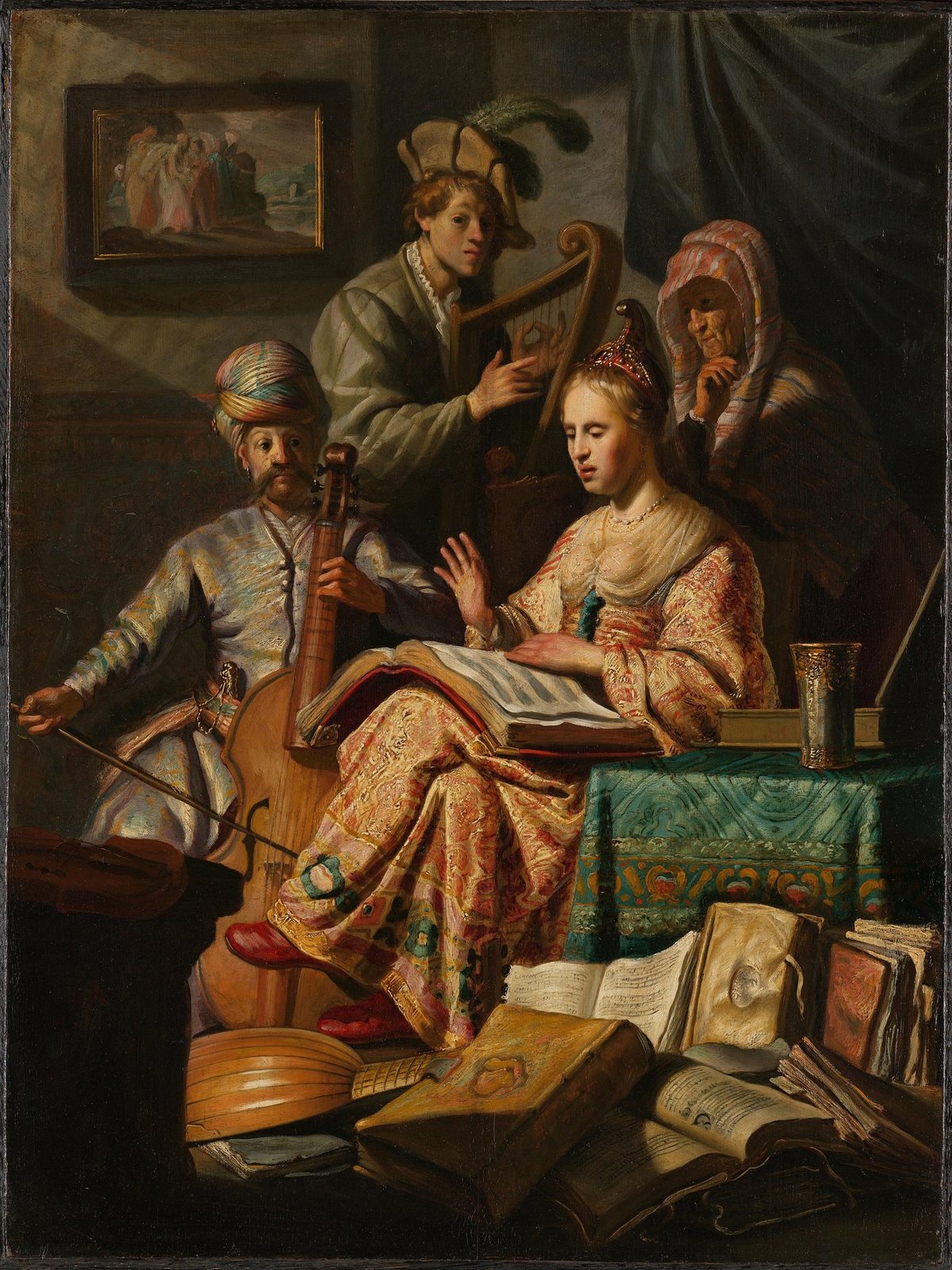
Four people have crowded into a dark room to make music. An old man in a turban bows a viol, a young man in a plumed hat plays a harp, and a young woman in a gold gown sings from an open book. On the right, an old woman simply watches.
Rembrandt, 1626, oil on panel
Rembrandt painted this in 1626, in oil on panel. The Rijksmuseum notes that his mother sat for the old woman, and that his own features can be seen in the young harpist. The meaning is less certain: perhaps a call to praise God through music, or a seduction, with the old woman as go-between.
A pyramid of players
The group makes a rough pyramid. The singer sits at its centre, the harpist and the man in the turban form the left slope, and the old woman closes it on the right. Below them, books, music and a lute case spill across the foreground. The picture on the back wall shows Lot fleeing from Sodom.
Where the light lands
The light comes from the upper left and falls hardest on the singer. Look at her forehead, the bridge of her nose and the pale chemise between her laces. Just below, the open music on her lap is one of the brightest things in the picture. Around her, the shadows go almost black.
The harpist's lit cheek
Now the harpist. The same light catches his brow, his cheekbone, his nose and his lower lip, and the paint there looks thick and creamy. The other side of his face slips into a cooler, greenish shadow. The lit edge of the cheek stays crisp, while his jaw fades into the dark coat.
A turban in bands of colour
Behind him, the old musician's turban winds round his head in bands of cream, teal, gold and rust. Each band seems to follow the curve of the cloth in a single stroke, and the colours blur a little where they meet. The underside sinks into brown-green shadow, which is what makes it look round.
Gold only where the light falls
Back to the singer's gown. The gold pattern seems to be dabbed on in thick touches of ochre and pale yellow over a red-orange layer. Follow a fold: the bright dabs gather on the lit ridges, while the creases turn crimson, almost maroon. The pattern shows mostly where the light catches it.
The watcher on the right
On the right, the old woman leans out of her striped hood. Her face is warm and ruddy, with the brightest touches on her nose, cheekbone and brow. Her eyes sink almost entirely into shadow, suggested with only a few dark strokes, and short hatched marks give the wrinkles round her mouth.
Cool green against the gold
The teal-green cloth is the one large cool note against all that warmth. Its band of gold scrollwork looks raised and is dotted with red. Below it, the books look well used, with worn spines, frayed page edges and an emblem on one cover.
Look closer
8 details, each checked against a close-up of the picture.
-
Central Figure
The light is brightest on the woman's forehead, chest, and the open sheet music.
The crop centers on the young singer, whose face and upper chest catch the strongest illumination; the highlight sits squarely on her forehead, the bridge of her nose, and the cream chemise exposed between her gown's laces. Below, the open sheet music on her lap registers as the highest-value passage in the crop, with near-white paper notes held against the warmer mid-tones of the gold brocade. The gold-patterned gown is built from many small dabbed touches of red, ochre, and cream over a darker ground, while the teal cushion/tablecloth at lower right is rendered with broader, flatter strokes. The right hand, raised with fingers fanned, is painted with loaded, slightly broken edges that read against the dark background, and a shadowed cast runs beneath her jaw onto the neck.
-
Brocade Gown
The gold pattern on the gown is made of circular and teardrop-shaped motifs dabbed in ochre and pale yellow over a red-orange layer.
The crop isolates a section of the brocade gown where diagonal folds sweep from upper right to lower left, creating alternating bands of highlight and shadow. The gold ornament is built up in thick, impastoed dabs of ochre and pale yellow laid over a warmer red-orange ground, with circular and teardrop/paisley motifs defined more by the high points of paint than by drawn lines. The deepest creases read as a saturated crimson that turns almost maroon in the recesses, while the raised ridges of the folds catch cream and pale ochre highlights. A teal circular rosette near the left margin (around 0.18, 0.62) and a darker teal ornament lower down (around 0.45, 0.75) punctuate the warm palette. Edges range from soft and feathered where the gold melts into shadow to crisp where a fold's lit crest meets a dark valley; the foreground red slipper and the open music book at lower right are rendered with thinner, more fluid strokes than the gown's heavy brocade work.
-
Harpist's Face
Strong highlight hits the right side of the face and the crest of the plumed hat.
The crop isolates a youthful, slightly flushed face beneath a tall soft-brimmed hat with a dark greenish plume curling from the upper right. A warm, raking highlight from the upper left strikes the right temple, cheekbone, bridge of the nose, and the ridge of the lower lip, while the left half of the face drops into a cooler, greenish-brown half-tone. The white linen ruffle catches the same key light with quick, broken highlights against deep grey-olive shadows. Below, the wooden harp frame and the plucking hand carry matching warm ochres, the fingertips modeled with bright flesh strokes against the dark strings. Visible impasto sits on the lit cheek and brow; thinner, more transparent scumbling describes the shadow side and the background wall.
-
Old Woman's Face
The woman's face is heavily lined with deep wrinkles and shadowed eyes, framed by a striped hood.
A tightly cropped portrait fragment of an elderly face emerging from a striped hood, with a hand resting near the chin. The face is built from warm, ruddy flesh tones (ochre, terracotta, raw umber) that sit against the dark background, with thick impasto highlights catching light on the bridge of the nose, the cheekbone, and the brow ridge. The eyes are deeply recessed and almost lost in shadow - the lids are described with just a few dark, blended strokes rather than crisp outlines. Wrinkles are indicated by short, hatched brushstrokes that follow the directional pull of aging skin, especially around the mouth and the outer eye corner. The hood's stripes are laid in with broad, confident parallel strokes in white, red, and ochre, with the strokes bending to follow the volume of the head. Edges between face and hood are softened, while the silhouette of the hood against the background is comparatively crisp.
-
Green Tablecloth
The tablecloth features a deep teal-green base with gold-yellow embroidery.
The crop centers on a draped teal-green tablecloth covering a rectangular form, with a horizontal decorative band of gold-yellow scrollwork running across its middle. The cloth's folds are suggested by broad sweeping strokes that shift from dark greenish-black in the recesses to lighter turquoise where the upper-left light grazes the surface. The gold ornament consists of thick, C-shaped and comma-like curl motifs punctuated by small red dots, painted with visibly raised impasto that catches the light. Edges of the tablecloth are soft and slightly lost against adjacent objects, while the inner edges of the embroidery curls are sharp where highlights meet shadow.
-
Foreground Books
The books show worn leather spines, frayed page edges, and a visible emblem on one cover.
The crop centers on a stack of foreground books rendered in heavy impasto against a deeply shadowed base. A large closed volume with golden-ochre leather dominates the lower center, its surface showing broad scumbling strokes that skip across a recessed oval emblem near the spine. Above it, an open book displays sheet music with thin, repeated horizontal hatching for staves and rapid vertical ticks for notes, the right-hand page catching raking light. Book edges are softened with wet-into-wet blending, while the gilt-stamped leather upper right shows a raised, dabbed highlight that reads as gesso or thick lead-white. Page edges along the open volumes are broken with short, choppy strokes of cool cream against the warm leather, suggesting fraying. Layered behind, a reddish-brown book stack and a turquoise textile with floral motifs are described in looser, more summary strokes, receding in value and detail.
-
Turban Details
The turban is composed of folded fabric with alternating bands of cream, blue, and gold.
The crop centers on a towering wrapped turban over the head of a mustachioed elder, with the face emerging beneath heavy brow shadow. The headwrap is built from layered, diagonal impasto strokes that curve around the skull, suggesting bands of cloth wound in a spiral rather than painted as separate stripes. Reading the bands from upper left to lower right: a pale cream zone at the top, a teal-blue middle, a warm gold/ochre ridge, and a rust-red band where the fabric meets the forehead. Edges between colors are left wet-into-wet and feathered, so the bands blend slightly at their seams rather than meeting as hard boundaries. Light rakes from the upper left, leaving the right and underside of the turban in a deep brown-green shadow that anchors the volume against the dark interior.
-
Lute
The lute lying in the bottom left shows its curved ribs and a polished surface highlight.
The cropped region centres on the ribbed wooden back of a lute whose convex flank is articulated by roughly eight thin, dark, sinuous lines that describe the grain following the object's curvature from upper left to lower right. A broad, soft-edged highlight of warm cream sits between two of these grain lines about mid-body, reading as the raking light glancing off a polished varnish. The lute rests on a cool grey-blue shape (a book or folded sheet) whose upper edge shows a thin, paler ridge, while thick, loose impasto dabs of ochre and cream define the page edges below. Deep umber shadows pool at the lower right and along the left margin, throwing the warm mid-tones forward, and a sliver of red drapery intrudes in the upper right corner.
Musical Company in context
Back home in Leiden
Rembrandt was born in Leiden on 15 July 1606, the ninth child of a miller [5]. After the Latin School he spent about three years from 1620 with the Leiden painter Jacob van Swanenburgh, then went to Amsterdam in 1624 or 1625 for six months with Pieter Lastman [2]. The Leiden Collection's essay calls Lastman the most important history painter in Amsterdam at the time [2].
He returned to Leiden in 1625 and set up as an independent master [2]. Musical Company is signed and dated 'RH 1626' [1]. Wikipedia reads this early monogram as standing for Rembrant Harmenszoon [5]. Museum De Lakenhal sees in it a young painter who was already technically ambitious, trying out different techniques, colours, effects of light and subjects [3].
Learning through rivalry
Lastman seems to have taught by emulation, not just imitation. In 1626 Rembrandt reworked Lastman's Balaam and the Ass of 1622, an example of trying to outdo a model rather than copy it [2].
Back in Leiden there was a rival close at hand. Jan Lievens, born in 1607, had set up his own studio in 1619 at the age of twelve [2]. From the mid-1620s until about 1632 the two worked unusually closely, often painting the same subject [2]. Wikipedia states plainly that they shared a studio from 1625, but H. Perry Chapman's essay for the Leiden Collection calls the shared studio an assumption, "undocumented but plausible" [2][5]. One link between them is visible here: according to De Lakenhal, the old woman in the striped headscarf turns up again in a painting by Lievens in its collection [3].
Who posed?
Accounts of the models differ. The Rijksmuseum says Rembrandt's mother posed for the old woman and that his own features can be recognised in the young man [1]. De Lakenhal reports a traditional identification of the four as possibly his sister Lysbeth, his brother Adriaan, his mother and Jan Lievens, who would be the standing man with the harp [3]. Chapman also writes that Rembrandt appears to have painted Lievens in this picture [2].
De Lakenhal adds a reading of the still life: the worn books and the lute in the foreground, it suggests, stand for the passing nature of earthly pastimes [3].
Dealers, a dictator and a return
The early history is patchy. The Rijksmuseum tentatively links the panel to a London sale of William Pole-Tylney-Long-Wellesley's collection in June 1822, where a 'Musical Party' was described as painted with Rembrandt's "usual powerful effect of chiaro scuro" and sold for £9 9s [1]. A label on the back shows it was then cleaned in Edinburgh by Chalmers & son, who traded from the addresses on the label between 1823 and 1825 [1].
In 1936 it sold at Christie's in London for 2,205 guineas to the dealer Edward Speelman [1]. By 1937 it was with the dealers Benjamin and Nathan Katz of Dieren, whose American agent showed it at the Los Angeles Museum in April 1938 [1]. On 2 August 1940 the dealer Alois Miedl bought it from the Katz brothers, and it passed for 85,000 guilders to Maria Almas-Dietrich for Hitler's planned Führermuseum in Linz [1].
After the war it was recovered, and in 1947, in the Rijksmuseum's own words, "unjustly returned" to the Katz dealers [1]. It sold in Paris in 1951 for 7,800,000 francs [1]. In 1976 the Rijksmuseum acquired it for 648,000 guilders, paid for with support from the Vereniging Rembrandt and other funds [1][4]. The two records name the seller differently: the museum gives Art Gallery A.G. in Zug, while the Vereniging Rembrandt lists the dealer E. Speelman, Zug [1][4].
A loan to Leiden
Museum De Lakenhal, in Rembrandt's home town, tried to buy the panel in the 1930s but couldn't meet the asking price [3]. It was shown there briefly in the exhibition 'De Jonge Rembrandt - Rising Star', from December 2019 to February 2020 [3]. Since April 2021 the Rijksmuseum has lent it to De Lakenhal on a long-term basis, and the museum's page says it will be on view there for some years [3].
- Musical Company (SK-A-4674): object record and provenance . Rijksmuseum, Amsterdam
- Rembrandt and The Leiden Collection (H. Perry Chapman, 2017) . The Leiden Collection
- Rembrandts schilderij 'Musicerend gezelschap' in Museum De Lakenhal . Museum De Lakenhal, Leiden
- Allegorisch musicerend gezelschap . Vereniging Rembrandt
- Rembrandt . Wikipedia