The horse is white because the paper is
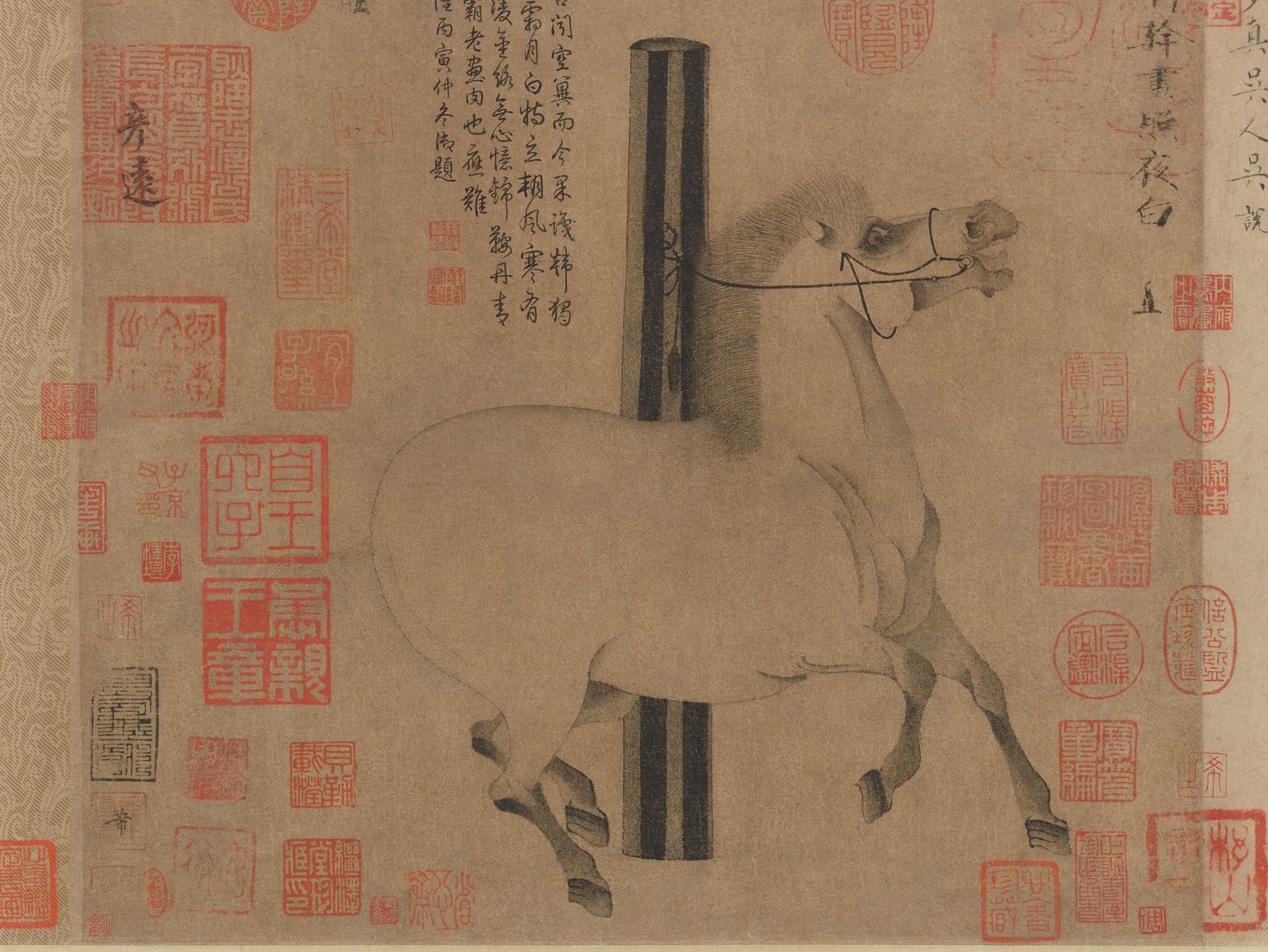
Han Gan draws a line, adds almost nothing, and lets the untouched sheet be the coat
- Artist
- Han Gan
- Title
- Night-Shining White
- Date
- ca. 750
- Medium
- Handscroll; ink on paper
- Image
- Public domain (CC0)
Open in Simple Art
Watch this story on iPhone and iPad, with offline downloads and a painting every day. This one is free in the app.
About 4 minutes of looking, in 10 parts.
Night-Shining White
The emperor's favourite horse, straining against its tether. There is no ground, no sky, no setting, and not a touch of white paint anywhere in it. The horse is white because the paper is.
Han Gan, about 750
Painted in ink on paper around the year 750, in the Tang dynasty. The horse was a real animal, a charger belonging to the Emperor Xuanzong, and its name was Night-Shining White. Not everyone approved. The poet Du Fu, praising Han Gan's teacher, wrote that Han Gan painted only the flesh and not the bone.
A post at dead centre
The design is blunt. A vertical post almost exactly at the centre of the sheet, and the horse straddling it, body to the left, head thrown up to the right. The left third is packed with red seals and writing that arrived centuries later.
The coat is the sheet
This is the lesson of the whole scroll. The barrel of the horse is untouched paper; you can read the fibre and the warm tone of the sheet straight through the animal. There is one contour line, so fine and so even it must have been drawn in a single breath, and a faint wash near the belly, and that is all.
Where all the ink went
Every mark you could call detail is in this one place. The eye rolls, showing white above the pupil, and that is what makes the horse look alarmed instead of posed. One dark hook for the nostril, a few strokes for the open mouth, and the bridle, a thin firm line of unvarying width drawn in one go.
A different mark for hair
The mane is drawn with a different mark from the body: dozens of short, dry, closely spaced strokes, all running the same way, laid in groups. Hide gets one long contour and hair gets grouped hatching. When the material changes, so does the mark.
The post is modelled. The horse is not.
Now look at the post, and at what I missed the first time. It has straight ruled sides, an ellipse at the top that makes it a cylinder, and dark bands that turn its surface. It is the only thing in this painting given light and shade, so the dead wooden object is solid while the living animal is barely touched.
Modelling at the joints only
I called these legs unshaded, and I was wrong. The hocks and hooves carry real wash. The pure line is kept for the long straight bone between them, so the split is joints against spans. Where the form turns, the brush adds tone; where it runs straight, it leaves the paper alone.
Twelve centuries of owners
Each red seal is an owner, pressed onto the sheet as a record of possession. Some print the character in red, some cut it out of solid red, and one is black. They run right up against the horse's contour, so the drawing and its owners physically touch.
Writing as weight
The inscription is in a softer, wetter hand than the drawing, from a different brush and almost certainly a different century. It sits on the picture instead of in a margin, and it balances the animal. Half of this composition was made by people who were not the artist.
Look closer
8 details, each checked against a close-up of the picture.
-
the head
The head carries nearly all the dark ink in the painting - the eye, the nostril, the open mouth - while the body a few centimetres away is left almost bare.
Every mark that could be called detail in this painting is inside this crop. The eye is drawn rolling, showing white above the pupil, which is what makes the animal read as alarmed rather than posed. The nostril is a single dark hook, the open mouth a few strokes with teeth suggested. The bridle is a thin firm line of unvarying width, drawn confidently in one go, and it is the most man-made mark on the sheet. The cheek and jaw carry soft grey wash - so the head is modelled, even though the body is not.
-
the bare-paper coat
The horse's white coat is untouched paper - there is no white pigment anywhere - with only a faint grey wash marking a few muscle transitions.
This is the whole lesson in one crop. The barrel of the horse is untouched paper - you can read the sheet's fibre and its warm tone straight through the animal - bounded by a single continuous contour so fine and so even that it must have been drawn in one breath. A faint grey wash sits near the top edge and along the belly and nowhere else. There is no white pigment in this painting at all.
-
the mane
The mane is built from dozens of fine parallel hatched strokes, a completely different mark from the smooth swelling contour used for the body.
Dozens of fine parallel strokes, closely spaced and all running the same way, describe the mane falling along the neck. It is a wholly different mark from the long smooth contour that bounds the body: shorter, drier, repeated, and grouped rather than individually placed. The bridle line cuts straight across it and pale wash sits underneath.
-
the tethering post
The post is a hard-edged dark vertical with straight parallel sides, the only ruled, man-made form in a picture otherwise made entirely of freehand curves.
The post has straight parallel sides, a drawn ellipse at the top that shows it as a cylinder seen slightly from above, and dark vertical bands that turn its surface. A ring and a hanging cord are drawn on its face. And here is the thing worth stopping on: this is the ONLY object in the painting given tonal modelling. The inanimate wooden post is described in light and shade. The living horse next to it is line and bare paper.
-
collector seals
Dozens of red seals in different sizes, shapes and scripts are stamped directly onto the paper around the horse.
Red seals crowd the paper in many sizes, shapes and scripts - square, rectangular, oval - and in two opposite techniques: relief seals print the character in red on a pale ground, intaglio ones cut the character out of a solid red block. One is stamped in black ink instead. They run right up against the horse's contour line, so the drawing and the ownership marks physically touch.
-
the forelegs
The forelegs are described by a single continuous contour line that swells and thins as it travels, with no shading at all inside it.
The same correction as the hind leg, and now it is clearly a rule rather than an accident: the knees and hooves carry substantial soft wash while the long bones between them are contour alone. The contour itself does swell and thin as it travels, thickening where the leg takes weight and thinning as it runs. The hooves are the darkest marks down here, which pins the animal to a ground that has not been drawn.
-
the hind legs
The hoof and fetlock carry dark ink and fine hatching while the leg immediately above them is a bare outline with nothing inside it.
My first reading called this a bare outline, and looking properly it is not. The hock, the fetlock and the hoof all carry soft grey wash, and the hoof is among the darkest marks in the lower half of the sheet. What is left as pure line is the long straight cannon bone between the joints. So the pattern is not top-versus-bottom, it is JOINTS versus spans: wherever the form turns sharply the brush adds tone, and wherever it runs straight it does not.
-
the inscription
A block of brush-written characters in columns sits at the upper left of the horse, written in a different hand and ink from the drawing.
Columns of brush-written characters run down the sheet in a fluid running script, noticeably softer and wetter than the drawing's line - a different brush, a different hand and almost certainly a different century. Two red seals sit beneath them. The dark edge of the post closes the crop at the right, so text and image share the same space rather than the text sitting in a margin.
Behind Night-Shining White
A painter at Xuanzong's court
Little about Han Gan's life is certain, and even his dates vary. The Met describes him as active from about 742 to 756 [1], while other accounts give him a lifespan of about 706 to 783 [5].
He is said to have come from a poor family, and one version of his story has him working in a wine shop in the capital, Chang'an, when the poet and painter Wang Wei noticed his talent [4][5]. He went on to study with the court painter Cao Ba, became a painter at the Tang court himself, and reportedly learned from the horses in the imperial stables. In time his reputation surpassed his teacher's [5].
His patron was Emperor Xuanzong, who reigned from 712 to 756 [1]. The Met's essay on the Tang dynasty calls that reign the classical period of Chinese art and literature, the age of the poets Li Bo and Du Fu and of the painters Wu Daozi and Wang Wei [2].
Portrait of a horse
Night-Shining White was a real animal, one of Xuanzong's chargers, and The Met calls this picture the most famous work attributed to Han Gan [1]. On the emperor's orders Han Gan painted a series of portraits of celebrated horses, and this sheet may once have been one of them [4].
Such horses carried a heavy load of meaning. The Met suggests that this fiery animal embodies Chinese myths about the celestial steeds of Central Asia, said to sweat blood and to be dragons in disguise [1].
The painting carries no signature or seal of the artist [1]. Its name and attribution come from what later hands wrote on it, including a two-character inscription that The Met assigns to Zhang Yanyuan. His Record of Famous Painters, with a preface dated 847, was later cited by the Qianlong emperor as naming Night-Shining White among Han Gan's horses [1].
The end of a brilliant reign
The Met's dates for Han Gan's activity end in 756, the final year of Xuanzong's reign [1]. The rebellion of An Lushan in the middle of the century considerably weakened the power of the court, although the restored government ruled for another century and a half [2].
Later owners read the scroll as a memory of that lost world. In a long poem written on it in 1747, the Qianlong emperor recalled Xuanzong riding this horse at polo and to banquets at his palace below Mount Li, and wrote that those joyous moments "Are now like empty dreams" [1].
Twelve centuries of owners
The seals and inscriptions record who held the scroll. The Met's translations include a short title by the Southern Tang emperor Li Yu (r. 961 to 975), a single character and a seal of the Song theorist Mi Fu, and a title possibly written by the Song emperor Gaozong [1][4].
The Qianlong emperor added the most. In a colophon dated 23 December 1746 he wrote that he had read of Han Gan's horse in Zhang Yanyuan's book and long wished to see it, and that, finding this scroll lively and authentic, he had commanded that it be acquired [1].
The Met describes more than a thousand years of seals and comments as a record of how the work was handed down and of its effect on later generations [1].
From London to New York
In the twentieth century the scroll left China. The Met's provenance record places it with Sir Percival David in London from the early 1930s until his death in 1964, and then with his widow, who sold it to the museum in 1977 [1]. The record doesn't explain how it reached David [1].
The purchase was funded by The Dillon Fund [1][4]. The Met presents it as an early sign of the then director's commitment to renewing the Department of Asian Art, under the curator Wen Fong and with the support of the trustee Douglas Dillon [1]. In 2015 the museum called it the oldest and most storied piece in its collection of Chinese art [3].
- Night-Shining White (object record 1977.78) . The Metropolitan Museum of Art
- Tang Dynasty (618–907) (Heilbrunn Timeline of Art History) . The Metropolitan Museum of Art
- Masterpieces of Chinese Painting from The Met Collection (press release, 2015) . The Metropolitan Museum of Art
- Night-Shining White . Wikipedia
- Han Gan . Wikipedia