Light for the chosen few
How Rembrandt lights only a handful of figures and turns a crowded militia portrait into a moment of action
- Artist
- Rembrandt van Rijn
- Title
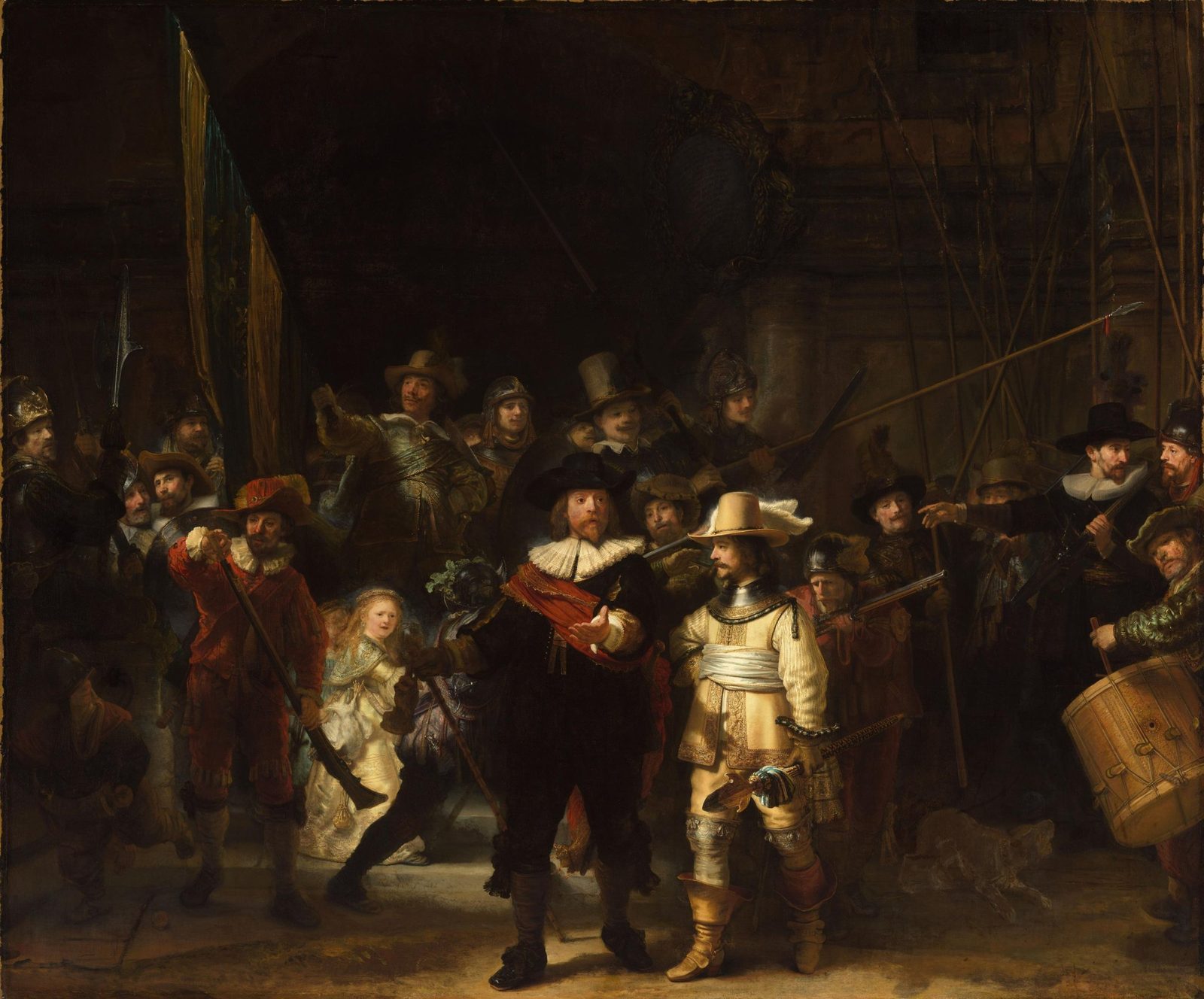
- Officers and other civic guardsmen of District II in Amsterdam, under the command of Captain Frans Banninck Cocq and Lieutenant Willem van Ruytenburch, known as ‘The Night Watch’
- Date
- 1642
- Museum
- Rijksmuseum
- Image
- Public domain (CC0)
Open in Simple Art
Watch this story on iPhone and iPad, with offline downloads and a painting every day.
About 4 minutes of looking, in 10 parts.
The Night Watch
A crowd of armed men comes out of the shadows towards us. Pikes cross overhead, a drum hangs at the right, and in the middle two officers step forward together. Almost everything around them is dark, and that is exactly why they catch your eye.
Amsterdam, 1642, oil on canvas
This is Rembrandt's portrait of the militia company of District Two in Amsterdam, painted in oil on canvas in 1642 and known as The Night Watch. The Rijksmuseum notes that he was the first to show a group portrait in action. The captain is ordering his lieutenant to march.
A wedge of men and pikes
The two officers sit at the point of a rough wedge, and the crowd fans out and back behind them. Long diagonals of pikes, muskets and a lance cut across the dark. Follow a few of them, and notice how often they lead you back to the centre.
Where the light lands
Now look at where the light falls. It seems to come from the left, and lands hardest on the lieutenant in pale yellow and on the captain's face and hand. The captain's black suit gives almost nothing back, so his ruff and red sash do the talking.
The girl in yellow
Down to the left, a small girl glows almost as brightly as the officers. Her dress runs from cream in the light to cool olive grey in the folds. A dark sleeve and a slanting pole cut hard across her, while her other side melts into shadow.
The captain's open hand
Here is the captain's hand, near the centre of the canvas. It opens palm up above the red sash, with a pale cuff at the wrist. It looks like the gesture of a man giving an order, and the group seems to wait on it.
Thick paint for the brightest folds
Drop to the lieutenant's yellow suit. The brightest folds, along the shoulder and down the front, look thickly painted, as if the paint itself were catching the light. The shadows stay thinner and cooler. The gold embroidery is picked out with finer touches.
Lace made of dabs
Up to the captain's collar. The lace isn't drawn thread by thread. It appears to be built from short dabs of white and cream, clustered into a pattern. Where it meets the dark cloth, the edge is soft and broken, and your eye fills in the rest.
Faces out of the dark
Now look over to the right, into the crowd. Here the men are barely there. A face, a white collar and a feathered hat catch some light, and the rest dissolves into brown. Above them, the pikes make hard, thin lines against that soft darkness.
A banner without an outline
Up at the far left, a tall banner hangs in the gloom. Its lit side is laid in with long, loaded streaks of golden ochre. Now follow its right edge. There's no outline at all, just strokes that grow darker and duller until they disappear into the background.
Look closer
8 details, each checked against a close-up of the picture.
-
Central Officers
The captain in black and the lieutenant in yellow stand side-by-side with the captain's red sash crossing his chest.
Two central officers stand shoulder-to-shoulder against a shadowy crowd of guardsmen. The captain at left wears a saturated black suit, a voluminous pleated white ruff, a wide-brimmed black hat, and a vermillion red sash that drops diagonally from his right shoulder across to his left hip, its edge softened by adjacent crimson shadow. The lieutenant at right is rendered in warm buff-yellow with a gold-embroidered doublet and a white waist-sash; his face and plumed hat are bathed in the strongest key light, while the captain's lit zone is concentrated on the forehead, nose, and outstretched hand. Background figures dissolve into loose, low-value browns, so the two officers' silhouettes are read as crisp, sculpted masses against an atmospheric, almost monochrome ground.
-
The Girl in Yellow
The dress is painted in bright yellow and cream highlights that contrast sharply with the dark background.
The crop isolates the little girl from Rembrandt's 'The Night Watch,' her face emerging from warm, softly blended flesh tones against an almost black ground. Her dress reads as cream and pale ochre in the lit passages, with cool olive-grey shadows tucked into the recesses of the fabric; the highlights appear raised and broken by the weave, not smoothly modeled. To her right, a guard's dark sleeve and a diagonal pole bite into her silhouette with a hard, near-silhouette edge, while her left side dissolves more gradually into the red curtain and shadow. A gilded tassel at her hip is dabbed in with a few loaded touches of warm yellow against a near-black shadow.
-
Impasto on the Lieutenant's Suit
The brightest highlights on the pale yellow suit appear to be laid on thickly, with thinner, cooler paint in the shadows.
The crop isolates the lieutenant's midsection, dominated by a pale yellow doublet and breeches wrapped with a white sash. Highlights on the jacket appear as thick, raised ridges of paint catching left-side light, particularly along the left shoulder seam, the left edge of the jacket panel, and the front pleat where it catches illumination. The pale fabric folds are constructed with broad strokes that follow the body's diagonal axis from upper-left to lower-right. Gold embroidery along the jacket edges and sash is rendered with finer, more deliberate touches of ochre and darker brown, contrasting with the looser fabric strokes. Cool blue-grey half-tones in the sash folds establish recession, while the highlights remain nearly cream-white. The sword hilt at lower right shows dark glazing over warm undertone, with jewel-like flecks of blue and gold.
-
Lace Collar Detail
The white lace collar above the red sash is suggested with short dabs of white and cream paint rather than precise lines; the captain's open hand sits just below it.
The crop centers on a wide, fan-shaped white lace collar above a saturated red sash, with an open flesh-toned hand and gold-embroidered cuff at lower right. The lace's scalloped lower edge and interior pattern are built from short, irregular dabs and dashes of white and pale cream paint, with paint texture standing slightly proud of the surface in places. Edges between the lace and the dark fabric behind it are soft and broken, not crisp contours, and a few dabs trail into the red sash without a drawn boundary. Highlights on the hand and cuff read as warmer, slightly thicker strokes, while the dark passages around them remain thinly painted.
-
Chiaroscuro in the Background
Figures at the right are only partially visible, with mainly faces, collars and hats catching light against the dark.
The crop isolates a cluster of partially emerged figures set against an unresolved umber field. Pikes and staves cut sharp diagonals from upper-right to lower-left as thin, hard-edged ochre and black lines, while the faces and white collars of the surrounding guardsmen are the only passages that lift in value. The leftmost face (with feathered cap, below) and the bearded man at right (in a flat black hat and wide linen collar) are read almost entirely through their lit edges — the rest dissolves into the ground. Value relationships are extremely compressed: the background sits around a 25–30% range, the lit facial planes push to roughly 60–70%, and the white collar at right is the only passage that exceeds 80%.
-
Hand Placement
The captain's hand is placed centrally, gesturing towards the lieutenant or the company.
The crop is dominated by a centrally placed, fleshtoned hand extending forward and slightly downward, emerging from a vivid crimson-orange sash or drape that sweeps diagonally from upper left to center. A pale cream ruffle or cuff edges the wrist, while the rounded gold-embroidered sleeve cuff glints just behind the wrist. The right edge shows a darker red drapery gathered around a turned wooden handle, and the left edge catches a thin glint of metal — likely a sword hilt. The background falls to very low values, leaving the hand and sash as the brightest passages in the frame.
-
The Banner
The vertical edge of the banner blends softly into the dark background without a hard outline.
The crop is dominated by a tall vertical banner, its lit left side rendered in loaded vertical streaks of golden ochre and warm umber that suggest hanging fabric. Behind it, a darker teal-blue field with cooler passages establishes the back layer of the flag. Where the banner's right edge meets the dark ground, there is no crisp contour: the ochre strokes lose chroma and value, passing through a mid-brown transition zone before dissolving into the near-black umber background. At the base of the crop, the top of a feathered hat and the lit cheek of a pikeman appear, with a sliver of red fabric and gold trim just visible in the lower right corner.
-
The Drummer
The drummer's hand holds a drumstick above a large drum with pale ribs and metal tension hooks.
The crop centers on a large military drum tilted on a steep diagonal, its cylindrical body occupying the right two-thirds of the frame. The drum's skin is rendered in warm ochre and tan, divided into vertical panels by pale ribs, with rows of small dotted impressions suggesting hammered or punched metal decoration between them. V-shaped tension hooks with greenish-bronze highlights anchor the lacing that runs along the top and bottom rims. At upper center, a hand grasps a slim drumstick descending from a sleeve trimmed with thick, curly gold-and-green embroidery. A wedge of saturated red fabric (the drummer's coat lining or sash) appears at the lower right, while the left half of the crop dissolves into near-black, warm umber shadow that makes the drum's lit flank read as a glowing volume.
The Night Watch in context
A painter at his height
Rembrandt had worked in Amsterdam since 1632, after his early years in Leiden [11]. There he became a prominent portraitist, and in 1639 he bought the impressive house that is now the Rembrandt House Museum [11]. His wife Saskia died in 1642, the year on this canvas, and the Met's Walter Liedtke wrote that The Night Watch could be said to mark the end of Rembrandt's most successful years [11].
A commission for the Kloveniersdoelen
The picture was made for the great hall of the Kloveniersdoelen, headquarters of Amsterdam's arquebusiers' civic guard [1]. It was one of seven militia portraits hung together there, alongside pieces by Govert Flinck, Jacob Backer and Nicolaes Eliasz Pickenoy [3][6].
When the work began is uncertain. The Rijksmuseum says Rembrandt had the commission before December 1640, because of the death of one of the guardsmen he painted, and that the work took at least a year and probably longer [2]. Wikipedia gives around 1639 instead [12]. According to the National Gallery in London, he was paid the huge sum of 1,600 guilders, with sitters paying an average of 100 guilders each, depending on how prominent they were [5].
Operation Night Watch has shown how he started. In 2021 researchers announced a rough sketch under the paint, laid in with a beige, chalk-rich paint over a brown ground, a type of paint not yet found in any other Rembrandt [8]. Scans also exposed changes of mind, such as feathers painted out of Claes van Cruijsbergen's helmet and an earlier position for Rombout Kemp's leg [8].
Cut down to fit
The painting is first recorded in the Kloveniersdoelen in a list of 1653 [1]. In 1715 the city ordered it cleaned and moved to the Small Council of War Chamber in the Town Hall on Dam Square [1]. It was too big for the new room, so it was cut down [3]. Accounts differ. A 2021 Rijksmuseum press release says strips came off all four sides, the largest from the left, while the museum's text on the Lundens copy says three sides [3][4]. RKD, citing the Rembrandt Research Project's Corpus, says it was cut severely on the right [6]. The pieces have never been found [2][3].
We know what went missing from a small copy on panel attributed to Gerrit Lundens, which the National Gallery thinks was probably commissioned by Banninck Cocq himself [4][5]. It shows two men and a child on the far left and more of the drummer [5]. In 2021 the Rijksmuseum used this copy, with help from artificial intelligence, to reconstruct the lost strips. They showed them around the original for several months, without any plan to add them to the painting itself [3].
The painting originally had no title. 'Night Watch' first appears in a document of 1797 [2]. Wikipedia links the name to a dark varnish that made the scene look nocturnal [12].
Moves, attacks and repairs
In 1808 the canvas went to the Trippenhuis, and it has been on loan from the City of Amsterdam to the museum ever since [1]. It moved into the new Rijksmuseum building in 1885, according to Wikipedia [12]. Then in September 1939 it was evacuated, first to bunkers near the coast and from 1942 to a cave in the St Pietersberg at Maastricht [2].
It has been attacked three times: with a knife in 1911, with twelve cuts in 1975, and with acid in 1990, when a guard's quick action limited the harm to the varnish [2]. A treatment had already been discussed in 1973, because the mastic varnish of 1947 had turned brittle and yellow, and the 1975 slashes made it unavoidable [10]. The Rijksmuseum counts at least 25 treatments in all [2].
Operation Night Watch
Operation Night Watch began on 8 July 2019 in a glass chamber where visitors could watch [7]. And on 12 November 2024, a team of eight conservators began removing the varnish applied in 1975-76 [9].
Reputation
Liedtke rejected the legend that dissatisfied clients ruined Rembrandt, citing later commissions from Jan Six and the city government [11]. Today the Rijksmuseum calls it the most famous and most important painting in the Netherlands [2]. Wikipedia traces its echoes in Mahler's Seventh Symphony and in Peter Greenaway's 2007 film Nightwatching [12].
- The Night Watch (SK-C-5): object record and provenance . Rijksmuseum, Amsterdam
- 10 things about Rembrandt's Night Watch . Rijksmuseum, Amsterdam
- For the first time in 300 years The Night Watch is complete again (press release, 23 June 2021) . Rijksmuseum, Amsterdam
- Copy of The Night Watch, attributed to Gerrit Lundens (SK-C-1453) . Rijksmuseum, Amsterdam
- Gerrit Lundens, after Rembrandt, The Company of Captain Banning Cocq ('The Nightwatch') (NG289) . The National Gallery, London
- Civic guardsmen of Amsterdam under command of Banninck Cocq (RKDimages 3063) . RKD – Netherlands Institute for Art History
- Operation Night Watch to start at the Rijksmuseum (press release, 10 December 2019) . Rijksmuseum, Amsterdam
- Preparatory sketch discovered beneath The Night Watch (press release, 7 December 2021) . Rijksmuseum, Amsterdam
- Restoration begins of Rembrandt's The Night Watch (press release, 12 November 2024) . Rijksmuseum, Amsterdam
- Brittle varnish: the 1975-76 treatment (Esther van Duin, 2021) . Rijksmuseum, Amsterdam
- Rembrandt (1606–1669): Paintings, Heilbrunn Timeline of Art History (Walter Liedtke, 2003) . The Metropolitan Museum of Art
- The Night Watch . Wikipedia