Two smiles under a tree
How Frans Hals sets a cheerful married couple in dark clothes against a bright garden
- Artist
- Frans Hals
- Title
- Portrait of a Couple in a Landscape, probably Isaac Abrahamsz Massa (1586-1643) and Beatrix van der Laen (1592-1639)
- Date
- c. 1622
- Museum
- Rijksmuseum
- Image
- Public domain (CC0)
Open in Simple Art
Watch this story on iPhone and iPad, with offline downloads and a painting every day.
About 4 minutes of looking, in 9 parts.
A couple in a garden
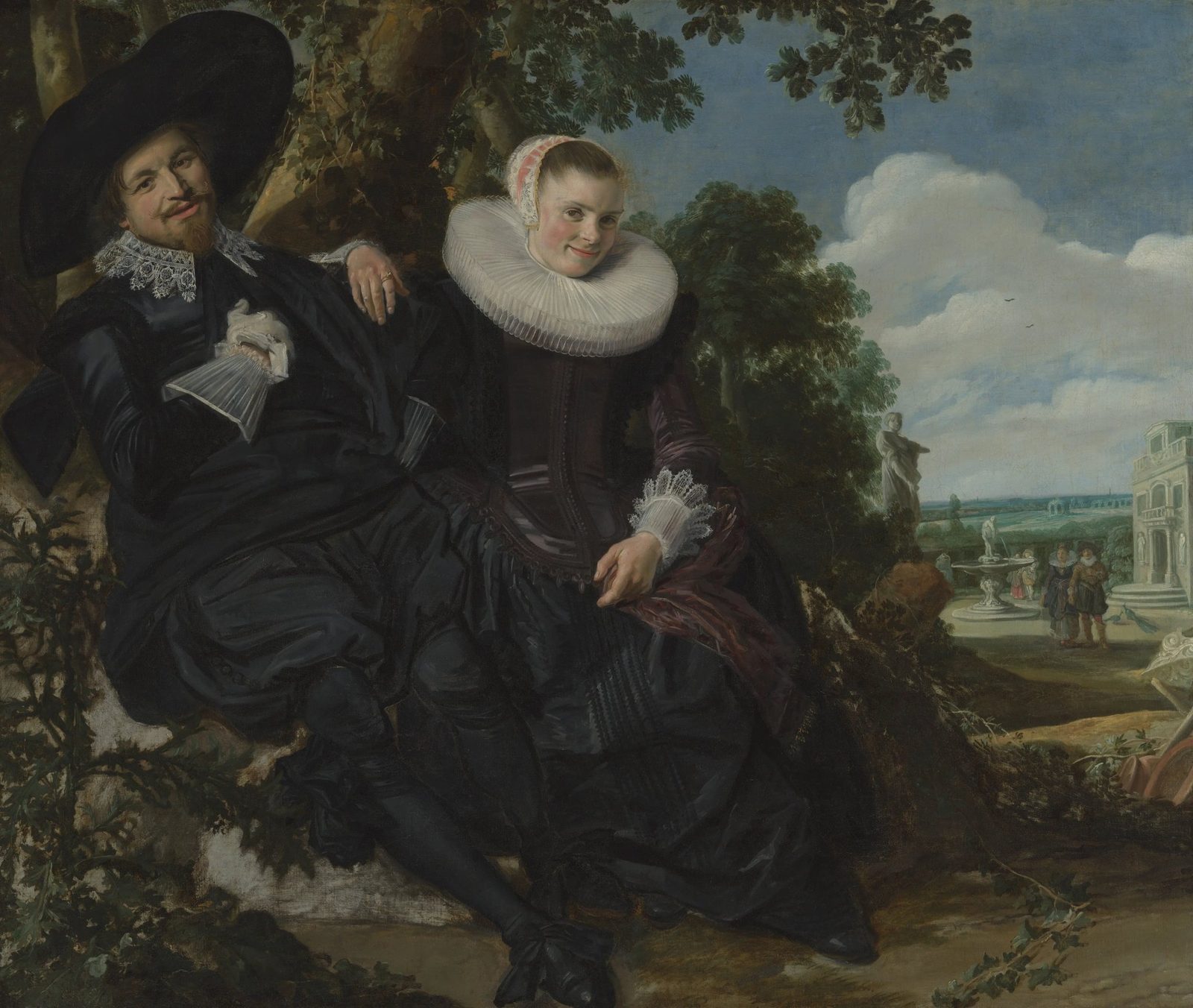
Two people sit close together under a tree and smile straight out at us. He leans back in a wide black hat. She rests her arm on his shoulder. Behind them, on the right, the view opens onto a bright garden and a big sky.
Frans Hals, about 1622
This is Frans Hals's portrait of a married couple, painted in oil on canvas around 1622. The Rijksmuseum identifies them as probably Isaac Abrahamsz Massa and Beatrix van der Laen, who married in Haarlem that April. The museum notes how rare it was to paint a couple together, life-size, and in such an intimate, joyful way.
Dark on the left, light on the right
The couple fill the left two-thirds as one big dark shape, broken only by white linen and two faces. The right third is open air, with trees, a garden and pale sky. The museum's catalogue points out a thistle at the lower left and ivy on the right.
Light from the upper left
The light comes from the upper left. On her face it catches the brow, the bridge of the nose and the upper lip, while the far cheek slips into a cooler, olive-grey shadow. Her skin is warm pink and cream. The ruff around it looks cool, almost blue-white.
A few quick accents
Now his face. The eyes seem to be set down with quick dark touches at the corners, and the moustache and beard follow the way the hair grows, curling up at the tips. Below, his lace collar is a cluster of small white marks on black. The dark between them reads as the holes in the lace.
The millstone ruff
Her great millstone ruff is built from broad, curving strokes of near-white and grey that fan out from the neck. Look at its outer edge. Some strokes run slightly past where the collar should end, so the rim looks soft and feathered rather than drawn.
A cuff of light
Down at her wrist, the lace cuff is the brightest thing in this part of the picture. Hals doesn't paint every thread. Short, chalky whites sit beside small dark gaps that read as openwork. Compare it with his collar. Hers looks more solid; his is a shorthand of dots.
A hand on his shoulder
Her hand rests on his shoulder, the small gesture that ties the two of them together. Warm flesh sits against black cloth, with sharp little lights on the knuckles. The ring is little more than one stroke of yellow ochre and a brighter fleck. The museum lists it as a wedding ring.
Out into the garden
Now let your eye travel out to the right. Past the trees there is a fountain and a pale classical house. Everything here is softer and bluer, with hardly a hard edge, and that is what pushes it so far back. The museum describes elegant couples strolling in this garden.
Look closer
10 details, each checked against a close-up of the picture.
-
The Couple
The figures are composed as a single dark mass contrasted against a light background.
The two figures merge into one large dark silhouette that occupies the central mass of the crop, broken only by the white millstone ruff on the woman and the man's lace collar and pleated cuff. Edges between the black clothing and surrounding tree/landscape are soft and broken, with thin half-tones of greenish-brown scumbled along the silhouette rather than drawn as hard contours. Faces are built from warm pinks and ochres laid over a cooler ground, with the brightest highlights catching the left sides of the cheeks and the cuff. The woman's lace cuff and the man's collar are flicked in with short, opaque white strokes over the dark underpainting, giving them a crisp, almost engraved look against the surrounding blacks.
-
Woman's Millstone Ruff
The white ruff is constructed from bold, overlapping white and grey brushstrokes.
The crop centers on a large, starched millstone ruff framing the sitter's face. The pleats are built up with broad, curving brushstrokes of near-white and cool grey that fan radially from the neck; individual strokes are clearly visible, with some extending slightly past the intended outer edge of the collar, producing a softly feathered silhouette rather than a hard line. Light from the upper left rakes across the top-left lobes, where the paint is thickest and brightest, while the lower-right folds are rendered in darker, more transparent grey glazes that let the warm ground/canvas show through. Crisp dark accents sit at the inner and outer fold tips, defining the scalloped rhythm; the surface shows fine age craquelure over the lighter passages.
-
Man's Face and Hat
The man's expression is captured with rapid, precise strokes around the eyes and mouth.
The crop isolates the man's head and lace collar against dark background and dark doublet. The face is built from warm flesh tones with pinker passages on the cheekbone and lower lip, set over a brownish underlayer visible in the shadows at the temple and under the jaw. Eyes are placed with quick dark touches at the outer corners and small light dabs on the lower lid; the mustache and pointed beard are drawn with directional strokes that follow the hair growth, curling up at the mustache tips. The lace ruff at the bottom is rendered with crisp, scumbled white highlights against deep black, reading as a pattern through contrast rather than drawn detail. Edges around the cheek and jaw are soft and feathered, while the lower contour of the beard and the lace silhouette are sharper.
-
The Hand and Pleated Cuff
The man's hand rests on his chest above a stiff pleated white cuff, its pleats picked out in alternating light and dark strokes.
The crop isolates the man's hand above a stiff pleated linen cuff angled diagonally from upper right to lower left. Pleats are defined by alternating strokes of dark gray-black and cool off-white, with the brightest highlights concentrated along the upper-right edge and the left-facing ridges of each fold. A warm ochre-brown passage at upper center marks where the cuff meets the hand, providing the only chromatic note against the otherwise near-monochrome palette. The edges of the cuff dissolve softly into the surrounding dark ground, especially along the lower edge where the pigment thins. A fine network of age cracks is visible across the paint film.
-
Skin Tones vs. Fabric
Warm pinks and creams of the face contrast with the cool whites of the linen ruff.
The crop isolates her head against the radiating folds of the millstone ruff. The face is built from warm pinkish flesh tones — a creamy peach on the forehead and nose bridge, with concentrated rosy pinks on the cheek apples and lips. The light source from the upper left places the strongest highlight on the brow ridge, the bridge and tip of the nose, and the upper lip; the right side of the face falls into a slightly cooler, more olive-grey shadow. The ruff behind and beneath her reads as cool, faintly blue-grey white, with the deepest folds dropping to a desaturated lavender-grey. Edges between skin and ruff are crisp at the chin and jaw where the head overlaps the collar, then softer where the ruff's bright petals meet the shadowed neck. Fine craquelure runs across the entire paint surface, visible in both flesh and fabric.
-
Distant Fountain and Pavilion
The distant architecture is painted with soft, blurred edges and atmospheric blue tones.
The crop reveals a distant pastoral landscape rendered with soft, dissolved edges and a palette dominated by cool atmospheric blues and muted greens. A central fountain with a small sculptural figure is built from quick, sketchy strokes of pale grey-blue against a denser band of olive-green foliage. On the right, a classical pavilion with columns and a balustrade is suggested through loose vertical and horizontal dabs in warm off-white and grey, with no crisp outlines. The horizon line carries the faintest blue-grey of a distant town and spire, where forms melt into the pale sky through thin, broken paint. Values are compressed in the distance, while small touches of warmer brown in the foreground ground the spatial recession.
-
Woman's Lace Cuff
The light hits the lace cuff creating a bright white accent against the dark sleeve.
The crop isolates a splayed lace cuff emerging from a near-black sleeve, with a sliver of warm flesh at the wrist. The lace is built from chalky whites and pale grays laid in short, scumbled touches, with small dark gaps punched into the mass to read as the openwork netting. Edges are irregular and broken; some tips of the lace terminate in crisp little zigzags while others dissolve into the dark ground. The vertical band at the cuff's base shows parallel ridges suggesting gathered fabric or a stiffened support, painted in slightly cooler grays than the highlight peaks. Against the deep umber-to-black sleeve the cuff reads as the brightest passage in the frame.
-
Man's Collar Lace
The lace collar is rendered as a series of small, dabbing white marks.
The crop isolates the lower portion of a starched, scalloped lace collar sitting against a near-black doublet. The lace is built from clusters of short, comma-shaped and lozenge-shaped white strokes that loop, branch, and intersect to imply reticulated openwork. The dark ground reads clearly through every gap between strokes, supplying the 'shadows' of the lace without extra pigment. Along the scalloped hem the marks become smaller and more numerous, while the upper band reads as a denser woven line of repeated short horizontals and verticals.
-
Woman's Hand on Shoulder
A small portion of the woman's hand rests on the man's shoulder.
The crop isolates a woman's hand resting on a dark, warm-black surface, with a small pale blue-grey frill of cuff visible at upper left and a gold ring on the ring finger. Flesh tones are built from warm pinkish-peaks on the knuckles that step down into cooler, slightly grey-warmed mid-tones along the finger sides and palm. A few small, sharp highlights sit on the tops of the knuckles and at the corner of the nail, while the underside of the hand loses definition into the dark ground. The ring is a quick loaded stroke of yellow-ochre with a single brighter fleck. The surface shows a network of fine craquelure across both hand and background, and the cuff's edges are broken and frayed, set against a black doublet that reads as deep brown-black with faint warmer passages.
-
Lower Foreground Texture
The ground is painted with thin, sketchy, translucent brown strokes.
The crop shows a foreground ground plane dominated by a broad, thinly painted area of warm brown-olive that extends across the right two-thirds of the frame. The brushwork here reads as long, horizontal, broken strokes with the lighter canvas weave showing through the gaps between marks, especially in the upper-right where the paint is thinnest. Darker passages of near-black, slightly more loaded paint cluster at the bottom edge and along the left margin, suggesting low vegetation or shadow with a few small dabs of muted green-grey leaf notes pressed into the dark mass.
Portrait of a Couple in a Landscape in context
A Haarlem merchant who knew Moscow
If the usual identification is right, the man is Isaac Abrahamsz Massa, the son of Flemish immigrants, baptised in Haarlem on 7 October 1586 [1]. Jonathan Bikker's catalogue entry for the Rijksmuseum says that from the age of fourteen or fifteen he spent eight years in Moscow and became an authority on Russia, later returning there as a merchant and as a representative of the States General [1]. He also seems to have served Sweden as a diplomatic agent, for which King Gustav II Adolf ennobled him in 1625 [1].
On 25 April 1622 Massa married Beatrix van der Laen (1592-1639), the daughter of a former Haarlem burgomaster [1]. He was close to Hals: he witnessed the baptism of the painter's daughter Adriaentje in 1623 [1]. Claus Grimm, in his catalogue of Hals and his workshop for the RKD, calls Massa a merchant, diplomat, author and cartographer and counts four portrait commissions he gave Hals between 1622 and 1635 [3].
Who are they?
When the painting sold in 1851, the couple were said to be Frans Hals and his second wife, Lysbeth Reyniersdr, an idea Hofstede de Groot rightly dismissed in 1910 according to Bikker [1]. In a 1914 publication with Wilhelm von Bode, Binder proposed Hals's younger brother Dirck and his wife, Agneta Jansdr, but no secure likeness of Dirck exists to test the idea [1]. The Massa identification first appeared, tentatively, in the Rijksmuseum's 1934 catalogue, and Eddy de Jongh and P.J. Vinken argued it in full in 1961 based on the man's likeness to other portraits of Massa, including Hals's small oil sketch in San Diego and a portrait of 1626 in Toronto [1].
Not everyone agreed: Bikker notes that Gudlaugsson saw no resemblance, and that Seymour Slive found the identification unconvincing and doubted the woman looked thirty [1]. Grimm, who once had doubts too, now accepts it after comparing high-resolution details of the eyes, nose and mouth [2]. The museum's title keeps the word 'probably' [1].
A garden full of meaning
Bikker reads the plants as references to marriage [1]. The vine clinging to the tree stands for love or friendship that outlasts death, and the clay pots on the right recall the fragility of life [1]. Ivy was a symbol of faithfulness and fertility, while the thistle next to the man, called Männertreu in German, became a sign of male fidelity, giving his hand on his heart the sense of an oath [1]. The courting couples near the fountain wear coloured doublets, but the married man wears black and sits apart from that garden [1].
This is Hals's only double portrait of a husband and wife [1]. Bikker suggests he may have taken the idea of a life-size couple in a garden from Rubens's self-portrait with Isabella Brant in a honeysuckle bower, which he could have seen in Antwerp in 1616 [1]. But Grimm points instead to Gerard van Honthorst's Granida and Daifilo of 1625, observing that open smiles like these went against the decorum of the time, suggesting the picture was meant for private rather than official display [2].
A later date and a second hand?
The museum dates the painting to about 1622, close to the wedding [1]. Grimm disagrees, arguing that no Hals portrait of the early 1620s shows heads and hands handled so freely, and he proposes about 1627, as a symbolic marriage portrait painted a few years after the event [2]. He also attributes most of the trees and the strolling couples to the landscape painter Pieter de Molijn, while keeping the two lit sprays of ivy for Hals [2].
Technical study for the museum shows that Hals worked from the background forward, generally leaving space for the figures [1]. The wife's hand on her husband's shoulder wasn't part of that plan, as it wasn't reserved, and its position reflects a change from the first idea [1]. The museum rates the condition as fair, with local abrasion, and Grimm notes that since the 1984 restoration, damage at the lower left shows as light patches [1][2].
From Lisse to the Six collection
The earliest firm record is the sale of the Amsterdam patrician Jan Six's collection on 6 April 1702, where a 'man and woman, life-size, by Frans Hals' went for 32 guilders to his widow, Margaretha Tulp [1]. The painting passed down the Six family to Jonkheer Hendrik Six, Lord of Hillegom, and was bought at his sale in Amsterdam on 25 November 1851 for 600 guilders on behalf of the museum [1].
Bikker argues that this route supports the Massa identification [1]. In the 1640s the Six family bought property around Hillegom and Lisse, next to the estate of Beatrix's father, Ter Specke, where the couple married [1]. So he suggests the portrait may have hung in Lisse from the start, staying there after Beatrix died in 1639 and Massa remarried in 1640 [1].
- Frans Hals, Portrait of a Couple in a Landscape, probably Isaac Abrahamsz Massa and Beatrix van der Laen (SK-A-133): object record, technical notes, provenance and catalogue entry (Jonathan Bikker, 2007) . Rijksmuseum, Amsterdam
- Claus Grimm, Frans Hals and his Workshop, cat. no. A2.8: Frans Hals and Pieter de Molijn, Portrait of Isaac Abrahamsz. Massa and Beatrix van der Laen . RKD Studies, RKD Netherlands Institute for Art History
- Claus Grimm, Frans Hals and his Workshop, chapter 3.7: Patrons, supporters, maecenases . RKD Studies, RKD Netherlands Institute for Art History