One bright band
How Frans Hals lets a wide white ruff hold a quiet portrait together
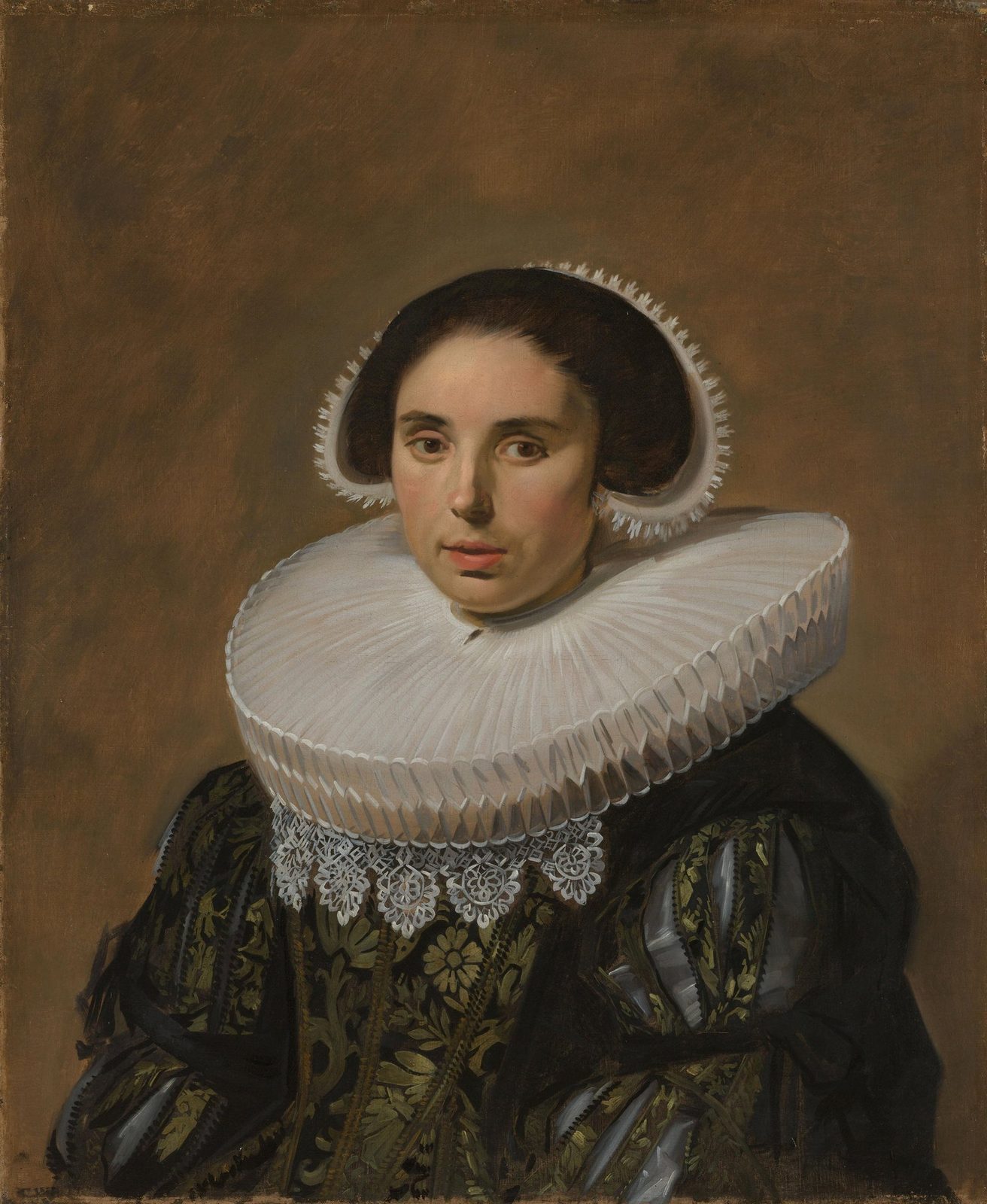
- Artist
- Frans Hals
- Title
- Portrait of Duijfje van Gerwen (1618-1658)
- Date
- c. 1637
- Museum
- Rijksmuseum
- Image
- Public domain (CC0)
Open in Simple Art
Watch this story on iPhone and iPad, with offline downloads and a painting every day.
About 4 minutes of looking, in 10 parts.
A face above a white disc
A young woman looks out at us. Below her face spreads an enormous pleated ruff, almost as wide as her shoulders. Nearly everything else is warm brown or close to black, so your eye goes straight to the face and that pale disc.
Frans Hals, about 1637
This is Frans Hals's portrait of Duijfje van Gerwen, painted around 1637 in oil on canvas. She was the youngest daughter of a wealthy Amsterdam wine merchant. The museum believes it was made soon after her marriage to Jan van de Poll, whose portrait is its matching pendant.
One bright band across the middle
Look at how simply it is built. The ruff makes one wide band of light across the middle, the face sits just above it, and the dark dress spreads out below like the base of a pyramid. That pale horizontal steadies the whole picture.
Light from the upper left
The light comes from the upper left. It catches her forehead and the left side of her nose, then slips gently into warm shadow across the far cheek. There's no hard line where light turns to dark, and that soft turn is what makes the face feel round.
Catchlights and a fringed cap
Now look into her eyes. Each dark pupil carries a tiny white catchlight, which looks as if it was placed in one touch and left alone. Just above, the rim of her white cap isn't a clean line at all. It's a fringe of short white dashes that follow the curve.
Pleats in single strokes
Drop down to the lower edge of the ruff. Each pleat appears to be one loaded stroke: a pale ridge, warm brown below it, cool grey tucked into the fold. No two are quite alike, so the row reads as a wave rather than a stencil.
The brightest white
Now find the brightest spot in the picture. It's probably here, on the upper left curve of the ruff, where scallops of almost pure white catch the light. Right beside them the white steps down into ivory and grey, and that is what makes the edge glow.
Lace made of accents
Below the ruff hangs a border of lace, and you won't find a single outline in it. The scrolls and round medallions seem to be built from cool white commas and loops laid straight onto the dark dress. The black showing between them does the work of the holes.
Olive green on black
The dress is nearly black, patterned with olive-green flowers and leaves. Each petal has a thin, lighter golden-green stroke along its upper left edge, the side that faces the light. Apart from the flesh and the brown wall, this is almost the only colour in the painting.
Silver on the sleeve
Out on her sleeve, broad diagonal streaks of silvery grey sit on the near-black cloth. They look as if each was laid down in one quick pass and never smoothed. Where the dark shows through their broken edges, the fabric seems to shimmer.
Look closer
8 details, each checked against a close-up of the picture.
-
Face and Expression
The eyes are rendered with dark pupils and small white highlights to create a focused gaze.
The crop centers on a young woman's face rendered with visible craquelure across the paint film. The eyes are defined by dark almond-shaped pupils set in warm brown irises, each marked with a small white catchlight on the upper-left that anchors the gaze toward the viewer's right. The skin is built from warm peach-ochre mid-tones with pinker passes on the cheeks and a redder accent at the corner of the mouth, while the bridge of the nose shows a soft cool shadow on its right side. Lips are laid in with a coral-pink stroke and a darker crimson notch at the left corner, and the white ruff beneath dissolves into rapid, scumbled brushwork at the lower edge.
-
Ruff Pleats
The white pleats are formed by a series of thick, rhythmic vertical brushstrokes of varying white and grey tones.
The crop is dominated by a large, fan-shaped ruff, its upper expanse a broad, cracked, warm-cream field of relatively smooth paint, while the lower edge breaks into a series of vertical, ridged pleats. Each pleat is built from a thick, pale highlight along its upper rim that feathers into a warm brown mid-tone, then into a cool grey-brown shadow tucked into the recess before the next fold. The edges of the pleats are soft and painterly, not crisp; the white strokes sit as raised ridges that taper at top and bottom rather than as hard lines. Below the pleats, a darker zone shows loose, calligraphic white-and-grey marks suggesting lace or embroidery against an almost black ground.
-
Lace Collar Edge
The lower edge of the ruff consists of delicate, scrolling white lace patterns against the dark dress.
The crop isolates the lower hem of a pleated white ruff and the free-hanging lace border beneath it. The scallop edge of the ruff is built from short, parallel white strokes that taper downward into small frills, sitting over a warm brown mid-tone. Below it, the lace is constructed almost entirely in cool greyish-white strokes placed directly onto the dark dress, forming scrolling foliate shapes, looped bows, and large circular medallions with openwork centers. The lower third reveals the dress fabric itself, where olive-green leafy forms are dragged loosely against the deep brown ground. Edges throughout are soft and broken rather than crisp, and a network of fine craquelure runs across the surface.
-
Facial Modeling
The light hits the left side of the nose and forehead, creating a soft transition into shadow on the right side.
Crop shows the central face from forehead to chin. Light falls from the upper left, brightening the left forehead, the left ridge of the nose, and the left cheekbone, while the right side of the nose, the right cheek, and the right temple recede into a warm, transparent shadow. The skin is built with broad, blended touches of warm pink over an ochre ground, and the cheek shows a distinct rosy flush laid on top of the modelling rather than blended into it. The eyes are rendered with a dark pupil, a brown iris and bright sclera, with a small white catchlight in each pupil indicating the same upper-left source. Lips are a cool pink-red with a hard, dark upper edge and softer lower edge; the chin and the right nostril wing sit in deep umbra.
-
Embroidered Bodice
The dark dress features olive-green floral patterns painted with thin, golden-green highlights.
The crop divides into two zones: an upper band of opaque, cream-white lace medallions with crisp punched-out openwork shapes, and a lower field of olive-green floral motifs laid over a near-black ground. The flowers (round, multi-petalled blooms and leaf-scrolls) are built from a mid-olive base, with thin, lighter golden-green strokes picked out on the upper-left edges of each petal and leaf. Edges between the green motifs and the dark ground are softened with broken, partly transparent brushwork rather than crisp contours, and the warm-brown priming shows through in several abraded passages. Crisscrossing weave texture of the linen support is visible where the paint is thin, especially in the shadow pockets between leaves.
-
Sleeve Highlights
The highlights on the dark sleeve are rendered with broad, diagonal strokes of a silvery-grey paint.
The crop isolates the upper arm/sleeve of the dark dress, where two broad, loaded strokes of cool silvery-grey sit on top of a warm, near-black ground. These highlight strokes run on a diagonal from upper-right toward lower-left; their edges are mostly soft and feathered into the dark, though a couple of spots (notably the bright streak in the upper-middle) have crisper, almost scraped-looking edges where the paint was laid down wet-into-wet. Smaller, more deliberate touches of olive-gold paint form the leafy embroidery along the vertical seam, contrasting in scale and warmth with the broad cool sweeps. Fine craquelure is visible across the brightest stroke, and the underlying dark shows through in places, giving the highlights a translucent, broken quality rather than a flat fill.
-
Ruff Highlight
The upper-left curve of the ruff contains the brightest white paint in the entire composition.
The crop isolates the upper-left arc of a pleated white ruff against a warm umber-brown ground. The left profile of the ruff is built from short, scalloped strokes of nearly pure white that follow the outward curl of each pleat, and these scallops are the highest-value marks anywhere in view. Moving rightward and downward, the surface steps through warm gray-ivory mid-tones, then cools into pale lavender-gray in the shadowed troughs between pleats. A dense web of craquelure crosses the whole ruff, with the cracks reading slightly darker than the surrounding paint, which subtly grays the highlights. A small wedge of peachy flesh tone appears at the top right edge, confirming the ruff sits below the sitter's jaw.
-
Headdress Rim
The outer edge of the white cap is defined by small, repeating vertical white dashes.
The crop isolates the curved outer rim of a white headdress set against a flat warm-brown ground. Along the entire visible perimeter, the white edge is broken into a series of short, vertical or slightly radiating dashes rather than a continuous line; these dashes sit just beyond a thicker, more solidly painted crescent of white and grey that forms the body of the cap. The dashes vary in length and tilt, with the ones on the upper curve leaning outward and the ones on the lower curve leaning downward, so that each tick reads as a small fringe element responding to local curvature. Behind the rim, dark brown hair is laid in with broader, softer strokes, and on the right edge a partial eye and brow emerge, with pale flesh tones butting directly against the dark hair. A fine network of age cracks (craquelure) runs across all passages, indicating an oil paint film that has dried and aged.
Portrait of Duijfje van Gerwen in context
A young bride from the Warmoesstraat
Duifje van Gerwen was born in 1618, the youngest daughter of a wealthy Amsterdam wine dealer on the Warmoesstraat, and married Jan van de Poll in 1637 [1][2]. Since the museum dates the portrait to about 1637, she'd have been eighteen or nineteen when she sat for it [1][2]. The Rijksmuseum thinks the choice of a Haarlem painter came through her uncle, Willem Warmond, who appears as a captain in one of Hals's militia pieces [2]. And no other portrait of her is known [2].
Mistaken for an older woman
For most of its time in the museum the picture carried someone else's name, or none at all [1]. When the Van de Poll family gave it in 1885 it was simply a portrait of a woman, the pendant to a man thought to be Nicolaes Hasselaer [1]. Then in 1909 Moes tentatively named her as Hasselaer's second wife, Sara Wolphaerts van Diemen, and that name stuck, with occasional hesitation, for most of the following century [1]. Hofstede de Groot's alternative, Brechtje van Schoterbosch, couldn't work, because she had died in 1618 [1].
Age was the main stumbling block: in his 2007 catalogue entry Jonathan Bikker pointed out that Hasselaer and Van Diemen were in their late thirties or early forties in the first half of the 1630s, but the woman here looked much younger [1]. Then in June 2024 the museum announced that the wills of Van Diemen's grandchildren and great-grandchildren showed the portraits couldn't have come down through her line, and renamed the sitters [2].
Not every catalogue has caught up with the change [3]. Claus Grimm's online catalogue of Hals and his workshop for the RKD, whose catalogue volume appeared in 2024, still titles the picture Portrait of Sara Wolphaerts van Diemen and treats the Hasselaer identification as confirmed by the provenance [3][4].
A formal wife, a casual husband
Bikker stresses the contrast between the two halves of the pair [1]. The husband sits sideways with an arm over the back of his chair and is painted loosely, while the wife takes a more formal pose, and viewers tend to assume she is seated too, though no chair is shown [1]. Bikker adds that Hals often painted men more sketchily than their wives, so the difference in handling needn't mean anything unusual [1].
Her clothes help with the date: her cap, her millstone ruff and the lace fringe below it, called a neerstik, closely match those in Hals's 1634 portrait of Catharina Brugman [1]. Grimm compares the loose painting of her face and the glittering slashes of her sleeve to the ensign in the Meagre Company, the Amsterdam militia piece Hals was working on in the same years [3].
How it was painted
The museum's technical notes describe a plain-weave canvas with a pinkish beige priming that shows at the edges and under the collar [1]. Hals laid a thin black underpaint under the costume and scratched a quick sketch into it, painted the green and grey details of the bodice and sleeves wet into the black, and added the white collar and neerstik last, over them [1]. The background went on in two stages, a thin black wash and then a darker, more opaque layer, and the face was built over a greenish brown underpaint with darker reddish brown in the shadows [1].
The condition is rated good, with mild abrasion in the thin dark passages of the costume [1]. M. Bijl carried out a complete restoration in 1996 [1].
Two centuries with the family
The pair can be traced back to Jan van de Poll (1721-1801) in Amsterdam [1]. His grandson stored them from 1802 with other family portraits in an aunt's house at Herengracht 479, and the next owner, Jan Stanislaus Robert van de Poll, kept them with 25 other family portraits at Herengracht 450 [1]. He gave them to the museum in November 1885 with 34 other family portraits [1]. The 2024 research showed that the donor was a direct descendant of the couple in the paintings [2]. When this was written the museum's website listed the portrait as on display in room 2.14 [1].
- Frans Hals, Portrait of Duijfje van Gerwen (1618-1658) (SK-A-1247): object record, technical notes, provenance and catalogue entry (Jonathan Bikker, 2007) . Rijksmuseum, Amsterdam
- Rijksmuseum identifies Amsterdam mayor and his wife in Frans Hals portraits (press release, 3 June 2024) . Rijksmuseum, Amsterdam
- Claus Grimm, Frans Hals and his Workshop, cat. nos. A1.62 and A1.63: Portrait of Nicolaes Hasselaer and Portrait of Sara Wolphaerts van Diemen . RKD Studies, RKD Netherlands Institute for Art History
- Frans Hals and his Workshop: editor's note . RKD Studies, RKD Netherlands Institute for Art History