Three notes of white
How Frans Hals builds a standing figure from a black dress, a plain wall and a few bright whites
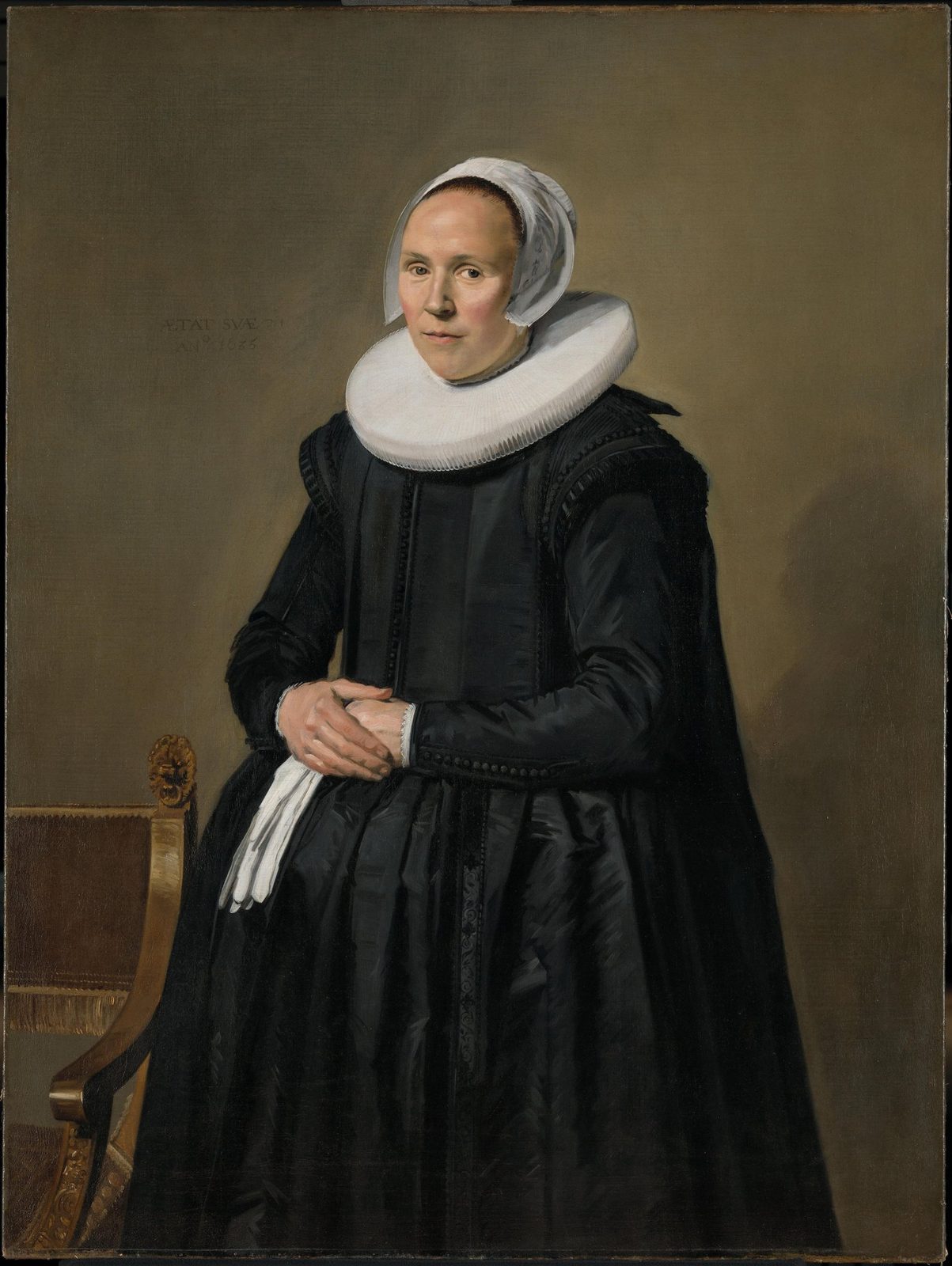
- Artist
- Frans Hals
- Title
- Portrait of Feyntje van Steenkiste (1603/04-40)
- Date
- 1635
- Museum
- Rijksmuseum
- Image
- Public domain (CC0)
Open in Simple Art
Watch this story on iPhone and iPad, with offline downloads and a painting every day.
About 3 minutes of looking, in 9 parts.
A woman in black
A woman in black stands beside a chair, her hands folded at her waist and a pair of white gloves hanging from her fingers. Her cap, her ruff and those gloves are the only bright notes. Everything else is black dress or a quiet olive-brown wall.
Frans Hals, 1635
This is Frans Hals's portrait of Feyntje van Steenkiste, painted in 1635 in oil on canvas. The museum describes her as the first wife of Lucas de Clercq, whose portrait is its pendant. Faint lettering at the upper left, which we'll come back to, gives her age that year as thirty-one.
A tall dark triangle
The figure makes a tall triangle. Her small head sits near the top, and the black dress widens until it fills the bottom of the canvas. Your eye lands on her face, drops to the ruff, then settles on the folded hands just below the middle.
Soft light, no outlines
Come in close to her face. The light falls from the upper left, warming her forehead and cheek, while the shadows turn cooler and greyer at the temple and under the jaw. Nothing is outlined. Even the edge of her cap melts softly into the forehead.
Dabs along the ruff
Now drop to the ruff. The pleats are a row of short, repeated white strokes with cool grey in between. Along the bottom edge each one ends in a small crisp dab that looks a little thicker than the paint around it, and those dabs give the linen its starched rhythm.
Folded hands, white gloves
Her hands rest one over the other, the thumb crossing the knuckles. The fingers are warm pink and ochre, with cooler violet-grey shadows between them, and their edges are softened rather than drawn. Beneath them the white gloves spill out against the black.
Black made of greys
Look along her sleeve. One broad sweep of cool, bluish grey curves across the black, crisp on its upper edge and feathering into the dark below. Further down, long vertical strokes of grey pick out the ridges of the heavy skirt, and the deepest folds are left almost bare.
A carved chair finial
At the lower left is the corner of a carved chair, its finial apparently a small lion's head. It's made of little dabs of light ochre set right beside deep brown, with almost nothing in between. That jump in value alone makes the carving look solid.
ÆTAT SVÆ 31 / ANº 1635
Up at the upper left, look for the faint Latin inscription. It gives her age as thirty-one and the year as 1635. The letters are brushed thinly in a brown only a little lighter than the wall, so they seem to float on the surface rather than announce themselves.
Look closer
9 details, each checked against a close-up of the picture.
-
Face and Expression
The eyes and mouth are rendered with soft, blended transitions of flesh tones.
The crop isolates the woman's face framed by the white linen cap and a portion of the pleated ruff. Skin is built from warm peach and rose tones on the cheeks and temples, shifting to cooler grey-greens in the hollows around the temples, the side of the nose, and beneath the jaw. Soft, feathered transitions—rather than hard contours—carry the eye from forehead highlight into the pink of the cheek into the soft shadow under the chin. The eyes are small dark anchors set into lighter lids, with a wet catchlight in each iris, and the mouth is a low-value smudge with a hint of upward tilt at the corner. Fine craquelure networks the paint surface across forehead, cheek, and ruff.
-
Ruff Pleats
The white ruff consists of distinct, rhythmic vertical strokes of thick white and grey paint.
The crop isolates the lower face, a large white pleated ruff, and the dark bodice beneath. The ruff shows a continuous band of vertically oriented pleats whose ridges are marked by short, repeated white strokes, while the recesses between them are rendered in cool grey. The bottom hem of the ruff carries the most emphatic brushwork: each pleat terminates in a small, crisp dab of near-white paint that sits slightly proud of the surface, separated from the next by a thin grey notch. The upper portion of the ruff, near the chin, reads as broader, softer strokes where the white blends toward the skin tones. A fine craquelure runs across the whole surface, confirming oil on panel or canvas.
-
Clasped Hands and Gloves
The hands hold a pair of white gloves, with the fabric showing sharp contrast against the black gown.
Two loosely brushed hands rest atop one another, the left hand folded over the right with its thumb crossing the knuckles. The flesh is built from warm pinkish-ochres and salmon highlights against cooler grey-violet shadows in the recesses between fingers. Crisp, scumbled white fabric spills from beneath the wrist toward the lower-left corner, sharply contrasted against the surrounding near-black gown. A vertical strip of white sleeve lining and a row of small dark buttons trim the right side. Edges between fingers are softened rather than outlined, and the white glove is left largely unpainted in places with pale blue-grey strokes only in its folds.
-
Gown Highlights
Bright, broad, sweeping white-grey highlights define the folds of the black silk sleeves.
The crop is dominated by a near-black ground interrupted by a single broad, sweeping highlight that curves from upper right down to lower center, modelling what reads as a folded silk sleeve. The highlight is not white but a cool, slightly bluish grey laid in with visible bristle marks; its upper edge is relatively crisp while the lower edge feathers into the dark. At top center a vertical decorative chain or trim with small linked beads descends into shadow, and at lower left a row of small round buttons along the cuff catches a faint glint. The dark base shows warm-tinged passages in the deepest recesses and thin scumbled layers along the highlighted ridge. Craquelure is visible across the whole surface, confirming aged oil medium on a rigid support.
-
Carved Chair Finial
The gold-toned carving is rendered with small, deliberate, high-contrast dabs of paint.
The crop centers on a carved chair finial in warm gold-ochre tones, with a dark upper background and a vertical chair stile descending below it. The carving is suggested through small, discrete dabs of light ochre highlights placed against deep umber recess tones, creating strong local contrast rather than smoothly blended modeling. To the right, a broad mass of black fabric meets a sliver of white linen (ruff or glove), forming a high-value edge against the dark. Paint application is loose, with visible directional strokes following the carved curves and a network of fine craquelure crossing the surface.
-
Lower Skirt Folds
Deep black areas are contrasted with broad, vertical highlights to indicate heavy fabric folds.
The crop is dominated by near-black passages interrupted by broad, vertical strokes of cool grey that read as highlights catching the ridges of heavy fabric folds. A narrow vertical band runs down the left-center, patterned with small repeating scrollwork motifs painted in slightly warmer mid-grey over the black ground. At the very top edge, a row of small rounded marks suggests buttons or studs along a waistband, and a sliver of pale flesh appears in the upper-left corner. The brushstrokes are clearly visible as long, downward sweeps with slight feathering at their edges; transitions from highlight to shadow are abrupt rather than blended, leaving the darkest passages almost untouched. A thin horizontal lighter line crosses near the bottom, possibly indicating the floor edge or a hem.
-
Inscription
The inscription ÆTAT SVÆ 31 / ANº 1635 is painted in a muted, slightly translucent light brown.
The crop isolates a flat, dark olive-brown ground against which a Latin inscription is brushed in a slightly lighter, warm brown. The text reads 'AETAT SVAE' on the upper line with what appears to be 'AN[?] 1635' below; the characters are thin, irregular and slightly translucent, sitting on the surface rather than carved into it. Edges of the strokes are soft and feathered, with the brush loading unevenly so some downstrokes fatten mid-letter and fade at terminals. A fine web of aged craquelure and small vertical canvas weave slubs cross the whole field, and the letters themselves seem to 'float' as a faint value lift rather than a pigment line.
-
Linen Cap Edge
The edge of the cap meets the skin of the forehead with a soft, slightly blurred transition.
The crop shows the upper face beneath a white linen cap, with eyes, brows, forehead and the cap's lower border visible. A thin, dark brown-black stroke runs across the forehead marking the cap's binding, and just below this line a soft zone of grey-olive shadow diffuses into the warm peach skin tone. The skin itself carries warm pinks against cooler pale passages, and a fine web of craquelure covers the forehead. The cap's brushwork is loose and broken, mixing near-white highlights with blue-grey half-tones rather than laying a flat white.
-
Background Tone
The background is a muted olive-brown with subtle variations in saturation and value.
The crop is dominated by a single, largely uniform olive-brown field that reads as a warm, desaturated khaki. Tone shifts are minimal: the right side sits slightly lighter and more chromatic, while the lower-middle and far-left read marginally cooler and grayer, with a few darker micro-patches near the bottom edge. A fine web of craquelure runs across the whole surface, slightly more visible in the lighter passages where the paint film is thin. At the lower left, a soft, blurred edge of a bright white linen form intrudes, with a sliver of deep black just below it; both edges are softened, not crisp.
Portrait of Feyntje van Steenkiste in context
A marriage in the linen trade
Feyntje van Steenkiste came from a prosperous Haarlem family in the textile business. The Rijksmuseum notes that her marriage to Lucas de Clercq strengthened the business ties between the two families [1]. Jonathan Bikker's catalogue entry describes De Clercq as a Haarlem merchant in potash, linen yarn and bleached linen, who married Feyntje in 1626 [1]. Her father also dealt in potash [1].
In 1629 De Clercq went into partnership with his brother-in-law Pieter van Steenkiste. After Pieter's death in 1634 he formed a trading company with the husbands of his wife's sisters [1]. The couple prospered, and they shared a country estate at Overveen, called Clercq en Beeck, with their brother-in-law Lucas van Beeck [1]. Feyntje died in 1640, five years after this portrait was dated [1].
Plain black on purpose
Both sitters were Mennonites. Bikker reads their faith in their dress [1]. Lucas's father, Jacques de Clercq, had been banished from Ghent in 1585 for taking part in a plot to replace the Catholic city government with one that would protect local Mennonites [1]. Claus Grimm notes that the couple signed their marriage certificate in Haarlem on 11 January 1626 [4].
Bikker contrasts the couple's clothes with Hals's 1634 portraits of Tieleman Roosterman and Catharina Brugman, who were not Mennonites [1]. Feyntje wears no richly embroidered stomacher and no lace fringe under her ruff. Her cuffs are modest, trimmed with only a narrow border of lace [1]. In the pendant, the museum adds, Lucas's right arm isn't in a sling, as some writers once thought, but wrapped in costly fabric [2].
One pair, two canvases
The inscription at the upper left reads 'ÆTAT SVÆ 31 / ANº 1635', giving her age as thirty-one in 1635 [1]. No date survives on the husband's portrait [4]. The museum dates it to about 1635 on the evidence of his costume, rejecting the view that it was painted almost a decade earlier [1][2].
Technical study found that the two canvases differ. Lucas's is fairly rough, with a two-layer ground, while Feyntje's is finely woven, with three layers and a reddish pigment in the top one [1]. Bikker argues this doesn't disprove the pairing, since Hals may simply have used two primed canvases of similar size that he had to hand [1]. Grimm, in his catalogue of Hals and his workshop for the RKD, takes the other side on the date [3][4]. He places Lucas's portrait in the late 1620s, close to Hals's civic guard banquet of 1627, and treats Feyntje's as a pendant matched to it years later, for reasons he calls unknown [3][4]. The two sources also describe the red in her ground differently, Bikker as red ochre and Grimm, citing examinations at the J. Paul Getty Museum in 2007 and 2008, as vermilion [1][3].
Hals or Leyster?
Several scholars have given this portrait to Judith Leyster, among them Six in 1916 [1]. Grimm proposed her again in 1971 and 1989 [1][3]. Bikker rejected the idea in 2007, writing that nothing in Leyster's work approaches the quality of this pair, which matches Hals's work of the mid-1630s in style and technique [1].
Grimm has since changed his mind [3]. Close-up images, he writes, show Hals's own handling in the hands, the costume, the cap and the ruff, with grey silk surfaces broken by hard black contours [3]. He finds the face flat and rigid, however, and suggests that apart from small areas around the eyes, eyebrows and nose it was covered by a later revision in thick, light paint [3]. The museum's own technical notes record other changes made during painting. The gloves were painted over the finished costume, the hands were altered, and the contours of both shoulders were adjusted late on [1].
Given to Amsterdam
The portraits stayed with the sitters' descendants until 1891, when Pieter de Clercq and his sister Maria de Clercq-van Eeghen gave them to the City of Amsterdam [1]. They've been on loan to the Rijksmuseum since May of that year [1]. The museum rates the condition as fair, with some abrasion and a varnish that is very discoloured in places [1]. When this was written, both portraits were listed as on display in the Gallery of Honour [1][2].
- Frans Hals, Portrait of Feyntje van Steenkiste (SK-C-557): object record, inscription, technical notes, provenance and catalogue entry (Jonathan Bikker, 2007) . Rijksmuseum, Amsterdam
- Frans Hals, Portrait of Lucas de Clercq (SK-C-556): object record and technical notes . Rijksmuseum, Amsterdam
- Claus Grimm, Frans Hals and his Workshop, cat. no. A1.72A: Portrait of Feyntje van Steenkiste . RKD Studies, RKD Netherlands Institute for Art History
- Claus Grimm, Frans Hals and his Workshop, cat. no. A1.42: Portrait of Lucas de Clercq . RKD Studies, RKD Netherlands Institute for Art History