A collar that flickers
How Frans Hals builds a burgomaster's portrait from a lit face, a dense black and quick strokes of white
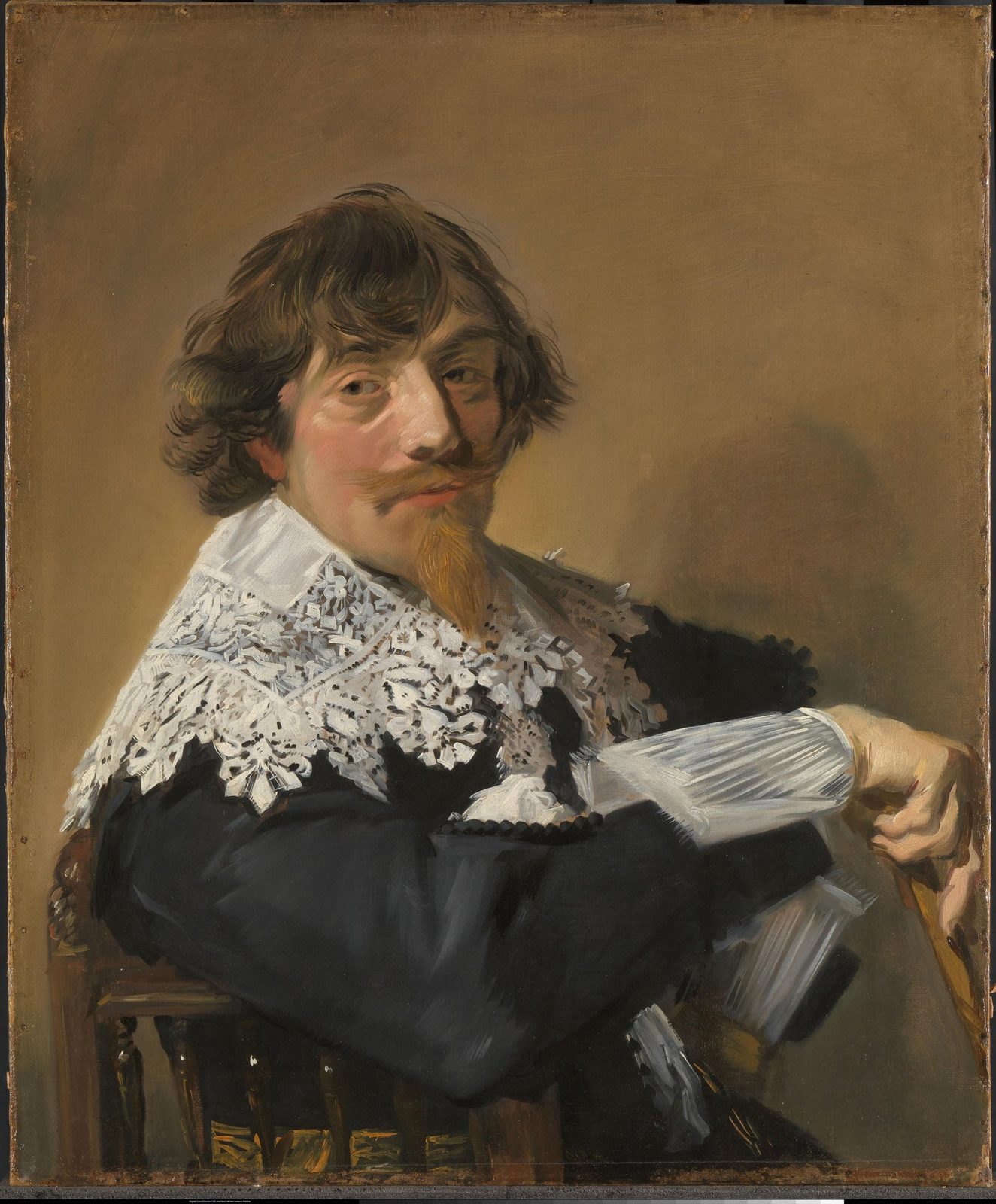
- Artist
- Frans Hals
- Title
- Portrait of Jan van de Poll (1597-1678)
- Date
- c. 1637
- Museum
- Rijksmuseum
- Image
- Public domain (CC0)
Open in Simple Art
Watch this story on iPhone and iPad, with offline downloads and a painting every day.
About 4 minutes of looking, in 9 parts.
Portrait of Jan van de Poll
A man in black sits sideways on a chair and turns to look at us over his shoulder. His face is lit, his lace collar blazes white, and everything around him is a plain warm brown. Notice how fast your eye runs from his face to that collar and out along his arm.
Amsterdam, about 1637
Frans Hals painted this in oil on canvas around 1637. The sitter, Jan van de Poll, was seven times burgomaster of Amsterdam, and the picture has a companion portrait of his wife, Duijfje van Gerwen. The museum describes him seated on a chair, holding a stick in his right hand.
One long diagonal
The design is a long diagonal. His head sits high on the left, his hand reaches the far right edge, and the broad collar spreads between them like a base. Around him there is almost nothing, just a thinly painted field, so the figure has to carry the whole picture.
Light from the upper left
The light comes from the upper left. Look at the forehead and the bridge of the nose, where thick, pale strokes seem to sit on top as highlights, while the far side of the face slips softly into shadow. There is hardly a drawn line here. The face is made of light and dark.
A warm beard, a cool collar
Now the beard. It is laid in with downward strokes of ginger and reddish brown, brightest at the centre and darker along the shadowed edge. Beside the cool white of the collar, that warmth looks even warmer. Up at the moustache, the tips break into fine, separate hairs.
Lace without the pattern
Move down to the lace. Up close it stops being a pattern. It is short dabs and curls of thick white, with darker paint showing between them to read as the holes. The museum's technical notes say the collar was left free while the black around it was painted, and began with a thin grey layer.
White against black
Follow the lower edge of the lace where it meets the black doublet. This is the strongest contrast in the painting, yet it is not a clean line. White and black interlock in little scallops, so the edge seems to flicker. The flat, dense black is what makes the white look so bright.
A sleeve in a few strokes
Out along the arm, the white sleeve is quicker still. Parallel strokes run along it in small groups, each one a fold, and they appear to have been blended wet into wet, so light and grey melt at their edges. Where the sleeve meets the black below, there is no outline at all.
The hand and the stick
At the right edge the hand comes to rest. The knuckles are a few warm, creamy dabs against cool grey shadow, with small reddish strokes in the creases. Below it runs a long brown form with one bright yellow-brown stroke along its top, probably the stick the museum mentions.
Look closer
9 details, each checked against a close-up of the picture.
-
The Face
The eyes and bridge of the nose are defined by concentrated highlights and soft blending.
Thick, opaque white and pale pink strokes form concentrated highlights down the bridge of the nose and left forehead. Soft blending characterizes the transitions between these highlights and the surrounding warm flesh tones, contrasting with the loose, broken brushwork defining the brown hair and reddish beard. A network of fine craquelure spans the surface. The right side of the face recedes into an umber shadow that softens against the olive-toned background, while red accents color the lips, nostrils, and cheeks.
-
Lace Impasto
The lace is built from thick, broken white strokes, with darker paint showing between them as the openwork.
The crop isolates the elaborate ruff collar rendered in heavily loaded white paint over a darker ochre-brown ground. Thick, broken strokes of lead white build up the raised lace patterns, with the dark underlayer left exposed between strokes to form the openwork eyelets and shadowed recesses. Edges are soft and gestural rather than crisp, with some strokes terminating in curling tips that suggest curls or scallops of lace. The brushwork varies from short dabs to longer sweeping marks that follow the direction of each lace element, and the impasto casts subtle shadows against the warm mid-tone ground visible in the upper right and along the diagonal folds.
-
White Sleeve
Broad, parallel strokes, blended wet in wet, form the folds of the white sleeve.
The crop is dominated by a broad expanse of white fabric rendered with thick, parallel brushstrokes that sweep diagonally from upper-left to lower-right. These strokes are cigar-shaped and laid in groups of two to five parallel marks, with soft, feathered edges where wet lighter tones meet the slightly grayer mid-tones of the receding folds. The transitions between highlight and shadow are blended directly on the canvas rather than by glazing, leaving visible ridges where the paint stands slightly proud. A network of fine craquelure runs across the whole surface, and the lower half dissolves into a near-black mass (the sleeve's underside/garment) with only a few scumbled brown and grey strokes at the very bottom-right corner hinting at an adjacent surface.
-
Collar-Doublet Boundary
The edge of the white lace creates a high-contrast boundary against the black garment.
This is a tight crop of the white lace collar meeting the black doublet of a man in a half-length portrait. The lace is built up with thick, creamy white strokes punctuated by short dark dabs that read as the openwork pattern, while the doublet is rendered in broad, dense black passages below. The boundary between the two is the highest contrast edge in the crop, though it is not a continuous sharp line—instead it jitters as the loaded white and adjacent black share irregular scalloped borders. A warm umber tone is visible in the thin transitions along the boundary and where the lace folds recede into shadow, suggesting the warm ground showing through leaner passages. Fine craquelure covers the paint film uniformly.
-
The Reddish Beard
The beard consists of saturated sienna and reddish-brown tones applied in vertical strokes.
The crop isolates the right side of a man's face, showing the mustache, a long pointed reddish beard, and the upper edge of a white lace collar against a dark garment. The mustache is built from a few thick, saturated sienna-red strokes that sit on top of a mid-tone flesh ground; the beard descends in clearly vertical, downward-sweeping strokes that shift from warm golden ochre at the lit center to dark reddish-brown along the right shadow edge. The dark garment reads as a single deep umber mass with a soft, slightly broken edge where it meets the beard hair. The lace below is a mosaic of bright white and cream dabs punctuated by small black accents, contrasting sharply with the warm hair above.
-
The Hand
The knuckles and fingers are modeled with soft greys and warm flesh tones.
The crop shows the modeled fingers and knuckles of a hand rendered in warm cream and peach highlights against cool grey-brown shadows, with a prominent ridge where the knuckle catches the light. Visible craquelure runs across the entire surface, indicating the oil paint has aged on a relatively absorbent ground. The brushwork is loose and loaded, with thick dabs of light paint placed wet-into-wet over darker underlayers; the edges between planes are softened but legible. A few darker, almost calligraphic strokes of reddish-brown sit at the joint creases, sharpening the read of the bending finger. The transition from lit form into shadow is built through juxtaposed strokes rather than a smooth gradation.
-
Mustache Texture
Thin, individual hair-like strokes are visible at the tips of the mustache.
The crop isolates the moustache and the upper lip area, where dark umber-brown bristle strokes sweep laterally and then curve downward past the corners of the mouth. At the outer and lower edges, the strokes resolve into very fine, separated filaments that taper to points, with tiny gaps of the warm orange-red ground showing between them. A soft reddish-pink half-tone beneath the moustache is laid in as a thin film rather than blended, so the skin reads as warm flesh but stays subordinate to the hair. Craquelure runs through both the hair and the skin, confirming a single aged oil film. Highlights pick out individual hairs with thin, slightly cooler brown-grey strokes, while the shadowed belly of the moustache is built from broader, drier-looking passes.
-
The Stick
A long diagonal brown form under the hand, probably the stick the museum describes, is painted in dark browns with one bright yellow-brown highlight.
The crop captures a long wooden form—the stick he grips—running diagonally from upper right toward lower left against a dark olive-brown background. A single loaded stroke of golden ochre/yellow-brown paint defines the lit top edge of the wood, placed wet onto a darker, leaner underlayer. The lower edge of the wood is built from a deep umber that blends softly into the surrounding shadow, with no hard linear contour—instead the form turns through value and temperature rather than outline. Craquelure is visible throughout, and the flesh tone at the top (a pinkish white) sits as a separate, more carefully blended passage, contrasting with the bravura single-stroke handling of the wood.
-
Background Handling
The background shows thin, scumbled paint with visible variations in ochre tone.
A near-monochrome field of warm ochre with subtle tonal variation across the surface. The paint sits thinly, with horizontal and slightly diagonal scumbled strokes visible throughout, particularly in the upper right quadrant. Canvas weave texture shows through the leaner paint films, and small lighter specks appear scattered across the surface. A few short, darker linear marks interrupt the field, and the lower portion is slightly cooler and lighter, reading almost as a faint wash against the upper warmer zone.
Portrait of Jan van de Poll in context
Haarlem's portrait painter
Frans Hals was born in Antwerp, probably in 1582 or 1583, and his family settled in Haarlem between late 1585 and July 1586 [1]. He joined the city's Guild of St Luke in 1610 and stayed in Haarlem for the rest of his life [1][4].
His lively, visible brushwork was popular, and the Frans Hals Museum says he was flooded with orders for portraits of rich brewers, merchants and the like [4]. Between 1616 and 1639 he painted five militia pieces for the headquarters of two Haarlem civic guards [1]. Success didn't mean security, though. The Rijksmuseum's catalogue notes he was in debt for most of his career [1].
The Amsterdam commission that stalled
In 1633 Hals accepted a rare commission from Amsterdam, a group portrait of the guardsmen of the city's District XI [1][3]. He was one of only two artists from outside Amsterdam to paint one of its civic guard companies in the seventeenth century [3].
It went badly. On 19 March 1636 the captain and lieutenant demanded he come to Amsterdam within fourteen days to finish it [3]. Hals, laid up in Haarlem with a bad leg, replied the next day he had agreed to work in Haarlem, and that gathering the men in Amsterdam had proved impossible and expensive [3]. So the guardsmen turned instead to the Amsterdam painter Pieter Codde, who completed the picture, now known as the Meagre Company, in 1637 [2][3].
A wedding in 1637
Jan van de Poll (1597-1678) married Duifje van Gerwen (1618-1658) in 1637 [2]. She was the youngest daughter of a wealthy wine dealer on Amsterdam's Warmoesstraat, and he went on to serve seven times as the city's burgomaster and, in 1650, to reach the rank of colonel in its civic militia [2].
The couple travelled to Haarlem around 1637 to sit for Hals [2]. The Rijksmuseum thinks the recommendation probably came from Duifje's uncle, Willem Warmond, who appears as a captain in one of Hals's Haarlem militia pieces painted ten years earlier [2]. Unlike the reluctant guardsmen, they were willing to make the journey, and apparently took advantage of the gap in Hals's calendar [2]. The result is the only pair of marriage portraits Hals is known to have made of an Amsterdam couple [2]. Jonathan Bikker's catalogue entry notes Hals first used the husband's informal sideways pose in a portrait of 1626 [1].
A gift with the wrong names
As far back as the records go, the portraits belonged to the Van de Poll family [1]. In 1885 Jonkheer Jan Stanislaus Robert van de Poll gave them to the Rijksmuseum together with 34 other family portraits, and the catalogue calls the Hals pair the most prized of the group [1]. The museum's 2024 press release calls the same arrival a bequest [2].
The sitters' names had been lost. In November 1885 the director, Frederik Obreen, suggested the man might be Nicolaes Hasselaer, and the woman was later tentatively identified as Hasselaer's second wife, Sara Wolphaerts van Diemen [1]. Hofstede de Groot proposed a different Hasselaer couple in 1910, but that idea also failed [1]. When Bikker wrote the catalogue entry in 2007, he judged the Hasselaer identification unconvincing and thought naming the sitters impossible for the time being [1].
Named at last
In June 2024 the Rijksmuseum announced Bikker had found the answer [2]. Wills of Sara Wolphaerts van Diemen's descendants showed the portraits couldn't have passed down that family's line of inheritance, and Jan's face matched his later portraits by Johann Spilberg of 1650 and Bartholomeus van der Helst of 1653, both now in the Amsterdam Museum [2]. No other portrait of Duifje is known [2]. The sitters turned out to be direct ancestors of the man who had given the paintings to the museum [2].
The news came while the pair was on show in the Rijksmuseum's Frans Hals exhibition, which ran until 9 June 2024 before the portraits moved on to the Gemäldegalerie in Berlin [2]. That exhibition, organised with the National Gallery in London and the Gemäldegalerie, was presented as a new retrospective after a gap of thirty years [5].
- Portrait of Jan van de Poll (1597-1678) (SK-A-1246): object record, provenance and catalogue entry (Jonathan Bikker, 2007) . Rijksmuseum, Amsterdam
- Rijksmuseum identifies Amsterdam mayor and his wife in Frans Hals portraits (press release, 3 June 2024) . Rijksmuseum, Amsterdam
- Militia Company of District XI under the Command of Captain Reynier Reael, known as 'The Meagre Company' (SK-C-374): object record and catalogue entry . Rijksmuseum, Amsterdam
- Would you like to know more about Frans Hals? . Frans Hals Museum, Haarlem
- Frans Hals (exhibition, 16 February to 9 June 2024) . Rijksmuseum, Amsterdam