Reading Hals: A Walk Through the Portrait of Lucas de Clercq
Following the eye path through brushwork, light, and the swagger of a Dutch burgher
- Artist
- Frans Hals
- Title
- Portrait of Lucas de Clercq
- Date
- c. 1635
- Museum
- Rijksmuseum
- Image
- Public domain (CC0)
Open in Simple Art
Watch this story on iPhone and iPad, with offline downloads and a painting every day.
About 4 minutes of looking, in 11 parts.
A Burgher Mid-Swagger
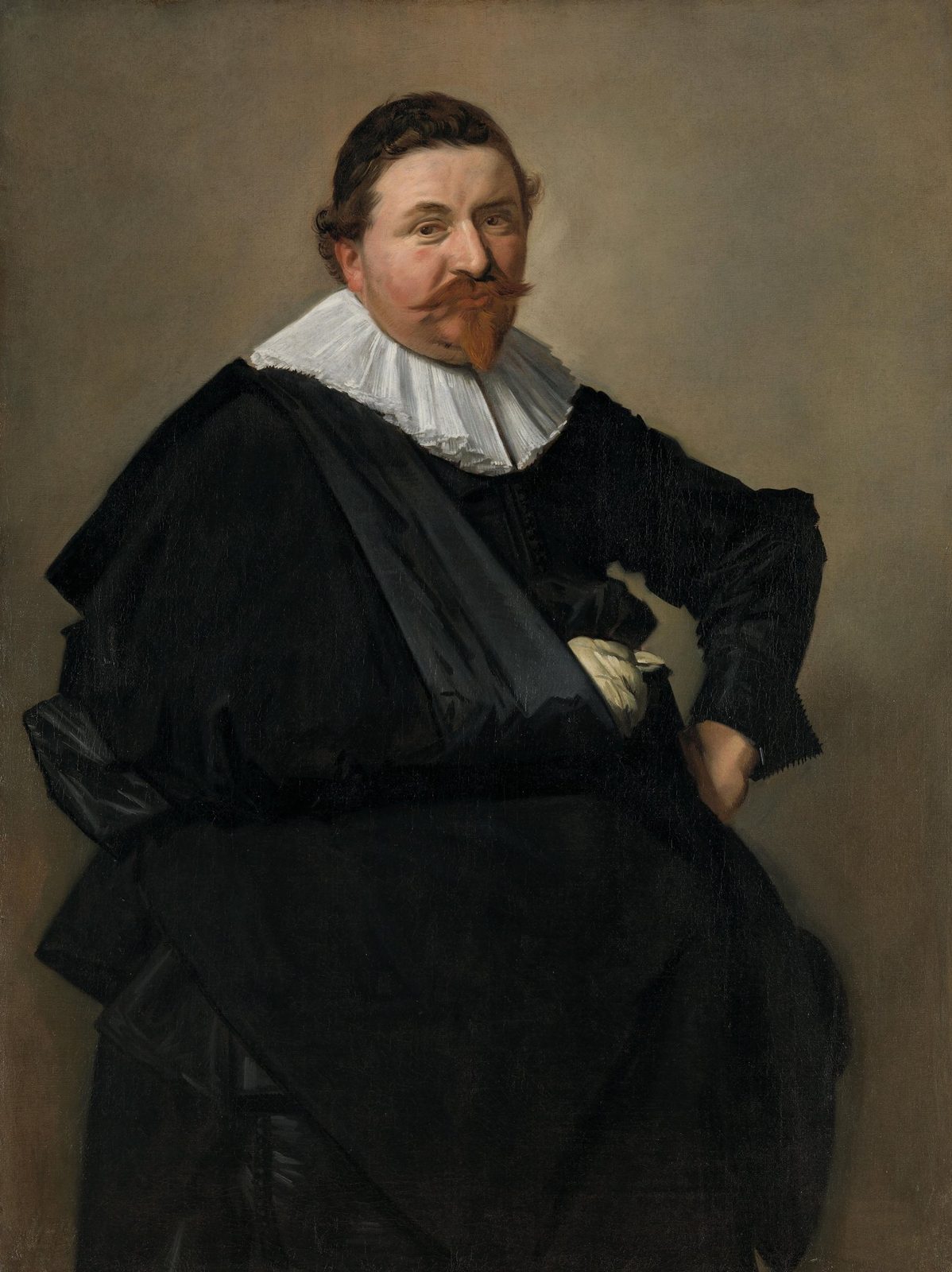
Before us stands Lucas de Clercq, painted by Frans Hals around 1635 — a confident middle-aged man caught mid-swagger, right hand planted on his hip, the other tucked into his doublet with a flash of white glove. Hals turns a sober burgher into a figure of bravura, and the brush itself seems to strut.
Dutch Golden Age Portraiture
Three-quarter length, the sitter is staged against a cool neutral background, his reddish-brown hair and pointed beard framed by a vast pleated white ruff. Hals is working in the painterly Baroque realism of the Dutch Golden Age, where loose, gestural brushwork becomes part of the sitter's attitude.
Pyramid and Counter-Diagonal
Step back and read the structure: a pyramid widening downward from the head, with a counter-diagonal that races from the cocked left shoulder through the arm down to the akimbo right hand. The face sits just above the upper third, anchoring the whole design, and your eye naturally traces that diagonal before swinging back up.
Light from the Upper Left
Light pours in from the upper left, raking across the forehead, the tip of the nose, and the left half of the ruff. That soft directional daylight sets the whole tonal game: brilliant whites, warm mid-valued flesh, and the deep blacks of the doublet, with subtle chiaroscuro modeling the form.
The Softly Blended Face
Move into the face. Hals blends the cheeks and chin into one soft, warm plane, then drops a single crisp, lighter stroke on the tip of the nose as a placed highlight. That small bright note is what tells your eye this is the focal point — everything else is read against it.
Strokes That Build a Beard
Just below, the mustache and pointed beard break that softness with directional flicks. Individual reddish-brown strokes fan outward to build the goatee, while loose curved sweeps rise at the mustache tips. The hair sits on top of an already-set face, almost certainly added last, and the broken silhouette is never blended.
Impasto Pleats
The ruff is a masterclass in value rhythm. Thick, loaded white impasto rides the crests of each pleat while cool grey-blue and warm umber tones pool in the troughs. Hals never draws the pleats — bright paint against dark, with the scalloped lace edges hinted by broken white touches, and your eye does the sculpting.
The Akimbo Right Hand
Follow the counter-diagonal down to the right hand planted on the hip. Hals uses broad tonal masses: warm ochre-lit knuckles along the ridge, then umber shadow swallows the lower fingers. The hand-to-sleeve edge is deliberately soft — a lost edge that lets only the catching planes read clearly.
A Glove in Few Strokes
Swing across to the waist and a small white shape appears: the glove tucked into the doublet. Just a few loaded cream strokes, with one bright impasto dab at the upper edge, and a cooler greenish-grey shadow inside. One thick light stroke against an already-painted dark — and the whole narrative lands.
Two Whites, Two Accents
Compare the two white accents: the ruff is built from many small impasto crests over a wide arc, while the glove is just one or two thick strokes. Same hue, very different economy — and together they balance each other across the pyramidal composition.
A Feathered Shoulder Edge
Now trace the silhouette of the cocked shoulder back up toward the face. The dark garment feathers into the warm background, broken by countless short vertical streaks of slightly cooler tone. That lost edge pushes the shoulder into atmospheric space while the face and glove pull forward.
Look closer
8 details, each checked against a close-up of the picture.
-
The Face
Softly blended transitions define the cheeks and chin while sharp highlights mark the tip of the nose and forehead.
The crop captures a close-up of the face from a Dutch Golden Age portrait, showing the bridge and tip of the nose, the cheek, mustache, beard, and the top of the white ruff. The skin across the cheek and chin is built with smoothly blended warm pinks and peaches that melt into cooler grey-violet shadows on the right side, while the forehead shows a pale, slightly cooler highlight. Against this soft flesh, the tip and ridge of the nose are set with crisper, lighter strokes that read as a distinct specular note. The mustache and pointed beard below are handled very loosely, with broken, directional strokes of reddish-brown and ochre where individual hairs remain visible, contrasting with the blended face above.
-
Ruff Highlights
Bright white impasto marks the tops of the pleats, with grey-blue tones in the recessed folds.
The crop isolates the lower half of a face with a reddish pointed beard resting above a broad, vertically pleated white ruff set against a black doublet and a warm grey-brown background. The pleat ridges are loaded with thick, opaque white paint that sits as raised impasto, while the troughs between pleats shift to cool grey-blue and warm umber-greys, producing a high-contrast tubular rhythm. Crisp scalloped lace edges along the ruff's lower border are defined by short, broken white touches that leave the dark doublet showing through. The black clothing is painted as a flat, loosely scumbled mass with soft, painterly edges where it meets the collar, and a thin curved shadow is cast by the beard onto the uppermost folds.
-
Left Sleeve Cuff
Diagonal, gestural white and grey strokes simulate the light hitting the fabric folds of the cuff.
The crop centers on a dark sleeve cuff rendered in deep black and charcoal tones, broken by a lighter grey-tan fold area on the middle-left that reads as fabric turning toward the light. Loose, diagonal white and pale-grey dashes streak across the cuff surface, varying in length and following the implied curvature of cloth rather than running parallel. The lower edge reveals a flesh-toned hand emerging, with a small highlight on a fingernail. Heavy craquelure covers the entire surface, the crackle web most visible in the mid-tone passages.
-
Mustache and Beard
Individual reddish-brown brushstrokes create the texture of the pointed beard and upturned mustache.
The crop frames the lower face: mustache, mouth, pointed goatee, a sliver of the white pleated ruff and black doublet below. Individual reddish-brown brushstrokes fan outward and downward to build the beard's pointed mass, and separate curved strokes sweep up at the mustache tips, reading as loose single-mark hairs. Warm golden-orange highlights sit on the upper beard and mustache crest where the upper-left light lands, while darker umber passages fill the mustache shadow and the hollow beneath the lower lip. The cheek and lips are softer pinkish-flesh transitions that recede behind the crisp, slightly broken silhouette of the facial hair.
-
Black Doublet Tones
The black garment is not a flat color but composed of deep browns and grey half-tones.
The crop reveals a section of dark garment fabric dominated by near-black tones, but on close inspection the blacks are not uniform. Subtle diagonal folds catch slightly warmer brown-black values where light rakes across them, while recessed creases hold cooler, more neutral greys. A pale cream-yellow form—likely the gloved hand—intrudes at the right edge, providing the only strong tonal break. The whole surface is fractured by a fine, irregular network of craquelure, and faint directional brushstrokes are visible following the diagonal fall of the cloth.
-
The White Glove
A small area of high-value white paint represents the glove tucked into the doublet.
The crop shows a pale, cream-white shape of a glove nestled into deep, near-black fabric of a doublet. The glove is built from a few broad, loaded brushstrokes in off-white and pale ochre, with a small, bright fleck of pure light at the upper edge where a cuff or fold catches the light. Edges between glove and doublet are soft and slightly feathered, not crisp, allowing the dark to bleed into the light in places. Shadow passages inside the glove are a cooler, slightly greenish grey-beige, while the surrounding doublet is a warm black with brown undertones showing through.
-
Akimbo Left Hand
The hand rests on the hip with fingers slightly curled, rendered with broad tonal shapes.
The crop isolates the left hand resting against the body, framed by a heavy black sleeve descending from the upper right with a slightly ragged lower edge and a tiny white speck (likely a button). The hand is built from broad tonal masses: warm ochre-lit knuckles along the top ridge transition into a deep umber shadow that swallows the lower fingers and wrist, leaving the curled digits barely legible. The edge where the hand meets the black sleeve is soft and unresolved, while the contour against the olive-grey wall is firmer. Craquelure runs across the entire surface, and the paint sits in visible ridges where the brush dragged loaded pigment.
-
Shoulder Contour
The edge of the shoulder against the background is softly blurred rather than sharply lined.
The crop isolates the upper-left corner where the figure's dark shoulder meets a warm olive-brown background. The black garment is not a flat field — it shows countless short vertical streaks of slightly lighter and cooler tone, suggesting dragged, broken brushwork rather than a single solid pass. The boundary between garment and background is feathered: along the diagonal contour the dark paint thins out and bleeds into the brown, creating a soft, atmospheric transition rather than a crisp line. A subtle lighter halo sits just inside the edge, the result of the dark pigment being lifted or not fully covering the underlayer, which softens the silhouette against the wall.
Portrait of Lucas de Clercq in context
What an elbow could say
The Rijksmuseum describes De Clercq's pose as anything but modest, reading his arm akimbo as a sign of self-assurance [1]. Art historian Joaneath Spicer studied this gesture in an essay called 'The Renaissance Elbow', published in a volume on the cultural history of gesture edited by Jan Bremmer and Herman Roodenburg [4]. She traced it to a double root in real movements from daily life and the rules of conduct literature, arguing that its many appearances in Dutch portraits reflect shared ideas about social ties and duties rather than pure artistic invention [4].
According to reviews of the essay, Spicer found this stance almost became a national attribute in the Dutch Republic [5]. She read it as self-possessive display in single portraits, while in marriage portraits husbands used jutting angles to mark out territory beside the recessive curves of their wives [4][5]. She suggested the relative social equality of Dutch society may have pushed men in authority to stress such signs [5].
A pose Hals kept returning to
The Wallace Collection in London calls the 'Renaissance Elbow' a bold pose that Hals often used [6]. In his online catalogue of Hals and his workshop, Claus Grimm notes that Hals's single sitters often appear as if on a plinth or a stage, swaggering in their costly clothes with arms akimbo [3]. Grimm adds that Hals set this conventional display against a gaze that seems to come from the moment of sitting, so the expression need not match the pose [3]. Here the swagger survives even without ribbons or lace, which the museum's catalogue finds missing from De Clercq's plain costume [1].
How the figure was built
Technical study at the Rijksmuseum suggests an order of work [1]. The background came first with the figure left in reserve, followed by the black costume, leaving the collar and hands open [1]. A thin underpainting set the shadows in the face, and the lit flesh was then worked wet in wet in white, pink and ochre, with olive green in the shadows [1]. Hals scratched lines into the thick white of the glove with the ferrule of his brush [1]. At a late stage he made the collar and body smaller by painting background over their edges, added unusually strong dark brown contours to the eyes and collar, and drew black lines into the hair [1].
The catalogue also explains the black band across the chest. Many male sitters of the period, it says, were shown with one arm wrapped in a black cape, a common accessory, so the old idea of a damaged arm in a sling is probably mistaken [1].
A mid-1630s manner?
The museum dates the canvas to about 1635, mainly on the evidence of the costume [1]. Grimm sees a late 1620s work instead, pointing to its blond colouring, the round modelling of the head and the stress on solid volume [2]. In his survey of Hals's development, Grimm describes a phase from about 1634 to 1637 marked by smoother modelling and softer passages between light and dark, possibly under Rembrandt's influence [3]. Which phase the soft cheeks of this face belong to is therefore still open to debate [1][2][3].
Lucas after the portrait
The museum gives De Clercq's dates as about 1593 to 1652, although an older title of the painting and Wikipedia place his birth around 1603 [1][7]. Wikipedia says the family moved in 1638 to a large house on the Spaarne near Haarlem's weigh house [7]. After Feyntje's death in 1640 he married Adriaentgen Keyser, doing so in 1645 according to Wikipedia [1][7]. A later portrait of the couple with children, now in the Amsterdam Museum, is attributed by the Rijksmuseum to Pieter de Grebber and by Wikipedia to Dirck Bleker, and the museum counts it among the evidence for identifying the sitters [1][7].
- Frans Hals, Portrait of Lucas de Clercq (SK-C-556): object record, technical notes, provenance and catalogue entry (Jonathan Bikker, 2007) . Rijksmuseum, Amsterdam
- Claus Grimm, Frans Hals and his Workshop, cat. no. A1.42: Portrait of Lucas de Clercq . RKD Studies, RKD Netherlands Institute for Art History
- Claus Grimm, Frans Hals and his Workshop, 3.4: The development of Frans Hals the artist . RKD Studies, RKD Netherlands Institute for Art History
- Review of Jan Bremmer and Herman Roodenburg (eds), A Cultural History of Gesture (1991), including Joaneath Spicer, 'The Renaissance Elbow' . Bryn Mawr Classical Review 1992.04.03
- David Trotter, 'Gesture as Language' (review of A Cultural History of Gesture) . London Review of Books, vol. 14, no. 2
- Frans Hals and Male Portraiture . The Wallace Collection, London
- Lucas de Clercq . Wikipedia