A stroke for every surface
How Frans Hals paints face, linen, lace and fur each in its own way
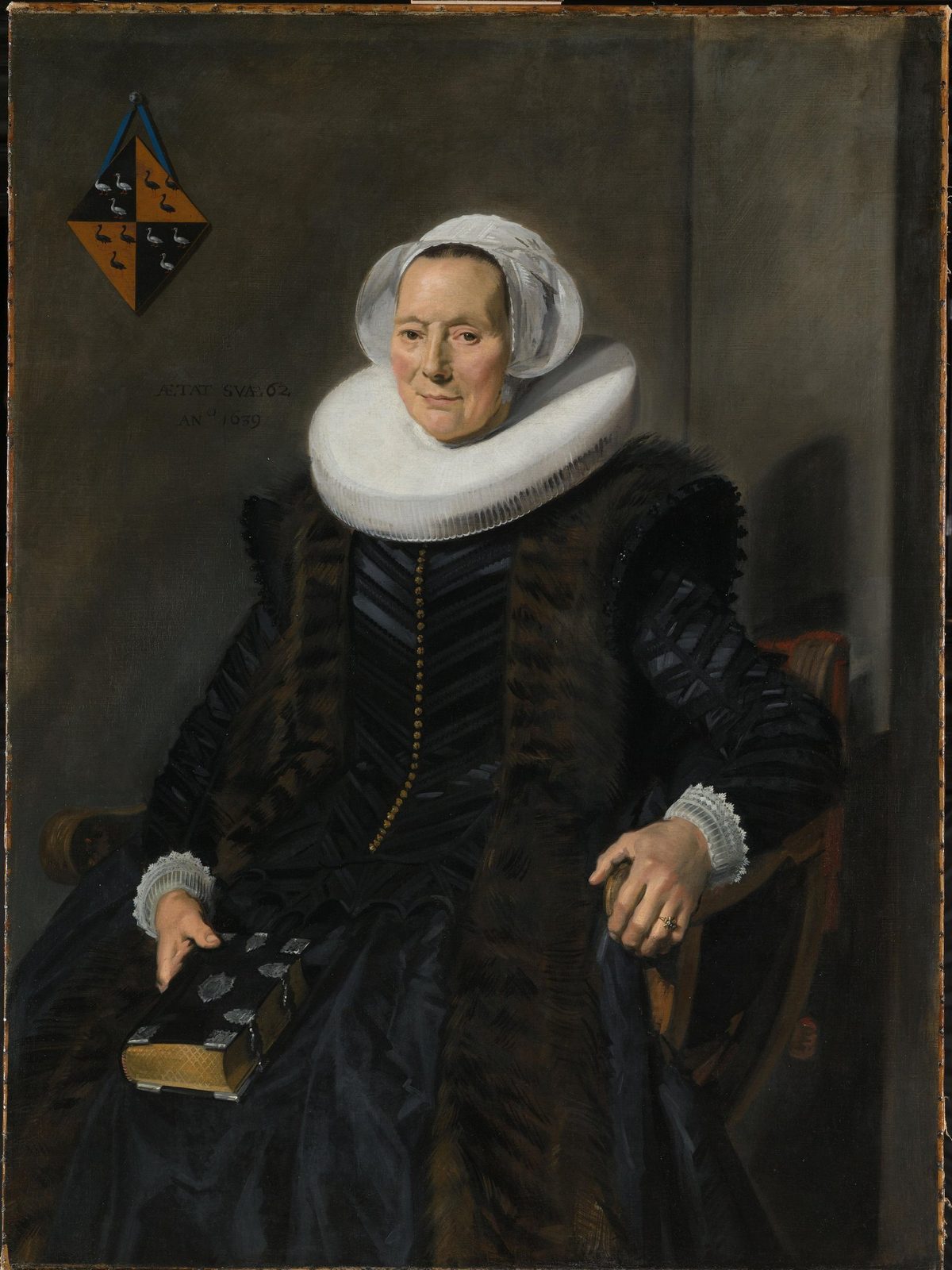
- Artist
- Frans Hals
- Title
- Portrait of Maritge Claesdr Vooght
- Date
- 1639
- Museum
- Rijksmuseum
- Image
- Public domain (CC0)
Open in Simple Art
Watch this story on iPhone and iPad, with offline downloads and a painting every day.
About 4 minutes of looking, in 9 parts.
Portrait of Maritge Claesdr Vooght
An older woman sits in a chair and looks calmly out at us. Her face is framed by a white cap and an enormous ruff, and below that is all black cloth and brown fur. One hand rests on a book, the other on the arm of her chair.
Haarlem, 1639, oil on canvas
Frans Hals painted her in oil on canvas. The inscription beside her head gives her age as sixty-two and the year as 1639. The coat of arms at the upper left was probably added later. The museum notes she came from a prosperous Haarlem brewing family, and that this portrait has a companion of her husband.
Narrow at the top, broad below
The shape is a broad triangle. The small pale head sits near the top, the ruff widens it, and the dark gown spreads out to fill the bottom of the canvas. Two hands steady the lower half, one on the book at the left and one on the chair at the right.
Light from the upper left
The light falls from the upper left. It catches the cheek and temple on our left, the bridge of her nose and the left curve of the ruff. The other side of her face drops into a cooler, greenish half-tone, and a soft shadow from her chin lies across the ruff.
Smooth face, thick cap
Come closer. The face is softly blended, passing from peach into warm brown shadow without hard lines. The white cap beside it is handled quite differently, with thicker, broken strokes that leave crisp ridges of light along the pleats and cool grey-blue in the folds.
A line of gold buttons
Down the front of her bodice runs a line of tiny gold buttons. Each is a single small dab of warm paint, with a lighter fleck near its centre and no outline at all. In a picture this dark, they are among the few warm notes, and they lead your eye downwards.
A hand on a prayer book
Her hand rests on a book the museum calls a prayer book. The thumb seems to press down on the cover. Now look at the book itself: silver-grey ornaments on black leather, each one a thick dab of light, and gilt page edges in warm yellow.
Lace in small touches
Across at her other wrist, the lace cuff is built from dozens of small white dabs and short strokes over cool grey. Together they read as flowers, leaves and looping threads. Beneath them, a stiffer pleated band is done in longer upright strokes.
Fur from flicked strokes
Now the fur trimming her gown. It's made of short, choppy strokes that keep changing direction, some flicking up, others curling, many ending in a dry, scratchy tail. Where the fur meets the black gown the edge is mostly crisp, though now and then a brown hair strays into the dark.
Look closer
7 details, each checked against a close-up of the picture.
-
Face and Cap
The facial features are modeled with soft blends while the white cap shows distinct, thick paint folds.
The crop shows the head, cap and ruff of a mature woman against a dark olive-brown background. The face is modeled with soft, blended transitions in warm flesh tones, the highest lights and rosier pinks sitting on the left forehead, the bridge of the nose, and the left cheek, while the right side of the face falls into a warm umber shadow. The white linen cap is built up with visibly thicker, more broken strokes: crisp ridges along the side pleats catch light against cooler grey-blue shadow folds, and the edges of the cap against the face and background are handled with confident, slightly dragged strokes rather than outlines. The large pleated ruff below is rendered with parallel, rhythmic vertical strokes that read as both structure and cast shadow, with the left edge catching brightest white and the right curve fading into warm grey.
-
Fur Trim Detail
The brown fur is created with short, flickering, multi-directional brushstrokes.
The crop is dominated by a diagonal band of brown fur trim crossing from upper-left to lower-center, set against an almost black gown on the right. The fur is built from dozens of short, choppy strokes that change direction constantly — some flick upward, others curl, and many break off abruptly mid-stroke, leaving dry-brushed tails where the brown ground or underlayer shows through. Above at the top edge sits the lower border of a white ruff drawn in repeating scalloped arcs of cream and pale gray, and at lower right a small tuft of white appears against the dark fabric. The right-hand gown is painted with broader, more horizontal sweeps in near-blacks, punctuated by thin gray-blue highlights that catch the ridges of folds. The boundary between the warm brown fur and the cool black gown is mostly crisp but occasionally lets a single brown bristle stray into the dark.
-
Ruff Lighting
The left side of the ruff is brighter than the right, indicating a light source from the upper left.
The crop frames the sitter's face and the uppermost tier of her large gauffered ruff against a dark, loosely brushed ground. The cheek and temple on the viewer's left are rendered in warm pinks and creamy ochres that sit at the highest value range of the face, while the right side drops into cooler, greenish-grey half-tones along the jaw and the right nostril wing. Crisp white strokes define the scalloped lower edge of the ruff on the right, but the corresponding band on the left reads as a continuous bright highlight broken only by faint grey modelling. Shadows cast by the chin fall onto the left-hand curve of the collar rather than the right, and the white linen cap gathers its strongest highlights on the left folds. The dark fur collar and background sit in the lowest value range, throwing the lit side of the face and ruff into higher contrast.
-
Lace Cuffs
The white lace at the wrists is rendered with crisp, staccato white marks over the dark sleeve.
The crop isolates a right hand emerging from a black sleeve, with a wide white lace cuff wrapping the wrist. The lace is built from dozens of small, discrete white dabs and short strokes that read as flowers, leaves, and looping threads over a cool gray-violet shadow. Beneath the lace, a stiff pleated/ribbed band (the inner cuff) shows vertical hatchings of white and gray. The hand's warm flesh tones — pinks, ochres, and a rosy flush along the knuckles — sit in strong value contrast against the near-black sleeve, and the cuff's bright white edges are the lightest notes in the frame.
-
Book and Clasps
The leather book features gold-edged pages and metallic clasps with a distinct highlight.
The crop isolates a hand gripping a dark leather-bound book against black drapery. The thumb at upper left is modeled in warm ochre flesh tones with a soft blended edge into a cool shadow. The book's cover is rendered in near-black with five lozenge or star-shaped silver bosses that catch thick, opaque highlights in cool gray-white, each highlight placed on the upper-left side of the boss to indicate the light source. The page edges are stacked at the bottom in a warm yellow-ochre, scored by a fine diagonal crosshatch that reads as a gilt-tooled lattice. The lower edge of the page block is sharply cut by a hard horizontal highlight, while the metal-to-leather boundaries are crisp and slightly raised.
-
Bodice Buttons
The row of buttons consists of small, warm gold-toned dots contrasting against the dark dress.
A descending line of small, warm gold-toned buttons runs from the upper center of the crop down to the lower left, curving gently with the body's contour. Each button is a quick dab of opaque paint, roughly 3-5 pixels across, with a slightly lighter fleck near the center suggesting a tiny highlight. The buttons sit atop a near-black ground that shows subtle warmer brownish and cooler bluish undertones, with V-shaped chevron-like patterns in muted dark blue-grey flanking the button row. The top edge of the crop reveals the lower fringe of a white-painted ruff with small repeating vertical strokes. Edges of the buttons are soft and slightly broken rather than crisp, and they remain legible purely through warm-against-cool value contrast rather than any drawn outline.
-
Right Hand
The fingers of the right hand are placed firmly on the cover of the book.
The crop isolates a right hand emerging from a frilled white linen cuff at upper left, descending into a dark mass that resolves into the leather cover of a small book. The thumb is the dominant gesture: bent at the interphalangeal joint, it presses firmly downward, its pad resting on the cover while a darker crescent of cast shadow pools beneath the nail. The fingers below the thumb are only partially read, suggested by a few pale strokes against the black ground rather than fully modeled. The book cover is studded with lozenge-shaped silver-gray ornaments applied in thick, broken strokes that catch the upper-left light. Edges between flesh and black are softened with no hard outline, the silhouette turning on value rather than contour.
Portrait of Maritge Claesdr Vooght in context
A brewing family
Maritge Claesdr Vooght (1577-1644) was the daughter of Claes Albertsz Vooght, owner of the Haarlem brewery Int Hoeffijser, and Volckje Willemsdr Lakeman. In 1595 she married Pieter Jacobsz Olycan in Haarlem [1]. The Rijksmuseum's display text says the marriage allowed him to hold high office and made him co-heir to the brewery [1]. The couple also founded a brewery of their own. It was registered in his name, as was then usual, and their daughter Geertruyt later carried on the business [1].
Olycan came from a successful Amsterdam merchant family, had studied commerce in Rome and taken part in four trade missions to Spain and the Baltic before settling in Haarlem as a brewer [1]. In 1618 Prince Maurits appointed him to the city council, and he later represented Haarlem in the States General six times and served five terms as burgomaster [1]. The couple had 15 children, most of whom, if they survived childhood, married into other wealthy brewing families with power in the city government [1].
Hals and the Olycans
Hals portrayed the family for much of his career, beginning with the 1625 wedding portraits of their eldest son Jacob Pietersz Olycan and Aletta Hanemans, now in the Mauritshuis [1]. He also painted Maritge's brother Willem Claesz Vooght as a colonel in the arquebusiers' civic guard group of 1627, and her sister Cornelia with her husband Nicolaes van der Meer in 1631 [1]. Jonathan Bikker, in the museum's 2007 catalogue, notes that Maritge sits in the same pose Hals had first used for Cornelia, a type derived ultimately from Titian and Antonio Moro [1].
Both sisters wear rather old-fashioned but expensive clothes suited to their age and station: double cambric caps, millstone ruffs, boned stomachers and fur-lined vliegers, long sleeveless overgarments worn open [1]. Unlike her sister, Maritge holds her prayer book upside down so the viewer can see it, probably as a reference to her piety [1].
A divided pair
The pendant of her husband is in the John and Mable Ringling Museum of Art in Sarasota, Florida. The two were separated in the nineteenth century [1]. His portrait is not inscribed but was certainly painted in 1639, one of his years as burgomaster. Conservator Gwen Tauber found that both canvases have the same weave density, so they were probably cut from the same bolt [1]. His canvas has been cut down, mostly at the right and bottom. And, as often in Hals's pairs, the man's portrait is painted more loosely than the woman's [1].
Hals had already painted Olycan a few years earlier. Grimm notes that the 1666 inventory of the couple's daughter Geertruyt records two pairs of portraits of them, one in the entrance hall and one elsewhere in the house [2]. In 2007 the Ringling museum showed the two 1639 portraits together. CODART described this as their first reunion in centuries, following a conservation treatment of Maritge's portrait that revealed details added well after Hals's death [3].
How much is Hals's?
The museum has no doubt about the sitter's identity, but traces of Prussian blue show that the coat of arms was added after about 1720; the museum treats the inscription giving her age as authentic [1]. Its technical note by Gwen Tauber describes a ground of warm beige, a thin first lay-in in dilute washes and paint built up in thin layers from background to foreground, and rates the condition as good after Tauber's complete restoration of 2006-2007 [1].
Claus Grimm, in his online RKD catalogue of Hals and his workshop, takes a more critical view and lists the picture as by Frans Hals and workshop [2]. He finds Hals's angular brushwork unchanged only in a few places, such as the right side of the cap, parts of the face around the lips and nose, the black silk of the sleeves and one cuff [2]. Elsewhere, including the ruff, the hands, the fur trim and the folds of the black gown, he sees a smoothing overpaint. He suggests the patrons asked for changes that were carried out by another hand, perhaps delegated by Hals himself [2]. This is one scholar's reading rather than the museum's position [1][2].
From the Bernard sale to Amsterdam
The painting's early history is uncertain. It may be one of the portraits in Geertruyt Olycan's 1666 inventory. And Tauber found an eighteenth-century family tree suggesting the Van Sypesteyn family once owned portraits of the couple [1]. It reappears at the sale of Jean Bernard in Amsterdam on 24 November 1834. There the dealer Jeronimo de Vries bought it for 160 guilders and sold it for 180 guilders to Adriaan van der Hoop [1]. Van der Hoop bequeathed it to the City of Amsterdam with the rest of his collection in 1854. It has been on loan to the Rijksmuseum since 30 June 1885 [1].
- Frans Hals, Portrait of Maritge Claesdr Vooght (SK-C-139): object record, technical note (Gwen Tauber) and catalogue entry (Jonathan Bikker, 2007) . Rijksmuseum, Amsterdam
- Claus Grimm, Frans Hals and his Workshop, cat. nos. A3.32-A3.33a . RKD Studies, RKD Netherlands Institute for Art History
- A Dutch Master: Two Portraits by Frans Hals Reunited (exhibition listing, John and Mable Ringling Museum of Art, 2007) . CODART