Nobody looks at the prince
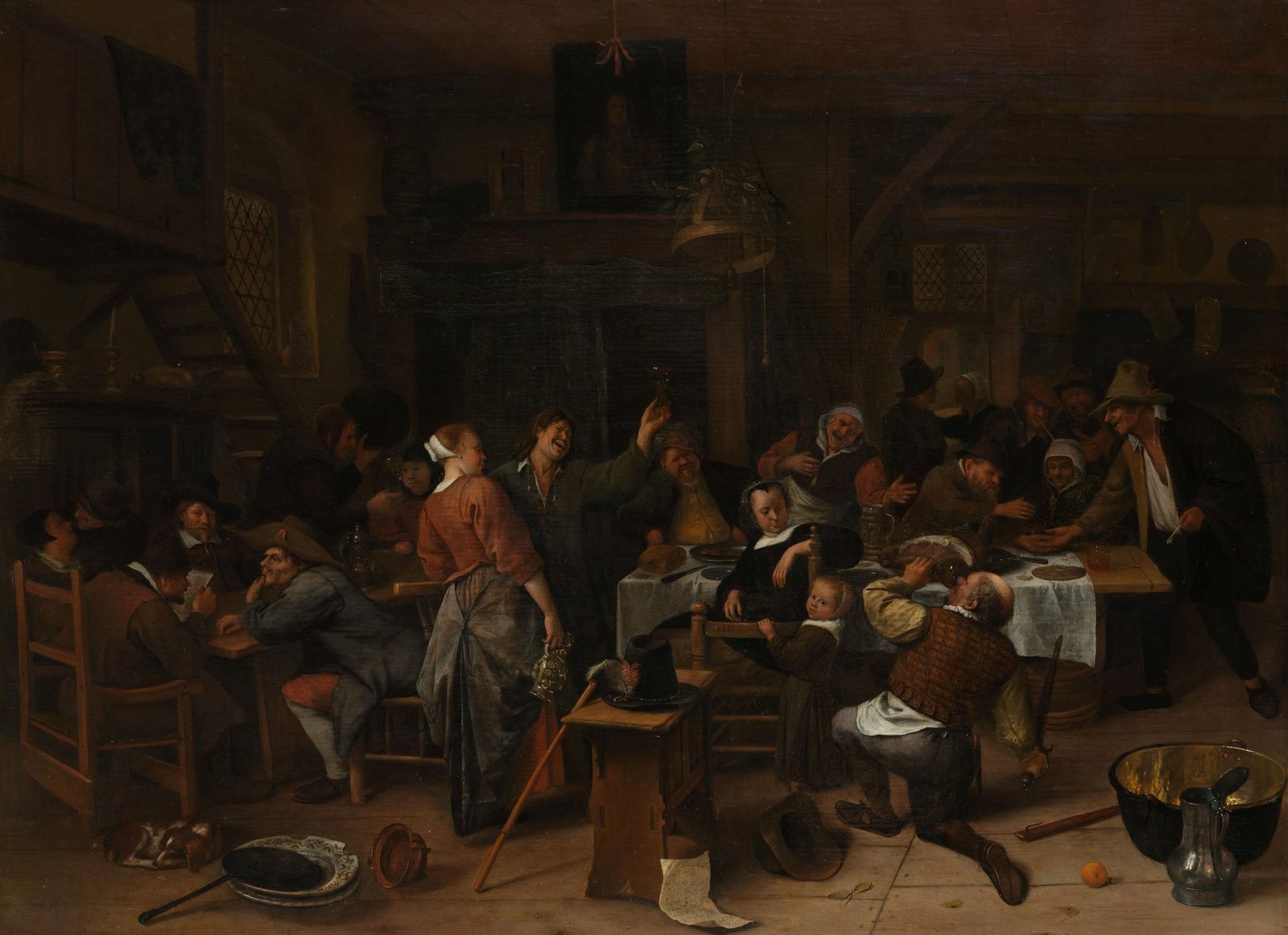
Jan Steen's tavern party for William III's birthday, with the toast written out on a scrap of paper on the floor
- Artist
- Jan Havicksz. Steen
- Title
- Prince’s Day
- Date
- 1660 - 1679
- Museum
- Rijksmuseum
- Image
- Public domain (CC0)
Open in Simple Art
Watch this story on iPhone and iPad, with offline downloads and a painting every day.
About 3 minutes of looking, in 9 parts.
Prince's Day
A tavern full of people, all talking at once. A man raises his glass high and laughs, a woman with a jug turns towards him, and in front a man kneels on the floor, head tipped right back, drinking. Everyone here is celebrating something.
Jan Steen, 1660 to 1679, oil on panel
This is Jan Steen's Prince's Day, painted in oil on panel some time between 1660 and 1679. The Rijksmuseum explains the occasion. It was a popular feast day for the birthday of Prince William the Third of Orange-Nassau, born on the fourteenth of November 1650.
The toast on the floor
Find the sheet of paper lying on the floor near the middle, just in front of the little table. The museum records what's written on it. It's a toast to the health of the young Nassau prince, with a rapier in one hand and a glass in the other. That's the plan for the whole party.
Drinking to the prince
This man seems to be taking the toast to heart. He kneels, throws his head back and raises his arm to tip a jug to his mouth, his whole body leaning backwards. A white napkin lies across his knee, and his patterned doublet is all broken, smudged strokes.
The prince on the wall
High on the back wall, above a box bed, hangs a dark portrait. The museum identifies it as the prince, with a red ribbon tied above the frame. It's barely more than a pale oval of a face. And as the museum points out, nobody in the room is looking at it.
Reading aloud
On the far left, almost lost in shadow, a group sits round a smaller table. According to the museum, one man is reading something aloud from a paper. Only slivers of faces and the bars of a wooden chair catch the light.
The lit tablecloth
Now the long table in the middle. Its white cloth is the brightest thing in the room, with bread, plates and a knife laid on it. The highlights are broken patches of off-white, and they fall away quickly into warm grey, then deep brown.
A child at the table
Just in front, a small child by the table looks straight out of the picture, wide-eyed. A crisp white collar frames the face, the sharpest edge in this corner. In all the noise, the child seems to be the only one who notices us.
Copper and pewter
Bottom right, a large copper basin and a pewter jug sit together on the floor. The copper glows with warm orange-gold dabs, while the pewter stays cool grey with crisp white highlights. Keeping the two temperatures apart is what makes them read as different metals.
Look closer
6 details, each checked against a close-up of the picture.
-
The reclining drinker
A kneeling man tilts his body backwards, head thrown back, raising his arm to drink from a jug.
The crop isolates a balding man in a red-brown patterned doublet and yellow-ochre sleeves, his torso canted backward roughly 30-40 degrees from vertical, head tipped fully back so the chin points at the ceiling. His raised right arm forms a strong diagonal from shoulder to the rim of a jug held against his mouth, with knuckles and tendons modeled in short, slightly broken strokes over a warm flesh tone. A hard white-edged cloth napkin lies across his gray breeches, its crisp folds contrasting the soft, smudged transitions in the doublet's checkered weave. The floor is a thin tan plane with scattered leaves, and a young girl's pale face peers in from the left, her white bonnet catching the brightest value in the lower half.
-
Tablecloth highlights
Bright white highlights on the cloth create a sharp contrast against the deep brown background.
The crop is dominated by a white tablecloth that occupies the left and central portion, set against a near-black warm brown background. The brightest highlights on the cloth appear as opaque, broken patches of cool-warm off-white clustered near the left edge and along the crest of the front fold, falling off quickly into warm gray mid-tones and then into deep umber shadows where the cloth tucks under the table. Edges between the cloth and the background are crisp and abrupt on the upper left, while the front apron of cloth shows softer, more modulated transitions. A loaf of bread, dark plate, knife handle, and ceramic vessels sit on the surface, their dark passages reinforcing the value gap between the lit cloth and the surrounding void.
-
The child's expression
A young child stands by the table with a wide-eyed, curious expression.
The crop centers on a small child's face in the lower right, with a dark-clad woman leaning above and behind. The child's forehead and cheek catch warm light from the left, modeled with soft pinkish-ochre flesh tones that blend into cooler brown shadows along the jaw and neck. The eyes are dark ovals with tiny pinpoint highlights, framed by faint lashes applied in single thin strokes; the mouth is a small, softly edged horizontal. Above, the woman's downcast face sits in deeper shadow, her contour merging into the warm brown ground. A crisp, scalloped white lace collar edges the child's dark garment, offering the strongest value contrast in the frame. Brushwork is loose and blended across the flesh, with slightly more loaded paint defining the lace.
-
Metalware textures
The copper pot and pewter jug exhibit distinct metallic glints and reflective highlights.
The crop centers on a copper bowl and a pewter jug resting on a planked wood floor beside a small orange fruit. The copper's interior is rendered with broken, mottled dabs of warm orange-gold (roughly #C8943A range) set against deep umber shadows, producing a hammered, uneven surface rather than a smooth plane. The pewter jug reads cooler, built from neutral greys with crisp, opaque white highlights concentrated on the neck, spout lip, and shoulder, while the body shows softer, broader tonal transitions. Edges vary in hardness: the copper rim is a sharp dark contour catching a thin bright sliver, whereas the pewter silhouette softens into the shadow it casts across the copper bowl. The two metalware forms read distinctly because warm and cool palettes are kept separate, even where the pewter overlaps the copper.
-
Background portrait
A small dark framed portrait hangs high on the back wall, with a red ribbon above it.
The crop shows a heavily darkened rectangular field reading as a framed portrait against a wall, with a small coral-red ribbon-and-bow motif hanging from the top edge (roughly upper-center, ~y 0.05-0.20). Within the frame, a single oval mass of slightly warmer, paler brown reads as a face (~0.30-0.55 vertically, slightly left of center), but features dissolve into the surrounding umber; only a faint highlight on the forehead and a soft chin edge are legible. The frame edge is barely registered as a straight vertical break on the right side near x≈0.78. Greenish leaf shapes intrude from the lower right corner (~0.80-1.00, y 0.55-0.95), painted with cooler, more saturated strokes that catch a touch of light. Overall the passage is dominated by low-value warm browns, with the face and ribbon serving as the only chromatic accents.
-
Left side figures
The figures on the left are partially obscured by shadows and a wooden chair back.
The crop is dominated by deep umber and near-black passages, with two figures on the far left reduced to fragments: a partial profile (roughly 0.05-0.15, 0.10-0.25) and another head behind it, both nearly lost in shadow. A warm wooden ladder-back chair (0.15-0.55, 0.15-0.75) runs vertically through the middle, its slats creating rhythmic breaks that further occlude the seated figure. A sleeping spaniel curls at the floor center-bottom (0.35-0.55, 0.85-0.98), and a dark frying pan rests at the lower right. The light catches only slivers of cheek, brow, and chair edge, while the rest dissolves into a unified dark mass with very soft, almost imperceptible transitions.
Prince's Day in context
A prince without an office
When the stadholder William II died in 1650 before his son was born, the States party, which opposed a hereditary stadholdership, took the chance to abolish it, opening what is called the First Stadholderless Period [3]. Against them stood the Orangists, supporters of the Prince of Orange-Nassau [3]. The child born after his father's death, William III, came into the world on 14 November 1650, and his birthday was celebrated as a popular feast known as Prince's Day [1].
R. Cordes, in a 2008 doctoral study of the poet Jan Zoet, calls Steen's panel a political genre piece [2]. The Rijksmuseum's description lists the signs of the occasion: a portrait of the prince on the wall above a box bed, and a copper chandelier over the table hung with an orange branch and a bell [1].
Words in the picture
Besides the toast on the paper in the foreground, which reads in the original 'Op de gesonheyt van het nasauss basie in de eene hant het rapier in de andere hant het glaesie', the museum records two more inscriptions [1]. The chandelier carries the Latin motto 'Salus patriae suprema lex esto', let the welfare of the fatherland be the supreme law, and the box bed bears the Dutch words 'Wij screuwe als leuwe' [1]. Steen signed 'J. Steen' on the same piece of paper, behind the toast [1].
The earliest publication the museum lists is an article titled 'De prinsjesdag van Jan Steen' in the 1871 journal De oude tijd [1]. It also lists the picture in Dichters om Oranje, a 1946 anthology of Orangist poetry [1].
A painted pamphlet?
It isn't certain that the painting celebrates the Orangists. Cordes summarises the analysis of art historian Lyckle de Vries, who called the scene a painted pamphlet [2]. De Vries thought the inn wasn't a real place. He believed the picture pokes fun at the common people who should be seen as Orange supporters, played by the drunkards and brothel visitors Steen mocked again and again in other works [2]. He suggested that such an unusual subject might even have been commissioned from the Catholic Steen by someone on the States party side [2].
Steen's family was indeed Catholic, and he lived in Haarlem from 1660 or 1661 until about 1670 [2][4]. The date of the picture is unsettled. The Rijksmuseum gives 1660-1679, while Cordes reports that De Vries thought it most likely painted between 1665 and 1668, which would place it several years before William was made stadholder [1][2][3].
A poet at the corner table
Cordes adds a hypothesis of his own. The man seated at the table in the left corner, apart from the merry crowd, closely resembles the few known portraits of the Amsterdam poet and innkeeper Jan Zoet (1609-1674), a fervent supporter of the House of Orange [2]. If so, the serious little group there, in which one man reads aloud from a pamphlet, might set a committed Orangist against the rabble around him [2]. Cordes himself stresses that the identification rests on appearance alone and that the occasion shown can't be pinned down [2].
1672 and after
The stadholderless period ended in the Disaster Year of 1672, when the Republic was at war with England, France, Münster and Cologne [3]. William III was made commander-in-chief and stadholder, and on 20 August Johan and Cornelis de Witt, leaders of the States party, were murdered by a mob at the Gevangenpoort in The Hague [3]. That same year, with the art market in crisis, Steen was licensed to run an inn in Leiden [4].
The painting came to the Rijksmuseum in 1870 with the bequest of L. Dupper Wzn. of Dordrecht [1].
- Jan Havicksz. Steen, Prince's Day (SK-A-384): object record . Rijksmuseum, Amsterdam
- R. Cordes, Jan Zoet, Amsterdammer 1609-1674: leven en werk van een kleurrijk schrijver (PhD thesis, 2008), section 9.2, 'Jan Steen, Jan Zoet en de herberg' . Vrije Universiteit Amsterdam, VU Research Portal
- De gebroeders De Witt . Canon van Nederland
- Piet Bakker, 'Jan Steen' (2017), in The Leiden Collection Catalogue, ed. Arthur K. Wheelock Jr. (archived PDF, 2020) . The Leiden Collection, New York