Colour beside colour
How Van Gogh makes a pale summer riverbank flicker with short strokes laid side by side
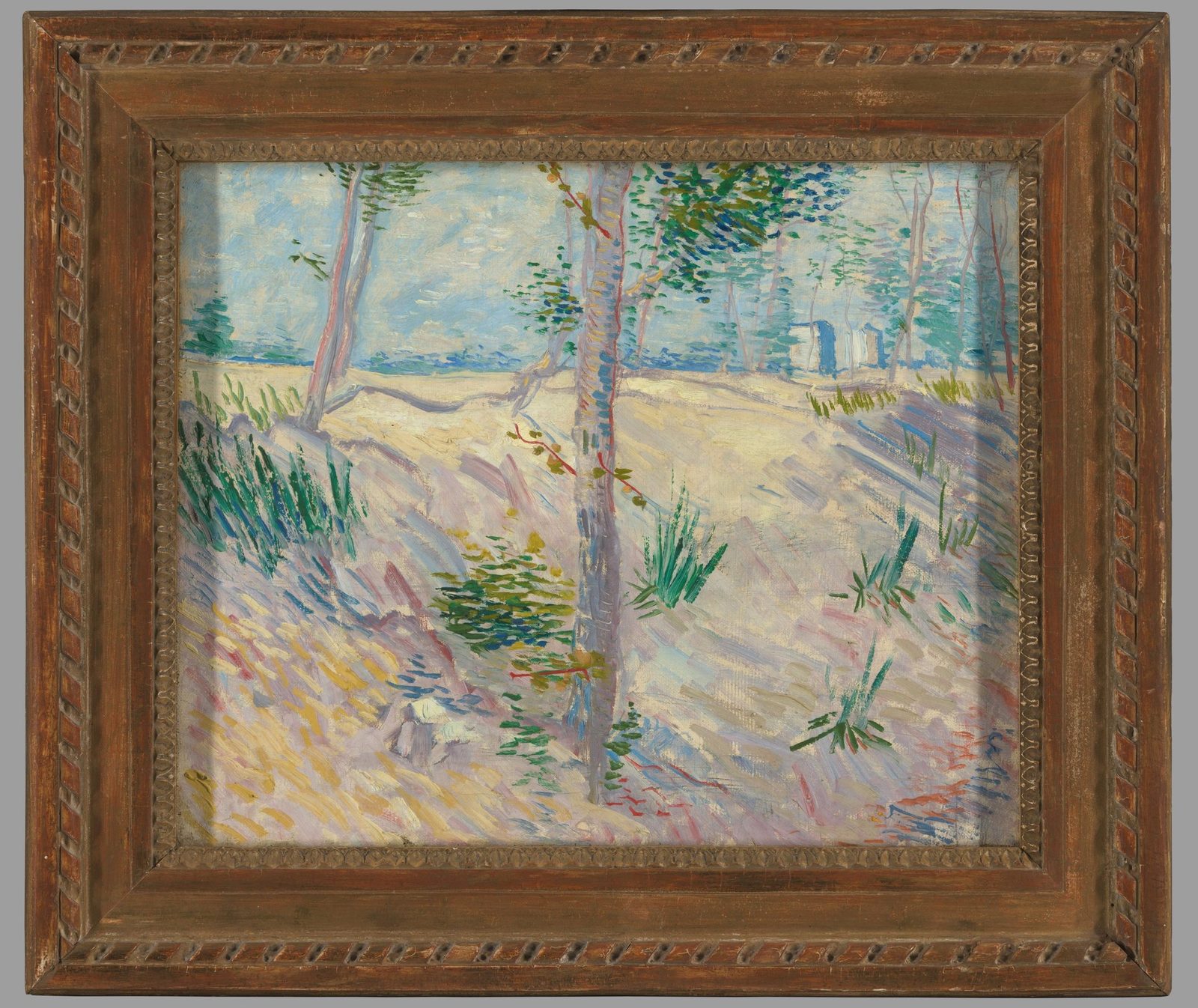
- Artist
- Vincent van Gogh
- Title
- Riverbank with Trees
- Date
- 1887
- Museum
- Rijksmuseum
- Image
- Public domain (CC0)
Open in Simple Art
Watch this story on iPhone and iPad, with offline downloads and a painting every day.
About 4 minutes of looking, in 9 parts.
A quiet bank that hums
A pale, sloping riverbank, a few slender trees and a soft sky. At first it looks hushed. Look a little longer, though, and the whole surface seems to flicker, because it is made of separate strokes of colour laid side by side.
The Seine, summer 1887
Vincent van Gogh painted this in oil on canvas in 1887. The Rijksmuseum identifies the place as a bank of the Seine near Asnières, outside Paris, where he enjoyed painting that summer. It shows him trying out the bright colours, short brushstrokes and modern compositions of the French Impressionists.
A sloping bank, an upright trunk
Read the structure first. The pale bank slopes across the picture on a strong diagonal, and a slender trunk near the centre stands straight up against it. That one vertical divides the canvas and steadies the slope.
Even, pale daylight
There is no strong sun here, just even, soft daylight. The brightest passages are the pale sky and the cream bank. Even the distant buildings are only pale blue and white blocks with no outlines. Their edges are simply where cool blue meets warm cream.
A trunk that isn't brown
Now the central trunk. It isn't brown. It's a column of short pink, lavender and pale blue strokes, with thin red lines along its edges. The right side carries more cool blue and the left reads lighter, so colour does the modelling.
Diagonal streaks of bank
Slide into the bank. It is laid in long, parallel diagonal strokes of cream, pale yellow, lavender and dusty pink, side by side rather than blended. In the thinner streaks you can see the weave of the canvas, and every stroke keeps the same tilt, which is what makes the ground slope.
Leaves against the sky
Lift up to where a tree meets the sky. There is no contour line. Green dabs sit on one side, short strokes of blue and cream on the other, and the edge is simply where one colour stops and the next begins. A few loose flecks of green float out into the sky.
Colour beside colour
Now compare two patches of ground. In the first, small dabs of green sit right against pinkish-purple strokes, and the edges seem to buzz. In the second, the shadows are lavender and soft blue over warm cream, with no black or brown at all. In both, separate colours sit next to each other instead of being mixed into a neutral.
One dab, one leaf
Up in the foliage, each leaf looks like a single dab of yellow-olive, sap green or blue-green, kept separate with crisp edges. The greens seem to have been mixed before they reached the canvas rather than blended on it. Start counting, and you will find a surprising number of different greens.
Look closer
7 details, each checked against a close-up of the picture.
-
Central Tree Trunk
The trunk is composed of vertical strokes of pink, lavender, and pale blue.
The central trunk rises as a column of short, vertical-to-slightly-curving strokes that read as a stack of color rather than a unified brown mass. The core is built from pink, lavender, and pale blue dabs laid side-by-side, with white and yellow-ochre flecks in the upper-middle. Thin vermilion contour lines run along the left and right edges, separating the trunk from the surrounding foliage and ground. The right side of the trunk carries denser cool-blue shadow dabs, while the left side reads lighter, suggesting ambient light from the front-left. Small green and yellow leaf clusters interrupt the column at the top, middle-left, and middle-right.
-
Embankment Strokes
The ground is rendered using long, diagonal, parallel streaks of cream and yellow.
The crop shows the upper pale embankment of a landscape rendered with broad, sweeping diagonal strokes running from upper-left toward lower-right. These strokes carry cream, off-white, pale yellow, lavender, dusty pink, and cool blue-grey tones, layered side-by-side with the canvas weave visible in the thinner passages. A slender tree trunk on the right is constructed from short vertical blue and grey dashes, while a red branch arcs across the upper right carrying small green leaf dabs. Green and yellow horizontal flickers form grass-like vegetation across the lower third, contrasting with the long diagonal sweep of the embankment behind it.
-
Complementary Contrast
Small dabs of bright green foliage sit directly adjacent to pinkish-purple ground strokes.
The crop shows a dense cluster of short, horizontal-to-diagonal dabs of green (olive, yellow-green, and dark forest green) interspersed with blue flecks, sitting directly over a ground of pinkish-lavender and mauve strokes. The tree trunk on the right is rendered in cool blue-purple with vertical hatching. A single saturated red horizontal stroke cuts across the lower-right area, and pale yellow-ochre touches appear near the top edge. The canvas weave and pale underpainting show through in gaps between marks, confirming a wet-into-wet, broken-color approach.
-
Foliage Dabs
The green leaves are applied as short, separate dashes and dots of varying greens.
The crop is dominated by a dense cluster of short, individual green and blue dabs in the upper-left to upper-center, set against a pale, thinly painted blue-white background where the underlying canvas weave shows through. The green marks vary from yellow-olive and sap greens to deeper blue-greens, and are clearly applied as discrete dashes and comma-shapes rather than blended washes, with the paint sitting on top of the lighter ground. Thin vertical pinkish-mauve lines run from top to bottom across the right and center, reading as slender tree trunks, and a few warm yellow and red-orange strokes appear at the far left edge. Edges between dabs are crisp and unblended, and the layering is shallow — the green sits over the pale ground rather than being built up in opaque layers.
-
Shadow Tones
The shadows on the ground consist of lavender and blue strokes rather than black or brown.
The crop shows a sloping ground area where the shadow zones are built from short, broken strokes in pale lavender, soft periwinkle blue, and diluted mauve-pink, layered over a warm cream underlayer. Green linear marks (foliage from slender trees) cut across the upper and middle areas, with a denser green cluster near center. Accent strokes of coral-orange and dusty rose are scattered along the right and lower edges, but no black, umber, or deep brown is visible in the shadow passages. Edges are soft and dry, with visible canvas tooth peeking through gaps in the paint film, and the brushwork follows a generally diagonal slope from upper left to lower right.
-
Distant Structures
The buildings on the horizon are simplified into small, pale blue and white rectangular blocks.
The crop shows distant structures as roughly three pale blue rectangular masses with whitish-blue right edges, set against a loose field of cream, beige and pale blue horizontal strokes. Thin vertical lines in lavender-grey — the trunks/branches seen in the wider view — cut down through the blue blocks, ignoring the building edges and unifying foreground and background. The architecture is not drawn: its outline is the meeting between cool blue masses and the warmer cream ground. At the lower margin, short vertical green dashes read as grass, while scattered pink and emerald-green flicks at the upper edges suggest tree foliage.
-
Tree-Sky Interface
The edges of the tree branches against the sky are soft and broken, not sharp lines.
The crop centers on a slender trunk rendered as a vertical column of pink-coral, lavender, and pale ochre strokes running top-to-bottom against a sky of broken pale blues, cream, and warm whites. At the top, clusters of foliage are built from short, dabbed green strokes that do not resolve into a clean silhouette. Small detached flecks of green (and a few pinkish dashes) float in the sky to the left, reading as separate marks rather than as part of a continuous branch outline. Where green meets blue, the boundary is a jagged, rhythmic alternation of strokes; no contour line binds them. Canvas weave shows through the thinner sky passages, especially along the right side.
Riverbank with Trees in context
A bank of the Seine, under two titles
The Rijksmuseum describes the painting as a close-up of a bank of the Seine near Asnières, outside Paris, and lists it in the Van Gogh catalogues as F 291 and JH 1314 [1]. The museum's data record also keeps an older Dutch title, 'Bomen in een veld op een zonnige dag', or 'Trees in a field on a sunny day' [2].
Martin Bailey, writing in The Art Newspaper, places the spot more precisely, probably on the northern side of the Ile des Ravageurs, and identifies the pale blocks in the background as two apartment buildings in Asnières [4]. The season is less settled than the year: the museum says Van Gogh enjoyed painting there in the summer of 1887 [2], while Bailey dates the picture to spring 1887 [4].
What Paris taught him
The Van Gogh Museum explains that in Paris his brother Theo introduced him to the work of modern painters such as Claude Monet, and that at Fernand Cormon's studio he met younger artists including Henri de Toulouse-Lautrec and Emile Bernard [5]. His palette grew steadily brighter, he developed a style of short brushstrokes, and his subjects shifted from rural labourers to cafés, boulevards and the countryside along the Seine [5]. The same page reproduces a photograph of Van Gogh, seen from behind, with Bernard by the Seine at Asnières, dated about 1886 [5].
Asnières was a day-trip destination for well-to-do Parisians but also an area of industrial development [6]. Paul Signac painted there 'dot by separate dot' in unmixed, contrasting colours, and the Van Gogh Museum says Van Gogh admired this skill and tried to emulate it [6]. The museum suggests he may have seen Signac's view of the Asnières jetty at the Salon des Indépendants in 1887 [6]. The Rijksmuseum reads Riverbank with Trees as part of this experiment with the bright colours, short brushstrokes and modern compositions of the French painters [1].
From a sister to a dealer's foundation
According to Bailey, Vincent gave this picture to his sister Lies [4]. The sources consulted here don't say how it later left the family, so that part of its history is best left open.
It eventually belonged to Piet de Boer (1894-1974), an Amsterdam dealer in old master paintings who, according to his firm, had a particular fondness for Van Gogh [7]. After his wife Nellie Pressburger died in 1960, he transferred the paintings and drawings he had collected to a foundation named after them both [7]. The firm says he acquired three paintings and four works on paper by Van Gogh [7], while the Rijksmuseum's press release speaks of three paintings and five drawings [3].
Beside a self-portrait in Amsterdam
The P. & N. de Boer Foundation lent the Rijksmuseum three Van Gogh paintings on a long-term basis: View of Amsterdam from Central Station (1885), Riverbank with Trees (1887) and Wheat Field (1888) [3]. The museum said the loan allowed it, for the first time, to show the artist's development, and the three works hang with its own Van Gogh self-portrait [3].
Bailey reported in April 2024 that the loans had just gone on display, with the spring 1887 self-portrait at the centre of the arrangement in room 1.18 [4]. He also noted that before the loan, the Rijksmuseum owned five drawings but only two paintings by Van Gogh [4].
- Vincent van Gogh, Riverbank with Trees (SK-C-1844): object record . Rijksmuseum, Amsterdam
- Riverbank with Trees (SK-C-1844): Linked Art data record . Rijksmuseum, Amsterdam
- Rijksmuseum receives three Van Gogh paintings on long-term loan (press release) . Rijksmuseum, Amsterdam
- Martin Bailey, 'The paint was still wet: a closer look at three Van Gogh paintings heading to the Rijksmuseum' (5 April 2024) . The Art Newspaper
- Vincent van Gogh's Style: From Dark to Light, 1886-1888 . Van Gogh Museum, Amsterdam
- Paul Signac, The 'Ponton de la Félicité' at Asnières (Opus no. 143): collection entry . Van Gogh Museum, Amsterdam
- The Foundation . Kunsthandel P. de Boer, Amsterdam