Follow the bend
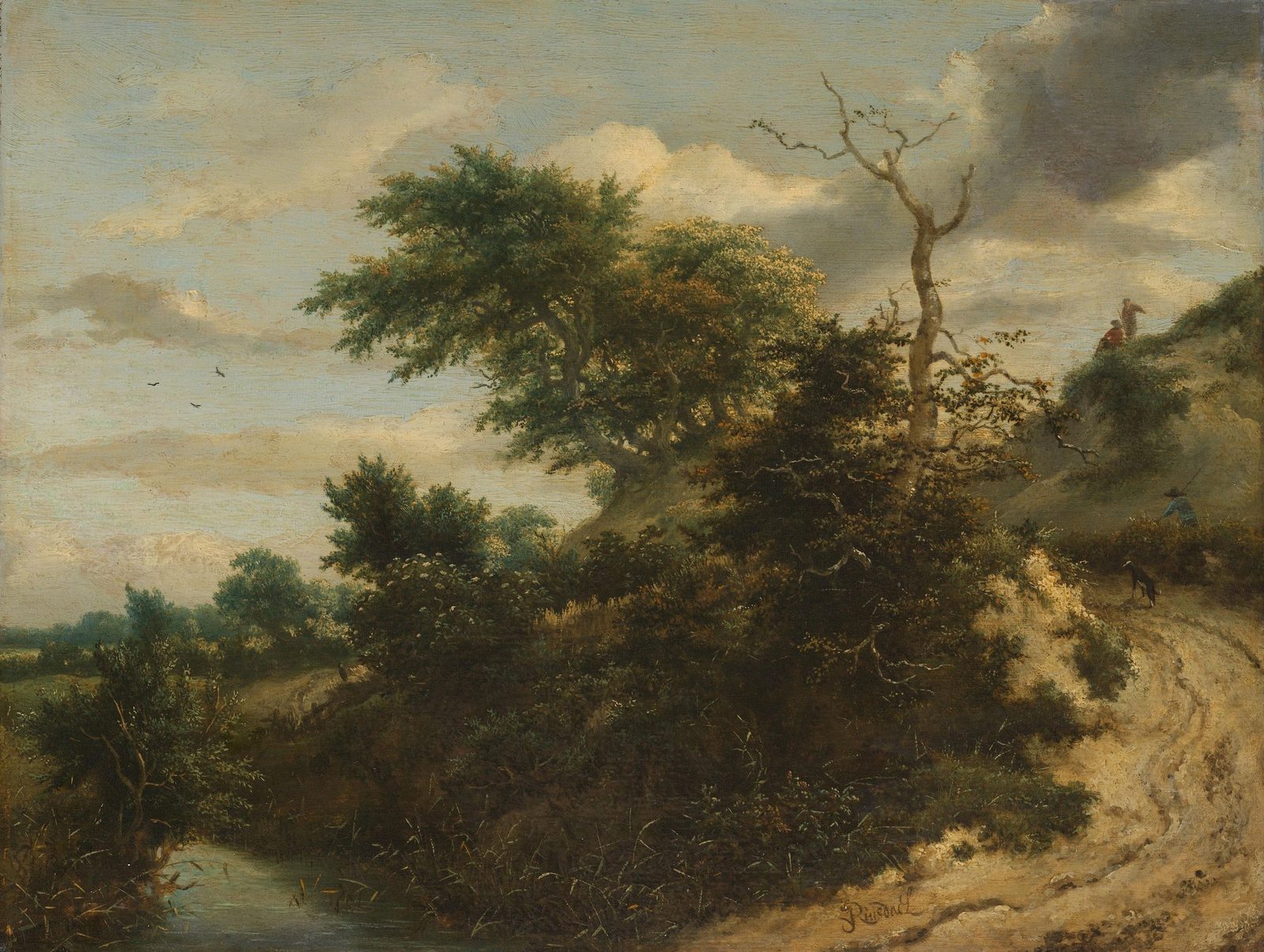
How the young Ruisdael ties a sandy track, two walkers and a stand of trees into one curve
- Artist
- Jacob Isaacksz van Ruisdael
- Title
- Sandy Track in the Dunes
- Date
- c. 1650 - c. 1655
- Museum
- Rijksmuseum
- Image
- Public domain (CC0)
Open in Simple Art
Watch this story on iPhone and iPad, with offline downloads and a painting every day.
About 3 minutes of looking, in 9 parts.
A track that bends out of sight
Put your eye at the bottom right, where the sandy track enters the picture, and follow it. It curves up the side of the dune and out of sight over the top. Now look above it. The same curve seems to carry on through the crowns of the trees.
An early work, on panel
This is Sandy Track in the Dunes by Jacob Isaacksz van Ruisdael, oil on panel, from around 1650 to 1655. The Rijksmuseum calls it a youthful work. It notes that he was already looking for ways to make a landscape feel tangible, linking everything from the reeds in front to the far horizon.
Pale diagonal, dark mass
The design is a contest between two shapes. A pale diagonal of sand climbs the right side, while a dark, heavy mass of trees and scrub fills the centre. On the left the horizon sits about two thirds of the way down, so the sky opens out behind the trees.
Sand you can almost feel
Here is the track up close. The sand seems to be made of dry, dragged strokes of ochre and cream over a darker brown, so the underlayer shows through in places. The marks run with the slope, and a few dark flecks read as pebbles. That broken surface is what makes it feel gritty.
A walker with a staff
Partway up, a figure in a blue jacket and dark hat walks along the track, a staff over one shoulder. Just below is something small and dark, perhaps a dog. Neither is really drawn. They're quick notations, softened into the grass.
Two people at the top
At the top of the dune are the two people the museum describes enjoying the view. One wears a rust-red cloak, the strongest colour in the picture. The other is kept to quiet middle tones, almost part of the slope. Your eye, like theirs, has reached the high point.
A dead tree against the sky
Behind them stands a bare, dead tree. Its branches are thin dark lines that taper as they go, laid over the pale sky rather than left out of it. The trunk is a little broader, lighter on its left side and darker on the right.
Where the curve carries on
Now the living tree in the centre. Its crown swells in a long arc that seems to echo the bend of the track below. The leaves are small warm dabs over a dark olive mass, brightest on the left where the light comes from, and the edge of the crown is scalloped, never outlined.
The dark foreground
Down in the foreground, the scrub is one continuous shadow of dark brown and olive. Thin pale strokes, grass or reeds, are scattered across it, and a few cooler dabs catch a weak light. Keeping this so dark makes the sunlit track look brighter still.
Look closer
8 details, each checked against a close-up of the picture.
-
Central Tree Crown
The foliage is composed of dappled yellow-green highlights against dark olive under-painting.
The crop centers on the tree's leafy mass, where small, loaded dabs of warm yellow-cream sit on top of a continuous olive-green underlayer. The lit left-facing clusters of leaves read as bright specks (the brightest reaching near #E8D89A), while the right-facing and recessed pockets fall into a dark, almost blackened olive that reads as deep shadow. Edges are broken: the silhouette of the crown is scalloped, not drawn, with leaf dabs and background sky/sand tones interlocking so that no single contour is fully closed. Underlying branches and the trunk are visible only as warm brown (#5A4222) verticals peeking through darker leaf masses, indicating the foliage was built over a pre-established dark mid-tone rather than around bare canvas.
-
Upper Traveler
Two small figures are at the top of the dune; one wears a rust-red cloak.
The crop is dominated by a pale, warm cream-beige expanse of sky or sunlit sand occupying roughly the upper two-thirds, brushed with thin horizontal drags that leave the ground or panel faintly visible in low-relief ridges. In the upper right at about (0.62, 0.28), a small standing figure is rendered in muted olive-brown and grey with a darker, cooler touch of blue-grey forming what reads as a head covering; the silhouette edge against the light ground is soft and slightly broken rather than crisp. Below and left of that figure sits a second, more chromatically assertive figure in a saturated rust-red cloak, seated on a slope of dark sap-green and umber brushwork that descends to the lower edge. The juxtaposition shows a clear value and saturation hierarchy: the red reads as the focal accent while the upper traveler is keyed to the middle values of the surrounding dune.
-
Bare Tree Branches
The thin branches are rendered with crisp, calligraphic dark lines against the pale sky.
The bare branches read as thin, dark, calligraphic strokes against a pale, partly clouded sky. The lines taper and shift in weight, with the finest twigs almost scratching into the ground, while the trunk has more body and shows a soft light/shadow transition (lighter on the left face, darker on the right). The sky around them is built from soft horizontal drags of cream, grey, and cool blue that sit visibly behind the branches, so the dark lines were laid on top rather than reserved out. A few warm ochre leaf dabs at the lower right and a mass of cool green-ochre foliage at the lower left frame the silhouette.
-
Lower Traveler
A figure with a blue garment and a hat is walking toward the right edge of the frame.
A small figure occupies the upper-right portion of the crop, wearing a blue/teal jacket that reads as the highest chroma note in an otherwise earth-toned field. The head is a dark, roughly oval mass (the hat) with only a sliver of face catching light, and the body merges downward into the grasses through a soft, slightly broken edge. A thin staff rises diagonally up and to the right from the figure's shoulder area, terminating near the upper-right corner as the lightest line in the crop. The figure's left side (toward u≈0.55) suggests a bundled object held close, darker than the jacket. Below, a much smaller, near-black silhouette is barely visible at the lower edge, lost in the dominant brown-olive vegetation. Values are tightly compressed in the middle range, broken by sparse ochre and straw-yellow highlights that dot the grassy foreground.
-
Cloud Highlights
The edges of the clouds show a transition from bright white to warm cream and grey shadows.
The crop is dominated by a sky field where broad horizontal sweeps of cream, pale yellow, and grey-blue interleave without hard contours. The brightest cloud mass sits right of center (around u≈0.65, v≈0.4), reading as a near-white highlight that softens into a warm cream belly before turning cool grey-blue along its upper edge. Visible directional strokes at the top (u≈0.5, v≈0.05) carry a loaded, two-value mix where a darker grey-blue is dragged through a still-damp lighter pass. At the bottom, the leafy crown of a tree breaks the sky with small dabs of green, ochre, and warm cream catching raking light along its upper edge.
-
Foreground Pond
The pond is painted in soft horizontal strokes of pale grey-green, framed by a dark bank.
The crop centers on a patch of still water bordered by dense, very dark foliage and earthy bank on the left. The water surface is rendered in cool, pale gray-greens and muted blue-whites, with a few warm ochre dabs near the bank suggesting reflected light or reed tips. Horizontal, soft-edged strokes dominate the water, while the left edge is irregular and broken by dark vertical slashes of bank and stems. A cluster of small pale touches reads as a possible glint of sky or open water, but the surface is too abraded and the tonal contrast is modest to confirm a literal sky reflection.
-
Sandy Path Texture
The sand is rendered with visible, textured strokes of ochre and beige paint.
This crop isolates a sun-warmed dune face where broad, dry strokes of ochre and cream ride over a darker umber underlayer. The marks are clearly directional, sweeping diagonally from upper-left to lower-right, following the implied slope of the sand. Value shifts are achieved through scumbled highlights—paler cream broken over the warm ground—rather than smooth blending, so the surface retains a tactile, broken texture. Small dark accents scattered across the surface read as pebbles and cast shadows, punched in with a finer, loaded brush. A thin horizontal scratch crosses the mid-area, consistent with aged panel craquelure rather than intentional mark-making.
-
Foreground Scrub
Dark green and brown strokes are layered loosely to create the appearance of wild undergrowth.
The crop is a dense thicket of dark brown umber and olive-green passages, with thin pale ochre and yellow-green strokes scattered across the lower half standing in for grass blades. Small cooler grey-green dabs in the central band read as leafy foliage catching weak left-side light, while the surrounding passages stay close in value to create a continuous shadow mass. Edges are broken and unresolved: individual blades are crisp thin strokes, but the boundary between one clump and the next dissolves into adjacent darks. A faint lighter scumble at upper-left suggests either a sunlit sandy edge or a thin cloud highlight reflecting back into the dune face.
Sandy Track in the Dunes in context
A walker, a dog and two men on the dune
The Rijksmuseum dates this panel to about 1650-1655 and calls it a youthful work in which Ruisdael was already exploring ways to make a landscape feel tangible [1]. Its Dutch catalogue description is more specific than the English label: a man with a dog walks along the track, two men stand on top of the dune, and there is water with reeds at the lower left [2]. The panel measures 32 by 42.5 centimetres, is signed 'JVRuisdael' at lower right, and is on loan from the City of Amsterdam [1][2].
Seymour Slive, the leading modern authority on the painter, noted that a solitary man with his dog turns up frequently in Ruisdael's landscapes, though he is often not easily seen [3]. The museum's documentation lists the panel in two catalogues devoted to Haarlem painting: De Gouden Eeuw begint in Haarlem (no. 27) and Frans Hals und Haarlems Meister der Goldenen Zeit [1].
A painter's family in Haarlem
Ruisdael was born in Haarlem in 1628 or 1629. He was the son of Isaack van Ruisdael, an impoverished Mennonite frame-maker, art dealer and painter [3]. The birth year is worked out from a statement he made before an Amsterdam notary in 1661 that he was thirty-two [3]. His uncle Salomon van Ruysdael was a prominent Haarlem landscape painter, and Salomon's son Jacob Salomonsz. van Ruysdael painted landscapes too [3].
Who taught him is not documented. The National Gallery in London says he probably trained with Salomon, and the Thyssen-Bornemisza museum says he was trained in the family workshop by his father and uncle [5][7]. Slive was more cautious, writing in 1982 that his master's name is unknown and that not much in the early work supports the idea that he studied with his uncle [4]. No painting by Isaack has been identified, so what Jacob owed to his father cannot be judged [4].
Unlike his relatives, Jacob spelt the family name with an 'i' when signing [4][7]. Slive suggested this may reflect a wish to keep his landscapes from being confused with theirs [4].
An early start
His earliest dated works are from 1646, when he was seventeen or eighteen [3]. Slive counted 10 signed and dated paintings from that year and 18 from 1647, and in 1648 Ruisdael joined Haarlem's Guild of Saint Luke [3]. The National Gallery describes one of its own pictures from about 1646-50 as influenced by Salomon, built around a narrow motif of scrubby trees and a farmhouse rather than a sweeping view [6].
Small pictures of plain places
During the 1650s Ruisdael made a group of small, unpretentious paintings, often on wooden panels, of plain Dutch motifs, including glimpses from a high dune and the scrubby dunes themselves [3]. Slive describes them as fresh and sketch-like, with a relatively bright palette, and quite different from the monumental effects of some of his larger landscapes of the same decade [3].
The Rijksmuseum panel shares the size, support and subject of that group, though the passage cited here doesn't discuss this picture by name [1][3]. That placing is therefore a comparison rather than a published attribution to the group.
- Jacob Isaacksz van Ruisdael, Sandy Track in the Dunes (SK-C-562): collection page and object data . Rijksmuseum, Amsterdam
- Linked Art data record for SK-C-562, including the Dutch catalogue description, inscription and credit line . Rijksmuseum, Amsterdam
- Seymour Slive, Jacob van Ruisdael: Windmills and Water Mills (Los Angeles: J. Paul Getty Museum, 2011), free PDF edition (archived copy) . J. Paul Getty Museum, via Internet Archive
- Seymour Slive, 'An old master comes into his own', Harvard Magazine 84, no. 3 (January-February 1982), pp. 26-30 . Harvard Magazine
- Jacob van Ruisdael (1628/9? - 1682): artist biography . The National Gallery, London
- Jacob van Ruisdael, A Cottage and a Hayrick by a River (NG2565) . The National Gallery, London
- Jacob Isaacksz. van Ruisdael: artist biography . Museo Nacional Thyssen-Bornemisza, Madrid