Feathers, blood and a watching girl
How Rembrandt turns two dead peacocks into a study of thick paint, dim light and one patch of green
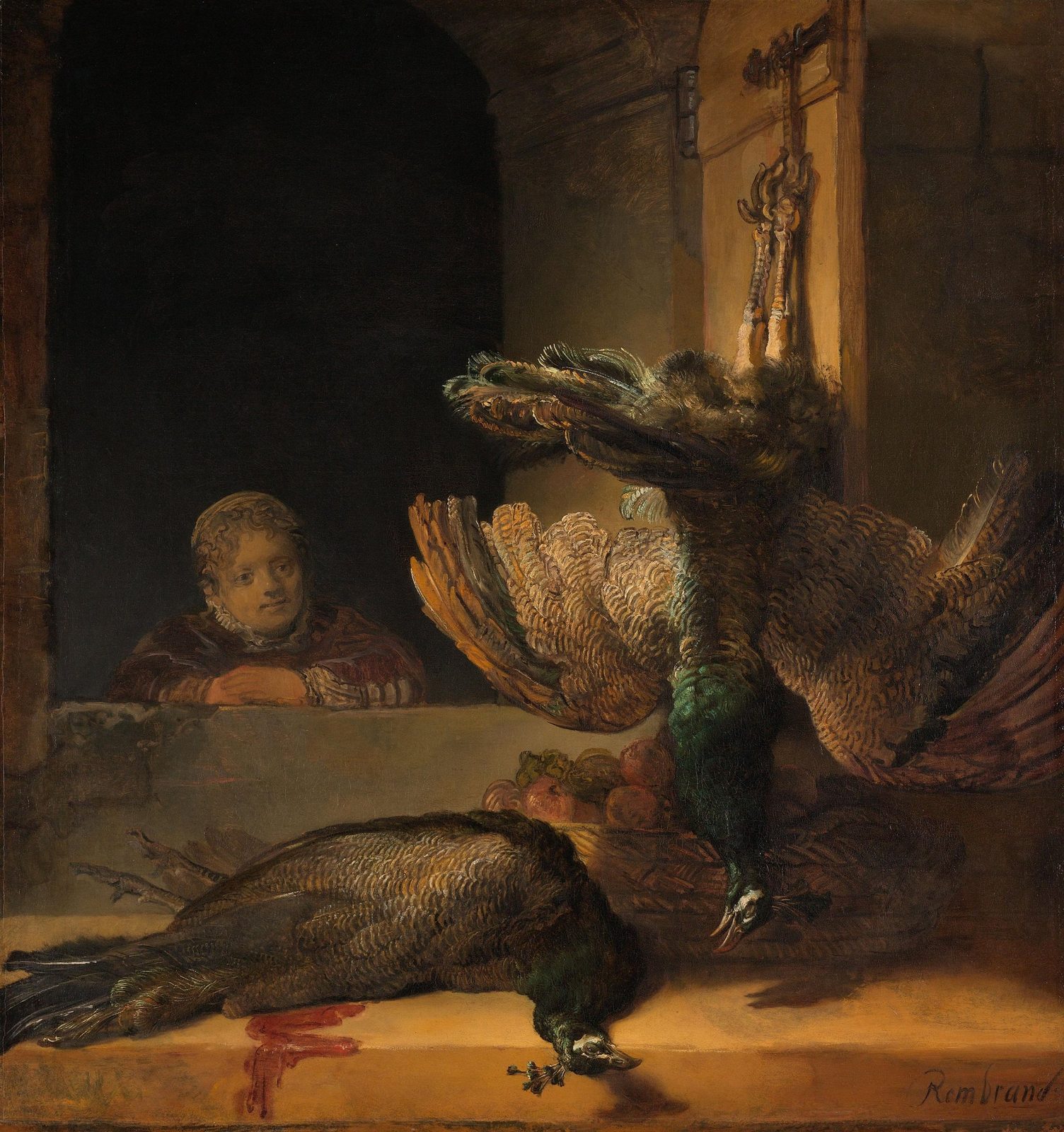
- Artist
- Rembrandt van Rijn
- Title
- Still Life with Dead Peacocks
- Date
- c. 1639
- Museum
- Rijksmuseum
- Image
- Public domain (CC0)
Open in Simple Art
Watch this story on iPhone and iPad, with offline downloads and a painting every day.
About 3 minutes of looking, in 9 parts.
Still Life with Peacocks
Two dead peacocks fill most of this picture. One hangs head down, the other lies on a stone ledge beside a pool of blood. Behind them, a girl leans on a window sill and looks on, quite calmly.
Rembrandt, c. 1639, oil on canvas
Rembrandt painted this around 1639, in oil on canvas, almost one and a half metres high. The museum notes that peacocks were then eaten by the wealthy, even baked into pies. What seems to have drawn Rembrandt, though, is the plumage, with its markings and its mix of blue, green and ochre.
A diagonal and a quiet counterweight
Look at the big shapes first. A diagonal runs from the top right, down the hanging bird and its spread wing, to the long body lying along the ledge. The girl sits apart on the left, small and still, and balances all that weight.
Hung by the feet
Up at the top right, the bird hangs from the open shutter. The shutter's edge is caught by one sharp line of light. The feet look tied together on a cord, their scales picked out in small pale dabs.
One stroke, repeated
Now the spread wing. Each pale feather looks like a single short, curved dab of cream or ochre, thick enough to stand up from the darker paint beneath. They're hardly blended at all. The repeated shape is what makes the wing feel full and layered.
Emerald among the browns
Follow the hanging neck down to the head. Here, at last, is a cool colour, a dense patch of emerald and blue-green in a picture made mostly of browns. There's no outline round the neck. The green simply darkens until it meets the shadow.
An edge that disappears
Now the bird on the ledge. Down at the far left, its dark feathers and the shadow around them are almost the same value, so the edge all but vanishes. You still read the body, though. Your eye fills in the contour the paint leaves out.
Thick paint where the light falls
Back up to the girl. The lit parts of her face, the forehead, the nose and the cheek on our left, look painted in thick, creamy strokes. The other side slips into warm shadow with no hard edge. The thickest paint goes only where the light falls fullest.
A pool of blood
Down on the ledge is the pool of blood. It appears to be thin red laid over the ochre, with a few brighter touches on top and runs trickling over the front edge. It's small, but it's the strongest red in the picture, and it reminds you these birds were killed.
Look closer
8 details, each checked against a close-up of the picture.
-
The Peacock's Neck and Head
The neck appears to be a concentrated patch of emerald and deep blue-green paint.
The crop isolates the peacock's hanging neck and head. A dense cluster of emerald and teal-green strokes occupies the neck (roughly x:0.40–0.65, y:0.15–0.45), layered with cooler blue-greens that darken into near-black along the right side and lower neck. The upper-left quadrant shows warm umber and ochre feather forms with visible directional brushwork radiating outward, while at the bottom the head carries a white facial patch and a pale ochre beak. The neck transitions abruptly from the cool green mass to a deep, almost black passage on the right, with no hard outline—edges dissolve through adjacent dark and light strokes. A network of fine craquelure crosses the entire surface, confirming aged oil paint, and the green pigment appears slightly raised (impasto) compared to the flatter brown surroundings.
-
The Girl's Face
The lit planes of the girl's face appear modelled with creamy, opaque highlights.
The crop isolates the girl's head against a near-black ground, with curly hair scumbled in loose, broken brown marks that do not fully resolve individual edges. The forehead, bridge of the nose, and the viewer's-left cheek are built up in thick, creamy yellowish-ochre paint that visibly sits proud of the surrounding film; these highlights read as the highest values in the image. The viewer's-right side of the face drops into a warm umber shadow through a soft, blurred transition rather than a crisp edge, and the chin/jaw contour where it meets the white falling band is left somewhat unresolved. The white collar at the base is set in with quick, zig-zagging pale strokes over a darker undertone, leaving thin dark gaps that read as folds.
-
Fanned Plumage Impasto
The pale feathers appear built from thick, short, directional dabs of paint.
The crop isolates a dense mass of fanned plumage rendered as overlapping, comma-shaped dabs. Highlights read as raised, opaque passages of warm cream and pale ochre (~#E8D5A8, ~#C9964A) sitting on top of mid-tone browns and greenish umbers. Edges between dabs are crisp where the highlight sits against a darker underlayer and softer where the same hue repeats, producing a scale-like, layered rhythm. A small cluster of iridescent teal-green strokes (upper right) is the only cool note in an otherwise warm, earthy field. The paint surface is clearly built up; the catches of light are peaks of impasto, not thin glazes.
-
Doorway Raking Light
The edge of the open shutter is caught by a sharp, bright line of light against the dark.
The crop centers on an open doorway with a strongly raking light entering from upper right. A thin, near-vertical highlight of warm yellow-ochre runs along the right jamb, sitting immediately against the deep umber-black interior of the door frame. From the top edge, dark hardware and a hanging cord descend into the opening, supporting the cluster of dark, scaly talons that occupy the lower half of the crop. A faint diagonal lintel or beam line cuts across the upper left at roughly 30°, separating a slightly cooler mid-tone wall plane from a warmer lower plane. Edges are softened in the talons but razor-sharp where the lit jamb meets shadow.
-
The Blood Stain
A small pool of red, apparently thin paint, lies over the yellow-ochre ledge, with runs trickling down.
The crop shows a warm yellow-ochre ground that has been loosely brushed, with a cluster of reddish marks in the upper portion. A brighter, more saturated pool of red sits in the upper right, where a small impasto highlight catches the light. Darker brown-red drips and verticals trail downward from the main red mass, thinning as they descend into the ochre field. The edges between the red and ochre are soft and broken, with the warm ground showing through in places, indicating thin, wet-into-wet application rather than hard contours.
-
Hanging Talons
The bird's feet appear bound together and hung from a cord.
The crop shows a vertical arrangement of long, scaly bird legs descending from darker masses at the top toward clawed feet at the bottom. The scales are rendered with small, repeated impasto dabs in pale cream and ochre that catch raking illumination, while the inter-scale recesses sit in deep umber shadow. Two to three leg forms overlap, their edges softened against the warm brown background rather than crisply outlined. The bottom shows curved talons gripping onto a darker, roughly brushed mass, with a faint reddish smear at lower left suggesting a floor stain.
-
Lost Edge of the Body
The dark plumage of the lower bird blends almost seamlessly into the shadowed background.
The crop shows the mid-body of a peacock laid on a warm ochre-umber ledge. Broad, sweeping feather strokes in near-black brown carry thin impasto highlights of teal-green that catch the raking light from the upper right. The upper contour of the wing is articulated with broken, bristly strokes that define individual barbs, while the lower belly edge melts into the ledge with almost no drawn boundary, the darks of the plumage nearly matching the value of the shadowed background. A small clawed foot appears at the top right, and a faint reddish smear sits on the ground at the bottom edge. The transition zones read as wet-into-wet blending rather than crisp line.
-
Rembrandt Signature
Rembrandt's name is written in dark paint at the lower right.
The crop isolates the lower-right area of an oil painting, dominated by a warm, mid-valued umber ground with visible canvas weave and a slightly cooler horizontal band (the stone ledge) running along the bottom edge. Across the center, the name 'Rembrandt' is brushed in a dark, near-opaque black, the letters showing fluent cursive ligatures, a tall flourished 'R' with a hooked terminal, and a trailing loop on the final 't'. The pigment sits crisply on top of the ground with sharp upper edges but slightly absorbed, granular lower edges where the binder has keyed into the weave. A thin, broken flourish underlines the name, thinner in the middle and thickening at its right end.
Still Life with Peacocks in context
Good years
The Rijksmuseum dates the canvas to about 1639 [1]. RKD notes it was once dated to 1636-37 or more loosely to the later 1630s, but says it is now generally placed around 1639 [2]. Those were prosperous years. Liedtke described Rembrandt in the 1630s as highly successful, with pupils and assistants and an art collection of his own, and in 1639 he bought the impressive house that is now the Rembrandt House Museum [4]. Wikipedia puts the purchase in May 1639 at 13,000 guilders and links the mortgage to his later money troubles [5].
An unusual subject for him
Wikipedia calls this one of the few still lifes Rembrandt painted [3]. RKD's catalogue reflects its mixed character, filing it under still life, animal painting and genre scene all at once [2]. Besides the birds and the girl at the stone window, the Rijksmuseum's description lists a basket of fruit on the ledge [1].
The signature is debated. RKD says not all art historians accept the 'Rembrandt' at lower right as authentic, and that the t is badly damaged [2]. Wikipedia adds that X-rays show the full name, though some letters appear to have been painted over, and stresses that the painting itself isn't in doubt [3].
Early owners
The probable first record is the inventory drawn up in Amsterdam on 16 October 1660 of the estate of Clara de Valaer, which lists a piece with two peacocks and a child by Rembrandt [1][2]. In September 1685, the inventory of her son Tobias van Domselaer mentions a large painting with two peacocks by Rembrandt [1][2]. The Rijksmuseum marks both entries with a question mark [1]. A lot of "dead birds" by Rembrandt at the Willem Six sale in 1734 might also be this picture, but RKD notes that the Rijksmuseum's research curator left it out of the provenance [2].
In England it may have passed from the collector John Blackwood, who died in 1777, through his son's widow Catherine Ann Blackwood to her nephew William Ralph Cartwright of Aynhoe Park [1]. Cartwright lent it to the British Institution in London in 1819, the first firm record of it in his hands [1][2]. It stayed with the family until at least 1915 [1].
Sold for Linz
The Amsterdam dealer Frederik Muller bought it around 1915, and in 1918 it passed to Jean Joseph Marie Chabot, who lent it to the Rijksmuseum from November 1923 [1]. On 21 July 1942 Chabot sold it, with two other paintings, for 800,000 guilders to Erhard Göpel, who was buying for Adolf Hitler's planned Führermuseum in Linz [1].
After the war it was recovered and placed with the Stichting Nederlands Kunstbezit in 1945 [1][2]. The foundation lent it to the Rijksmuseum from 1948, and ownership passed to the museum in 1960 [1][2]. Meanwhile, it was shown in the Mauritshuis exhibition of recovered art in 1946, and in Paintings Looted from Holland, which toured the United States from 1946 [2].
Afterlife
Wikipedia notes that the motif of a figure at a stone window with objects was later developed by Rembrandt's pupil Gerrit Dou [3]. Liedtke lists Dou first among Rembrandt's many pupils [4]. In 1999 the painting appeared in the Rijksmuseum exhibition of Dutch still life from 1550 to 1720, which also went to Cleveland [2].
- Still Life with Peacocks (SK-A-3981): object record and provenance . Rijksmuseum, Amsterdam
- Still life with peacocks, c. 1639 (RKDimages 3066) . RKD – Netherlands Institute for Art History
- Still Life with Peacocks . Wikipedia
- Rembrandt (1606–1669): Paintings, Heilbrunn Timeline of Art History (Walter Liedtke, 2003) . The Metropolitan Museum of Art
- Rembrandt . Wikipedia