Blind as an owl
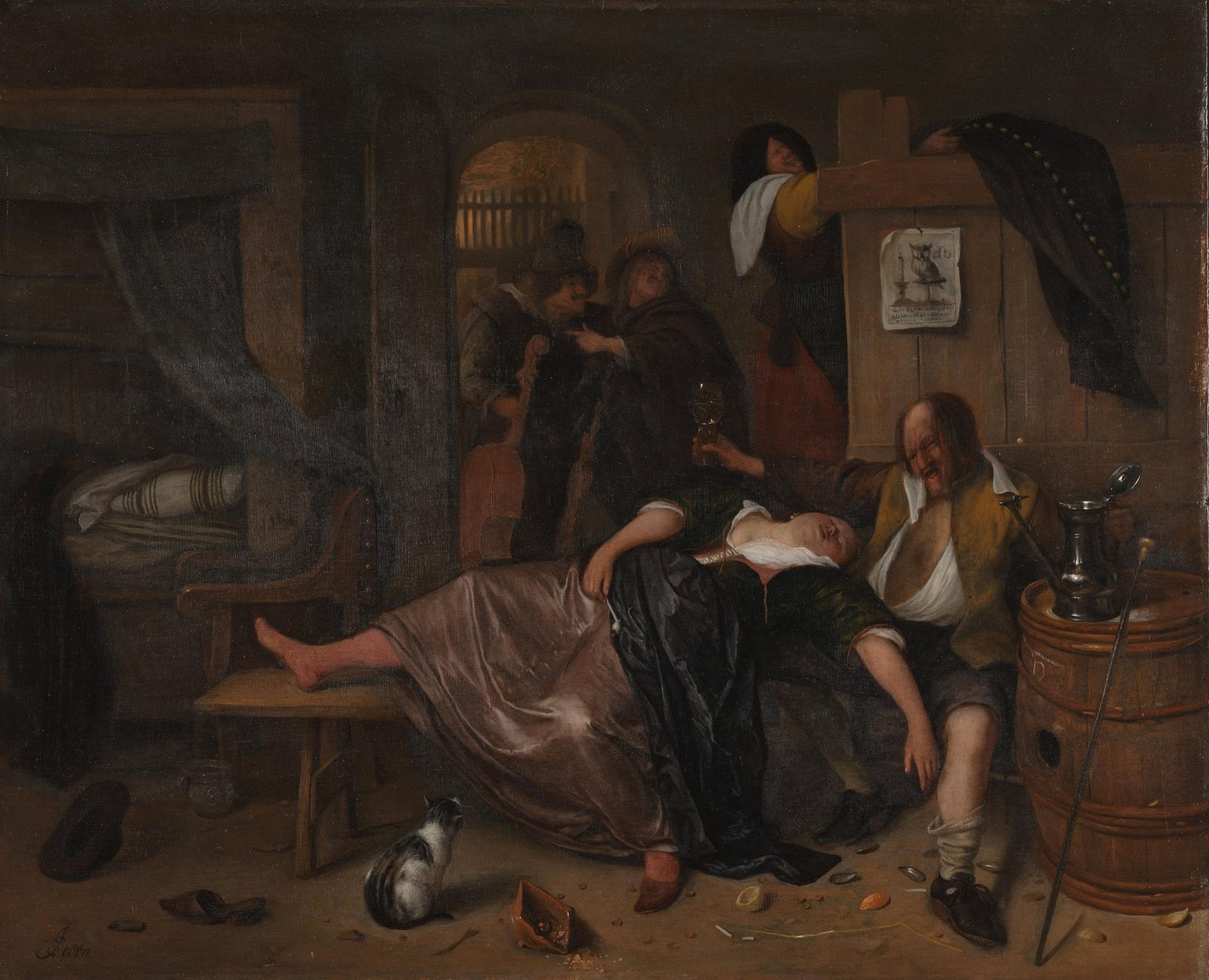
Jan Steen's drunken pair sleep and sing while their own clothes are carried off behind them
- Artist
- Jan Havicksz. Steen
- Title
- The Drunken Couple
- Date
- c. 1655 - c. 1665
- Museum
- Rijksmuseum
- Image
- Public domain (CC0)
Open in Simple Art
Watch this story on iPhone and iPad, with offline downloads and a painting every day.
About 3 minutes of looking, in 9 parts.
The Drunken Couple
A woman lies stretched across a bench, fast asleep, one bare foot up on the wood. The man beside her holds up a glass, mouth wide open. Neither of them is paying the slightest attention to what's going on behind their backs.
Jan Steen, about 1655 to 1665
This is Jan Steen's The Drunken Couple, painted in oil on panel around 1655 to 1665. The Rijksmuseum puts it plainly. These two are so drunk that they don't realise they're being robbed.
A song, not a laugh
Look at his face. The eyes are squeezed almost shut and the mouth hangs open, with a few pale dabs for teeth. It could pass for a laugh, but the museum's description has him singing, drunk, beside her.
Out cold
Her head has dropped against his shoulder, and her white chemise spills open in crumpled folds. The white is warm where the light hits and turns cool, almost grey-violet, in the creases. Her face looks pale and slack.
A satin skirt
Her skirt is a pinkish mauve satin, painted in long strokes that sweep down with the fall of the cloth. Pale touches ride the crest of each fold. Where it meets the black cloth beside it, the edge is crisp and sure.
The thieves
Now the doorway behind. Two musicians, one holding a stringed instrument, lean together in the shadow. According to the museum, they and a woman are stealing the man's clothes. Follow the line up to the partition, where she's hauling a cloak over the top.
The owl print
Pinned to the boards beside her is a small print of an owl, with a candle and what look like spectacles. The museum explains it. To Steen's contemporaries the owl was a foolish creature, blind by day even with a candle or glasses. And the couple are just as blind.
The cat
Down on the floor, a black and white cat sits with its back to us, looking up. The museum notes that it's watching the woman. Next to it lies a broken earthenware jug, its pieces set down in a few quick strokes.
Litter and pewter
Along the bottom edge, look at the litter. There seem to be shells, nuts and bits of broken pipe, each a single small touch of paint. Then move across to the pewter jug on the barrel, where a few near-white highlights make the metal shine.
Look closer
8 details, each checked against a close-up of the picture.
-
Laughing Man's Face
The man's mouth is wide open, showing a few teeth, with deep creases around nearly closed eyes.
The crop isolates the laughing man's head and upper torso against a dim brown background, with a sleeping woman's pale face just visible at lower left. His mouth gapes open in a laugh, showing a dark cavity with small dabs of lighter paint suggesting teeth, framed by deep creases that pull the eyes into nearly closed slits. Warm reddish-browns build the shadow side of his face on the right, while warmer flesh tones with pinkish highlights catch light on the left side of his nose, cheek and chin. A yellow-ochre jacket surrounds the head, with a crumpled white cloth falling vertically beside his neck. The sleeping face below is rendered in cool, chalky flesh tones with a softly blended edge against dark drapery.
-
Woman at the Partition and Owl Print
A woman leans over the partition to take a dark cloak; a small print of an owl is pinned to the boards beside her.
The crop shows a woman leaning over a wooden partition at left, a white cloth over her yellow sleeve, while her hand at upper right hauls a dark cloak studded with gold buttons over the top. Pinned to the boards below is a small print of an owl beside a candle, with spectacles and a two-line inscription. The overall value structure is a steep falloff from the brightest yellow (~u0.5, v0.2) down into near-black at the lower right corner, with the figures' clothing resolved as broad, soft-edged masses rather than detailed rendering. The pale print and the white cloth are the brightest notes in the crop.
-
Pink Skirt Folds
Broad, sweeping brushstrokes are used to define the highlights and deep folds of the pink fabric.
The crop isolates the lower half of a collapsed woman in a pale mauve-pink skirt slumped across a man's lap, bordered at right by a near-black cloak. A small tabby cat sits at lower left looking up toward the figures, and a broken earthenware jug lies at bottom center with scattered droplets. The pink skirt is built from broad diagonal strokes sweeping down-and-leftward along the fall of the fabric, with lighter loaded touches riding the crests of the folds and warmer brown-mauve tones pooled in the valleys. Edges between the pink skirt and the dark cloak at upper right are crisp and decisive, while interior transitions within the skirt stay soft, suggesting on-canvas blending.
-
Foreground Litter
Small, distinct objects including a nut, shells, and a pipe lie scattered on the floor.
The crop captures a brownish-olive floor scattered with small discarded items rendered as quick dabs: orange-brown round dabs read as nuts or crumbs, a pale yellow oval as a pipe bowl or ring, a white straight stroke as a pipe stem, and a thin curved line as a straw or string. On the left, an overturned reddish-brown ceramic vessel with a chipped rim and an interior dark cavity shows a small cluster of bright orange-red dots inside and a spatter of pale crumbs beneath it. The upper center shows the toe and shaft of a reddish-brown boot with a soft highlight ridge, while the upper right is dominated by near-black drapery with a faint bluish sheen. Edges between the scattered objects and the floor are soft, with shadows anchoring each item; fine craquelure runs across the whole surface.
-
Cat and Jug
A black and white cat sits beside a fragmented ceramic jug on the floor.
The crop shows a black-and-white tabby cat seated on a warm brown floor, viewed from behind with its head turned upward and to the right. Loose, gestural brushstrokes build the cat's form: creamy white highlights along the spine and skull (catching the light from upper-left), with dark, broken patches of charcoal and umber describing the tabby markings. The cat's silhouette against the floor is soft and absorbed, while the dark background is a thin scumbled wash that lets the canvas weave show through. At the right edge, a fragment of a terracotta-red ceramic jug appears, its broken rim rendered in a few quick strokes of saturated orange-brown over a darker base.
-
Musicians
Two figures hold instruments, one with a lute-like object, in the shadowed mid-ground.
Two shadowy figures occupy a low-lit interior passage; the left figure wears a tall dark hat above a face barely lifted out of the umber ground, with a small smear of pale cream at the collar catching the window light. A rounded, warm-brown shape (the lute body) sits against his lap, its curved back defined mostly by a slightly lighter tonal edge against the darker cloth beside it. The right figure, marked by a reddish cap and an open-mouthed, ruddy-cheeked face turned in profile, leans forward with an arm gesture that crosses into the shadow; a glint of pale flesh at the wrist and a few bright strokes at the right edge (possibly a glass rim) are the lightest notes here. Vertical craquelure runs across the panel and is visible in nearly every dark passage, betraying an aged oil ground. Edges are softened and atmospheric, with figures reading as value-clusters rather than crisp contours.
-
Pewter Pitcher and Barrel
The pitcher has a metallic grey sheen and rests on a textured wooden barrel with visible staves.
A pewter pitcher with a scrolled handle sits centered atop a wooden barrel, its body reading as cool silver-grey against the warm umber staves; sharp, near-white highlights cluster on the left of the spout, shoulder, and stem, while the right cheek is dropped into deep neutral grey, confirming a single light from the upper left. The barrel is constructed of vertical staves bound by two reddish-brown hoops, with a chalk scrawl resembling a 'b' or '5' on the upper-left stave and a dark bunghole punched through a lower stave. A clay pipe crosses at upper left, its white bowl and slender dark stem reaching the pitcher's foot, while a separate long cane with a pale knob leans against the barrel down to the floor. Edges between the pewter and wood are crisp at the contact rim where the highlight is brightest, but soften into broken brushwork along the shadowed right side, and the canvas tooth shows through in the mid-tones.
-
Woman's Collar
The woman's white chemise spills in crumpled folds against her dark jacket.
The crop is dominated by a billowing white chemise or collar fabric that sweeps diagonally from upper-left toward lower-right. The fabric's highlights are warm off-white, while its shadowed folds shift into cool grey-purples, with soft, blended transitions between light and dark. The lower-left corner shows a dark mass (the jacket) painted in very deep brown-black with a hint of warm undertone, set against the white fabric by a soft, irregular edge. A pinkish flesh tone appears at upper-left and a sliver of face at upper-right; a reddish-brown strap or ribbon cuts diagonally across the white folds near the lower-center. The fabric reads less as a crisp triangle than as a draped, crumpled shape, with the brightest accents concentrated along the upper ridge near (0.4, 0.25).
The Drunken Couple in context
A proverb on the wall
The little print on the partition shows a candle, an owl and a pair of spectacles above a well-known proverb, 'Wat baeter kaers of bril, als den uijl niet sien en wil', roughly: what use are a candle or spectacles if the owl will not see [2]. The panel was shown in the Rijksmuseum's 1976 exhibition Tot lering en vermaak (To Instruct and Delight), on the meanings of Dutch genre painting [1]. Its catalogue notes that prints on this theme were popular and that several other painters, like Steen, included the saying as a detail in their pictures [2].
The catalogue adds that Steen was particularly fond of owls as imagery. In a schoolroom scene, which in 1976 was on loan to the National Gallery of Scotland in Edinburgh, a boy offers spectacles to a live owl perched beside a lit lantern, acting out the same proverb [2]. The owl stood for drunkenness as well as folly, as shown by Dutch sayings like 'zo zat als een uil', as drunk as an owl [2]. And the authors point to a 1664 drawing of a drunken woman by Steen's friend Frans van Mieris, engraved by Hendrick Bary, with an owl looming over the scene [2].
Smaller warnings
Other details are harder to spot. The 1976 catalogue reads the open bed, the oyster and mussel shells on the floor, the clay pipe resting in the woman's lap and the cat looking up at it as erotic allusions that contemporaries wouldn't have missed [2]. Against them Steen set a counterweight: to the left of the owl print, drawn as if in chalk on the partition, is a little gallows with a figure hanging from it [2].
The authors set the picture against a real concern of the time. Town councils issued laws to curb drinking and other excess, and in 1665 the Gouda minister Jacobus Sceperus published more than two hundred pages against drunkards, taverns and the drinking of toasts [2]. They also mention an older identification of the scene with the farce Lichte Klaertje, first performed in 1645, but find it unconvincing, partly because no old woman stealing a coat appears in the play [2].
'A Jan Steen household'
The Rijksmuseum notes that Steen's cheerful paintings of disorderly families gave rise to the Dutch saying 'a Jan Steen household' [3]. It adds that he often put himself into his pictures in questionable roles, for example as a drunken rake, and that his paintings often carry a lesson without becoming preachy [3]. In The Merry Family of 1668 the lesson is written on a note on the mantelpiece, 'As the old sing, so shall the young twitter', asking what will become of children whose parents set a bad example [4].
Early biographers took such pictures as evidence of his life. According to Arnold Houbraken and Jacob Campo Weyerman, Steen never regained control of his household after his first wife died in 1669 [5]. Houbraken also told, at length and with humour, how Steen seduced Jan van Goyen's daughter Margriet before their marriage [5]. Piet Bakker notes that no baptism of a child conceived before the wedding has been found, which led Abraham Bredius to think the story belonged to another of Van Goyen's sons-in-law, the painter Jacques de Claeuw [5].
Dates and owners
The Rijksmuseum dates the panel to about 1655-1665 [1]. Dutch Wikipedia reports that the RKD, the Netherlands Institute for Art History, dates it later, to 1668-1672, and the 1976 catalogue implied a date close to Van Mieris's drawing of 1664 [2][6]. The painting belonged to the Amsterdam banker and collector Adriaan van der Hoop, whose bequest went to the City of Amsterdam, and it is now on loan from the city to the Rijksmuseum [1]. According to Dutch Wikipedia, it hung in the Museum Van der Hoop from 1855 and was lent to the Rijksmuseum on 30 June 1885 [6].
- Jan Havicksz. Steen, The Drunken Couple (SK-C-232): object record . Rijksmuseum, Amsterdam
- E. de Jongh et al., Tot lering en vermaak: betekenissen van Hollandse genrevoorstellingen uit de zeventiende eeuw (exh. cat. Rijksmuseum, 1976), cat. no. 65, Jan Steen . DBNL (Digitale Bibliotheek voor de Nederlandse Letteren)
- Jan Steen (Dutch Masters series) . Rijksmuseum, Amsterdam
- Jan Havicksz. Steen, The Merry Family (SK-C-229): collection data record . Rijksmuseum, Amsterdam
- Piet Bakker, 'Jan Steen' (2017), in The Leiden Collection Catalogue, ed. Arthur K. Wheelock Jr. (archived PDF, 2020) . The Leiden Collection, New York
- Het dronken paar . Wikipedia (Dutch)