The Merry Family — A Steen Walkthrough
How Jan Steen turns a household into a proverb, from window light to wall scroll
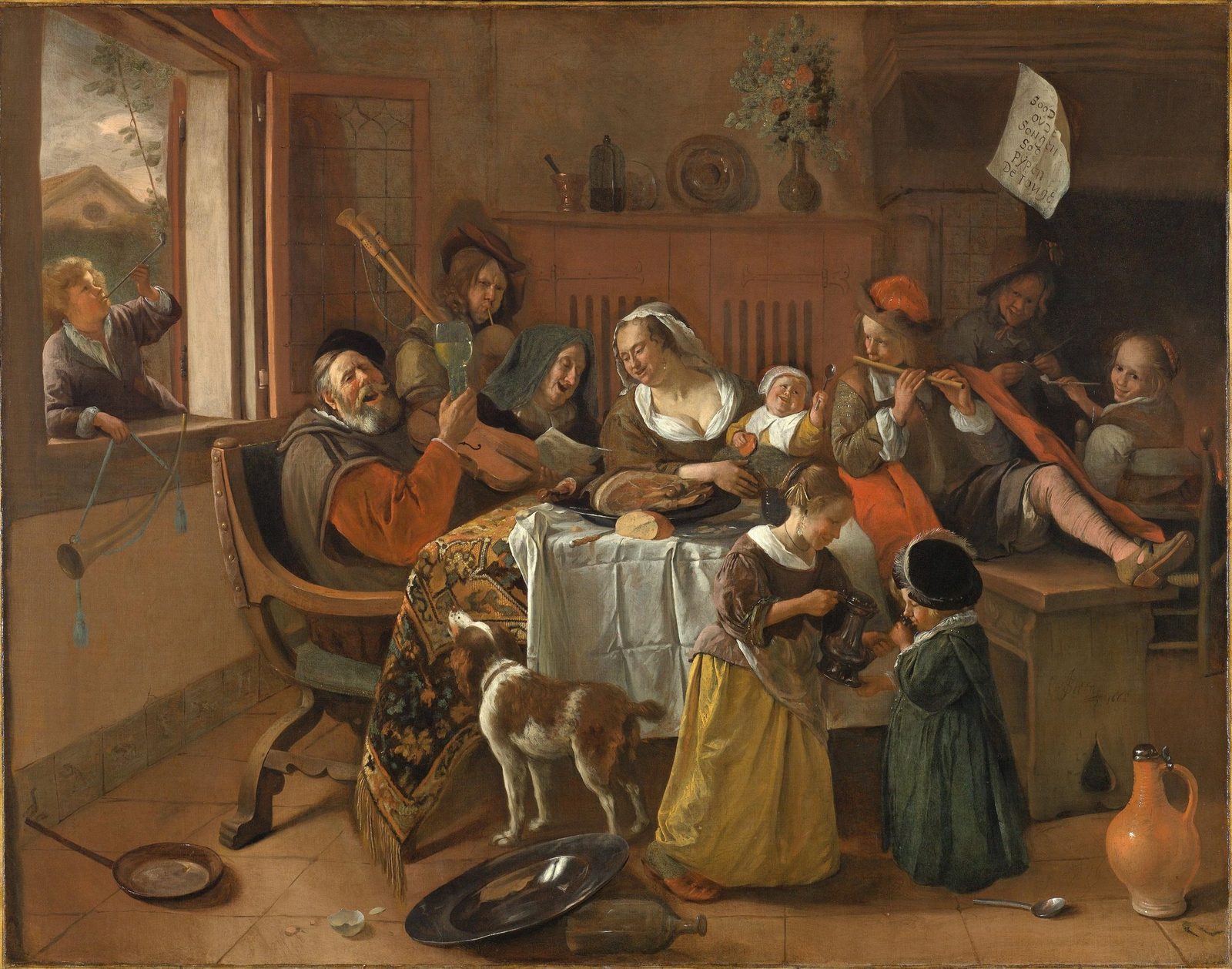
- Artist
- Jan Havicksz. Steen
- Title
- The merry family
- Date
- 1668
- Museum
- Rijksmuseum
- Image
- Public domain (CC0)
Open in Simple Art
Watch this story on iPhone and iPad, with offline downloads and a painting every day.
About 5 minutes of looking, in 11 parts.
A crowded Dutch interior, lit from the left
Look first at the whole canvas — a crowded Dutch interior glowing with warm light. Figures press around a table, a dog laps at a fallen plate, a child leans out a window with a tube to his eye. It feels joyful, but Steen has staged every detail as a warning.
A 1668 moralizing genre scene from Haarlem
This is a moralizing genre scene from 1668, painted in the Haarlem tradition. The paper scroll we'll reach at the end of our eye path is the key: it spells out a Dutch proverb that every figure here embodies. The so-called merry family is really a cautionary tableau about greedy haste.
A frieze band with a triangular eye path
Step back and read the structure. The horizon sits low, just under the upper third, and the figures form a horizontal frieze across the middle of the canvas. The diagonals pull you from the bright window on the left, down to the fallen jug, and back up to the children on the right — a true triangular eye path.
The window: raking daylight from screen-left
Now move to the far left, where light enters through the open window. Watch how Steen paints that pane as a near-white slab, then rakes a cool, oblique highlight across the boy's cheek, nose and the cuff of his shirt. The hard contour of the casing against the dark wall tells you instantly that this is your light source.
The seated woman: focal anchor and soft edges
Sweep along the table to the seated woman in white. She is the compositional anchor — the headdress catches the strongest highlight along the lace edge, while her low-cut blouse reads as a broad, simple mass of brownish-grey. Notice how Steen reserves crisp edges for just three places: the lace, a tiny pearl earring, and the white ruffle at her neckline. Everything else melts into the next tone.
The singing violinist — head tilted up, jaw in shadow
To her left, the singing violinist tilts his face upward with mouth open. Light strikes the brow and cheekbone hard, while the right side of the jaw falls into warm umber. His beard is built from short, broken grey-white strokes over a darker ground — see how the brown imprimatura shows through the hollows, doing half the modelling for him.
Flute player's fingers: gesture without outlines
On her right, the flute player holds his instrument horizontally to his lips. Watch the fingers — each one is just a short dark accent at the knuckle, with a slim shadow line beneath, suggesting contact without any drawn outline. The flute itself is a flat ochre rod; Steen doesn't bother to model it as a tight cylinder, leaving it loose and gestural.
Stippled carpet versus feathered fur
Drop your eye down to the tablecloth. Here the handling shifts: thousands of small, discrete dabs of gold-ochre and muted teal-blue, stippled over a dark brown ground, read as an oriental carpet. Compare that crisp, stitched edge to the soft, feathered fur of the spaniel beside it — two completely different paint logics in the same crop.
Children pouring — warm light against cool dark
Now swing up to the right, where the children pour themselves drink. The girl in yellow-ochre and dusty mauve pairs against the boy in a deep, low-chroma green — warm light against cool dark, doing the separation more than any drawn edge could. Behind them, a saturated orange-red sleeve punches the highest value contrast in the whole scene.
The fallen jug — hard contact, soft cast shadow
Drop down to the floor where the jug has toppled. Look at the foot: there is a sharp, continuous contact edge where earthenware meets board, then a soft, feathered cast shadow spreading out to the right. Steen reserves the hard edge for the contact and feathers the cast shadow with a translucent brown scumble — two different shadow behaviours in a single shape.
The paper motto: the proverb that frames the scene
And finally, rise to the paper scroll pinned on the back wall. Handwritten Dutch reads 'Soo de Oude Songen Soo Pypen De Jonge' — as the old sing, so the young pipe. The torn, curling edges cast a soft shadow; the lettering itself is hand-painted, with slight modulation in stroke weight that no printer could fake.
Look closer
8 details, each checked against a close-up of the picture.
-
Central Woman
The woman wears a white linen headdress and a low-cut blouse with soft shadows in the folds.
The crop centers on a woman whose white linen headdress catches the strongest highlight along the lace edge running diagonally from the upper left of her head down toward her right shoulder, then fading into warm cream. Her face is modeled with soft transitions from a lit left cheek to a cooler shadow side, with a small pearl earring picked out as a single bright dot. The low-cut blouse reads as a broad, simply shaped mass of brownish-grey, where the only edges that matter are the crisp white ruffle along the neckline and the cast shadow beneath the right breast, both painted with visibly loaded strokes. To the left, the secondary woman is rendered in much looser, darker passages, her features barely resolved, which forces the eye back to the central figure's smoother finish. The platter of meat in the foreground uses broad, unblended brown and ochre strokes that sit on top of the warm ground.
-
Motto Scroll
The paper scroll contains handwritten text in black ink on a pale background.
The crop isolates a roughly triangular piece of pale paper pinned or adhered to a deep umber wall. Handwritten Dutch text in dark brown-black ink reads 'Soo de Oude Songen Soo Pypen De Jonge' across five lines, with letters drawn freehand rather than typeset. The paper's right and lower edges are torn and irregular, curling slightly away from the wall and casting a soft shadow that helps establish its three-dimensional form. Subtle warm-to-cool tonal shifts across the sheet suggest it is not flat against the picture plane, while the surrounding wall is built up in thin scumbled browns over a darker ground.
-
Window Light Source
Bright white light enters from the window, creating strong highlights on the boy's face and shoulder.
The crop isolates the upper-right window bay and the boy leaning into it. The window pane is rendered as a near-white vertical slab with thin, dry brushwork showing a warm grey-brown underlayer along its inner edge. The boy's face catches a strong oblique highlight on the left cheek, nose bridge, and forehead, with the shadow side of the jaw falling into warm umber. The white shirt at his cuff is the brightest local accent on the figure, set against the muted lilac-brown of his jacket. Edges: the window casing meets the dark wall with a crisp, hard contour, while the figure's silhouette against the wall is softened by intermediate halftones. A small ribbon-like form and a faint motif at the top edge hint at the paper motto and smoke trail mentioned in the broader scene.
-
Table Runner Texture
The intricate patterns on the table runner are rendered with small, precise dabs of gold and blue paint.
The crop centers on a draped, densely patterned carpet or table runner rendered as thousands of small, distinct dabs of paint rather than blended strokes. Gold-yellow ochre dots read as the raised or highlighted portions of the woven motif, set against a dark brown ground with accents of muted teal-blue and black that define the arabesque shapes. To the right a spaniel's head and forequilbined head catch cooler light from the left, the fur built with soft, directional strokes that blur into the cream-white highlights — a soft, feathered edge that contrasts sharply with the crisp, stippled edge of the carpet beside it. A loose, scumbled white drapery occupies the upper right, its folds described with broad, thin strokes that let the brown ground show through. Warm red-orange fabric fills the upper left, painted wet-into-wet so its folds melt rather than stipple.
-
Children Pouring Drink
The girl's dress is a bright yellow-ochre, contrasting with the boy's dark green coat.
The crop centers on two children: a girl in a yellow-ochre skirt and dusty mauve bodice tipping a dark pewter jug toward a boy in a deep green coat and black beret. Her skirt reads as broad, vertically swept strokes of mid-value ochre with brighter yellow highlights riding the left-facing folds; the shadows on the right fold back into a warmer brown, suggesting the ground tone showing through. The boy's coat is a low-chroma dark green with cooler highlights catching on the shoulder and a soft sheen along the sleeve; edges between the two figures are kept soft, while the rim of the jug and his cheek are crisper. Behind them, a saturated orange-red sleeve and a white tablecloth provide the strongest value and temperature contrast in the scene.
-
Flute Player's Pose
The musician holds a flute to his lips with fingers positioned over the holes.
The central figure holds a cylindrical ochre flute horizontally to his lips, with both hands raised to chest height; the fingers are individually articulated by short dark accents at the knuckles and a darker line beneath each finger to suggest contact with the instrument. The flute itself is painted as a relatively flat yellow-ochre rod with a soft shadow underneath rather than a tightly modeled cylinder, indicating loose handling. The white shirt cuffs and collar are rendered with broad, broken strokes where the warm brown underpainting reads through at the edges, contrasting with the denser, cooler grey-brown of the doublet sleeves. The face is turned in three-quarter view toward the left light source, with the right cheek and jaw melting into the dark background through a soft, unblended edge.
-
Violinist's Expression
The man singing with a raised glass, a violin resting against him, has an open mouth and eyes squeezed shut.
The crop isolates a bearded man's head and shoulders, his face tilted upward with mouth open in apparent vocalization and eyes squeezed shut. Light strikes the left side of his face and forehead strongly while the right side falls into warm shadow. The beard is built with short, broken grey-white strokes over a darker ground, with the same brown imprimatura showing through in the hollows. A dark soft cap sits on his head; to the right a red-sleeved figure intrudes, painted with broader, wetter strokes that lose edge against the man's shoulder.
-
Jug and Floor Intersection
The base of the terracotta jug meets the floor with a soft shadow and a crisp outline.
The crop centers on the bulbous lower body and splayed foot of an orange-brown earthenware jug resting on a flat brown surface. The jug's painted surface shows subtle vertical brushwork modulating from a warm, lighter ochre on the left-facing curve to a deeper umber on the right flank, with a small bright catchlight dot at center. The contact edge between foot and floor is sharp and continuous, reading as a thin, slightly lighter rim of paint. To the right, a soft-edged cast shadow spreads across the boards, blending into the floor tone rather than terminating in a hard line. Faint craquelure runs diagonally through the floor area.
The Merry Family in context
One proverb, many versions
The Rijksmuseum also lists the picture under the title of its inscription, 'Soo de ouden songen, pijpen de jongen', and records the signature and date 'JSteen 1668' at the lower right [1]. Steen returned to the proverb again and again: Wikipedia, in its article on the version in the Mauritshuis in The Hague, counts thirteen treatments of the subject and calls that canvas of about 1668-1670 the model of the series [4]. Dutch Wikipedia describes the Amsterdam picture as Steen's second version of the proverb, after one painted a few years earlier [5].
The same article ties the title to a proverb made famous by Jacob Cats. It notes that the theme is thought to have been inspired by the Flemish painter Jacob Jordaens, whose version of about 1640 came first [4].
Pipes and pipers
The Dutch verb pijpen, to pipe, lets Steen make the proverb literal. The museum's description lists a boy with a pipe and a horn in the window, a man playing the bagpipes, a boy with a flute, and a boy and a girl smoking pipes [1]. In a short film on the picture, the Rijksmuseum goes further, saying that Steen poked fun at himself by portraying himself as the bagpiper, playing the instrument of fools [2]. Wikipedia reports a different arrangement in the Mauritshuis version, where Steen is identified as the father teaching his son to smoke [4].
The museum's bibliography shows how much this question has interested scholars. It lists H. Perry Chapman's 1995 article 'Jan Steen as family man' and a 1997 genealogical study of Steen's closest relatives [1].
A second marriage
Steen's own household changed soon after this date. Piet Bakker records that in the spring of 1673 the widowed painter married Maria Dircksdr van Egmond in Leiderdorp [3]. She was the widow of a book dealer who had gone bankrupt in 1661. She earned a little by selling home-boiled sheep's heads and feet at the market, which did nothing to ease the family's debts [3].
Arnold Houbraken turned the match into comedy. In his version Steen proposed on the advice of his sister, a Catholic lay sister, and was refused before winning the widow over with sweets [6]. Houbraken also tells, on the authority of the painter Carel de Moor, how Steen added a basket of boiled sheep's heads and feet to De Moor's portrait of his new wife, so that people would recognise her [6].
The end of the story
Houbraken wrote that the second marriage produced a son, Dirk, who became a sculptor and later worked at one of the German courts [6]. He gave the year of Steen's death as 1678. But Bakker dates his burial to February 1679 and adds that he left Maria with a host of children and an estate burdened by debt [3][6]. Maria died in 1687 [3].
Early fame
The museum's bibliography for the painting begins with John Smith, who included it in 1833 and again in a supplement of 1842 [1]. It later belonged to the A. van der Hoop bequest to the City of Amsterdam and is on loan to the Rijksmuseum [1].
- Jan Havicksz. Steen, The Merry Family (SK-C-229): object record . Rijksmuseum, Amsterdam
- The Merry Family, Jan Steen (One hundred masterpieces) . Rijksmuseum, Amsterdam
- Piet Bakker, 'Jan Steen' (2017), The Leiden Collection Catalogue (archived 2020) . The Leiden Collection, New York
- As the Old Sing, So Pipe the Young (Jan Steen) . Wikipedia
- Het vrolijke huisgezin . Wikipedia (Dutch)
- Arnold Houbraken, De groote schouburgh der Nederlantsche konstschilders en schilderessen, vol. 3: Jan Steen . DBNL