The Milkmaid
One line of milk, one window, and a picture built to hold still
- Artist
- Johannes Vermeer
- Title
- The Milkmaid
- Date
- c. 1660
- Museum
- Rijksmuseum
- Image
- Public domain (CC0)
Open in Simple Art
Watch this story on iPhone and iPad, with offline downloads and a painting every day. This one is free in the app.
New: step inside this painting, rebuilt in 3D, and watch her finish the pour.
About 3 minutes of looking, in 12 parts.
One line of milk
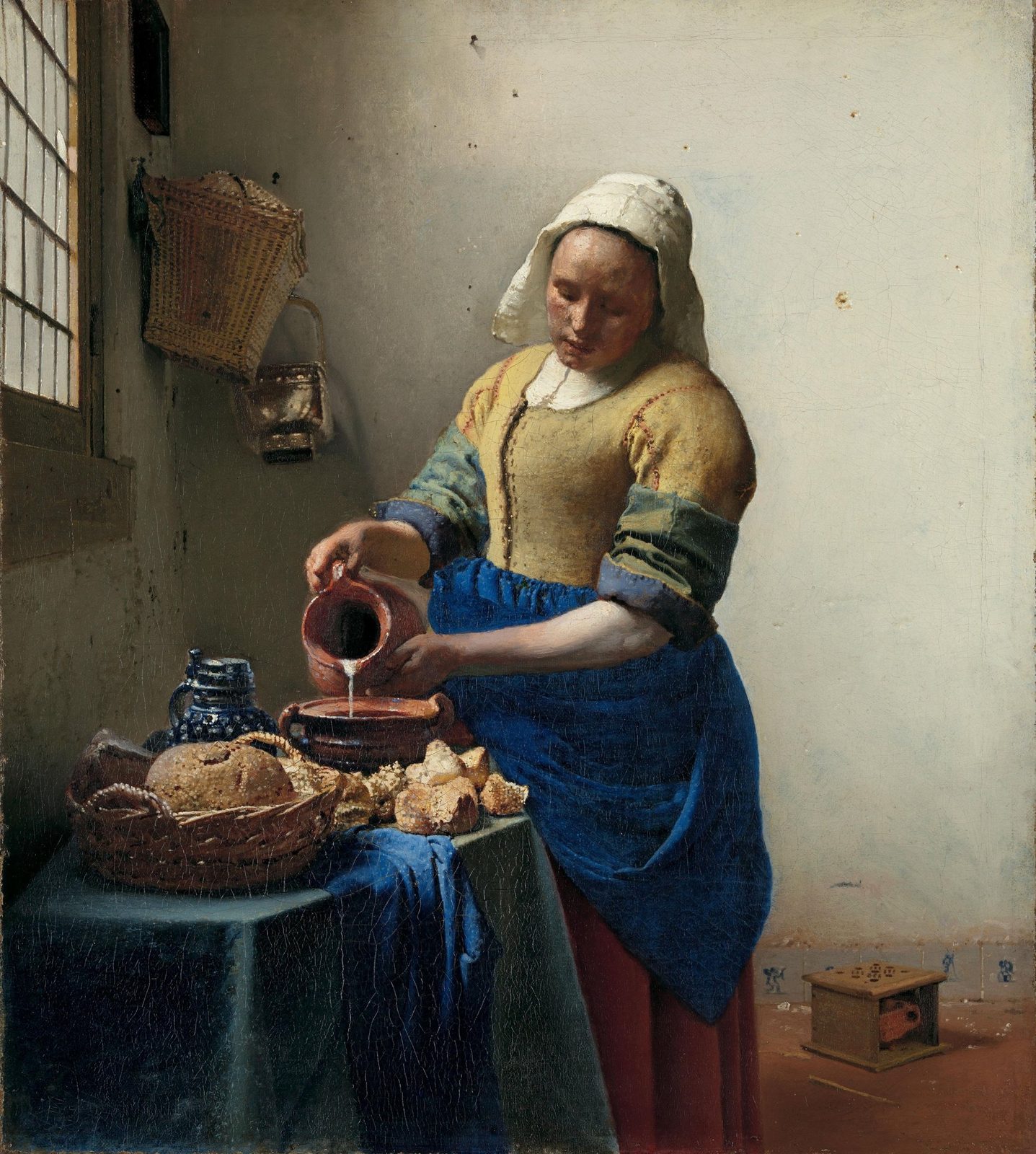
A maid pours milk, and nothing else in the room moves. There is no story beyond that. Watch the thin white line between the jug and the bowl.
Delft, around 1660
It is by Johannes Vermeer, catalogued at about 1660, and it hangs in the Rijksmuseum: a kitchen corner, a window, a table of bread and one woman at work.
A triangle that holds still
The figure is a stable triangle, from the white cap down to the wide blue apron. The table's edge runs diagonally from the lower left towards her hands, so everything leads to the pour.
Daylight from one window
All the light comes through this window. The panes are a cool pale grey, and the light crosses the bare wall to the right.
Even a nail
Even the bare wall is observed closely. A small nail throws a soft shadow down and to the right, away from the window, so the light agrees here too.
Her attention is on the pour
Her face is turned down to the jug. The forehead and cheek catch the light from the left, the other side falls into soft shadow, and nowhere is there a hard edge.
The simplest mark
At the centre of the picture, the stream of milk is a single thin pale line, slightly broken where it leaves the lip. The one moving thing in the room is painted with the simplest possible mark.
Light as dots
The crusts and the basket are sprinkled with small raised dots of pale yellow and white. They describe light sitting on a rough surface, with no attempt to draw the crumbs.
A cooler vessel
Beside it, the blue grey stoneware jug is covered with white dots and dashes too, a cool, glossy counterpart to the warm earthenware.
Yellow, green and blue
Her rolled sleeve is where the colours meet: olive green with a blue edge, between the yellow bodice and the bare arm.
Blue kept strong
The apron is the strongest colour in the room. Its lit folds are lighter blue and its deep folds nearly black blue. Vermeer models it in blue and never in grey, so it keeps its intensity.
A quiet corner
Down in the corner, a small wooden foot warmer stands in front of a row of blue and white tiles, painted simply so it never competes with the pour.
Look closer
9 details, each checked against a close-up of the picture.
-
The stream of milk
A thin pale stream of milk runs from the lip of the earthenware jug down into the bowl.
The jug is tipped towards us, its dark opening facing the viewer, and a thin white line of milk falls from the lip into the brown bowl. The stream is narrow and slightly broken at the top where it leaves the lip. A few pale highlights mark the jug's rim and the bowl's handles. The hands holding the jug are warm and softly modelled.
-
Dots on the bread
The bread crusts and basket are covered with small raised dots of pale yellow and white paint.
The loaf and rolls are warm brown and ochre, and their crusts are sprinkled with small pale yellow and white dots. The dots also appear on the wicker of the basket. They catch the light as texture rather than describing each crumb.
-
The window
The window panes at left are pale grey-white, and the light from them falls across the wall to the right.
The window is a grid of small panes, pale grey-white, lighter towards the top. The wooden frame and the wall under the sill are dark. This is the only light source in the picture.
-
The blue apron
The apron is an intense blue with lighter blue on the lit folds and near-black blue in the deep folds.
The apron is an intense, saturated blue. Lit folds are lighter blue, deep folds almost black blue. It sits against the yellow bodice above and the blue cloth on the table beside it.
-
The lit face
The face is lit from the left, with the right side of the face and the eyes, looking down, in soft shadow.
The face is turned down towards the pour. The forehead and left cheek are lit a warm pink, while the right side and eye sockets are softer brown. The white cap is lit on its left side and shadowed on the right. There is no hard edge on the face at all.
-
The stoneware jug
The blue-grey stoneware jug is marked with small white dots and dashes for highlights.
The stoneware jug is dark blue-grey, with a pewter lid and handle. Its body is covered with small white dots and short dashes for highlights. A loaf sits in front of it.
-
A nail in the wall
A small nail near the top of the wall casts a short dark shadow on the plaster.
On the bare plaster is a small dark nail. It throws a soft grey shadow down and to the right, away from the window. Around it are small cracks and a second mark lower down.
-
Foot warmer and tiles
A wooden foot warmer with a pattern of holes stands on the floor in front of a row of blue-and-white tiles.
A small wooden box with a pattern of holes on its top sits on the red-brown floor; an earthenware pot shows through its side. Behind it, a row of blue-and-white tiles with small figures runs along the base of the wall.
-
The rolled sleeve
The rolled-up sleeve is olive green with a blue edge, between the yellow bodice and the bare forearm.
The sleeve is rolled up into an olive green band with a blue-grey edge. Above it the bodice is yellow; below it the forearm is bare and pale. Three colours meet within one fold.
The Milkmaid in context
A painter finding his way
The Rijksmuseum dates The Milkmaid to about 1660, while the Met's Walter Liedtke placed it in about 1657-58, among the last works of Vermeer's formative years. [1][2] In that early period, Liedtke wrote, Vermeer borrowed subjects and styles from other painters while adding effects drawn from direct observation. [2] He saw this picture on the threshold between that early work and the mature style. [2]
Vermeer produced a small number of paintings, perhaps about forty-five, mainly for a small circle of patrons in Delft. [3] As much as half of that output was acquired by one local collector, Pieter van Ruijven. [3]
Kitchen maids in Dutch art
Liedtke linked the picture to the detailed realism of Gerrit Dou and his Leiden followers, calling it Vermeer's most illusionistic image. [2] Dutch literature and pictures of the period often praised the steady performance of household chores, and it has been plausibly suggested that the maid is making bread porridge from stale bread and milk. [2]
There may be a second layer. Milkmaids and kitchen maids in earlier Netherlandish art often carried amorous overtones, and Liedtke read the Cupid tile, the foot warmer and a tile showing a travelling man as hints in that direction. [2] He was careful to add that Vermeer may or may not have intended the tilted jug as an erotic allusion. [2] Kitchen scenes were also a matter of taste. Essential Vermeer notes that the art theorist Gerard de Lairesse recommended that such pictures be hung only in kitchens, yet of seventy-two kitchen paintings recorded in specific rooms in Dutch inventories from 1600 to 1679, only three hung there. [4]
Patron, sale and fame
The painting was probably bought from the artist by Van Ruijven, who appears to have owned twenty-one works by Vermeer when he died in 1674. [2] When those pictures were sold from the estate of his son-in-law, Jacob Dissius, on 16 May 1696, The Milkmaid was called "exceptionally good" and fetched the second-highest price, behind only the View of Delft. [2] The Rijksmuseum records it as lot 2, sold for 175 guilders to Isaac Rooleeuw of Amsterdam. [1]
Its reputation travelled with it. At the sale of Jacob van Hoek's collection in 1719, it was listed as "The famous milkmaid, by Vermeer of Delft, artful". [2] It then passed through several Amsterdam collections, with recorded prices rising from 560 guilders in 1765 to 2,125 guilders in 1813, when it was bought for Lucretia Johanna van Winter. [1][4] She married into the Six family of collectors in 1822. [2]
Kept in the Netherlands
In 1908 the Rijksmuseum bought the painting from the heirs of Jonkheer Pieter Hendrik Six, along with thirty-eight other pictures, for 550,000 guilders, with support from the Vereniging Rembrandt. [1] Liedtke adds that the Dutch government also contributed. [2]
The purchase was contested. According to Essential Vermeer, the director of the Mauritshuis, Abraham Bredius, was convinced that the American collector J. Pierpont Morgan wanted the picture, and the question was argued in the press and in parliament. [4] Opponents led by the socialist Troelstra preferred to spend on modern art, while Victor de Stuers argued for keeping the painting in the country at any cost, and the majority agreed. [4] Cartoons showed the milkmaid turning down her American suitor, Uncle Sam. [4]
A century later the painting crossed the Atlantic on loan. The Metropolitan Museum of Art showed it in Vermeer's Masterpiece "The Milkmaid" from 9 September to 29 November 2009, with the Met's own A Maid Asleep among the works on view with it. [5]
- The Milkmaid (SK-A-2344): object record and provenance . Rijksmuseum, Amsterdam
- Johannes Vermeer (1632–1675) and The Milkmaid, Heilbrunn Timeline of Art History (Walter Liedtke, 2009) . The Metropolitan Museum of Art
- Johannes Vermeer (1632–1675), Heilbrunn Timeline of Art History (Walter Liedtke, 2003) . The Metropolitan Museum of Art
- The Milkmaid (catalogue entry) . Essential Vermeer
- A Maid Asleep (14.40.611): exhibition history . The Metropolitan Museum of Art