A tooth held high
How Jan Steen turns a village quack's show into a stage full of small stories
- Artist
- Jan Havicksz. Steen
- Title
- The quack
- Date
- 1650 - 1660
- Museum
- Rijksmuseum
- Image
- Public domain (CC0)
Open in Simple Art
Watch this story on iPhone and iPad, with offline downloads and a painting every day.
About 3 minutes of looking, in 10 parts.
A show under a tree
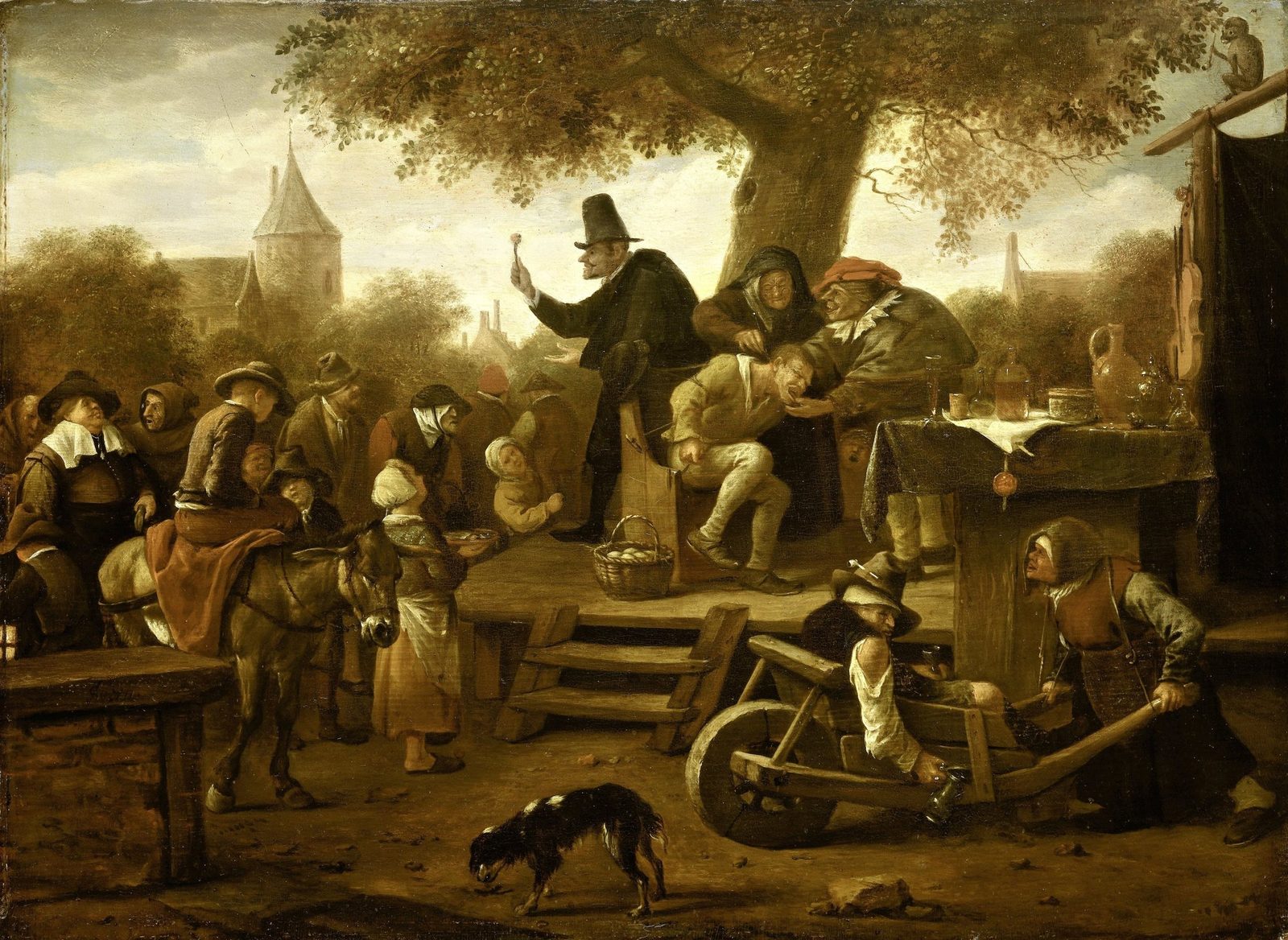
On a platform under a big tree, a man in a tall black hat holds something up between finger and thumb. Around him a whole village has gathered, and much of the crowd is turned his way. It's a performance, and we're in the audience.
Jan Steen, 1650 to 1660, oil on panel
This is The Quack by Jan Steen, painted in oil on panel between 1650 and 1660. The Rijksmuseum describes the scene simply. In a village square, a quack shows the villagers a tooth, or perhaps a stone, that he has pulled from a man tied to a chair.
The quack at the top
The quack is the high point of the picture. His dark figure stands out against the pale sky, and the platform makes a long base beneath him, with the crowd spilling out on either side.
The prize, held high
Look at his raised hand. Between finger and thumb is a tiny pink-red dab on a thin dark stem. It looks more like the museum's tooth than a bottle of medicine. A thin rim of light along his hat shows the light coming from the upper left.
The patient
Just to the right, the patient slumps with his head back and his mouth hanging open, while a man in a red cap leans in over him. You can read the lean of those shoulders even in silhouette.
A dog with frayed edges
At the front, a black-and-white dog noses at the ground. Its coat holds some of the darkest paint in the picture. Watch its edges: lighter strokes fray out into the ochre earth instead of a drawn outline.
One red cloth
On the left, a man in a brown coat sits on a grey donkey, facing the quack. Over the donkey's flank hangs an orange-red cloth, the strongest colour in this corner. Nearly everything around it is brown, ochre or umber, so one warm note goes a long way.
Leaves without outlines
Up in the tree, the handling changes. Over a dark olive mass, short dabs of yellow-green seem to have been dragged on top, with the dark showing round each one. You read sunlit clusters of leaves, yet no single leaf is drawn.
A monkey on the pole
In the top right corner, a small monkey sits on a wooden beam. The museum says it has a pipe, and a violin hangs from the same pole. The monkey is built from soft umber strokes, with one crisp touch of light on its nose.
A tower far away
Far behind the crowd, a church tower rises above the trees. It's painted in soft browns and ochres, and its right edge melts into the pale sky, so it stays quietly in the distance.
Look closer
7 details, each checked against a close-up of the picture.
-
The Quack's Pitch
The quack's raised hand pinches a tiny pink-red object on a thin dark stem against the dark tree.
The focal crop centers on a quack's raised hand presenting a tiny object against a dark tree mass. The object itself reads as a small pink-red bulb or nub (~5px wide) on a thin stem, pinched between thumb and forefinger; it does not read clearly as a cylindrical vial at this resolution—it is more akin to a pin with a colored head or a small ampoule blob. The hand is painted with warm mid-tone flesh, edges softened into the surrounding dark coat. The coat is a dense olive-black mass with subtle warm brown modulation along the shoulder seam, and the hat forms a near-silhouette shape with a thin warm rim light along the upper-left crown indicating the light source. The sky to the left is a scumbled cream-yellow, and the foreground wood plank shows a warm umber with a thin lighter highlight on its front face.
-
The Monkey
A small brown monkey is perched on a wooden beam in the upper right corner.
The crop shows a small dark-furred monkey seated on a thick, ochre-toned wooden beam that angles down from upper right to lower left. The monkey is built from short, scumbled strokes of umber and warm brown, with a brighter flesh-toned highlight catching the bridge of the nose and the rim of the eye, suggesting a light source from the upper left. Behind and to the left, foliage is suggested with quick, broad dabs of olive-green and brownish-grey over a thin, cool-grey sky wash, leaving irregular patches of bare ground visible through the canopy. The wooden beam shows a single brighter ochre edge along its top and a cooler brown shadow underneath, giving it a faceted, almost geometric volume despite the loose handling.
-
The Donkey Rider
A man in a brown coat sits atop a grey donkey facing right toward the quack.
The crop centers on a man in a dark, wide-brimmed hat and a brown coat seen from behind, mounted on a grey donkey whose head turns to the right. A vivid orange-red cloth drapes over the donkey's flank, creating the highest chroma in the crop against an otherwise muted brown-olive field. A small child in dark clothing clings to the right side of the group, and a hooded woman with a pale, highlighted face peers from the upper left. Brushwork is loose and summary: the donkey's grey coat is laid in with broad, slightly scumbled strokes that leave the rump brighter, while the man's coat is built from warmer mid-browns with a thin sliver of white collar catching the light. Edges are soft throughout except where lit contours (the rim of the man's hat, the woman's cheek, the donkey's hip) are picked out with small, loaded strokes.
-
Tree Canopy Foliage
The leaves are rendered with dappled, scumbled dots of yellow and green paint.
The crop centers on a dense tree canopy where the foliage is built up from short, dabbed touches rather than drawn leaves. Individual clusters read as small comma-like and ovoid dabs of yellow-green and ochre sitting over a continuous dark olive-brown mass that forms the shadowed body of the tree. A thick, near-black trunk drops vertically through the center-right, its edges softened by a halo of scumbled mid-tones rather than a hard contour. A heavy, web-like craquelure runs across the whole surface, intersecting both the paint and the exposed pale ground, and brightens the sky passages at lower left and right where the foliage thins.
-
The Assistant's Support
A man in a red cap leans over a slumped patient whose head lolls back with an open mouth.
Three figures occupy the frame: a man in a rust-red cap leans forward from the right, his face in partial shadow with a snaggletoothed grimace, his white ruff catching light. Below him, a slumped figure in a pale ochre doublet and white shirt is held up, head lolling back with a slack, open mouth. Behind both, a hooded woman stares down with a hard, lined face. Edges between the man's red cap and the sky are crisp but slightly feathered; transitions on the slumped figure's arm dissolve into the surrounding shadow without a hard contour. Paint appears to be layered in thin to mid glazes over a warm ground, with thicker, loaded highlights on the ruff, the patient's cheek, and the rim of the cup at right.
-
Foreground Dog
The dog's coat consists of deep blacks and white patches against the ochre ground.
A black and white dog is rendered in profile against an ochre-toned background. The painting surface exhibits widespread, fine craquelure across both the figure and the ground, indicating aged oil paint on a rigid support. Opaque, dark brown-black pigment forms the bulk of the animal's coat, while lighter, warm off-white strokes delineate the patches. The silhouette features soft, broken edges where dry, lighter brush marks extend outward from the dark forms into the surrounding ochre layer. Illumination from the upper left is evidenced by a row of pale, opaque highlights along the animal's upper back.
-
Background Architecture
The distant church tower is painted in soft brown-ochre tones, its right edge fading into the pale sky.
The crop centers on a tall church tower with a steep pointed spire and a small chimney/vent, rendered in warm brown-ochre tones. The right edge of the tower fades softly into the pale cream sky, showing some atmospheric blending, while the left edge is swallowed by darker midground foliage. A faint vertical slit window and a few lighter horizontal touches hint at masonry, but most structural detail is suppressed. The sky is the lightest passage in the crop; the tower sits in a middle value range that reads comparable to, rather than distinctly paler than, the surrounding midground.
The Quack in context
Props of a travelling trade
Beyond the quack and his patient, the Rijksmuseum's description highlights the small props of the scene: a basket of eggs at the feet of the man tied to the chair, and a table covered with bottles, jars and a document with a seal [1]. The museum dates the panel only broadly, to 1650-1660, and notes the signature 'JSteen' at the lower left [1].
Writing about a related Steen panel, Wouter Kloek and Arthur Wheelock separate two kinds of healer. Itinerant charlatans, or quacksalvers, from which the English word 'quack' derives, toured Dutch village fairs selling dubious remedies, while the local barber-surgeon worked from home and held a degree of respectability [2]. Steen's showman on a stage under a tree seems to belong to the first type [1][2].
An old joke about folly
Kloek and Wheelock trace the theme of the sham healer and the gullible patient back to the fifteenth century, to pictures such as Hieronymus Bosch's Extraction of the Stone of Madness, which marks the start of sixteenth-century imagery of folly [2]. They call a 1523 engraving by Lucas van Leyden the earliest significant image of a dentist in Dutch art, and note that sham dentists appealed to Brouwer, Molenaer and the Van Ostade brothers [2]. Gerrit Dou had already put a basket of eggs beside a seated peasant in a dentist scene of about 1635 [2]. Dentists fared badly in popular speech too: 'He lies like a tooth-puller' was a common saying [2].
The authors argue that Steen's version of the joke is never mean-spirited. In such pictures he set out to amuse, they write, yet left room for sympathy with both deceiver and deceived [2].
A subject from the early years
Quacks and tooth-pullers were with Steen from the start. Kloek and Wheelock list a Tooth-Puller of about 1650 whose whereabouts are unknown, and another dated 1651 in the Mauritshuis, and they date their own Country Doctor to about 1653 [2]. The earlier scholar Karel Braun doubted that the Country Doctor was by Steen, but the authors consider his doubts unwarranted [2]. The Rijksmuseum's date range puts The Quack in the same restless decade.
The Hague, Leiden and Warmond
Piet Bakker's biography follows Steen through those years. After his marriage in 1649 he worked in The Hague, where he may have helped Jan van Goyen produce his much-demanded landscapes, and quickly built a reputation [3]. In 1650 an Utrecht auctioneer sent a peasant wedding by Steen to Denmark for sale, and in 1651 the agent Harald Appelboom bought four of his paintings at a Hague auction for the Swedish field marshal Carl Gustaf Wrangel [3].
Van Goyen died in 1656 with an estate so deep in debt that it had to be auctioned [3]. In 1658 Steen paid his dues to the Leiden guild again, but the record already notes that he had left town [3]. By 1660 he was paying village tax in Warmond, probably drawn by Leiden Remonstrants who had built a church there, attended by his uncle and aunt and by his friend Frans van Mieris [3]. Bakker thinks Steen most likely painted his Poultry Yard there, with the castle of the Lord of Warmond in the background [3].
A prince's picture
According to Wikidata, the panel belonged to the collector Willem Lormier (1682-1758), whose collection was sold in 1763, and then to Prince William V of Orange until 1795, hanging in his gallery in The Hague [4]. The same entry places it in the Trippenhuis in Amsterdam from 1808, before it reached the Rijksmuseum [4]. These details come from a secondary database and are best treated as provisional.
- Jan Havicksz. Steen, The Quack (SK-A-387): object record . Rijksmuseum, Amsterdam
- Wouter Th. Kloek and Arthur K. Wheelock Jr., 'Country Doctor' (2025), The Leiden Collection Catalogue . The Leiden Collection, New York
- Piet Bakker, 'Jan Steen' (2017), The Leiden Collection Catalogue (archived 2020) . The Leiden Collection, New York
- The Quack (Q17320385) . Wikidata