Looking up from the sample book
How Rembrandt uses soft light, one red cloth and lost edges to catch six men in the middle of their work
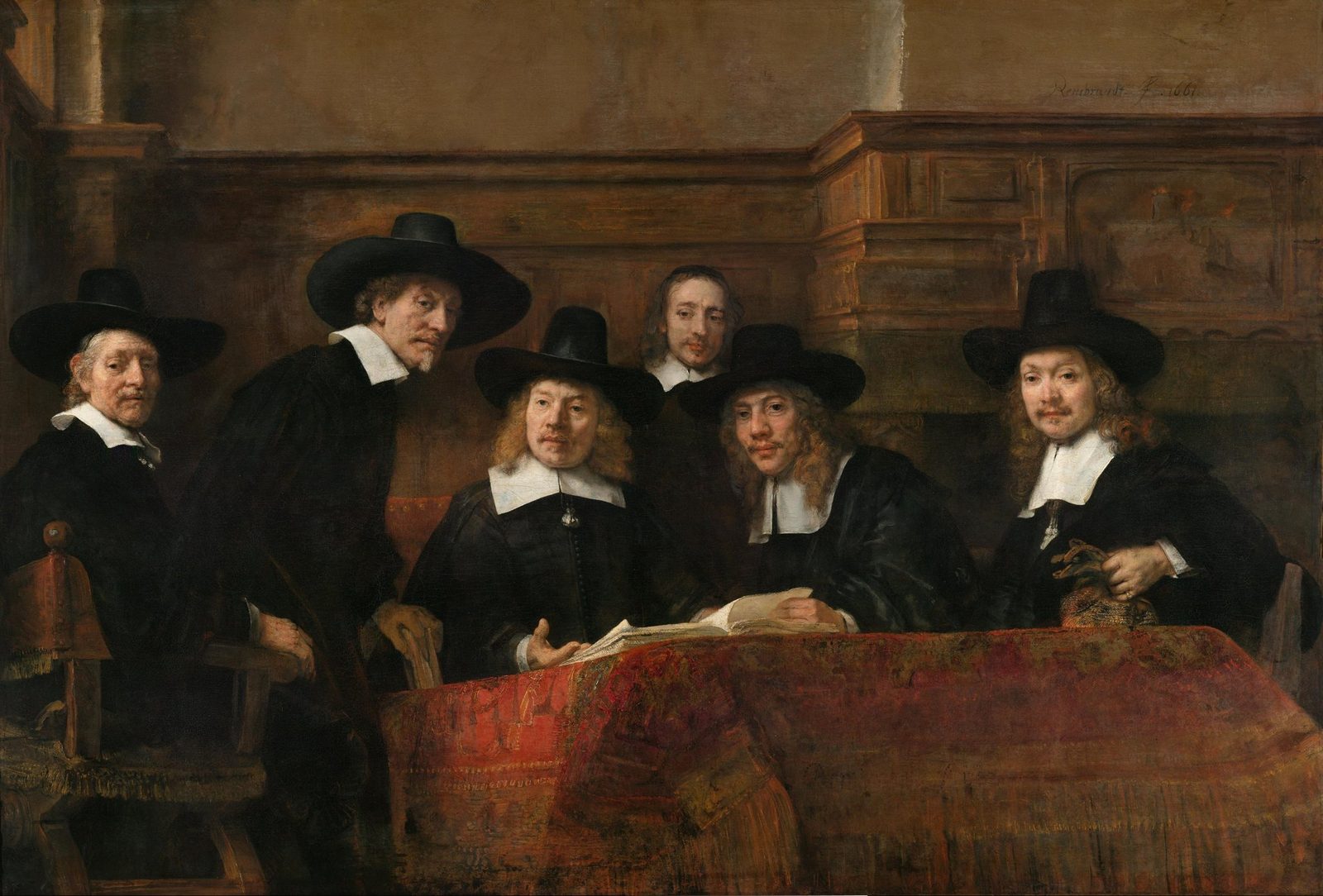
- Artist
- Rembrandt van Rijn
- Title
- The Sampling Officials of the Amsterdam Drapers’ Guild, known as ‘The Syndics’
- Date
- 1662
- Museum
- Rijksmuseum
- Image
- Public domain (CC0)
Open in Simple Art
Watch this story on iPhone and iPad, with offline downloads and a painting every day.
About 4 minutes of looking, in 9 parts.
The Syndics
Five men in black hats look up from a table, as if we had just walked in on their meeting. A sixth, bareheaded, stands behind them. Apart from their faces and collars, the only strong note in the room is the red cloth in front of them.
Amsterdam, 1662, oil on canvas
This is Rembrandt's portrait of the sampling officials of the Amsterdam drapers' guild, known as The Syndics, painted in oil on canvas in 1662. According to the Rijksmuseum, they are going through a book of fabric samples. The man standing behind them is their servant, Frans Hendricksz Bel.
A row of heads above a long table
The long table gives the picture a strong horizontal, and the heads run across it like a frieze. The tall man second from the left stands and leans in, breaking the line, so the row never feels stiff.
Light from the left
Now the man at the far right. The light seems to come from the upper left, perhaps from a window we can't see. It catches his brow, nose and upper lip, and the far side of his face slips into soft shadow without any hard line between.
The one red
Drop to the table. The red cloth is the one saturated colour in the painting. Up close it looks less like a drawn pattern than a scatter of short dabs, yellow and dark brown over red, which your eye assembles into a weave. Along the front runs a fringe of yellow dashes.
A face that meets ours
Now the seated man near the centre. Like several of his colleagues, he looks straight out at us. Light picks out his forehead, the bridge of his nose and his lower lip, and a tiny highlight sits in each eye. Where his cheek meets the hat, the edge softens and gets lost.
Pages without words
Below him lies the open sample book, with his hand held open beside it. Look closely and there are no letters or lines on the pages at all. They are a few broad strokes of cream and white, dragged at a slant. Rembrandt paints the brightness of paper and leaves the rest to you.
White in three steps
Back up to his white collar. It isn't one white. Cream at the inner edges cools to grey across the flat panels, then drops to grey brown where the linen turns under. Those steps make it feel folded, and its edge against the black robe is soft rather than cut.
A brim without an outline
Now the standing man's hat against the brown wall. There's no hard black line around the brim. In places the brown seems to creep into the black along a feathered seam. That broken edge lets him sit in the air of the room instead of looking cut out.
Look closer
8 details, each checked against a close-up of the picture.
-
Central Figure Face
The seated central figure looks straight out at the viewer, with light on his forehead, nose and lower lip.
The crop isolates a male face framed by a wide-brimmed black hat and long auburn hair, with a white linen collar at the base and a sliver of a second figure (only chin and lower lip visible) at the upper right. Light strikes from the upper left, catching the forehead, the bridge and tip of the nose, the left cheekbone, and the lower lip, while the right side of the face dissolves into warm umber shadow. Edges are sharply modeled on the lit side of the nose and the upper lip, then deliberately softened and lost where the cheek turns into the hat and the jaw into the collar. The gaze is locked: both pupils carry tiny pinpoint highlights set into dark wells, and the eyes are aligned almost level with the viewer. A fine craquelure net runs uniformly across the whole surface, and the hair is built from gestural, comma-shaped strokes that skim across the temples rather than describing individual strands.
-
Textbook/Ledger Details
The pages of the open book are rendered with broad, sketchy white strokes rather than precise text.
The crop isolates two hands holding an open ledger, with the page surfaces described entirely by broad, loaded white-and-cream strokes laid diagonally from upper right toward lower left; no letterforms or ruled lines are present. The lower edges of the paper are picked out with a thin darker stroke that reads as a curl or fold against the dark background. Beneath the book sits a densely worked red textile where small dabs of crimson, ochre, and near-black tile into an allover pattern without any fully resolved motifs. The background reads as a near-uniform dark brown-black against which the bright page and warm flesh tones push forward.
-
Red Carpet Texture
The red tablecloth uses broken dabs of yellow and dark brown to suggest a woven pattern.
A heavy red drapery dominates the crop, its surface built from broad, thinly loaded strokes of crimson and vermilion interrupted by short dabs of golden yellow and dark umber. The dabs read as a repeating woven or embroidered motif along the upper edge and across the fall of the fabric, while loose vertical streaks of deeper brown and black suggest folds and accumulated grime. Edges are deliberately unresolved: the cloth melts into shadow on the right and breaks into crisp, pointillist-like accents where the pattern catches the light. A fringe of yellow dashes runs horizontally, clearly defined against the dark recess beneath the table. Layering is translucent rather than opaque, with the warm ground showing through the upper scumbles.
-
Linen Collar Highlights
The white collars feature a range of tones from bright white to grey-brown shadows.
The crop shows the lower face, a broad white linen collar in two triangular flaps meeting at the throat, the dark robe beneath, and a small ornamental tassel or pendant hanging at center. The collar carries a clear value range: cream-bright highlights near the upper inner edges and along the central crease, cooling to mid-grey across the broad panels, and dropping into grey-brown shadows along the lower outer edges and where the linen turns under. The boundary between white linen and black robe is soft and slightly irregular, not a hard cut. A network of fine craquelure runs across the white surface, and warm reddish-brown background tone shows at upper left.
-
Hat Brim Silhouette
The edge of the black hat against the brown wall is softened and slightly blurred.
The crop shows the upper portion of a figure wearing a wide-brimmed black hat against a warm umber-brown wall, with the right eye, brow, and bridge of the nose visible below the brim. The silhouette of the hat is not a crisp line: where the dark hat mass meets the brown wall, the boundary feathers slightly, with the brown visibly intruding into the black in thin transitions rather than terminating at a hard edge. The wall reads as a single muted brown layer interrupted by craquelure rather than by reworking, while the hat interior shows subtle warmer browns bleeding up from the face below. Skin on the brow and temple is built with blended warm and slightly cooler passages, and a sliver of white collar at the bottom anchors the figure against the dark mass above.
-
Side-lit Face (Right Figure)
Light falls across one side of the man's face, while the other side turns into soft shadow.
The crop isolates a man's head, framed above by a wide-brimmed dark hat and below by a pale, loosely painted collar. Light rakes across the figure's right cheekbone (viewer's right), the bridge of the nose, and the upper lip, leaving the left temple, the left eye socket, and the hair mass in deep, soft shadow. The transition between lit and shadowed flesh is handled with blurred, feathered edges rather than a hard line, and the hair is built from curling, broken strokes of umber and reddish-ochre. Craquelure runs across the whole surface, and the background reads as a near-black void with a faint, illegible light inscription at upper left.
-
Hand on Table
The central figure's open hand, palm up, sits at the edge of the open book, its fingertips softened against the pages.
The crop isolates a right hand resting on a thick, open ledger, with the wrist wrapped in a white cuff and the book lying over a deep crimson carpet patterned with dark arabesques. Fingertip silhouettes against the cream-colored page are softened by translucent warm-grey scumbling rather than crisp contour, while impasto highlights sit on the page edges as raised, butter-cream ridges catching the upper-left light. The carpet reads as layered glazes: a saturated red-brown ground interrupted by near-black calligraphic marks that sit on top, and the hand's flesh is built from warm umber mid-tones with cooler grey-violet shadows in the knuckles. Craquelure runs diagonally across the hand and table, and a thin warm rim separates the thumb's upper edge from the dark background.
-
Background Servant
A man without a tall hat stands behind the seated officials, his face lit against the panelled wall.
The crop centers on a man's head and shoulders, painted against a warm brown background. His face is modeled with a bright left side catching cool, directional light, and a shadowed right side that melts into the background; loose, broken brushstrokes describe the wispy hair and a small dark skullcap above. A crisp white collar at the throat provides the highest value in the crop, set against the deep near-black of the robe. In the lower right, a second face emerges in half-shadow: only an eye, cheek, and part of a brow are resolved, with a softly blurred edge that reads as a background figure standing back in space. Aged craquelure runs across the entire surface, fragmenting the paint into small tiles.
The Syndics in context
Working after the bankruptcy
Rembrandt declared bankruptcy in 1656 and had to hand almost all his possessions to his creditors [3]. To stop new fees going to them, Hendrickje Stoffels and his son Titus set up a company with Rembrandt as its only employee [3]. By February 1658 his house had been sold and the family had moved to humbler lodgings on the Rozengracht, Wikipedia reports [6]. A major commission secured in 1661 for the new town hall, The Conspiracy of Claudius Civilis, was rejected by the mayors and returned to him within a few weeks [6].
The Rijksmuseum notes that the Amsterdam elite no longer called on him as often, yet he remained popular enough for this important guild to order a group portrait [1]. Liedtke counted the Syndics among the dozens of major works Rembrandt produced after declaring insolvency [4].
Six men and a sample book
The sitters were the staalmeesters, or sampling officials, of the Amsterdam drapers' guild [1]. Wikipedia explains that they compared batches of cloth against samples, earning them their name, and that the post was unpaid and honorary [5]. Terms ran for a year from Good Friday, and these men served from 1661 to 1662 [5]. RKD identifies them as the wardens of those years [2]. Wikipedia says they included two Catholics, a Mennonite, a Remonstrant and a Reformed Protestant [5].
From left to right the Rijksmuseum names Jacob van Loon, Volckert Jansz, Willem van Doeyenburg, the servant Frans Hendricksz Bel, Aernout van der Mye and Jochem de Neve [1]. Its description also notes a Persian carpet on the table and, above a fireplace at the right, a painting of a burning beacon [1].
Made for one room
The guild commissioned the work for its hall, the Staalhof on the Staalstraat [1][2]. Wikipedia reports that the canvas probably hung high, perhaps above a mantelpiece, and that Rembrandt likely chose a low viewpoint and matched the painted light to the room for that reason [5]. RKD lists portraits of Jacob van Loon and of Volckert Jansz, and one of three of the wardens together, as works the painting is based on [2].
Restoration in 1991 showed that an object long seen as a bag, held by the man on the far right, is in fact a pair of gloves, according to Wikipedia [5]. The canvas also carries two signatures. 'Rembrandt f. 1662' sits at the bottom centre, while a second, dated 1661, high on the wall at the right was added later, says RKD [2]. The Rijksmuseum lists that second one as false [1].
From the Staalhof to the museum
A label once on the back recorded the painting's transfer to the 'Konstkamer' in the Town Hall on 27 November 1771 [1]. It has been on loan from the City of Amsterdam to the museum since 15 August 1808, and RKD places it in the Trippenhuis until 1885 [1][2]. It has been lent to exhibitions including the Stedelijk Museum's Rembrandt show of 1898 and the National Gallery's Rembrandt: The Late Works in London in 2014-15 [2].
A lasting image
Wikipedia quotes a description of it as his "last great collective portrait" [5]. It has also had a long life outside the gallery. The image appears on Dutch Masters cigar packaging, hangs on a wall in the opening of the 1960 film The Time Machine, and plays a role in Zadie Smith's novel On Beauty [5]. Liedtke noted more broadly that Rembrandt inspired painters across Europe in the 18th century and many 19th-century realists [4].
- The Sampling Officials of the Amsterdam Drapers' Guild, known as 'The Syndics' (SK-C-6): object record and provenance . Rijksmuseum, Amsterdam
- De waardijns van het Amsterdamse lakenbereidersgilde, bekend als 'De staalmeesters' (RKDimages 3046) . RKD – Netherlands Institute for Art History
- Rembrandt van Rijn: Rebel with a cause (Dutch Masters series) . Rijksmuseum, Amsterdam
- Rembrandt (1606–1669): Paintings, Heilbrunn Timeline of Art History (Walter Liedtke, 2003) . The Metropolitan Museum of Art
- Syndics of the Drapers' Guild . Wikipedia
- Rembrandt . Wikipedia