Taking the pulse
How Jan Steen makes a comedy of a sickbed, with every line leading to two hands
- Artist
- Jan Havicksz. Steen
- Title
- The sick woman
- Date
- c. 1663 - c. 1666
- Museum
- Rijksmuseum
- Image
- Public domain (CC0)
Open in Simple Art
Watch this story on iPhone and iPad, with offline downloads and a painting every day.
About 3 minutes of looking, in 8 parts.
Two hands meeting
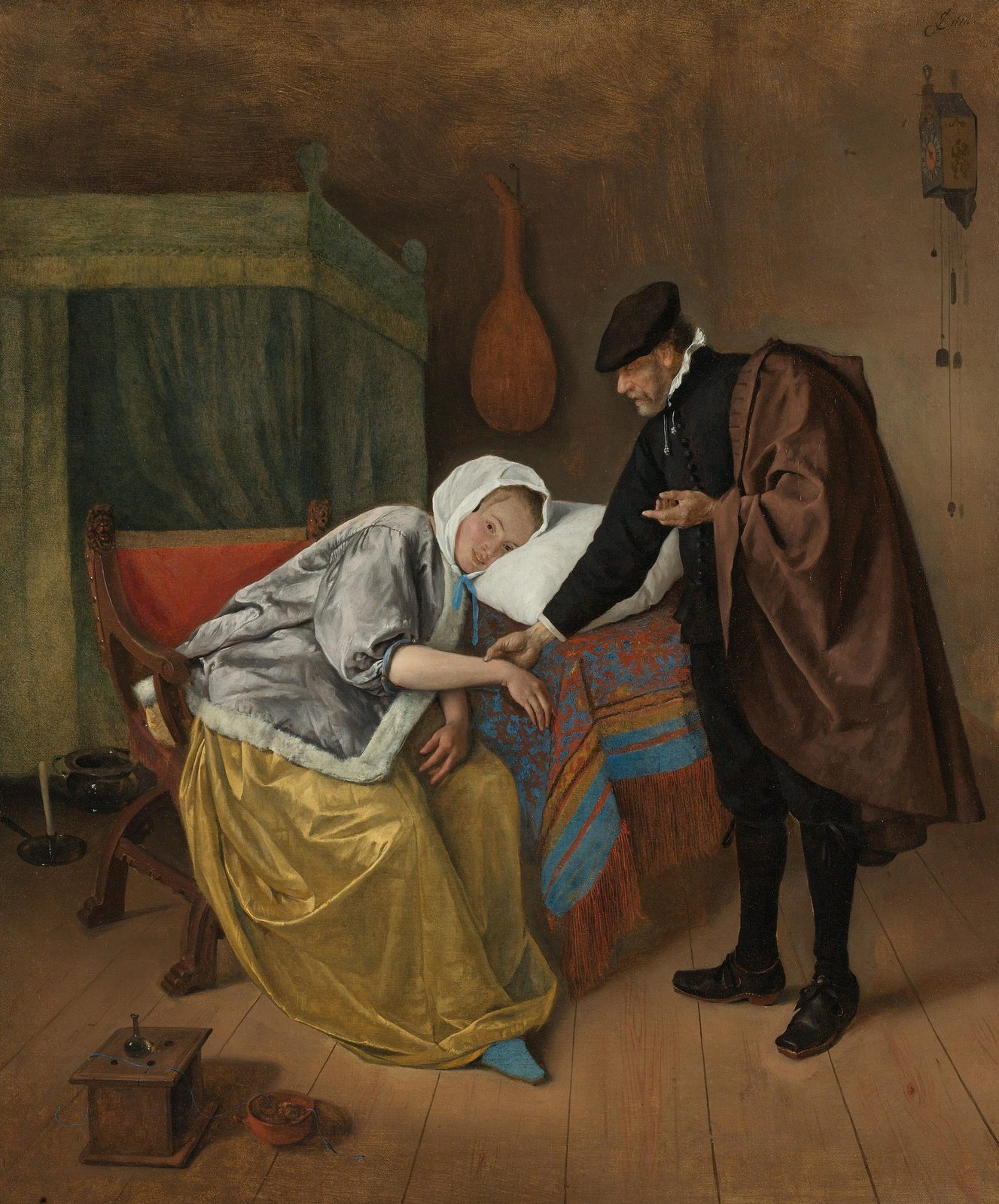
A young woman leans on a pillow at the edge of her bed, her eyes almost closed. A man in a black cap and a long brown cloak bends over her and holds her wrist. Your eye goes straight to the place where their hands meet.
Jan Steen, about 1663 to 1666
This is The Sick Woman by Jan Steen, painted in oil on canvas around 1663 to 1666. The museum suggests she is faint with fever, and wonders whether she might be lovesick, or pregnant. The man is a quack making his diagnosis, and his old-fashioned clothes mark him out as a figure of fun.
A triangle to the hands
The two figures make a triangle. His body leans in from the right, hers slumps from the left, and they meet at the joined hands. The slope of his shoulder leads your eye straight down to her wrist.
The pulse
Here is the centre of it all. His fingers press into her inner wrist, the knuckles sharply drawn, while her hand hangs limp, paler and cooler, with a faint vein on the forearm. The museum adds that such a quack might also set a strip of her clothing smouldering in a brazier, so the smell would reveal her secret.
A coverlet in dabs
The coverlet beneath their hands is painted another way. Its pattern is short dabs of dull red and muted blue, side by side over a warm brown, and down the right side close-packed red strokes read as a fringe. Next to the smooth hand above, it looks almost woven.
Heavy lids
Now look up at her face. The lids are heavy, with only dark crescents of the eyes showing. Her cheek is warm pink, turning cooler along the jaw where it sinks into the white pillow, and a small blue bow sits against her headscarf.
Yellow satin
Her yellow skirt pools towards the floor, the strongest colour in a room of browns. Its highlights run in narrow, crisp lines along the folds, then drop sharply into deep golden brown. That hard step from light to dark is what makes the cloth look like satin.
A lute on the wall
Up on the wall hangs a lute. Light runs down its left edge, the body of the bowl is kept darker, and a soft shadow falls to the right, so it sits on the wall rather than floating in front of it.
Look closer
6 details, each checked against a close-up of the picture.
-
The pulse-taking gesture
The doctor's fingers press firmly into the woman's inner wrist.
The crop centers on two hands meeting over a richly patterned textile. The doctor's hand enters from the upper right, its thumb and fingers curling down to grip the woman's pale inner wrist; his thumb nail and knuckle creases are sharply defined with a cooler gray-violet shadow in the recesses. The woman's hand drops limply forward, her skin noticeably lighter and cooler, with a faint blue-green vein visible along the forearm. Behind the hands a vivid carpet of red-orange ground and turquoise-blue floral motifs provides a saturated counterpoint to the muted flesh. The light from the left hits the thumb's outer edge and the top plane of the wrist, throwing soft cast shadows where the doctor's fingers press into the pulse point.
-
The woman's expression
The woman's eyes are open and turned toward the viewer, her head tilted onto the pillow.
The crop centers on a young woman's face pressed into a voluminous white pillow, framed by a folded white headscarf and a small blue ribbon bow. Her eyes are open and look out at the viewer, dark irises under slightly lowered lids, with a faint sheen on the lower lid catching the left-side light. The cheek facing us is a warm pink, set against cooler shadow along the jaw that fades into the pillow's mass. Craquelure runs across the whole surface in a tight web, and the headscarf is built from broad, soft-edged strokes of warm white over cooler grey-blue shadow rather than crisp lines. A lock of auburn hair is tucked behind her ear and disappears under the cap.
-
The yellow satin skirt
Bright saffron highlights contrast with deep golden-brown shadows in the fabric folds.
The crop is dominated by a yellow satin skirt pooling on a wooden floor. The fabric is rendered with crisp, almost linear highlights along the crests of the folds — pale lemon to warm saffron — that drop abruptly into deep golden-brown, almost olive shadows in the recesses. The folds sweep diagonally from upper-left to lower-right, and the brushwork visibly tracks along those directions. At the top edge a white fur-trimmed bodice reads as a soft, broken edge against the satin, and on the right a hand with reddened fingers and a blue-and-orange patterned textile intrude into the frame. A small terracotta bowl with blue thread and a tiny creature sits in the lower-left corner against warm tan floorboards.
-
The patterned coverlet
Individual red and blue strokes create a woven texture on the blanket.
The crop centers on a heavily patterned coverlet draped over a figure, with a pale hand resting on its upper left edge and a yellow skirt visible at the lower left. The main field shows a dense scrollwork/floral design built from short, dabbed strokes of dull red and muted blue set over a warm reddish-brown ground; the marks are small, slightly blurred at their edges, and sit closely side-by-side rather than melting into a continuous wash. A border runs diagonally down-right made of longer, more linear strokes in alternating bands of cobalt blue, ochre, and reddish-brown, where each color edge is fairly soft but readable as a stripe. Along the right side, a fringe area is rendered with dozens of short, near-vertical parallel red strokes laid close-packed to read as hanging threads. The hand and forearm above are modeled with much smoother blending, providing a clear contrast to the broken, multi-hued mark-making of the textile.
-
The hanging lute
A brown, pear-shaped lute hangs vertically against the brown wall.
The crop shows a single lute hanging vertically against a mottled dark brown wall, with its broad pear-shaped bowl filling the lower two-thirds of the frame and its narrow neck tapering upward into a small dark headstock at the top edge. The bowl is painted in warm umber and ochre, with a brighter raking highlight running down the left contour where the left-side light catches the curved side. The core of the body is kept distinctly darker than the lit edge, and a soft cast shadow falls to the right of the instrument against the wall, anchoring it in space. The headstock at the top registers only as a few dark, broken touches suggesting the tuning pegs rather than a fully modeled form.
-
The bed curtain edge
A lighter vertical band runs down the green curtain as a soft tonal seam rather than a sharp line.
The crop is dominated by a vertical strip of olive-green drapery with brown undertones, where subtle tonal shifts suggest a soft fold rather than a single crisp boundary. A slightly lighter vertical band runs near the right-center, fading rather than terminating sharply into the darker brown/green mass on its right. Surface texture shows fine, short vertical brush marks and what appears to be canvas weave intermingled with the paint, especially in the mid-tones. At the very bottom edge, a small curved pale shape intrudes, possibly the top of a head or vessel, but it is too cropped to read clearly.
The Sick Woman in context
A Leiden subject
The Rijksmuseum's short description of the room points out a bed in the background, a lute and a clock on the wall, and a foot stove with a small fire-pot at the lower left [1]. Writing for the Leiden Collection, Junko Aono notes that the doctor's visit was especially popular among Leiden painters in the 1650s and 1660s, including Gerrit Dou, Frans van Mieris and Steen [2]. In their pictures, the pale patient suffers from an illness with no cure, lovesickness, while the doctor either takes her pulse or studies her urine [2].
Aono credits Dou with the prototype of the doctor inspecting urine, in a picture of 1653, while Van Mieris showed a doctor taking the pulse in 1657 [2]. She links the theme's popularity to Leiden's university, whose scholars and doctors enjoyed paintings with pseudo-medical subjects [2].
Love as a fever
The catalogue of the 1976 exhibition Tot lering en vermaak explains the medical thinking behind such scenes. Under the old theory of the four humours, love was a warm, moist passion, and love left unsatisfied was thought to make the body cold and dry, the marks of melancholy [3]. The French physician Jacques Ferrand even wrote a book in 1623 on lovesickness as erotic melancholy, which the poet Jacob Cats and the physician Johan van Beverwijck cited repeatedly [3].
Feeling the pulse could signal that diagnosis. Cats retold the ancient story of Prince Antiochus, whose pulse raced when his stepmother Stratonice came to his bedside. Yet both Cats and Van Beverwijck denied that any special 'love pulse' existed [3]. The catalogue adds that Steen painted the Antiochus story too [3].
A doctor in stage costume
The same catalogue explains why the museum calls this doctor's dress old-fashioned. In many of these scenes he wears a gown about a hundred years out of date, which by then only stage doctors still wore [4]. The authors argue that Steen's physician descends from the doctor of the commedia dell'arte. This character reached the Dutch stage by way of France around 1660 as a charlatan and money-grubber [4]. Van Beverwijck himself compared many doctors to actors who wore the costume but weren't the person they played [4].
Other museums read the props in a similar way. The Philadelphia Museum of Art describes the ribbon smouldering on a brazier in its own Steen doctor's visit as a quack's test for pregnancy [5].
Family ties in Leiden
Steen had his own links with the Leiden painters who made the subject popular. Piet Bakker notes that his great-uncle Pieter Dircksz Steen was a painter and goldsmith, and that an aunt's marriage in 1632 may have brought the boy into contact with the work of Jan Lievens [6]. His brother Wijbrand later married a sister of the painter Ary de Vois, and the two earliest mentions of Steen's work in Leiden inventories, from 1656 and 1657, come from the family of his sister Margareta's husband, a goldsmith [6].
Signature and owners
The canvas is signed 'JSteen' at the upper right and is dated by the museum to about 1663-1666 [1]. It belongs to the City of Amsterdam through the A. van der Hoop bequest and is on loan to the Rijksmuseum, whose record locates it in the Gallery of Honour of the main building [1].
- Jan Havicksz. Steen, The Sick Woman (SK-C-230): object record . Rijksmuseum, Amsterdam
- Junko Aono, 'Doctor's Visit' (Jacob Toorenvliet) (2017), The Leiden Collection Catalogue . The Leiden Collection, New York
- E. de Jongh et al., Tot lering en vermaak (1976), cat. 61: Jan Steen, Doktersbezoek . Rijksmuseum, Amsterdam, via DBNL
- E. de Jongh et al., Tot lering en vermaak (1976), cat. 63: Jan Steen, Doktersbezoek . Rijksmuseum, Amsterdam, via DBNL
- Jan Steen, The Doctor's Visit, c. 1660-1665: object page . Philadelphia Museum of Art
- Piet Bakker, 'Jan Steen' (2017), The Leiden Collection Catalogue (archived 2020) . The Leiden Collection, New York