One dome, one cloud, one walker
How Van Gogh catches an Amsterdam canal view with quick strokes on a small panel
- Artist
- Vincent van Gogh
- Title
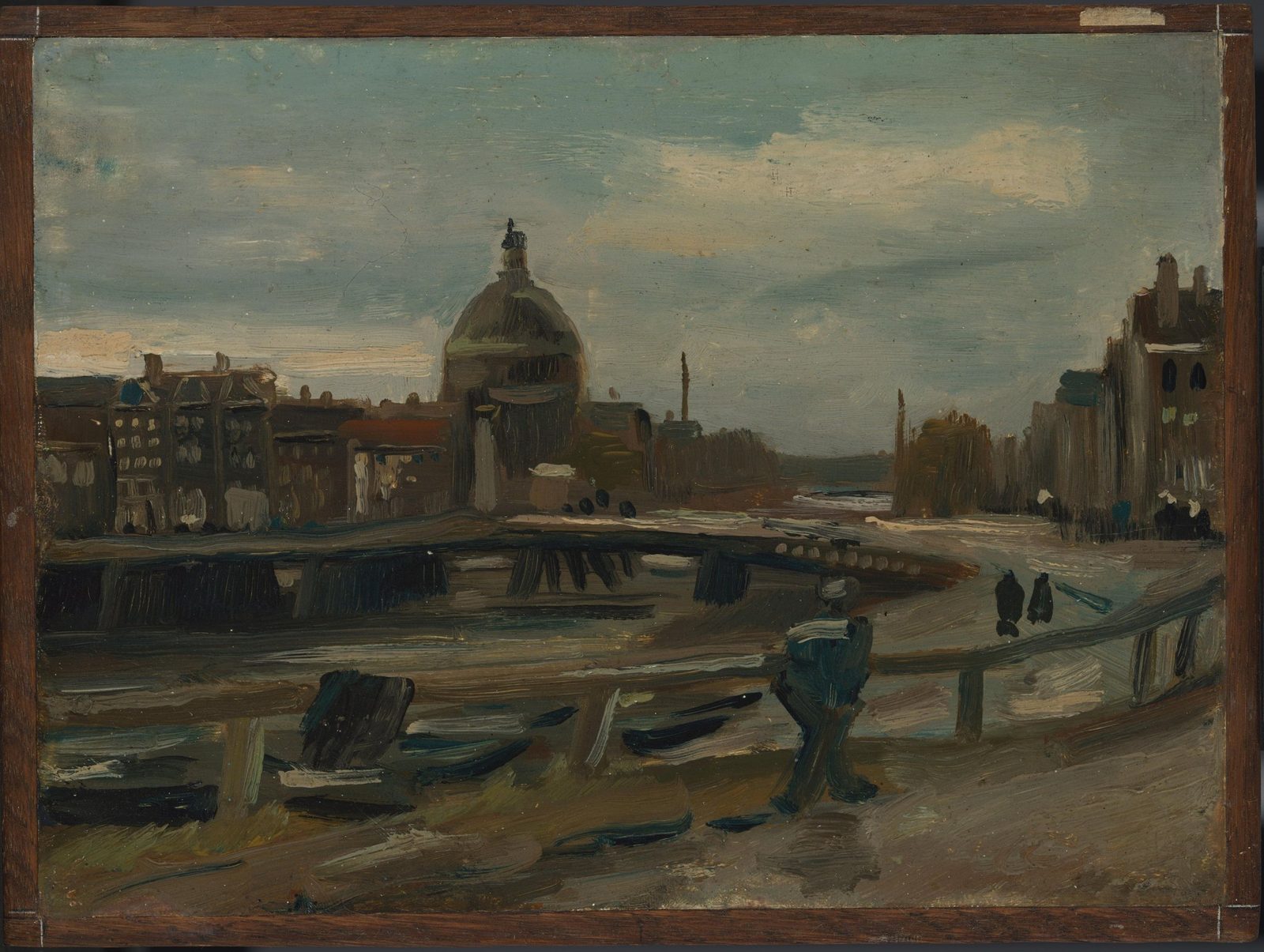
- The Singel near the Lutheran Church in Amsterdam
- Date
- 1885
- Museum
- Rijksmuseum
- Image
- Public domain (CC0)
Open in Simple Art
Watch this story on iPhone and iPad, with offline downloads and a painting every day.
About 4 minutes of looking, in 9 parts.
A dome, a quay, a walker
This is a very small picture, about nineteen by twenty-five centimetres. A dark dome rises over a canal-side street, a quay runs across the middle, and a single figure walks through the foreground. Almost everything is done in quick, broad strokes.
Amsterdam, 1885, oil on panel
Vincent van Gogh painted this in 1885, in oil on a small panel. According to the Rijksmuseum, he came to Amsterdam to see the newly opened museum, and was so struck by the loose brushwork of Frans Hals and Rembrandt that he painted this view of the Singel. He had brought the panel and a paint box with him.
Balanced, then tipped
The layout is almost symmetrical. The dome holds the middle, rooftops gather on either side, and the band of the quay cuts across below. Then a small figure on the right breaks the balance, and that slight lopsidedness keeps the picture from going stiff.
One pale cloud
Lift your eyes to the sky. A broad, cream-coloured cloud lies against muted teal, and it is the brightest thing in the picture. It looks dragged on in long sideways strokes, thin enough at its lower edge for the teal to show through. Over to the left, the sky is deeper teal at the top and paler, greyer blue lower down.
The dome
Now the dome, presumably the Lutheran church of the title. It is a dark silhouette with a tiny spire on top, built from long strokes that seem to follow its curve, with a lighter band across the base. Look at its edges. They are soft and broken, as if sky and dome were painted into each other rather than outlined first.
A walker in a dozen strokes
Down to the right, a single figure crosses the quay. He is roughly a dozen heavy strokes of blue-black and brown, with a paler sweep across the shoulder and no face at all. Yet you read his weight and direction straight away.
Ground made of dragged paint
In the lower left, the ground is a tangle of overlapping horizontal strokes in brown, olive and dark grey. Over the top, a drier, lighter stroke has been scuffed across. That broken drag is what makes the surface look rough and wet rather than flat.
A ragged waterline
Trace the line where the quay meets the water. It isn't one clean stroke but a dark, broken ribbon that thins and thickens, with short vertical marks dropping from it, perhaps posts, perhaps runs of paint. Below it, streaky darks read as reflections.
Near and far, the same mark
Now compare the walker with two tiny figures further back on the right. They are little more than dark vertical dabs over the same horizontal strokes of ground. The gesture hardly changes, only the size, and your eye still reads people.
Look closer
8 details, each checked against a close-up of the picture.
-
The Domed Building
The dome is rendered as a dark silhouette with a small vertical spire at the peak.
The crop centers on a large domed church rendered as a dark mass against a teal sky with cream-colored cloud highlights biased to the upper left. The dome itself is built from broad, vertical and slightly curving strokes of olive-brown, raw umber, and a muted yellow-green, with a horizontal band of lighter grey-green marking the drum or base ring beneath it. A small dark spire topped with a tiny finial silhouette sits at the apex. Flanking the dome are simpler dark building masses, a vertical post/column in the left foreground, and a thin obelisk-like spire at the right edge. The edges between dome and sky are soft and broken, not crisp.
-
Foreground Figure
The figure is composed of a few thick, dark vertical and angled strokes with no facial detail.
The crop centers on a single foreground figure reduced to roughly a dozen heavy brushstrokes. A dark mass of blue-black and umber paint forms the torso and legs, with a paler horizontal sweep of grey-white reading as a shoulder or carried load. The head is just two or three smudged marks; there are no eyes, nose, or mouth. Background ground is laid in with broad horizontal sweeps of raw umber and ochre, while the top edge holds a dark band dotted with small pale rounds (windows or lamps).
-
Muddy Ground Texture
The foreground consists of overlapping horizontal strokes of brown, olive, and dark grey paint.
The crop is dominated by horizontal, overlapping brushstrokes that read as muddy ground. Warm brown-olive passages sit beneath cooler dark-grey strokes, with dry, scratchy lighter highlights dragged over the top. A vertical wooden post in the center interrupts the horizontal flow, and the lower edge of a dark-clothed figure enters the upper right. Edges are soft and broken where strokes overlap, while isolated lighter drags create crisp, linear accents against the darker layers.
-
Cloud Highlights
The bright cream-colored cloud is applied as a flat, broad patch of light paint against the teal sky.
The crop isolates a horizontal band where cream-tan cloud paint sits against a muted teal sky. The cloud body reads as a single, broadly applied horizontal passage, but on close inspection it is not perfectly flat: thin directional streaks run left-to-right, and patches of the teal below remain partly visible through thinner scumbles along the lower edge. The boundary between cream and teal is soft and irregular, with the cloud feathered down rather than meeting the sky in a hard line. Small dark specks scattered across the surface appear to be dirt or pressed-in debris on the paint film rather than pigment.
-
Bridge/Quay Edge
The line separating the land from the water is a broken, irregular dark horizontal band.
A dark, roughly horizontal band runs across the middle of the crop, separating a tan-beige upper zone (quay surface with pale, streaky highlights) from a darker brownish lower zone (water with vertical reflections). The band is not a single clean stroke; it is broken into segments, thinning and thickening, with dark vertical drips and posts descending from it. To the right, pale horizontal smears sit above the band and small repeating vertical touches suggest posts or pilings, while the lower zone mirrors the upper with streaky, diluted dark reflections. The claim is supported: the land/water boundary reads as a discontinuous, irregular dark ribbon rather than a straight line.
-
Sky Gradients
The sky transitions from a saturated teal at the top to a paler, greyish-blue near the horizon.
The crop captures a sky region dominated by horizontal, gestural brushwork in muted teal-to-grey-blue tones. A dark brown wooden band runs along the very top edge, likely a frame or stretcher. The upper third shows the most saturated teal pigment, applied in scumbled horizontal strokes that partly reveal a lighter ground beneath. Moving downward, the value lightens and the hue cools toward a chalky grey-blue, with a small warmer, beige-pink passage breaking the gradient near the lower center. Surface marks include fine scratches, scattered white specks, and a few deeper gouged lines on the right side, all sitting on top of the paint rather than being integrated into it.
-
Left Architecture
The buildings on the left are rendered as blocks of brown and ochre with minimal window detail.
The crop shows the left flank of the street's architecture as stacked, blocky masses of dark umber and chocolate brown with a single red-tile roof peeking in from the right. Windows are reduced to small pale-ochre dabs—roughly four rows of soft, oval smudges on the main façade—laid wet-in-wet over the dark base rather than drawn with crisp edges. A solitary teal accent sits high on the left tower mass, and a thin strip of the wooden panel edge is visible at the far left, confirming this is an oil sketch on a hard support. The vertical brush direction dominates, with dragged strokes on the left mass becoming shorter, choppier dabs where the windows cluster.
-
Background Figures
Two small, dark vertical ticks represent people standing near the right edge of the bridge.
Two small dark vertical forms sit in the lower-center of the crop against a field of roughly horizontal brushwork. The left figure is a dense, rounded black mass with a slightly bulbous top, while the right figure is taller, more streaky, and shows thin vertical drag marks within it. Surrounding the figures the ground reads as a mix of warm brown, ochre, and cool teal-grey streaks laid in long, parallel gestures. A few tiny light specks (one near the figures' feet, others scattered below) sit on top of the wet ground layer. The bottom edge of the crop darkens into a thicker band of saturated umber, and the right side has a small cool teal dab.
The Singel near the Lutheran Church in context
Three days at the museum
Van Gogh went to Amsterdam from Nuenen on 6 October 1885 and was back on 8 October, as he told his brother Theo in a letter written on or about 10 October [2]. The editors of his letters explain that 'the museum' he mentions is the Rijksmuseum, which had opened in its new building that July, and that his companion was his friend Anton Kerssemakers from Eindhoven [2]. In the same letter he praised Rembrandt's Jewish Bride and a militia piece by Frans Hals and Pieter Codde that he had not known before [2].
Two souvenirs in a hurry
He wrote that the two little panels he painted in Amsterdam were done in a tearing hurry. One was painted in the station waiting room while he waited for his train, and the other in the morning before he went to the museum at about ten [2]. The editors identify them as View in Amsterdam (F 113 / JH 944), which is this panel, and De Ruyterkade in Amsterdam (F 211 / JH 973), painted on 7 and 8 October [2]. The letter doesn't specify which of the two was made in the waiting room, and the sources consulted here don't settle it [2].
A few days later he warned Theo that both sketches were quite badly damaged. They had got wet on the journey, the panels warped as they dried, and dust got into them [3]. The editors note that both still show traces of dirt and probably soot [3]. But he sent them anyway, to show that he was beginning to be able to dash off an impression in the space of an hour [3].
Lessons from Hals and Rembrandt
The Rijksmuseum's label connects the panel directly to that visit. It says he was so impressed by the loose brushwork of Hals and Rembrandt that he painted this view of the Singel with quick strokes [1]. His letter of about 13 October makes the same point in his own words. The old Dutch masters had usually painted quickly, putting it straight down and leaving it alone if it worked [3]. He singled out hands by Rembrandt and Hals that lived without being finished in the modern sense, and heads done with the first brushstrokes and no retouching [3].
The dome in the title
The editors of the letters cite the Van Gogh Museum's 1999 catalogue for identifying the place each panel shows [2]. The museum's title names the Lutheran church on the Singel, today known as the Ronde Lutherse Kerk [1][4]. Amsterdam's architecture centre Arcam records that Adriaan Dortsman designed it in 1671 with a dome rather than a tower, because only Reformed churches were allowed towers [4]. A fire on 18 September 1822 destroyed almost the whole interior and brought the dome down. The church was rebuilt by 1826 to designs by T.F. Suys and J. de Greef [4]. The dome Van Gogh sketched in 1885 would therefore have been the rebuilt one [4].
The panel measures 19 by 25.5 cm and is in oil on panel [1]. It isn't owned by the Rijksmuseum, but is on loan from the Stichting Collectie P. & N. de Boer [1].
- Vincent van Gogh, The Singel near the Lutheran Church in Amsterdam (SK-C-1843): object record . Rijksmuseum, Amsterdam
- Letter 534, to Theo van Gogh, Nuenen, on or about 10 October 1885, with editorial notes . Van Gogh Museum and Huygens ING, Vincent van Gogh: The Letters
- Letter 535, to Theo van Gogh, Nuenen, on or about 13 October 1885, with editorial notes . Van Gogh Museum and Huygens ING, Vincent van Gogh: The Letters
- Ronde Lutherse Kerk: architecture guide entry . Arcam, Architectuurcentrum Amsterdam