Bigger than the castle
How Ruisdael lets an ordinary mill on the Lek outgrow everything around it
- Artist
- Jacob Isaacksz van Ruisdael
- Title
- The windmill at Wijk bij Duurstede
- Date
- c. 1668 - c. 1670
- Museum
- Rijksmuseum
- Image
- Public domain (CC0)
Open in Simple Art
Watch this story on iPhone and iPad, with offline downloads and a painting every day.
About 3 minutes of looking, in 9 parts.
The mill and what it dwarfs
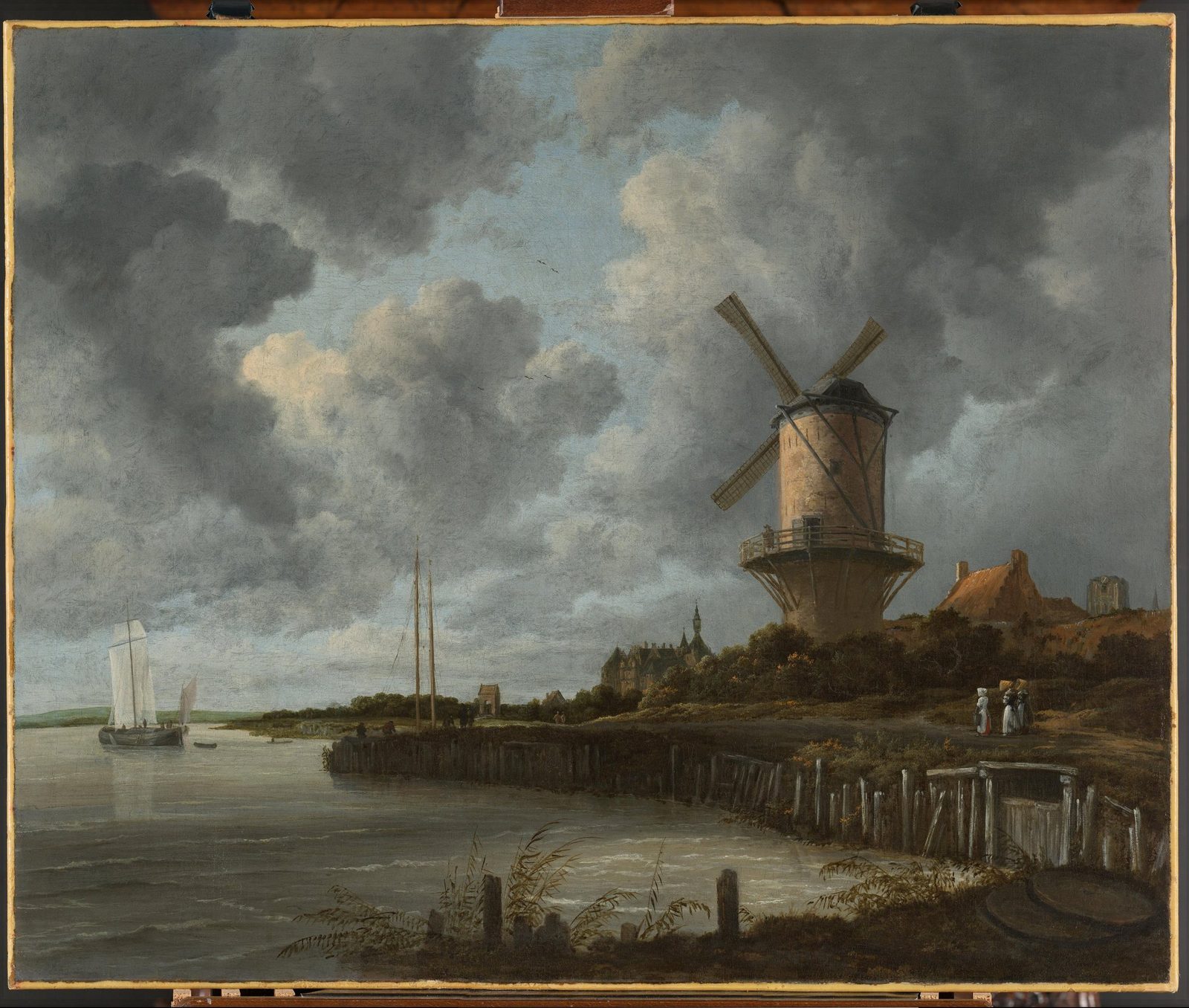
Look past the windmill for a moment. The museum points out that the castle and church of Wijk bij Duurstede are here too, in the background. Beside the mill they hardly register. A working building has been allowed to outgrow them all.
Wijk bij Duurstede, c. 1668–70
This is The Windmill at Wijk bij Duurstede by Jacob Isaacksz van Ruisdael, oil on canvas, painted around 1668 to 1670. The river in front is the Lek. The museum calls it world famous, and notes how it gathers the low land, the water and the big sky onto one mill.
Everything leads to the mill
Follow the lines. The row of posts curves in from the right, the far shore runs in from the left, and the horizon lies low. The mill stands on the right third, with a sailing boat at the far left to balance it.
The opening in the cloud
The brightest patch in the painting isn't on the mill at all. It's this gap in the clouds, left of centre, a pale cream glow with soft, dragged edges. Everything around it sits a shade darker, so it reads as light without a single hard line.
A tower in two temperatures
Now the mill itself. The lit side of the tower is a warm ochre and the side turned away a cooler brown, and that change alone makes it round. The stonework is only hinted at with a few seams and small dark windows. On the gallery, a tiny figure seems to be standing.
The counterweight on the water
Over on the left, a boat with pale sails answers the mill across the whole width of the canvas. The sails are flat light shapes, with a little grey brushed into one side to suggest a curve. Beside it, a rowing boat is barely more than a dark stroke.
Three figures on the path
On the path below the mill are three small figures in pale clothing. One wears a white cap and what looks like a red-orange skirt, the only strong colour near the mill. They seem to be carrying something, perhaps baskets, but they're made of a few soft dabs rather than drawn.
Reeds in one stroke each
Right at the bottom edge, reeds bend over the water. Each blade looks like a single pull of a fine brush, thicker at the base and tapering to a hair. Nothing inside them is modelled. They work as marks, not as plants.
A curving row of posts
Along the river's edge runs a row of wooden posts. They seem to be cut out of one dark mass, with a few bright vertical streaks added at the end, perhaps light on wet wood. The row bends with the bank and carries you back towards the mill.
Look closer
8 details, each checked against a close-up of the picture.
-
The Stone Windmill
The windmill tower is constructed of stone blocks with a wooden gallery and four sail blades.
The crop isolates the upper section of a cylindrical stone windmill tower topped by four sail blades set in an X-formation. The lit (left/upper) face reads as warm ochre stone with subtle vertical masonry seams and small window slits, while the right face drops into cool brown shadow, giving the cylinder convincing volume. A wooden gallery with a railing encircles the tower about two-thirds down; a tiny figure stands on its left side. The sky is a softly blended grey with the brightest cloud opening just left of center, and a fine craquelure network covers the entire surface, confirming an aged oil on panel/canvas.
-
Break in the Clouds
The brightest area of the painting is a pale, luminous gap in the clouds left of center.
The crop is dominated by a turbulent cloud mass rendered in cool greys, slate-blues, and warm cream tones. A clearly defined luminous opening sits left of center, roughly between u≈0.30–0.50 and v≈0.25–0.45, where the underlying pale cream paint reads as the highest-value passage in the field. Surrounding cloud edges are softened through dry, feathery transitions rather than hard contours, and the dark passages at lower-left and lower-right are built from layered, partly translucent greys. A network of fine craquelure covers the surface, and a few small dark flecks (likely losses or tiny paint specks) sit near the center and upper-center. The overall value contrast is moderate, driven by the single bright aperture rather than by sharp edges.
-
Foreground Reeds
The reeds are rendered with thin, quick, calligraphic flick marks of paint.
The crop isolates a band of foreground reed fronds arching across the river and silhouetted against the water. Each reed is a single thin stroke of warm olive-brown that swells slightly at its base and tapers to a hair-thin tip, with a curved or sinuous trajectory suggesting wind-blown movement. The reed strokes are painted on top of a low-value underlayer (a dark earthy bank at the bottom and three vertical dark stone-like blocks in the middle) and directly over the grey river water, so their edges read crisply against the lighter passages. A few reeds cross or overlap one another, but no reed shows internal modelling — they function as graphic marks rather than three-dimensional objects. The water behind is a flat, thinly brushed grey with pale wave crests, providing the value contrast that makes the flick marks legible.
-
Figures on the Bank
Three small figures wearing pale clothing stand together on the grassy bank.
Three small figures occupy the center of the crop, rendered with loose, economical brushwork against a dark earthen bank. The leftmost figure wears a white bonnet, a pale grayish-white bodice, and a warm red-orange skirt that breaks the otherwise muted palette. The two right-hand figures are softer and more merged, their pale heads and shoulders catching the only real light in the field. Yellow-ochre passages above suggest a tarp or sail, and the surrounding ground is a scumbled dark brown with subtle olive undertones. Edges are blurred, not drawn; the figures are read mainly through value contrast rather than contour.
-
Sailing Boat
A small boat with two white sails is positioned on the calm water at the left.
The crop shows a dark-hulled sailing vessel with two near-white sails, one large foresail dominating the upper-left and a smaller, slightly grey-pink sail set aft. A small dark figure stands on the deck near the mast. To the right floats a tiny rowboat rendered in a single low-value stroke. The water reads as a flat, grey-green band with almost no horizontal ripple marks, while the sky above is a pale, slightly warm grey with soft cloud transitions. A dense network of fine craquelure covers the entire surface, breaking the paint into small irregular cells.
-
Cloud Texturing
The darker clouds exhibit soft, blended transitions between grey and brown tones.
The crop isolates the upper sky of the painting, showing two large cloud masses separated by a lighter luminous break in the upper-center. Edges are soft and smoky rather than hard; highlights are brushed as thin, broken veils of cool grey over a slightly warmer grey-brown ground. The darker underbellies of the clouds carry subtle olive-brown notes where the paint has been thinly dragged, and these warm tones fade imperceptibly into the cooler mid-tones above. Fine craquelure runs throughout, but the value relationships remain clearly readable: pale silver highlights at top, medium grey body, and the deepest grey-browns pooling in the lower cloud belly around u≈0.55, v≈0.65.
-
Village Rooftops
The buildings in the distance feature muted red-orange tiled roofs.
The crop is dominated by a large thatched roof rendered in warm orange-ochre with directional diagonal strokes that read as straw or reed thatch, capped by a small reddish brick chimney at upper-left. Below the roof sits a dense mass of dark olive-brown foliage with a soft, broken silhouette against a sliver of paler middle ground. Through the trees at center-right, a small cluster of buildings with whitish walls and faintly warm roofs is just barely legible, sitting in atmospheric shadow. A thin band of cool grey-blue sky crosses the upper edge, and fine craquelure runs across the entire paint film. The brightest passage is the sunlit thatch; the deepest is the lower-left foliage mass.
-
River Bank Piling
The river's edge is defined by a series of dark vertical wooden posts.
The crop shows a row of dark, vertical wooden pilings extending across the right two-thirds of the frame, each post roughly uniform in width but varied in height and tone. The posts are set against a deep, near-black background of shadowed riverbank and dense foliage above. Several pilings carry bright, near-white vertical streaks — these are highlights, not separate objects, suggesting either water staining, light glancing off wet wood, or deliberately added reflective slashes. The river occupies the lower-left third in cool greys with horizontal scumbled whites, while the foreground holds tangled, broken-brush reeds in warm browns and ochres. A single isolated dark mooring post rises from the water at lower-left, reading as a thin vertical silhouette.
The Windmill at Wijk bij Duurstede in context
A real town, rearranged
The Rijksmuseum's Dutch catalogue picks out the details. The towers of Duurstede Castle sit in the distance, St John's church tower rises on the right, and a few women walk along the bank [2]. Slive puts Wijk bij Duurstede about twenty kilometres from Utrecht, right where the Lower Rhine splits into the Lek and the Kromme Rijn [3].
Until the middle of the twentieth century the painted mill was thought to be one that still stands in the town [3]. Slive explains that this was wrong: the surviving mill is a gate mill with a square base north of the town, while Ruisdael's had a round base and stood to the south [3]. An anonymous drawing dated 1750 in the Rijksmuseum shows it still intact; it was demolished in 1810 and only traces of its foundations remain [3].
Ruisdael also left something out. The town's Women's Gate stood a short way to the right of the view. One scholar suggests the three women on the road may be an allusion to it [3].
Dating by a clock
In 1668 the town ordered clock faces fitted on all four sides of the church tower, and Ruisdael painted the tower with them in place [3]. Slive concludes the picture was probably painted in 1668 or a few years later. This matches the museum's date of about 1668-1670 [1][3]. The canvas measures 83 by 101 centimetres and is signed 'Ruisdael' at lower right [2].
Slive also cites two specialists on the accuracy of the details. An oceanographer read the crossing wave fronts in the foreground as evidence of two separate wave sources. And an aeronautical engineer who studies windmill history called it the earliest known picture of a sail spar set at quarter-chord, close to the sail's aerodynamic centre [3].
A meaning, perhaps
Some contemporaries may have read the mill symbolically. A 1625 emblem book by Zacharias Heyns compared the miller's need for wind with man's need for the spirit of God. And Roemer Visscher's Sinnepoppen of 1614 likened a mill to a virtuous prince [3]. Slive found it difficult to say how far Ruisdael intended such meanings, and saw no firm evidence for the idea that the picture was a commissioned portrait of the mill [3].
An Amsterdam painter and an Amsterdam collector
By the time he painted the mill, Ruisdael was living in Amsterdam [3]. Slive described it as a short move of about eighteen kilometres from Haarlem, presumably made because the city offered a better market [4]. The earliest record of him there is his request on 14 June 1657 to be baptised into the Reformed Church, and he became a citizen on 15 January 1659 [3]. The Thyssen-Bornemisza museum gives about 1656 for the move [5].
Nothing is known of the painting's first owner [3]. The earliest recorded fact is its purchase from a dealer in 1833 by the Amsterdam collector Adriaan van der Hoop for 4,000 guilders [3]. He bequeathed it to the city in 1854 with more than two hundred Dutch paintings. It has been on loan to the Rijksmuseum since the museum opened in 1885 [1][3].
- Jacob Isaacksz van Ruisdael, The Windmill at Wijk bij Duurstede (SK-C-211): collection page and object data . Rijksmuseum, Amsterdam
- Linked Art data record for SK-C-211, including the Dutch catalogue description, inscription and credit line . Rijksmuseum, Amsterdam
- Seymour Slive, Jacob van Ruisdael: Windmills and Water Mills (Los Angeles: J. Paul Getty Museum, 2011), free PDF edition (archived copy) . J. Paul Getty Museum, via Internet Archive
- Seymour Slive, 'An old master comes into his own', Harvard Magazine 84, no. 3 (January-February 1982), pp. 26-30 . Harvard Magazine
- Jacob Isaacksz. van Ruisdael: artist biography . Museo Nacional Thyssen-Bornemisza, Madrid