Sun and shadow over Haarlem
How Ruisdael stripes a flat country with light and lets a small city hold the horizon
- Artist
- Jacob Isaacksz van Ruisdael
- Title
- View of Haarlem from the Northwest, with the Bleaching Fields in the Foreground
- Date
- c. 1650 - c. 1682
- Museum
- Rijksmuseum
- Image
- Public domain (CC0)
Open in Simple Art
Watch this story on iPhone and iPad, with offline downloads and a painting every day.
About 4 minutes of looking, in 9 parts.
Bands of light on flat land
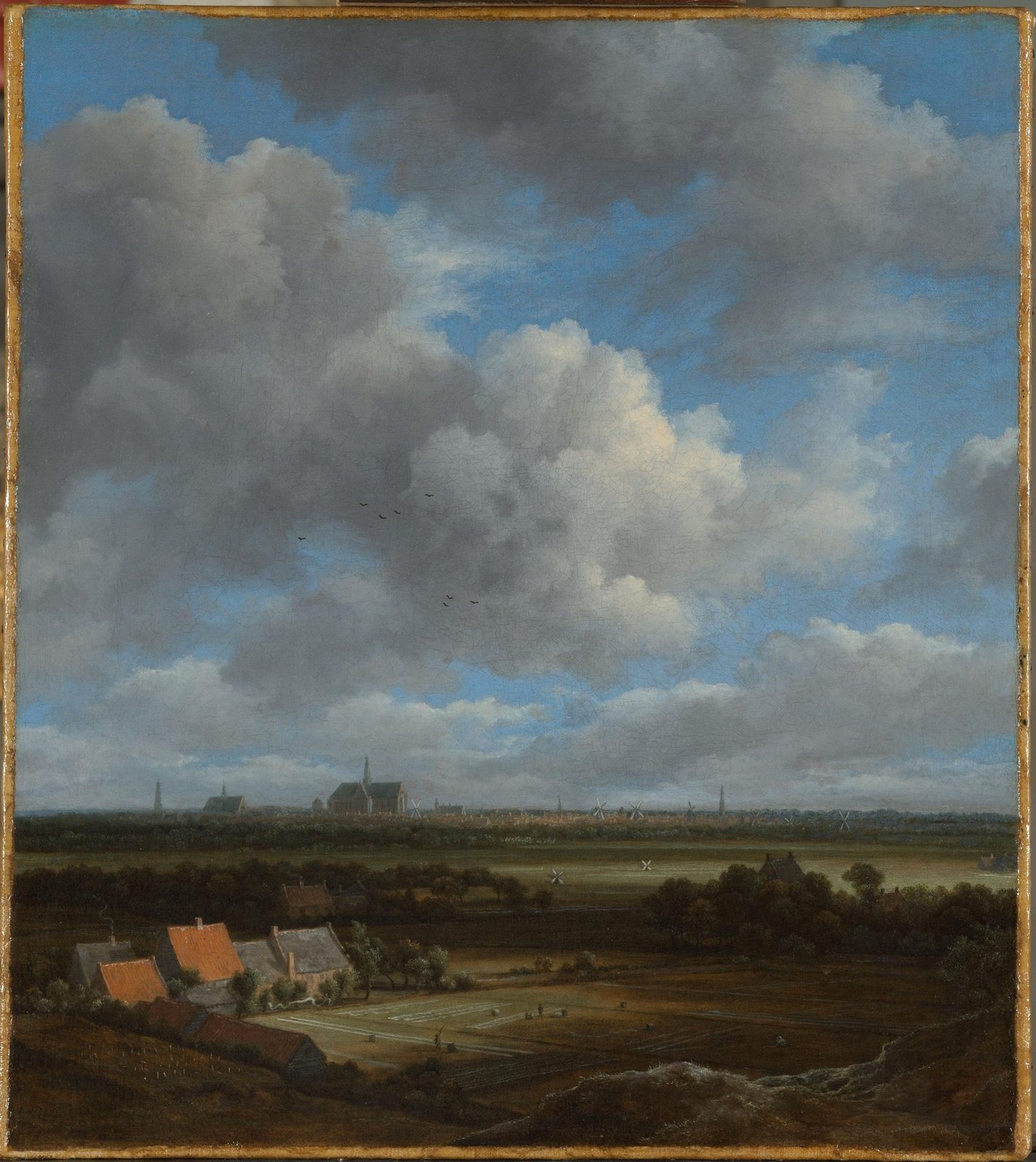
Before you look up, look at the land. It lies in stripes: a dark foreground, a pale field, a dark belt of trees, a lit green meadow, and then the city. It looks as if passing clouds are switching the country on and off, one band at a time.
Haarlem, oil on canvas
This is Jacob Isaacksz van Ruisdael's View of Haarlem from the Northwest, with the Bleaching Fields in the Foreground. The Rijksmuseum dates it broadly, to between about 1650 and 1682. It's oil on canvas and quite small, forty-three centimetres high. The cloth in the foreground was part of Haarlem's linen trade, which relied on the pure water of the dunes.
A low horizon, a tall sky
The canvas is a little taller than it is wide, and Ruisdael spends most of that height on sky. The horizon sits nearly three quarters of the way down, so the whole country is pressed into a narrow strip. A few small verticals, spires and windmill sails, keep that strip from going flat.
Where the sun breaks through
The brightest paint in the picture is here, along the top of the central cloud where it meets the blue. The edges are soft, almost feathered, and the white seems faintly warm against the cooler greys beneath. This is the light that lands, in patches, on the fields below.
Linen laid out to bleach
Down in the foreground, long pale strips of cloth lie on the grass, with a few tiny workers among them. They show up because this field is in sun. Just behind, the ground drops into a dark belt of trees, then lifts again into a brighter meadow.
St Bavo's on the skyline
On the horizon sits Haarlem. The museum points to the high roof of St Bavo's, the big church just left of centre. It's painted as one dark silhouette against the pale sky, a spire, a gable and a long roof, with almost nothing inside the shape.
Red roofs in the near shadow
Closer to us, at the lower left, is a cluster of farm buildings. Two roofs are a warm red-orange, and you can just make out fine diagonal strokes running down the slopes, probably rows of tiles. The roofs beside them are a duller grey-brown, so the warm ones become the only real colour on the ground.
Two windmills, two crosses
Out in the lit meadow are two windmills. Each is little more than a white cross of sails. One has a small dark body beneath; the other seems to have none at all. At this distance the sails alone are enough.
A few birds for scale
High in the open sky, a few birds, each a tiny dark V that tapers at the tips. Cover them with your thumb and the sky loses its size. With them, you can sense how far the clouds hang above the fields.
Look closer
8 details, each checked against a close-up of the picture.
-
Central Cloud Break
The brightest white highlights of the clouds are concentrated in a central break against a blue sky.
A central cumulus cloud mass breaks against a blue sky, with the brightest whites concentrated in a diagonal band running from upper-left to lower-right within the cloud body. The cloud edges are softly feathered where they meet the blue, suggesting wet-into-wet blending rather than crisp contour. A warm, faintly peach-tinted highlight sits within the white passage, contrasting with cooler grays in the lower and left portions of the cloud. The entire surface is overlaid with a fine web of craquelure, confirming aged oil paint on a rigid support.
-
Haarlem City Silhouette
Small vertical spires and building outlines are visible along the horizon line.
The crop resolves a vast, low-horizon band of sky over a flat, olive-brown plain, with a tight cluster of architectural silhouettes breaking the horizon. The central church is built from a small number of dark, opaque dabs: a vertical spire stroke, a triangular gable, and a blocky nave, all reading as a single dark value against the lighter sky. To the left, a lower farmhouse gable is hinted at with a few angled strokes. On the right, three or four pale cross-standards (bleaching field markers) are picked out with the brightest passages in the lower half, applied as small, soft-edged dabs. Fine craquelure runs across the entire surface, and the sky itself is built from broad, scumbled cloud masses in cool grays rather than crisp edges.
-
Bleaching Fields
Long pale strips of cloth are laid out on a sunlit field, with a few small figures among them.
Pale rectangular patches of opaque white pigment lie flat against a scumbled expanse of ochre and olive earth. Tiny, unresolved dabs of paint form figures laboring near the crisp, hard edges of these white forms. Beyond a softly brushed horizontal band of dark vegetation, a second cluster of muted white shapes stretches across a green field, punctuated by two loosely painted windmill crosses in the hazy distance. The foreground soil relies on textured, broken strokes, transitioning to smooth, blurred horizontal sweeps above.
-
Farmhouse Roofs
The roofs of the small buildings feature warm red-orange pigments.
The crop isolates a small farmhouse cluster where two roofs read as a saturated red-orange while the flanking roofs are a duller gray-brown. The red-orange passages show fine parallel striations running diagonally down each roof plane, indicating individual tile courses, with the right-facing slope of the central gable catching the strongest chromatic intensity. A pale chimney stack rises near the upper center of the lit roof, its highlight catching against the dark foliage behind. Edges between roofs and trees are softened with broken brushwork, whereas roof ridges against the dark background stay crisp and linear. The lower right reveals a pale muted-green ground plane with horizontal white scumbled lines, contrasting strongly with the warm roof mass above.
-
Storm Cloud Transitions
Soft, blended gray transitions occur between the dark storm mass and the blue sky.
The crop is dominated by a large cumulus-like mass rendered in mid-to-dark grays, bordered at the top by patches of muted blue sky in the upper-left and upper-right corners. The transition from blue to gray is not a hard contour but a feathered, atmospheric edge where the gray cloud body lifts into a softer, slightly warmer half-tone before meeting the cooler sky. Within the gray mass, value shifts are gradual rather than abrupt: a paler, almost chalky gray runs down the right side while the left and center deepen into a denser, more uniform charcoal-gray. The surface shows extensive craquelure, but the underlying paint reads as thin, blended layers without visible hard brushstrokes in the cloud body itself.
-
Distant Windmills
Small white crosses representing windmill sails are visible in the mid-ground.
The crop isolates a mid-ground passage of a Dutch landscape dominated by a flat band of muted olive-brown and grey-green paint. Two tiny windmill silhouettes appear: the left one near (u≈0.27, v≈0.40) reads as a loose white X of crossed strokes with a small dark body beneath, while the right one near (u≈0.75, v≈0.34) is a tighter, more compact four-armed cross with no visible body. A darker horizontal smear, slightly bluer than its surroundings, runs across the middle of the field, possibly a road or drainage line. Dark, soft-edged tree masses anchor the lower-left and lower-right corners, and a thin band of stippled light tones runs along the upper edge suggesting a distant treeline. Edges are universally soft; nothing in this crop is hard-edged.
-
Birds in Flight
Small, dark V-shaped marks representing birds are scattered in the central sky.
The crop shows a pale, desaturated gray-blue field marked throughout by a dense network of dark hairline cracks (craquelure) characteristic of aged oil paint. Seven tiny, near-black V-shaped silhouettes are scattered across the surface: two in the upper right quadrant, a tight cluster of three near the center-right at roughly mid-height, one isolated on the left at lower-middle height, and two in the bottom right corner. The background shifts subtly from a slightly cooler, lighter blue-gray in the lower-left to a warmer, marginally darker gray toward the upper-right, suggesting distant cloud modulation rather than flat paint.
-
Craquelure Pattern
A fine network of cracks (craquelure) is visible across the paint surface.
The crop shows a cluster of steeply pitched roofs painted in warm orange-ochre and terracotta tones, with a darker brown-grey roof in the foreground and a glimpse of dark sky at upper left containing a small chimney. The paint surface is crossed by a fine web of craquelure — thin dark lines that fracture both the bright roof planes and the shadowed areas, with no visible ground or panel underneath. The orange roofs are built up with parallel directional strokes that follow the slope, while the darker foreground roof uses shorter, more agitated marks; small dabs of off-white and pale green sit along the ridges and edges, suggesting foliage or weathering highlights. Edges between roofs are crisp where dark values meet light, and softer where the orange ridges drop into shadow.
View of Haarlem from the Northwest in context
What the museum records
The Rijksmuseum's Dutch catalogue describes the view as seen from the higher dunes, with the bleaching fields in the foreground and the profile of the city with St Bavo's in the distance [2]. The canvas measures 43 by 38 centimetres and is signed 'JVRuisdael' at the lower left. It came to the museum in 1870 with the bequest of L. Dupper Wzn. of Dordrecht [1][2]. The museum dates it only to about 1650-1682 [1].
Linen and the dunes
The National Gallery in London explains that Haarlem's bleaching fields were considered the best in Europe in the seventeenth century, and that linen had to be bleached from its natural beige to fetch the highest prices [3]. The work was done in spring and summer: the cloth was steeped in lye made from wood ash, doused with a stronger boiling solution for about a week, soaked in buttermilk for five or six days, and finally spread on the grass and kept damp until the sun finished the job [3].
The same museum notes that in most of Ruisdael's bleaching views, the strips of linen become part of a panoramic landscape and the workers shrink to tiny dots [3]. The Rijksmuseum links the industry to the pure water of the dunes [1].
Little views of Haarlem
Panoramas of this kind are often called Haerlempjes, a diminutive that once suggested small cabinet pictures [5]. Wikipedia, drawing on local historical studies, says such views were painted from an imaginary point in the air rather than from a real summit. It also mentions a high dune in Bloemendaal called Het Kopje [5].
Slive dates the start of Ruisdael's panoramas of the Haarlem skyline and its bleaching grounds to the 1660s. He says the towering clouds and sense of distance grow in the following decade [4]. So the later part of the museum's wide date range seems more likely. But the Rijksmuseum itself has not narrowed it, and the painting carries no date [1][2][4].
Back to St Bavo's
The great church on the horizon has a family link. Ruisdael's uncle Salomon was buried in St Bavo's in November 1670. On 14 March 1682, a grave was opened there for Jacob himself in the south transept [4]. Slive notes that he may have returned to Haarlem shortly before his death, because no evidence has been found that his relatives paid the fine due to Amsterdam for burial outside the city [4]. And in June 1682, the Haarlem painters' guild charged a commission on the sale of his paintings [4].
An older story held that Ruisdael died a pauper in a Haarlem almshouse. But Slive points out that the Dutch archivist H. F. Wijnman showed in 1932 that this was his cousin, Jacob Salomonsz. van Ruysdael, who spent the last weeks of his life there [6].
- Jacob Isaacksz van Ruisdael, View of Haarlem from the Northwest, with the Bleaching Fields in the Foreground (SK-A-351): collection page and object data . Rijksmuseum, Amsterdam
- Linked Art data record for SK-A-351, including the Dutch catalogue description, inscription and credit line . Rijksmuseum, Amsterdam
- Jacob van Ruisdael, A Bleaching Ground in a Hollow by a Cottage (NG44) . The National Gallery, London
- Seymour Slive, Jacob van Ruisdael: Windmills and Water Mills (Los Angeles: J. Paul Getty Museum, 2011), free PDF edition (archived copy) . J. Paul Getty Museum, via Internet Archive
- Haerlempjes . Wikipedia
- Seymour Slive, 'An old master comes into his own', Harvard Magazine 84, no. 3 (January-February 1982), pp. 26-30 . Harvard Magazine