One warm note in the cold
How Ruisdael lets a dark sky, a low light and a single brick tower set the mood of a winter day
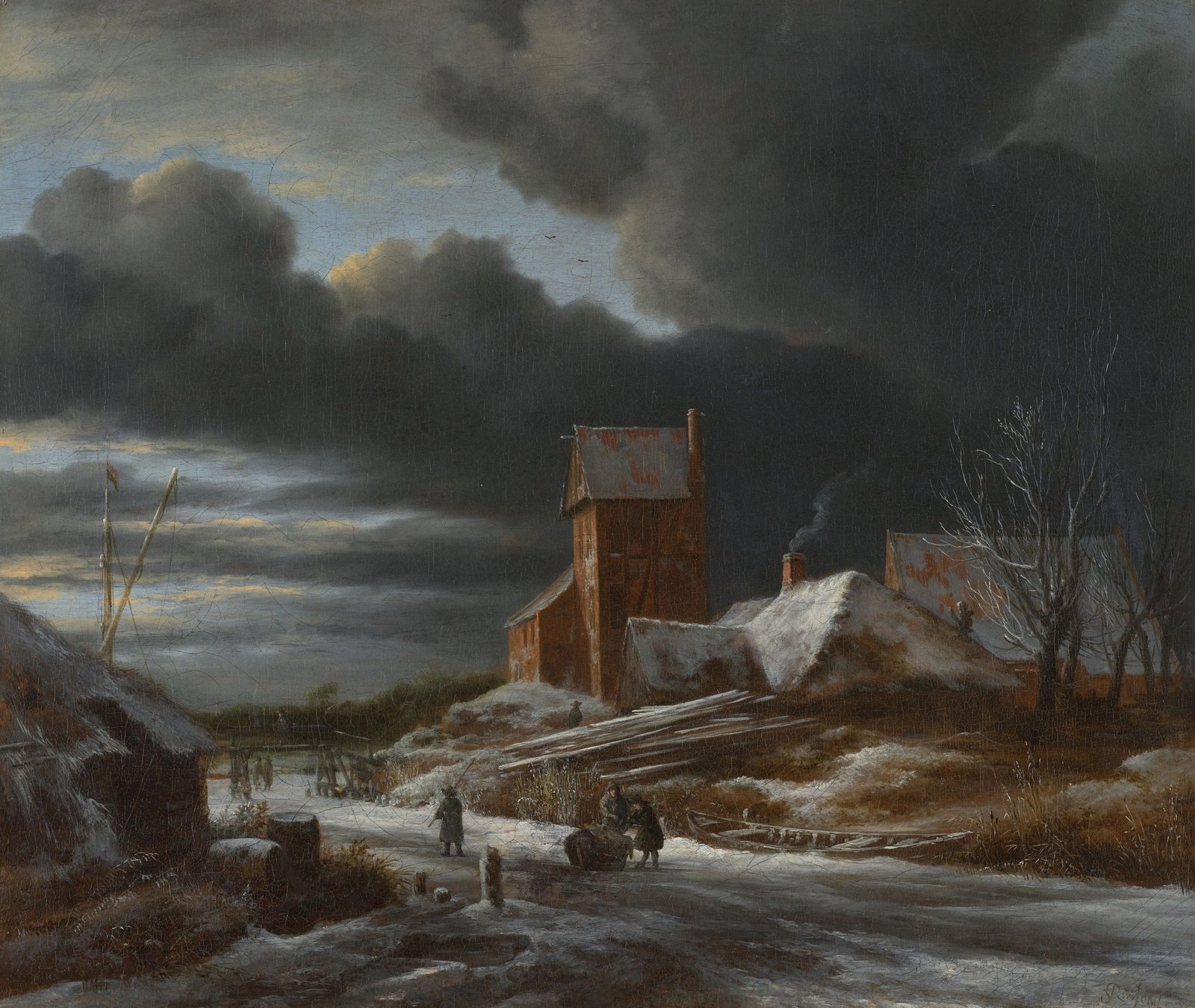
- Artist
- Jacob Isaacksz van Ruisdael
- Title
- Winter landscape
- Date
- c. 1665
- Museum
- Rijksmuseum
- Image
- Public domain (CC0)
Open in Simple Art
Watch this story on iPhone and iPad, with offline downloads and a painting every day.
About 3 minutes of looking, in 9 parts.
A cloud that fills the sky
Most of the upper half of this picture is one dark cloud. It hangs over a few snowy houses and a frozen waterway, and only at the upper left does it break open onto pale sky. Before you look at anything else, let that weight settle.
Winter, about 1665
This is Winter Landscape by Jacob Isaacksz van Ruisdael, oil on canvas, from around 1665. The Rijksmuseum notes that he painted about twenty-five winter scenes, and that a cheerful crowd of skaters would have been out of place in one like this. Here the weather sets the mood, not the people.
Two diagonals meet at the tower
The shapes lock together on diagonals. Light falls from the opening at the upper left down towards the tower, while the dark cloud sweeps in from the upper right towards the same spot. Below, the ice and snow stretch out in a broad pale band, with a dark barn at the far left.
Low light from the left
The museum describes low, raking sunlight from the left, and this is where it comes from. Pale blue grades into cream and a little yellow ochre, and the edges against the dark cloud are soft and feathered. It's a small opening for so large a sky.
The one warm note
Follow that light down to the square tower. Its brick is the warmest colour in the painting, red and rust among cool greys. The lit side is paler, the far side left as a flatter, darker passage, and touches of snow seem to sit along the roof and eaves.
Snow in warm and cool
Next to the tower, a long roof lies under snow. The top is a warm off-white, and the snow turns cool blue-grey where it tucks under the eaves. Look closely and a faint reddish tone seems to show through the shadows, so the snow never goes dead grey.
Bundled up on the ice
Out on the ice are a few figures, one on his own and two or three with a sled. They're almost silhouettes, painted in one dark tone, with just a fleck of light on a face. The museum calls them insignificant against the weather, and at this size they are.
Poles against the sky
At the far left, two wooden poles cross against the sky, with what looks like a small red-orange flag at the top. Their edges are crisp and straight against the soft bands of cloud behind, some of the few hard lines in the picture.
Bare trees on the right
On the right, bare trees rise into the darkest part of the sky. Their branches are fine, tapering strokes, mostly near-black, with a few pale silvery touches where the light catches them. Against that background, the thin lines look cold and brittle.
Look closer
8 details, each checked against a close-up of the picture.
-
Red-brick tower
The square tower is painted in warm red-orange brick tones contrasting with the surrounding cool greys.
The crop is dominated by a tall red-brick tower rising through the frame, painted in warm umbers, ochres and rust tones. A cooler, near-neutral gray sky wraps around the structure on the left and above, while the right-facing wall of the tower reads as a much darker value—evidence of light arriving from the upper-left cloud break noted in the context. Edges along the roof eaves are softened with white and pale gray scumbles that read as snow resting on tile and stone; the lower-right quadrant shows a pale, sloped snow surface descending sharply against a shadowed bank. A network of fine craquelure cracks the entire surface, and a tiny dark figure at the base provides a scale reading against the building.
-
Luminous sky break
Pale yellows and light blues create a bright opening amidst dark storm clouds.
The crop isolates a luminous opening framed by heavy, dark cloud masses at the lower left, upper right, and far right. Within the bright passage, pale cerulean and grey-blue passages grade into warm cream and pale yellow ochre accents, with the warmest tone sitting in the upper-left of the opening and a second warm pocket near the lower right. Edges between the dark cloud bodies and the luminous sky are soft and irregular, with feathery, brushed transitions rather than crisp contours. The entire surface is overlaid with a dense, multi-directional craquelure network that follows the stress of the paint film rather than the underlying forms.
-
Figures on ice
Small figures are depicted skating and pushing a sled on the frozen waterway.
The crop shows small dark figures on a frozen waterway: a solitary skater on the left, and a cluster of two or three figures with a dark sled on the right. The figures are rendered as near-silhouettes with a warm umber-black body color, with only a small flesh-toned fleck catching light on the nearest face (around u≈0.74, v≈0.21). The ice is laid in with broad, horizontal, slightly broken strokes alternating between cool gray, warm ochre, and a paler cream where the snow-bank meets the frozen channel. A vertical stake or post rises in the lower-left foreground (u≈0.27, v≈0.30–0.75), its right side catching a thin highlight while the left falls into deep shadow. Dense, web-like craquelure runs across the entire surface, confirming a lead-based, aged oil ground.
-
Cloud edges
The boundary between dark and light clouds is rendered with soft, blended transitions.
The crop isolates a stretch of cloud-filled sky framed by deep umber-slate cloud masses at the left and lower right, with a luminous break of blue sky and warm cream-tinted vapor in the upper center. The boundary where the dark left-hand cloud meets the lit central vapor is not a hard line: values shift through several mid-tone passages, and warm ochre tones sit along the rim of the brighter cloud, suggesting reflected light along the edge. Paint is applied thinly over what appears to be a darker imprimatura in the shadows, with the cracked varnish/craquelure network running continuously across both light and dark passages. Edges in the lower cloud mass read slightly drier and softer than the upper rim, where a faint, warmer contour catches directional light from the upper left.
-
Mast and spar
Two crossed wooden poles, with what looks like a small flag at the tip, stand with crisp edges against the sky.
The crop isolates a mast and a slanting spar: two pale wooden poles cross diagonally, with a small red-orange flag fixed at the tip of the taller beam. The silhouettes of the beams read as sharp, straight-edged shapes against an atmospheric sky made of horizontal bands - cooler grey-blue cloud masses alternating with thinner peach and ochre strips of warmer light breaking through. A network of fine craquelure threads the whole surface. At the lower left, a sliver of dark umber ground anchors the verticals, while the rest of the field is open sky. The wood has a cool, slightly desaturated tone; its right-hand edges are crisp, its left-hand edges slightly softer where they meet the lighter cloud.
-
Snowy thatch
The snow on the roofs is a mix of off-white and cool gray shadows.
The crop captures the lower edge of a snow-laden thatched or shingled roof meeting a row of horizontal wooden planks or rails. Broad, softly blended strokes model the snow mass, which steps from a warm off-white highlight (upper right) down into cooler mid-gray and blue-gray recesses where it tucks under the eaves. Crisp, narrow linear strokes define each exposed wooden beam beneath, painted in deep warm browns with thin pale-gray snow dusting their top edges. A warm reddish-brown vertical mass — likely the brick tower — sits at the left, and a russet ground tone fills the lower right. Craquelure is dense across the surface, fragmenting every passage into a fine web of cracks.
-
Bare winter trees
The trees on the right are composed of fine, spindly dark lines.
The crop is dominated by silhouetted bare trees rising into a deep, stormy grey-blue sky. Branches on the left tree (around u≈0.25, v≈0.35) are picked out in pale, almost silvery highlights against the dark ground, while the right-hand tree mass (u≈0.70–0.90) is built from a denser net of fine, near-black linear strokes. The lower third is a warm rust-ochre bank, and a pale grey-blue band of snow or frozen water runs through the middle ground at roughly v≈0.55. The whole surface is broken by a regular craquelure network, and the marks themselves taper like dry-brushed threads rather than uniform lines.
-
Bottom right corner
There is a faint inscription or signature in the lower right foreground.
The crop shows a passage of aged oil paint dominated by a cool, desaturated gray-blue field (approximately #4a5560 to #6b7682) covered by a dense, web-like network of craquelure running in irregular polygonal cells. Across the lower-center to lower-right of the crop, a faded brownish inscription in cursive script sits directly on this tone, with letterforms that read faintly as flowing loops and descenders, too eroded to be fully legible. A small, slightly lighter scumbled patch appears in the upper-center (around v≈0.18), and a tiny dark fleck sits at right-center. Edges between the inscription strokes and ground are softened by age and abrasion, but the strokes themselves appear to have been laid wet-into-wet before the surrounding tone.
Winter Landscape in context
What the museum records
The Rijksmuseum's Dutch catalogue lists a square tower and a few houses along a frozen waterway in a snowy landscape, some figures with a sledge on the ice, and a farm barn on the left [2]. The canvas measures 42 by 49.7 centimetres. It's signed 'JVRuisdael' at lower right, and came to the museum in 1870 with the bequest of L. Dupper Wzn. of Dordrecht [1][2]. And the museum dates it to about 1665, noting that Ruisdael painted around 25 winter landscapes [1].
Winter without drawings
Slive pointed out in 1982 that not a single drawing of a winter scene by Ruisdael is known, although many of his drawings are probably lost [4]. And he observed that neither Ruisdael nor other Dutch painters showed winter mills in gales or blizzards [3].
Slive dates a winter landscape in the Philadelphia Museum of Art to the late 1660s [3]. When Gustav Waagen, a leading authority on painting in his day, saw it in 1835 he wrote that he had never seen the feeling of winter expressed with more truth [3].
Constable's thaw
John Constable copied the Philadelphia picture in 1832, when it belonged to Sir Robert Peel, shortly after the death of his close friend Archdeacon Fisher [3]. In a lecture at the British Institution in 1836 he used his copy to argue that Ruisdael understood what he painted, reading the furled sails, the turned mills and the glow in the sky as signs of an approaching thaw [3].
Slive noted that the nineteenth century, led by painters like Constable, came to value the brooding moods of Ruisdael's winter scenes more highly than the waterfalls his own contemporaries had preferred [4].
The painter in the mid-1660s
Two wills of May 1667 give a glimpse of Ruisdael's life at about this time [3]. In the first he's described as sick in body but sound of mind, a bachelor living in the Kalverstraat near the Dam, and four days later he made his father his sole beneficiary [3]. The early biographer Arnold Houbraken reported hearing that he never married so he could better support his father [4].
His finances were modest but not poor. In 1674 he paid a war tax that valued his possessions at 2,000 guilders [3]. A Jacobus Ruijsdael received a medical degree from Caen in 1676, and the National Gallery notes that Ruisdael is said to have practised as a physician in later life [3][5]. Slive found the evidence inconclusive: the name was scratched out of the Amsterdam list of doctors, and Caen's list of registered students begins only in 1702 [3][4].
- Jacob Isaacksz van Ruisdael, Winter Landscape (SK-A-349): collection page and object data . Rijksmuseum, Amsterdam
- Linked Art data record for SK-A-349, including the Dutch catalogue description, inscription and credit line . Rijksmuseum, Amsterdam
- Seymour Slive, Jacob van Ruisdael: Windmills and Water Mills (Los Angeles: J. Paul Getty Museum, 2011), free PDF edition (archived copy) . J. Paul Getty Museum, via Internet Archive
- Seymour Slive, 'An old master comes into his own', Harvard Magazine 84, no. 3 (January-February 1982), pp. 26-30 . Harvard Magazine
- Jacob van Ruisdael (1628/9? - 1682): artist biography . The National Gallery, London