Steen's Woman at her Toilet: a study in seeing
A walk through Jan Havicksz. Steen's quiet Dutch genre scene, 1655–1660, with attention to light, color, and handling.
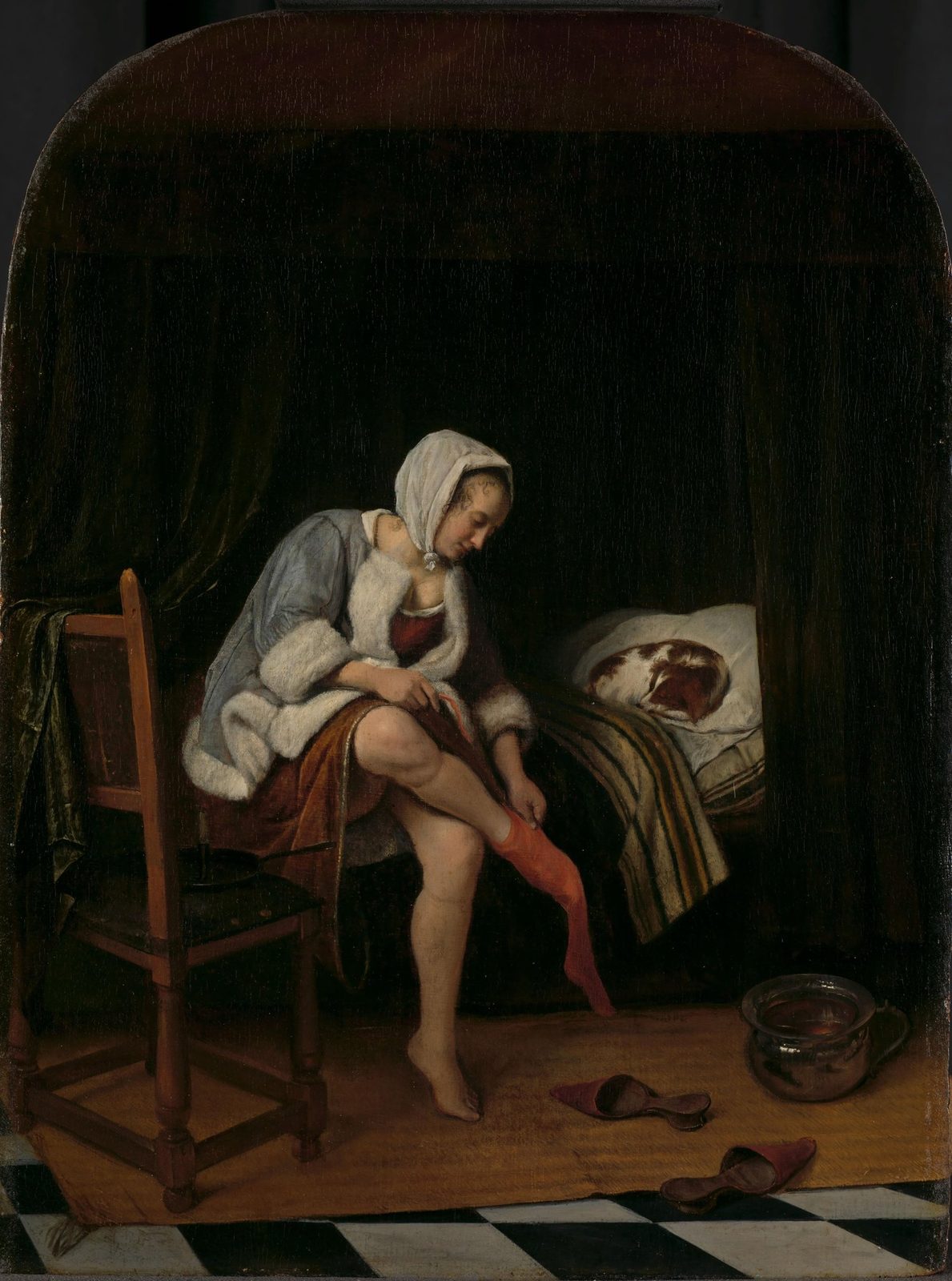
- Artist
- Jan Havicksz. Steen
- Title
- Woman at her Toilet
- Date
- 1655 - 1660
- Museum
- Rijksmuseum
- Image
- Public domain (CC0)
Open in Simple Art
Watch this story on iPhone and iPad, with offline downloads and a painting every day.
About 7 minutes of looking, in 11 parts.
A woman caught mid-motion
Before you is a small, hushed room, and inside it a woman caught mid-motion, her head bowed, a white cap glowing against the dim interior. Watch the single red thread that pulls your eye from her face, down through her hands, and into the stocking she is drawing up her calf. This is Jan Havicksz. Steen's 'Woman at her Toilet,' painted between 1655 and 1660, a quiet Dutch genre scene that turns a private morning into a small theatre of seeing and being seen.
A Dutch morning toilet
The 'toilet' in the title means dressing, not plumbing, and Steen stages it as a domestic genre piece in the Dutch Golden Age tradition. The survey records a seated woman in a white headscarf, a blue jacket with fur trim, and a red skirt lacing on a red stocking, with a second small figure lying in a bed to the right, a chamber pot, discarded slippers, and a black-and-white checkered floor in the foreground. It is the kind of intimate interior his contemporaries favored, and Steen gives it just enough strangeness to keep us looking.
Triangle and red diagonal
Pull back and the picture resolves into a stable triangle: the seated woman forms the apex near the upper middle of the frame, and the base runs down through her foot to the checkered floor, with the dark mass of the bed counterweighting the right side. The survey marks the diagonals as a guiding structure, and you can trace one strong line from the headscarf through the arm into the stocking, the same red diagonal your gaze already followed. The focal point, where action and brightest color collide, sits at her hands drawing up the red stocking, around the lower center of the canvas.
Light from the upper left
Light enters from the upper left and rakes across her face, her bare shoulder, the curve of her breast, and the red stocking, while the right side of the room and the bed retreat into warm shadow. Notice how the values stack: the highest key sits on the white cap, the fur trim, the skin, and the stocking; the deepest low key lives in the brown background and the bedding; and the blue jacket and red skirt bridge them in midtones. It is a quiet chiaroscuro, soft rather than spotlit, keyed to skin and linen.
Highlight on the breast
Drift down to the exposed shoulder and breast, and the light tells you almost everything about form. The brightest value is small, isolated, and slightly cooler than the midtones, sitting on the upper curve where the breast turns toward the window. Below, the form dissolves into the warm red-brown bodice without a drawn contour, what the read calls a soft lower terminator. The lesson here is simple: place one decisive highlight at the turning point of a rounded volume, and let the underside melt into its local color.
Red stocking, fused edge
Now move to the focal point, the hands on the red stocking, and watch how Steen fuses skin and fabric. The leg is built in warm peach and pink midtones with cooler grey-violet shadows along the inner contour where it turns away from the light, and the vermillion stocking sits wet-into-damp against that flesh, producing the soft, almost melted edge where the red bleeds slightly into the calf near the garter. The fabric sags in heavy folds from her grip, deepening into brick and oxblood where it dips into the dark background. Highlights were reserved rather than added on top, consistent with working from dark to light.
Dabbed fur trim
Slide up to the fur trim of the jacket, and the handling changes character completely. Instead of soft blends you get short, slightly curved strokes in cream, warm white, and cool grey, dabbed over a darker mid-tone that peeks through between tufts. Each stroke keeps its individual character, and your eye fuses them at a distance into the lobed, cushion-like mass of the fur. The contrast with the smoother red skirt below makes the texture read as tactile rather than as pattern. When you paint fur, resist the urge to blend the lighter strokes into the dark base; let the optical mixing do the work.
A small figure in the bed
Now glance to the right, into the dim bed, where a small head with reddish-brown hair rests on a white pillow. The figure's back blends wetly into the cream belly with no hard contour, almost losing itself into the cushion in a deliberately lost edge. Below, a striped blanket runs in roughly parallel diagonal bands of ochre and near-black, painted with broader, more graphic strokes than the soft fur above. This is a Steen ambiguity: the bedded figure is small and unclear, perhaps a child, perhaps a pet, perhaps something else, and that uncertainty is part of the painting's quiet charge.
Discarded slippers
Drift to the foreground right, where two reddish-brown slippers lie discarded on the warm umber floor. The upper slipper lies on its side with the heel up; the lower one tips on its back, its interior cavity dropping into near-black umber. Notice how that dark interior is laid in as a single confident value, with only a small warm rim where the floor bounces light into the cavity. The slippers sit on a soft, scumbled field that is then interrupted by the hard-edged geometry of the checkered floor at the bottom edge, a useful comparison between soft and crisp contours.
Copper chamber pot
Right beside the slippers sits a copper-colored chamber pot, rounded with a wide thick rim and a low handle. The upper-left curve of the rim catches a bright, broken highlight that tapers into deep umber on the shadow side, and a single soft white smear at the belly does almost all the work of describing volume. The handle is barely drawn, more a tonal shift than a contour, which keeps the form quiet in the surrounding darkness. One correctly placed, soft-edged highlight on an otherwise dark mass: that is the lesson to carry home from this corner of the room.
Checkered floor in glaze
Finally, take in the checkered floor, the perspectival ground that anchors the whole scene. The dark tiles are not pure black but a transparent brown-black glaze over a warm mid-tone, while the cream tiles vary from pale buff to greyish-tan, scumbled thinly over the same ground. The grout edges are sharpened with a fine brush so the converging diagonals read tautly into the distance, and the seam where floor meets bed is a crisp horizontal line broken only by the cast shadow under the stocking. Reserve your lights, glaze your darks, and the floor will unify instead of competing with the figure.
Look closer
7 details, each checked against a close-up of the picture.
-
Dressing action
The woman's hands are pulling a bright red stocking up over her calf.
The crop centers on a fleshy leg and calf rendered in warm peach and pink mid-tones with cooler grey-violet shadows along the inner contour where the leg turns away from the light source at upper left. A hand at the top edge grips a swag of vivid red-orange fabric that cascades down the calf in soft, sagging folds; the fabric's shadows deepen into brick and oxblood where it dips into the dark background. Edges between skin and stocking are softened rather than crisp, with the red bleeding slightly into the flesh near the garter line. The background on the right is built from broad, scumbled strokes of olive-brown and near-black, while the floor band at the bottom is a flat, thinly scumbled warm umber.
-
Exposed breast and shoulder
Light falls strongest on the upper curve of the breast and the shoulder.
The crop centers on a softly modeled breast and shoulder in warm flesh tones, with a relaxed hand resting on a thigh in the lower left. The brightest value sits on the upper curve of the breast and the top of the shoulder, both catching a cool, almost cream-tinted light that contrasts with the warmer mid-tones below. The lower edge of the breast melts into a deep red-brown bodice through a soft, diffused transition rather than a hard contour. To the right, a heavy dark mass (the jacket and room shadow) crowds the figure, while the white fur trim above shows short, broken directional strokes that read as texture rather than as form.
-
Dog asleep in bed
A small brown-and-white dog lies curled asleep on a white pillow.
The crop shows a small curled form, reddish-brown over white, resting on a softly modeled off-white pillow. The figure's back and head read as warm umber and dark sienna, blending wetly into a cream-white belly with no hard contour; the pillow around it shows long, slightly curving strokes that follow the bulge of the cushion, with cooler gray-violet shadows in the hollows. Below the pillow a striped blanket runs in roughly parallel diagonal bands of ochre and near-black, painted with broader, more graphic strokes than the soft fur above. The background is a near-uniform very dark brown that pushes the lit pillow forward, and a faint vertical strip at the right edge suggests a bedpost or wall corner.
-
Fur trim texture
The fur trim consists of many small, overlapping white and grey strokes.
The crop centers on a thick band of painted fur, rendered as a cluster of lobed, cushion-like forms curving diagonally from upper right to lower left. Individual hair marks read as short, slightly curved strokes in cream, warm white, and cool grey, layered over a darker mid-tone base that peeks through between tufts. Above the fur, a blue-grey sleeve is modelled with broader, flatter strokes and a soft shadowed crease; below, the warm reddish-brown skirt is painted with longer, smoother directional strokes that contrast with the stippled fur. Edges between fur and adjacent fabrics are softly blended rather than sharp, and fine vertical craquelure runs across the whole surface, indicating aged oil on a rigid panel support.
-
Chamber pot
A copper-colored basin with a handle sits on the floor.
The crop shows a rounded, dark vessel with a wide thick rim, a bulbous body, and a low handle on the right, set against a near-black background on a warm brown floor. The rim catches a bright, broken highlight along its upper-left curve that tapers into deep umber on the shadow side. A single soft white smear sits at mid-belly of the body, describing the volume with one decisive touch. The interior reads as a pool of dark color with a faint warm pinkish reflection, suggesting wetness or glaze. The floor is laid in with horizontal, slightly scumbled strokes of warm brown and ochre, and a fragment of a pinkish object (slipper) intrudes at lower left. Vertical craquelure threads through the darkest passages, betraying aged oil on panel.
-
Floor tiles
The floor consists of alternating black and cream-colored square tiles.
The lower two-thirds of the crop is dominated by a perspectival checker floor rendered as alternating dark and cream diamonds receding toward a horizontal baseline. Above it sits the warm reddish-brown wooden floor, with a chair foot on the left and, on the right, a red slipper with its brown sole. The dark tiles are not pure black but read as deep warm brown-black, while the cream tiles vary from pale buff to greyish-tan, with subtle horizontal scumbling and vertical craquelure crossing both. The seam between the wood and the floor is a crisp horizontal line broken only by the slipper at the right.
-
Slipper details
Two reddish-brown slippers lie discarded on the floor with visible interior linings.
Two reddish-brown slippers lie abandoned on a warm umber floor, one upper-left lying on its side with heel up, the other lower-right tipped on its back with interior cavity exposed. The uppers are built from a mid-saturation maroon with brighter crimson highlights catching the upper-left light, while the interiors drop into near-black umber through a thin scumbled transition. The floor reads as a broad scumbled ochre-to-burnt-sienna field with directional drag marks running roughly horizontally. At the bottom edge a black-and-white checkered pavement is laid in with crisp, hard-edged geometry that contrasts with the soft, lost-and-found contours of the slipper leather.
Woman at her Toilet in context
A play on the word 'kous'
When the panel was shown in the 1976 Rijksmuseum exhibition Tot lering en vermaak, under the title Het ochtendtoilet, the catalogue grouped it with two other works by Steen and a panel attributed to Adriaen van de Venne [2]. Three of them show a young woman on a bed pulling a stocking on or off. The fourth shows a girl darning a red stocking while a faun-like man plays the flute [2]. In each case, the authors argue, the joke turns on the Dutch word kous, stocking, which in a second sense could mean the female sex or a woman in general [2].
The catalogue agrees with the museum that the woman is probably taking the stocking off, judging by how she holds it and by the marks of her garters [1][2]. It suggests that the dog, the slippers and the chamber pot may complete the erotic meaning, and that the half-full pot might cast her as a 'piskousje', a teasing name for women common in seventeenth-century writing [2].
A larger version for a king
The Rijksmuseum's record notes a related painting in the British Royal Collection [1]. The 1976 catalogue calls the two pictures closely related. It says the royal version is dated 1663 and is more detailed, with a lute, a music book and a wreathed skull in the foreground as reminders of death [2]. Wikipedia reports that George IV acquired it in 1821, and summarises the Royal Collection's reading of the arched doorway framing the scene as a sign of moral probity set against the vanity of the room beyond [4]. The Amsterdam panel, which the museum dates to 1655-1660, measures 37 by 27.5 centimetres, with rounded top corners [1].
Houbraken's Steen
Much of what was long believed about Steen comes from Arnold Houbraken's lives of the Dutch painters, published between 1718 and 1721 [3]. Houbraken opened his account by saying a whole book could be written about Steen's farcical life. He summed him up in a single line: his paintings were like his way of life, and his way of life like his paintings [3]. And he named the Leiden painter Carel de Moor, a regular visitor to Steen's house, as one of his informants [3].
Houbraken also noticed the side of Steen this panel shows. Among his smaller pieces, he wrote, were many painted in careful detail from life and no less witty in conception. He observed that such works now fetched far more than Steen had received for them [3]. To close, he defended his right to record artists' faults as well as their virtues [3].
A twentieth-century gift
The museum's provenance, written with a focus on the years 1933-1945, begins with Dr A. Pauli of Amsterdam. From him, the panel passed for 25,000 guilders in 1924 to Johanna Geertruida de Bruyn-van der Leeuw in Spiez, Switzerland [1]. She and her husband Isaäc de Bruijn gave it to the Rijksmuseum in 1949 while keeping the right to use it. It was transferred to the museum in 1961 [1].
Willemijn Fock later reproduced the picture in a 1998 article in Oud Holland asking whether Dutch genre interiors show real rooms or an illusion of them [1]. That question applies here too. The bed, slippers and pot may be everyday objects, but the 1976 catalogue reads them as part of Steen's joke [2].
- Jan Havicksz. Steen, Woman at her Toilet (SK-A-4052): object record . Rijksmuseum, Amsterdam
- E. de Jongh et al., Tot lering en vermaak (1976), cat. 64: Jan Steen, Het ochtendtoilet . Rijksmuseum, Amsterdam, via DBNL
- Arnold Houbraken, De groote schouburgh der Nederlantsche konstschilders en schilderessen, vol. 3: Jan Steen . DBNL
- Woman at her Toilet (Steen) . Wikipedia