A letter in the morning light
How Vermeer builds a private moment from one blue jacket, a map and a sheet of paper
- Artist
- Johannes Vermeer
- Title
- Woman in Blue Reading a Letter
- Date
- c. 1663
- Museum
- Rijksmuseum
- Image
- Public domain (CC0)
Open in Simple Art
Watch this story on iPhone and iPad, with offline downloads and a painting every day.
About 3 minutes of looking, in 8 parts.
A letter we cannot read
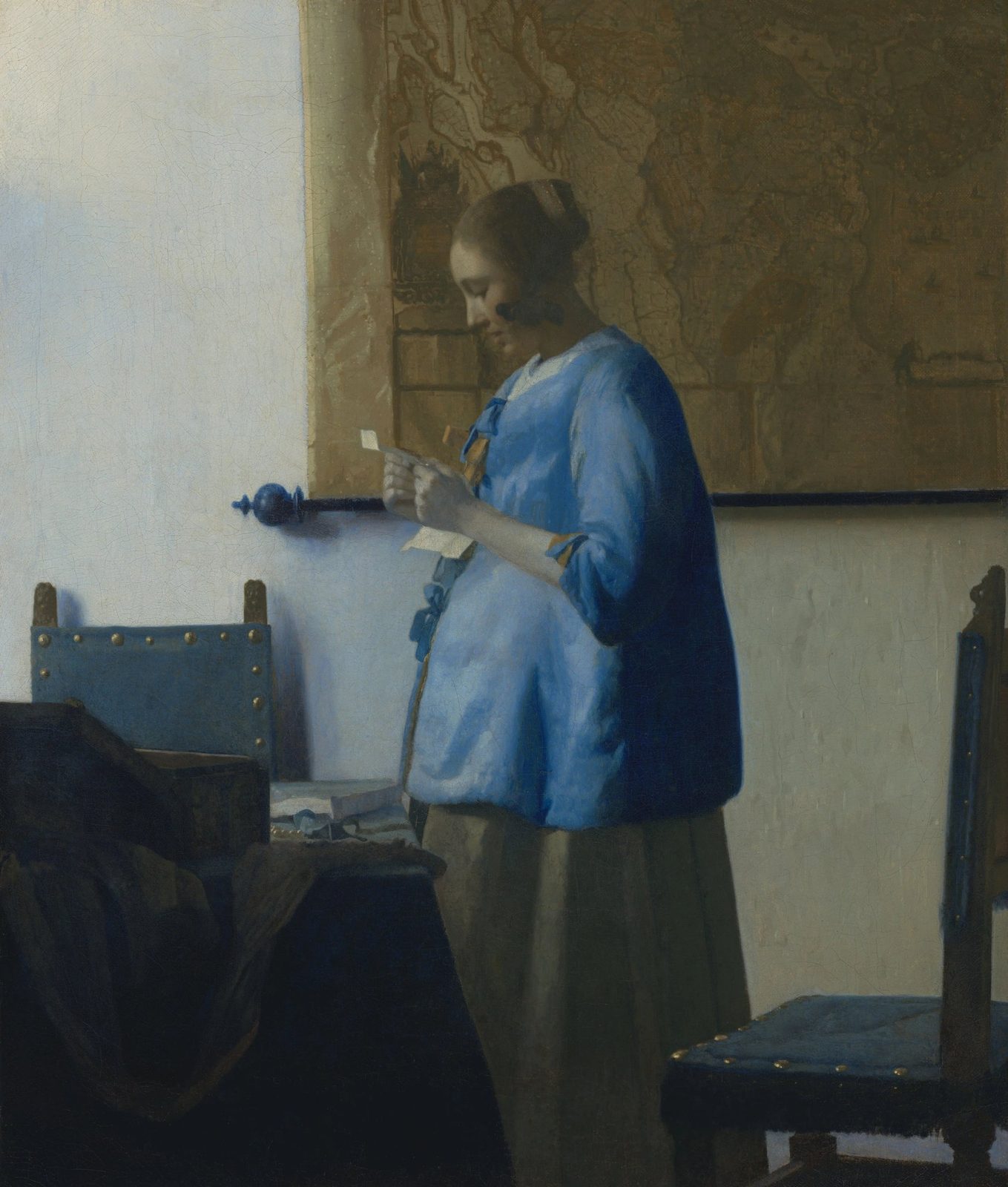
A young woman stands reading a letter, held close in both hands. We can't see a word of it, and we never will. All we're given is her attention, and the blue of her jacket.
Johannes Vermeer, about 1663
This is Johannes Vermeer's Woman Reading a Letter, also known as Woman in Blue Reading a Letter, painted in oil on canvas around 1663. The Rijksmuseum describes her as absorbed in her letter in the morning light, still wearing her blue night jacket.
A map on rollers
Behind her hangs a large map on rollers. Its dark lower rod runs straight across the picture just above her hands. She stands right of centre, with a chair on either side, and the rod passes behind her like a line she has stepped in front of.
Light on a bent head
Come closer to her face. Light falls on her forehead and the bridge of her nose, while the back of her head sinks softly into shadow with no outline at all. The museum points out that Vermeer used pale grey to model her skin, which was a bold choice at the time.
Hands and paper
Now the hands and the letter. The paper is a thin, pale plane with a slight curl along its lower edge. The backs of her fingers catch the light, while their undersides drop into soft, cool shadow.
Yellow under blue
At her front, a little warm yellow shows from beneath the blue. It looks as if the jacket was painted over it, leaving a soft, broken edge. The museum notes that every colour here gives way to the radiant blue, a lapis lazuli blue, and this small yellow makes it look cooler still.
Studs, and a blue wall
On the chair at the left, each brass stud is a tiny dome: a mid-tone body, a darker rim and one bright touch at the upper left. Now look past them at the wall. It isn't plain white but a pale blue grey, the kind of blue shadow the museum singles out.
A map that stays back
Above her head, the map is painted quite differently from her jacket. Its browns and ochres are thin and broken, and its lines dissolve rather than sharpen, so it stays behind her instead of competing with her face.
Look closer
7 details, each checked against a close-up of the picture.
-
Hands and Letter
The letter consists of small, rectangular folded papers held by slender fingers.
The crop isolates the hands and folded letter held at chest height against the map and its dark rod. Slender fingers wrap around a small rectangular paper, with the thumb pressing the top edge and the index finger curving along the front; the back of the hand catches a bright window-lit highlight while the underside of the fingers and the paper's lower edge fall into a cool, soft-edged shadow. The paper itself is a thin, near-white plane with a subtle warm tint, and its lower edge shows a faint curl where it turns back on itself. A network of fine craquelure covers the entire surface, and a second pale sheet hangs below the hands against the blue-lit wall.
-
Face and Profile
Light falls on the forehead and nose, leaving the back of the head in soft shadow.
The crop isolates the woman's head in profile, with the bridge and tip of her nose catching the strongest light against a softly modelled forehead. A dark, softly-edged cast shadow sits over the eye socket, and the hair/hood mass behind the head dissolves into a deep, low-chroma brown with no hard contour. The cheek and jaw transition through warm mid-tones into the cool blue collar at the lower right, and the entire surface is threaded with a fine, regular craquelure that follows the paint layer rather than any drawn line.
-
Chair Studs Left
Each brass stud on the chair back is rendered with a bright specular highlight.
The crop isolates a section of a blue upholstered chair back bordered by two dark wooden posts and set against a pale blue-gray wall. A dark, near-black form intrudes at the lower left, likely the draped table. The fabric is rendered in a muted, slightly desaturated mid-blue with subtle tonal variation, while ten visible brass studs are spaced along the top edge and right margin. Each stud is a small domed circle with a distinct bright highlight on its upper-left quadrant and a darker shadow tone toward its lower-right, reinforcing a spherical read. The paint surface shows extensive craquelure — a web of fine fissures — most visible in the lighter wall area and crossing the blue fabric and studs. Edges of the studs are crisp against the blue, with no visible halo or blending into the surrounding fabric.
-
Wall Map Texture
The wall map behind her is painted in thin, broken layers of muted olive-browns and ochres whose lines dissolve rather than sharpen.
The crop is dominated by a wall map rendered in a muted, low-contrast palette of olive-browns, ochres and warm greys, with curving coastlines, waterways and map lettering dissolving into the ground. Paint is laid in thin, broken, scumbled layers; the marks are dry and granular, and edges between subject and ground are deliberately lost so that the design seems to float ambiguously in a muted field. A network of fine craquelure runs across the whole surface, and a small dark architectural or figural motif (a cartouche or vignette on the map) reads as the darkest passage on the left. At the lower edge, the soft, hazy contour of the woman's dark brown hair meets a warm cream skin tone and a thin bluish-white trim, all painted wet-into-wet against the map.
-
Yellow Bodice Edge
A sliver of yellow fabric is visible beneath the blue jacket's neckline.
The crop isolates the upper-shoulder junction where the yellow bodice sits beneath the blue jacket. A diagonal running from upper-right to lower-left defines the overlap: the blue sleeve/jacket edge is painted over the yellow with a slightly broken, soft contour rather than a hard line. The yellow reads as a warm ochre with a darker shadowed wedge to the upper left and a brighter lit plane lower down. The blue mass above shows two values—a lighter cerulean plane on the lit shoulder and a deeper ultramarine in the recessed fold—with a soft-edged shadow band where the fabric rolls inward. Fine craquelure is visible across the entire paint film, slightly more open along the yellow-to-blue boundary.
-
Table Draping
Heavy dark fabric folds create deep shadows and sharp linear edges in the foreground.
The crop is dominated by a heavy dark drapery falling over a tabletop, with deep cast shadows in the recessed folds and crisp linear highlights where the upper-left light rakes across the fabric edges. Along the top of the crop sits the corner of a blue upholstered chair studded with brass nails, and at center-top stands a dark wooden box. On the right edge, papers, a blue ribbon and a string of pearls lie on the table top. The dark cloth is not flat black; it carries subtle warm umber transitions along the fold ridges that read as a dark, almost black, deep blue in shadow and a chocolate brown along the lit edges. A fine network of age crackle covers the whole surface.
-
Chair Right
The right chair is partially cut off by the frame and exists in deeper shadow.
A tall, near-silhouette vertical form occupies the right portion of the crop, abruptly cut off by the right frame edge so only the inner edge of the chair is visible. Small, evenly spaced round dots—readable as brass or gilt studs—punctuate the dark vertical, with the brightest dot near the top and progressively dimmer ones descending. The background wall is a desaturated olive-green, broken throughout by a dense network of fine craquelure lines that follow no single direction. A horizontal band of deeper blue-black runs along the bottom, suggesting the chair seat meeting a draped surface or floor, and the whole right-hand object sits in noticeably deeper value than the wall behind it.
Woman in Blue Reading a Letter in context
A date in the early 1660s
The Rijksmuseum dates the picture to about 1663, and it doesn't carry a signature [1][2]. Specialists give slightly different ranges: Albert Blankert and Wayne Franits suggest 1662-1665, while Arthur Wheelock and Walter Liedtke place it in about 1663-1664 [3]. Essential Vermeer notes that in the early and mid-1660s Vermeer painted a series of single women absorbed in some activity in the corner of a room [3]. In 1662, aged thirty, he'd been elected for the first time as a headman of the painters' Guild of Saint Luke in Delft [3].
Letters in Dutch painting
Vermeer didn't invent the subject. Dirck Hals had painted a woman tearing up a letter by 1631, and Gerard ter Borch's Woman Writing a Letter came almost a decade before Vermeer's picture of that title [3]. In Dutch painting, women reading letters are almost always linked with love, although studies of real letters written by women show that most dealt with friendship and social ties [3]. The Rijksmuseum points out that the jacket was worn only at home, so the letter is probably a personal one rather than business [2]. And Gregor Weber has argued from the folds in the paper that she's rereading a letter received some time before [3].
The map on the wall
The map has been identified as Balthasar Florisz van Berckenrode's map of Holland and West Friesland, published by Willem Jansz Blaeu around 1620 [2][4]. Vermeer used it more than once: a coloured version hangs in his earlier Officer and Laughing Girl, while here it is shown as a monochrome print [3][4]. Essential Vermeer reports that the only surviving copy is in the Westfries Museum in Hoorn [3].
Its meaning is debated. It has been read as a hint that the letter came from a travelling husband, while others see the pearls on the table as pointing towards a lover [4].
Pregnant, or just fashionable?
The woman's rounded shape has often been taken as a sign of pregnancy, but many have argued that it simply reflects the fashions of the day [4]. The costume historian Marieke de Winkel notes that pregnancy was rarely shown in Dutch art and that she knows of no pregnant women in Dutch portraiture [3]. She identifies the garment as a satin bed jacket, which was not maternity wear, and Wheelock has observed that a short jacket over a padded skirt could create a bulky silhouette [3].
Revisions, restoration and a bequest
Technical images show that Vermeer first gave the woman a wider jacket, perhaps with fur trim, and that the edge of the map once reached a few centimetres further left [2][3]. He also seems to have left out the shadow she'd have cast on the wall [3]. The blue is natural ultramarine, made from lapis lazuli, and it even appears in the pale grey mixtures of the wall [2][3]. The 2010-11 restoration brightened the jacket, uncovered a row of brass nail heads on a chair and removed later retouching on the map [2][3].
The museum's provenance has gaps before the dealer John Smith of London, who sold the picture to Adriaan van der Hoop of Amsterdam in 1839 for £73 10s [1]. Van der Hoop bequeathed it to the Academie voor Schone Kunsten, and it passed to the City of Amsterdam in 1885 and has been on loan to the Rijksmuseum since then [1].
- Johannes Vermeer, Woman Reading a Letter (SK-C-251): object record and provenance . Rijksmuseum, Amsterdam
- 10 things about Vermeer's Woman Reading a Letter . Rijksmuseum, Amsterdam
- Woman in Blue Reading a Letter (interactive catalogue entry) . Essential Vermeer
- Woman Reading a Letter (Vermeer) . Wikipedia