Art Bootcamp Notes · 04 · Seeing accurately
How to Measure Proportions with a Pencil (and Why Artists Do It)
The arm-out, one-eye pencil trick explained: the triangle behind it, how to keep the measurement steady, and why being roughly right beats a perfect copy.
 By LIPAI WANG · Chapter 4 of his book Art Is a Puzzle You Can Solve
While you are making artwork, traditionally or digitally, you have to measure things. You may have seen artists stretch out an arm, hold up a pencil or a brush, close one eye and sight along it with their thumb. I love this. I think it is one of the coolest things an artist can do. But what on earth are they doing? Are they just striking a dashing pose, or is there a real function to it?
There is a function, and in this chapter I explain it: the simple geometry behind measuring with a pencil, how to hold the pose so you can repeat it, and why you are measuring at all. Then I want to share a question about measuring that has puzzled me for a long time: if measuring adds value to a drawing, why doesn’t perfect measuring add perfect value?
Why we measure
Earlier I talked about drawing from observation rather than from concept. What is a good way to observe something intensely and accurately? Measure it. Measure well and you get good proportions. That is also why we start with still life: a subject that keeps moving is very hard to measure, at least without a camera to take a shot and measure later.
Say you are drawing a big tree. The tree is so big that you can’t possibly draw it at its real size on your canvas, so you have to shrink it. Measuring is how you shrink it in proportion.
The geometry behind it
The logic is a little bit of mathematics, and I won’t go into detail, but you can treat it like this. Your eye is a point. From your eye, two lines run out to the top and the bottom (or the two sides) of the object you are looking at. That makes a triangle. Hold a pencil up inside that triangle and the object’s height is shrunk, proportionally, to a length on your pencil. The tip of the pencil lines up with one edge of the object, and your thumb marks the other.
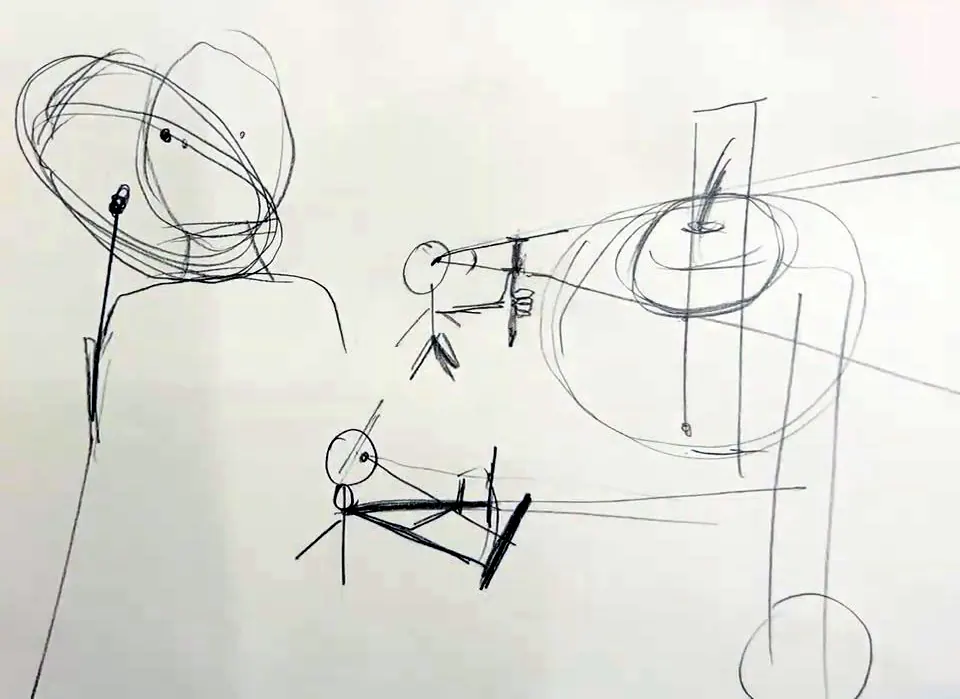
Since the angle is the same, you can shrink the object to any size. Imagine a really big apple, a hundred times bigger than a normal apple (or an elephant, something really big), and you are standing far away from it. You hold out your pen, line the tip up with the top of the apple, and slide your thumb to the bottom. Now you have a mark. Transfer that length to your canvas, from here to the place where you set the marker, and that is the height of the apple.
If that comes out too small, scale it. Double it, and you get a much bigger apple on the page. The same technique works for scaling up.
Fixing the proportion: the pose
For this to work, the proportion has to stay fixed. If you measure once with your arm like this, the second time like that, and the third time another way, it won’t work, because the proportion changes every time.
So the trick is:
- Make your arm as straight as possible. Don’t bend your elbow. If you curve it, you can’t control the curve, and the distance between your eye and the pencil changes. Really reach out, so there is no room for your position to change.
- Hold it out at a fixed angle, flat. I hold my arm straight out in front of me.
- Use one eye. I prefer my right eye because it looks straight at things. It is just like aiming a gun at an enemy.
That is a pose I can replicate every time, with a little margin of error. My arm is fixed, so the eye, the marker (my thumb or the point of the pencil) and the object are all fixed. It is very useful when you are drawing scenery.
Keep your eye at the same distance
There is another problem. Often the situation isn’t ideal. Maybe you are measuring a tree, or something lower down, so you have to look downwards and move your arm down to take the measurement. That changes the distance between your eye and the pencil. Measuring something straight in front of you and measuring something below you give completely different distances.
A lot of artists will tell you the neck is the important part here, because the neck keeps moving and changing the distance. My way of avoiding this is to take the neck out of it:
- Tilt your head to one side and lock it there, even when you are measuring something straight in front of you.
- Bring your eye down to roughly the level of your shoulder.
- Now your shoulder works like an axis. Your arm rotates around it, but the radius stays the same. Even when you look far below, your eye stays the same distance from the pencil, moving in a circle-ish path.
- Squint a little to make a good measurement, then project it onto your canvas.
Try it. Set a real object on your table and pretend it is huge and far away. With your arm straight and your head locked, measure its height on your pencil, mark it with your thumb, and transfer that length to your paper. Then double it.
Measure the proportion, not the exact size
The second thing to understand is that you are not measuring precisely. It would be cool if you could replicate things a hundred per cent, but that is a loose meaning of creating art. If you want a hundred per cent replication, bring your phone and use the camera. What is missing is your involvement: your input, your value added.
I saw a lot of students in art school use gadgets. Some are brilliant in a way. One set-up, for example, linked two pens: you trace the outline of an image with one, and the other draws an exact copy on the other side. Students used tricks like this to finish their homework quickly. But teachers see that. Other people see that. It is an exact copy, and it lacks your thought and your input. In some way it lacks the soul. You are not adding your observation. You are not accentuating something here and omitting something there. It lacks your feeling for the subject. That is why I don’t want you to get exactly the same result.
So what I want from you is approximate measurement.
You might ask: if it’s only approximate, why not just eyeball it? Because measuring gets rid of some of the tricks your eyes play on your brain. Human perception is pretty imprecise. We look at something, and it isn’t really the way we think it is. It is very easy to put down your brain’s idea of the thing rather than what is actually there. Then, even though you have added your own thoughts and value, the drawing doesn’t look like the original. I don’t want that. You are referencing something and then adding value, but you shouldn’t get things completely wrong, like anatomy that just doesn’t make sense.
In my experience, you measure to get the proportions right. Not the size, the proportion: the angles, whether something is symmetrical or not, what percentage of the whole one part takes up. Get the proportions approximately correct and you are good to go.
What is the value of accuracy?
That is the technical part. But I also want to share a thought I have been turning over. Measuring with a pencil is a traditional way of doing things, almost a lost art (no pun intended). We also have modern, more techy ways. This is a thought experiment. I love sharing my thoughts in my lessons. It is just my style. Some people hate it, but I’m not going to change it.
Imagine three ways of drawing the same apple:
- A. You observe and use your pencil as a guide. You might get 80 or 90 per cent of it right. Sometimes things come out a bit bigger, sometimes a bit smaller.
- B. You take a photo and use a projector to throw it onto your canvas. Now you have the width, the height, all the information. You still have to draw over it, so maybe it is 98 per cent correct.
- C. Go further. You take a photo and print it with a special printer. There have been great advances in 3D printing, so imagine an amazing charcoal-printing machine. It prints exactly what you saw, in charcoal: 100 per cent accurate.
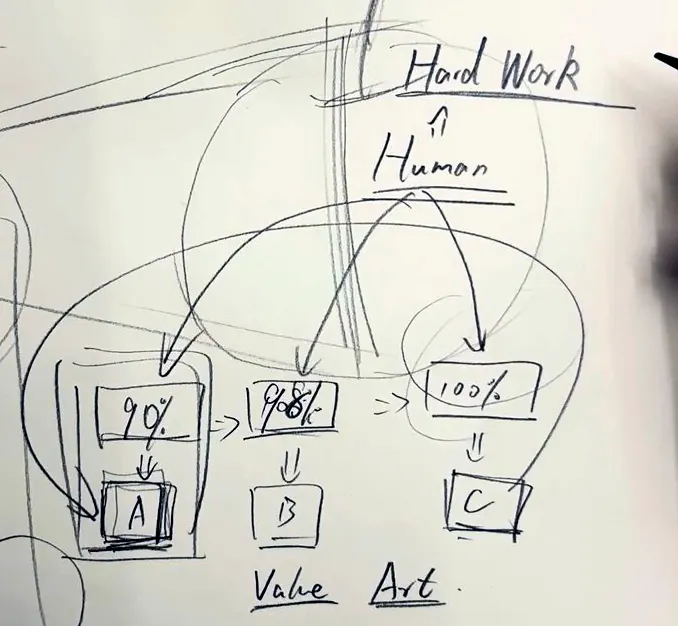
So is C, the 100 per cent accurate charcoal print, worth more than A? If you just take a photo and share it with your friends, they may say: this is worthless, I can take that photo with my phone, I’m not paying a hundred bucks for it. But if you draw it, and record the process, even at 90 per cent accuracy you may be able to sell it for a few hundred. If it is a masterpiece, maybe for hundreds of thousands of US dollars. So what is the added value? Why won’t people pay for the more accurate version? Why do they call it worthless?
I have been pondering this for a long time, especially since I changed my whole career and my life choices and dived into art and digital art. Part of the reason I’m learning both is to find a perspective on it. While I learn, I reflect on the techniques traditional artists and the masters use, and I keep asking why they do them, whether they add value, and what accounts for that value.
Honestly, I can’t fully explain it. If measuring adds value to a drawing, then more accurate measuring should add more value, and a photograph should have the utmost value. But it doesn’t. This world is so weird.
My current answer is that we value human work. In scenario A a person puts in a lot of effort; in B, less; in C, almost none. People value A because they know you had a hard time doing it and really put your time into it. From a poetic point of view, you poured your heart and your emotion into the creative process. But essentially, it is hard work. That is the answer I have for now. I’d really like to hear yours.
Key takeaways
- Measuring with a pencil works by simple proportion: your eye, the pencil and the object form a triangle, so the object shrinks to a length you can mark with your thumb and transfer, or scale, onto your canvas.
- The pose must be repeatable: arm completely straight, never curved, one eye sighting as if aiming.
- Tilt your head and bring your eye towards shoulder level, so the distance from eye to pencil stays the same even when you measure something lower down.
- Measure proportions (angles, symmetry, what share of the whole each part takes), not exact sizes.
- Measuring corrects the tricks your eyes play on your brain; it is not about copying a hundred per cent. Your observation, emphasis and omissions are what you add.
- A perfectly accurate copy isn’t the most valuable one. People value the human effort and heart that go into the work.
LIPAI WANG
A self-taught artist and teacher, known to his video students as William Jiamin. A former programmer, he teaches drawing, painting, pixel art and 3D the way he learned them: one solvable piece at a time.