Look through the doorway
How Vermeer builds deep space out of darkness and one small lit rectangle
- Artist
- Johannes Vermeer
- Title
- A Maid Asleep
- Date
- ca. 1656–57
- Medium
- Oil on canvas
- Image
- Public domain (CC0)
Open in Simple Art
Watch this story on iPhone and iPad, with offline downloads and a painting every day. This one is free in the app.
About 3 minutes of looking, in 10 parts.
A Maid Asleep
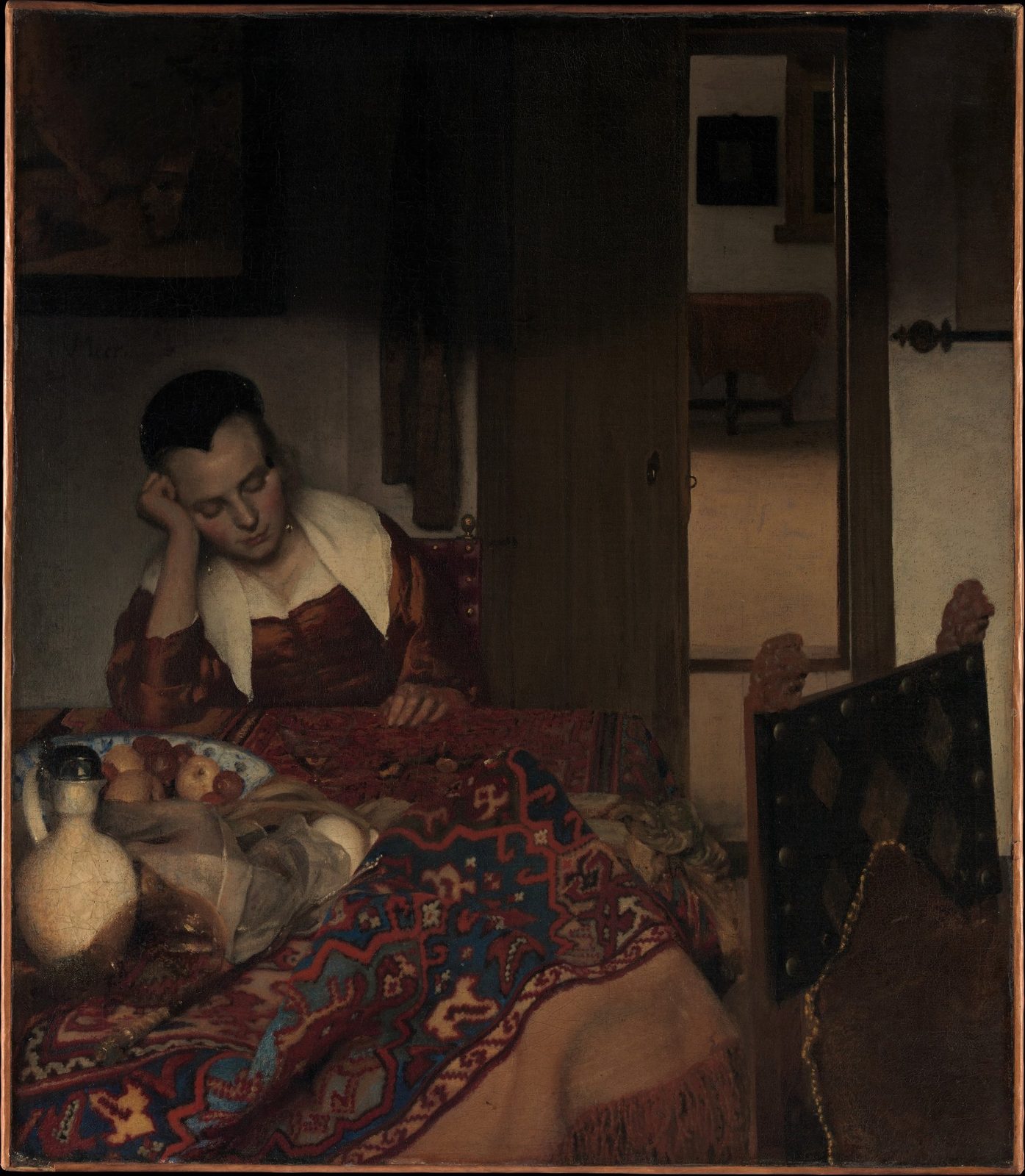
A girl has fallen asleep at a table. Watch where your eye goes, though. It keeps sliding off her and into that small bright doorway behind her shoulder.
Vermeer, about 1657
Vermeer painted this in Delft around 1657, quite early. He is about twenty-five and already solving the problem that occupied him for the rest of his life: how to make a room feel deep.
Dark, then light
The design is brutally simple. A wide band of near-black across the top and middle, a warm mid-toned foreground of carpet and figure, and two small bright accents, her collar and that doorway. The light goes only where it matters.
A face with no edges
Her whole head lives in a narrow band of value. Forehead to cheek to jaw is one unbroken gradient with no visible brushmark anywhere inside it. The only strong dark is her hair, and even that meets her forehead softly, without a drawn line.
Soft where it counts
Her collar is the brightest thing on her, right up against the darkest red of the bodice. That is the biggest value jump in the figure, and Vermeer gives it the softest edge in the painting: on the right, the two colours simply melt together.
The other handling
The carpet looks as if a different person painted it. Every part of the pattern is a separate deliberate touch, with red contours, a blue field and cream shapes dropped on top, nothing blended. Same painter, same picture, opposite method.
Keep the brightest thing simple
The cream jug is the lightest object in the foreground and also the simplest: one smooth turn from light into shadow, a soft highlight, no drawn outline. The complexity goes into the cloth instead.
A dark shape, held flat
The chair in front is almost a flat black shape. Vermeer doesn't lighten it to show you what it is. Two rows of brass studs, each a single point of light, and two carved lion heads are the entire description.
Where the edges go hard
Almost everything in this painting is soft, except here. The door jamb is a crisp straight boundary and the iron latch a flat dark silhouette. Hard edges are rationed like the light, and they are spent on the structure of the space.
The far room
Look how little is in the far room: a table, a dark stretcher underneath, a big plane of quiet wall, all at far lower contrast than anything in front. Technical study has shown that Vermeer first painted a man in that room and a dog looking at him, then painted them both out. He made the room feel distant by taking things away.
Look closer
7 details, each checked against a close-up of the picture.
-
the sleeping head
Her face is modelled with no visible individual brushmarks; the change from lit forehead to shadowed cheek happens as one continuous gradient with no edge anywhere in it.
The whole head lives inside a narrow band of value. The lit forehead, the turn of the cheek and the shadow under the jaw are one unbroken gradient - there is no visible brushmark and no edge anywhere inside the form. The only strong dark is her hair, which is close to black and meets the forehead with a soft, almost furry boundary rather than a drawn line. The pearl earring is a single light touch. Fine craquelure runs over everything, which tells you how thin these layers are.
-
the lit far room
Through the doorway there is a second room lit by its own separate light source, containing a table with a cloth and a framed object on the far wall.
There is startlingly little information here. A dark door edge with a keyhole and a small ring handle, then through the gap a red-brown table top with a dark cross-shaped stretcher beneath it, and below that a large plane of softly lit wall carrying almost no detail at all. The red lion-head finial of the foreground chair pushes in at the bottom. The contrast inside the far room is far lower than anywhere in the foreground.
-
the carpet pattern
The carpet is drawn with small separate deliberate touches of red, blue and cream laid over a warm underlayer, unlike the seamless blending used on the face.
Every part of the pattern is a separate deliberate touch: deep red contour strokes, a dark blue field between them, cream and tan motif shapes dropped on top. Nothing is blended into anything. The carpet's folded edge runs as a crisp scalloped line across the crop, and to the right of it is bare warm ground carrying heavy craquelure and almost no incident.
-
jug and fruit bowl
A white lidded jug and a blue-and-white bowl of fruit sit at the far left of the table and are the brightest objects in the foreground.
A cream lidded jug with a dark pewter lid stands at the left, its glaze covered in a pronounced crackle. Beside it a blue-and-white bowl holds peaches, apples and a dark plum, and a heavy white cloth spills across the table onto the carpet. The jug is the single lightest object in the foreground and it is also the simplest - one smooth gradient from lit left side into shadow, with a soft-edged highlight and no drawn contour.
-
white collar against red
The white collar is the highest value on the figure, and its boundary with the red bodice is soft and slightly lost rather than cut.
The collar is plainly the highest value on the figure, and its boundary with the rust bodice is soft and in places entirely lost - on the right the two simply melt together with no line at all. This is the largest value jump in the whole figure and it is handled with the softest edge in the crop. The pearl earring sits just above, and her left hand rests at the lower right.
-
studded chair back
The chair back in the lower right is a large dark shape with a row of brass studs picking up small points of light along its edge.
The chair back is a nearly flat near-black shape. Two rows of domed brass studs run around it, each one a single small point of light, and a carved red lion-head finial sits at each top corner. A gold beaded cord hangs down across the dark. The pale wall behind throws the whole silhouette forward.
-
door latch and jamb
A dark iron latch hangs on the pale door at the right, on a strong vertical edge that separates the near room from the far one.
A dark iron latch with a round central boss sits on the pale door surface, and a strong dark vertical jamb runs down the left of the crop, separating the dim near room from the lit door. Both are genuinely hard edges, which is rare in this painting. The pale door plane itself is almost featureless apart from craquelure.
A Maid Asleep in context
A young painter in Delft
Vermeer's father trained as a weaver of fine material. But by about 1630 he was running an inn and dealing in art. [2] According to the Met's curator Walter Liedtke, the father's debts and his death in 1652 probably explain why Vermeer had to teach himself rather than study with an important master. [2]
In 1653 Vermeer married the daughter of a wealthy Catholic divorcée, converted to her family's faith and moved into their house in the heart of Delft. [2] On 30 November 1657 he and his wife borrowed 200 guilders from Pieter Claesz van Ruijven, a wealthy Delft citizen and collector. [4]
A first scene of daily life
The Met describes this canvas as possibly Vermeer's first attempt at the kind of picture that filled nearly all his mature career: domestic scenes centred on a woman and her surroundings. [1] It probably dates from 1656 or 1657, after a mythology, a biblical subject and The Procuress, which is dated 1656. [1] Liedtke saw it as probably his earliest scene of modern manners, and noted that it recalls slightly earlier pictures by Nicolaes Maes. [2]
The subject was familiar. The misbehaviour of unsupervised maidservants was a common theme for Dutch painters of the time. [1] On the wall above the maid, the corner of a painting shows the leg of a Cupid and a theatrical mask. [1] Similar pictures appear in other works by Vermeer and may be based on a painting of Cupid listed in the 1676 inventory of his estate. The Met suggests the mask may hint that love is here unmasked. [1]
Imported luxuries on the table
Pile carpets from the Islamic world were popular in Europe from the fourteenth century onwards. European paintings are now a primary source for studying them. [3] Vermeer painted very few pictures, yet many of them include such carpets. This one shows two different seventeenth-century Anatolian carpets. [3] Essential Vermeer identifies the fruit bowl as a klapmut, a large bowl of Chinese porcelain made at Jingdezhen. [4]
Vermeer also changed his mind about the table. Technical study shows that the still life was substantially revised. And the Met reads the open door and untidy objects as signs that a visitor has just left, not that one is expected. [1]
From a Delft collection to Fifth Avenue
The painting is likely to be one of the earliest Vermeers bought by Van Ruijven, who owned all or most of the twenty-one works by the artist sold from the estate of his son-in-law, Jacob Dissius, in 1696. [1] The Met marks this early ownership as probable rather than proven. [1] At the Amsterdam sale on 16 May 1696 it was lot 8 and fetched 62 guilders. A sale record printed in 1752 describes the subject as a drunken sleeping maid at a table. [1]
The Met's provenance then jumps to the Paris collector John Waterloo Wilson. He owned it after 1873 and sold it in 1881. [1] Essential Vermeer fills part of the gap with a probable Amsterdam sale in 1737 and a Paris sale in 1811. [4] From Wilson it passed through the dealer Sedelmeyer to the Paris collector Rodolphe Kann. His estate sold it to Duveen in 1907. [1] Benjamin Altman bought it from Duveen in 1908 and left it to the Met on his death in 1913. [1]
Exhibitions and afterlife
In 1903 it was shown in London as The Cook Asleep, lent by an anonymous Monsieur X of Paris. [1] Six years later it appeared at the Met's Hudson-Fulton Celebration under the title Girl Sleeping. [1] It has since featured in the Met's Vermeer and the Delft School exhibition of 2001 and in the 2009 show built around a loan of The Milkmaid. [1] Under the terms of Altman's bequest, it may not be lent. [1]
Vermeer's reputation grew late. Liedtke notes that he produced perhaps about forty-five pictures, thirty-six of which are known, and remained relatively obscure until the end of the nineteenth century. [2] Liedtke links that long obscurity to the small output itself, made mainly for a small circle of Delft patrons, with as much as half of it acquired by Van Ruijven. [2]
- A Maid Asleep (14.40.611): object record, catalogue entry, provenance, exhibition history and references . The Metropolitan Museum of Art
- Johannes Vermeer (1632–1675), Heilbrunn Timeline of Art History (Walter Liedtke, 2003) . The Metropolitan Museum of Art
- Islamic Carpets in European Paintings, Heilbrunn Timeline of Art History (Walter Denny, 2011) . The Metropolitan Museum of Art
- A Maid Asleep (catalogue entry and Vermeer's life, 1657) . Essential Vermeer