A cadet in black and gold
How the young Degas keeps a portrait dark and quiet, and lets a few touches of gold do the talking
- Artist
- Edgar Degas
- Title
- Achille De Gas in the Uniform of a Cadet
- Date
- 1856/1857
- Medium
- oil on canvas
- Image
- Public domain (CC0)
Open in Simple Art
Watch this story on iPhone and iPad, with offline downloads and a painting every day.
About 4 minutes of looking, in 9 parts.
A cadet against a red wall
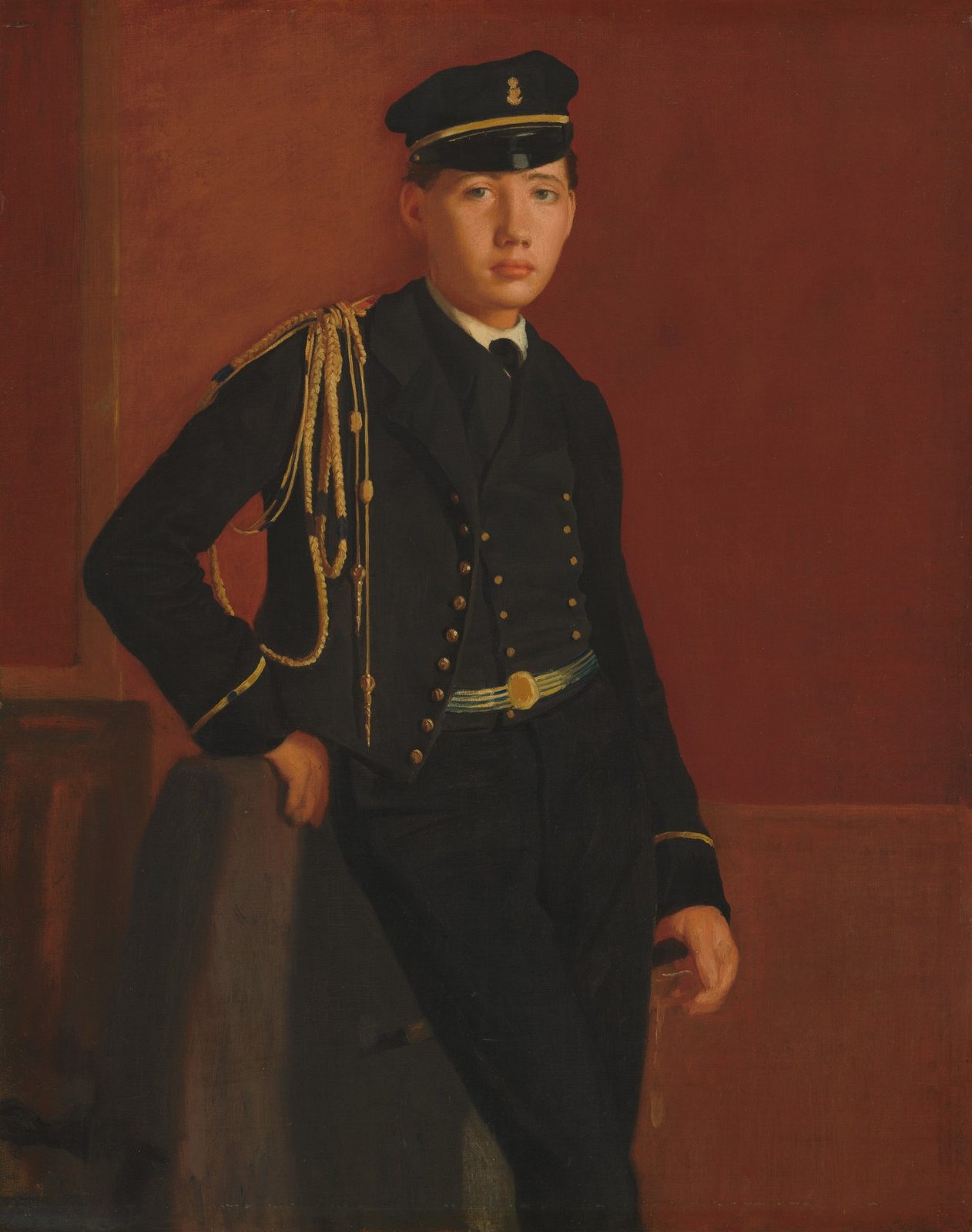
A young man in a black uniform and peaked cap leans against a chair and looks straight out at us. Behind him is a flat, rust-red wall. Almost everything here is dark or reddish brown, so the few touches of gold have a lot of work to do.
Edgar Degas, 1856/1857, oil on canvas
This is Edgar Degas's Achille De Gas in the Uniform of a Cadet, dated 1856 to 1857 and painted in oil on canvas. De Gas was the painter's own family name, and the picture later belonged to René de Gas, the artist's brother.
A centred, upright figure
The figure is set squarely in the middle. A vertical line runs from the badge on his cap, down the buttons, to the belt, and the body widens below like a steady pyramid. Against all that symmetry, the gold cords hang from one shoulder only.
A shadow under the brim
Come in close to the face. The light seems to come from the upper left, and the brim of the cap throws a crisp shadow across his forehead. The palest flesh sits on the cheekbone and the bridge of the nose. The jaw is kept soft, while the mouth is drawn more firmly.
Gold cords on one shoulder
Now drop to his right shoulder, on our left. Gold cords loop over the black sleeve, each one parted from the next by a thin dark line, and they end in small metal tips that catch the light. The gold looks thickly painted. Partway down, there's a tiny touch of dark blue.
Light rising from the collar
Look where the jaw meets the white collar. The lit cheek is warm, but just under the jaw the shadow turns cooler and greyer, as if light were bouncing up from the white cloth. It's a small touch, and it keeps the face from sinking into the dark uniform.
Buttons, belt and buckle
Follow the buttons down to the belt. Where the light reaches them they are bright gold discs, each with a pale dab of highlight. Further into shadow they flatten into dull ochre. The belt is striped blue and gold, and the buckle carries one small, cool white touch.
Three tones, no drawn line
His right hand rests on the brown chair back. Count the tones: a pale warm light on the knuckles, a richer middle tone, and a deep reddish shadow underneath. There's no drawn outline. The shadow is so close to the colour of the chair that the lower edge of the hand simply melts away.
A thumb and a shadow
His other hand hangs at his side, closed round something dark, perhaps gloves or the hilt of a sword. The thumb crosses in front, and one narrow dark wedge beneath it is enough to tell you what sits in front of what. The brushwork here looks looser than in the face.
Look closer
7 details, each checked against a close-up of the picture.
-
Face and cap
The sitter's face is framed by the dark cap brim and white collar, with visible eyelid creases and a soft highlight on the left cheekbone.
The crop shows a young man's head and shoulders rendered against a flat, warm reddish-brown ground. The dark navy-black cap dominates the upper third, with a thin yellow-gold band and a small gold insignia catching light; its brim casts a crisp shadow line across the forehead at roughly y=0.30. The face is built from closely related warm flesh tones, with the lightest values hugging the left cheekbone, the bridge of the nose, and the lower eyelid of the right eye. The eye sockets and the side of the nose are darker, and the upper eyelids show a thin crease mark. Edges around the jaw and against the cap are softened, while the mouth and the cap insignia read as firmer, more drawn contours. A small triangle of white collar sits beneath the chin, and dark fabric with brass button glints fills the lower half.
-
Gold aiguillettes on right shoulder
Individual gold cords are separated by thin dark lines and terminate in small metallic buttons against the black sleeve.
The crop shows a cluster of gold aiguillettes draped over a black uniform shoulder against a warm reddish-brown background. Individual cords are clearly visible, separated by thin dark shadow lines where the fabric recess creates negative space between strands. The braids terminate in small oblong metallic buttons that catch highlights on their upper-left surfaces. Paint application on the gold is thick and directional, with raised impasto catching the raking light from the upper left, while the black sleeve shows softer, more blended handling with visible weave texture. A small dark blue accent appears partway down one cord, breaking the monochrome gold reading.
-
Cheek and collar light
A warm highlight falls on the left cheek while the white collar reflects light upward onto the jawline.
The crop isolates the lower face, neck and collar against a flat reddish-brown ground. The left cheek (viewer’s left) carries a broad, warm half-tone that rakes diagonally from the zygomatic arch toward the corner of the mouth, while the right cheek drops into a cooler, denser shadow that merges with the jaw. The collar reads as a creamy off-white whose upper edge is soft against the neck, and the chin/jaw underside shows a clear cool-warm shift — cooler grey-pink just under the jaw, warming as it meets the white cloth. The jacket below the collar is a near-black that is not uniformly flat; it shows subtle warm glazes along its upper edge where it meets the collar, reading as reflected light from the white fabric.
-
Brass buttons and belt buckle
The brass buttons vary from bright circular highlights to duller shadowed disks, and the buckle shows both yellow-gold and cool white accents.
The crop isolates the lower torso of a dark uniformed jacket, showing a vertical column of round brass buttons running down the left placket, a scattering of smaller buttons across the chest, and a horizontally striped belt with a central oval buckle. The buttons on the upper-left placket catch the most light and read as thick, bright golden discs with pale cream highlights and warm orange-brown cores; buttons set further into shadow become flatter ochre disks with little or no specular mark. The belt is rendered with short, directional strokes alternating between muted teal-blue and yellow-gold, following the slight curve of the waist, and the buckle carries a small cool-white accent on its right side that contrasts with its otherwise warm orange-gold body. Edges of the bright buttons are crisp against the near-black ground, while the shadowed buttons have softer, less defined contours.
-
Cap badge and visor
The small gold cap badge sits above the visor, which carries a single horizontal highlight strip along its lower edge.
The crop centers on a dark peaked cap and the subject's eyes. A small gold cap badge sits just above the visor, rendered with quick opaque dabs of yellow ochre and pale gold that read as a vague heraldic form rather than a crisp emblem. The visor's upper edge catches a warm gold highlight that runs horizontally across the cap; along the lower edge of the visor a thin, broken lighter line appears, but it is broken in places and reads more as a wet-into-wet lift or a scraped-back sliver than a continuous strip. Below the brim, the eyes are set in soft, warm flesh with the light raking from the upper left, leaving the right eye (viewer's) in subtle shadow. The background is a deep reddish-brown, laid on in broad, slightly uneven strokes that show canvas texture.
-
Right hand on chair back
The knuckles and wrist are modeled with three distinct tonal values and no visible outline.
The crop isolates the right hand draped over a dark chair back, with three readable tonal steps on the flesh: a pale warm-orange highlight along the upper knuckles (roughly #C77A45), a saturated mid-tone across the back of the hand and wrist (#9A4A22), and a deep reddish-brown shadow tucked under the lower knuckles and into the finger clefts (#5C2A14). The contour where flesh meets the dark brown-black background (#2A1A12) is soft and is built by value contrast rather than by a drawn line; the shadow tone of the hand is close in value to the chair, which makes the lower edge read as an absence rather than a stroke. A few small bright flecks on the hand read as scumbled highlights laid over the mid-tone, not as a continuous outline.
-
Left hand holding gloves
The thumb overlaps the dark shapes the hand grips, with a narrow dark gap indicating cast shadow between them.
A close-up crop of a loosely rendered hand gripping darker shapes (the gloved fingers) against a warm reddish-brown background, with a near-black sleeve bordering the left edge. The thumb arcs across the upper portion of the bundle, and between the thumb's underside and the recessed glove forms there is a narrow, darker wedge of paint reading as cast shadow. Brushwork is visibly broken: the lit knuckles are thick, loaded strokes in warm peach-orange, the recessed zones are thinner and redder, and the background is dragged in long vertical passes. Edges are soft throughout, with no hard outlines—the thumb-to-glove transition is built entirely from value shifts rather than line.
Achille De Gas in the Uniform of a Cadet in context
The second son
Edgar Degas was the eldest of five children born to Augustin De Gas, a banker, and Célestine Musson De Gas, a Creole from New Orleans. He later simplified the family name to Degas [2]. Achille Hubert de Gas, the sitter here, was born in Paris on 16 November 1838 [3]. The auction house Bonhams describes him as the second of the five children [4].
According to a biographical file kept by a site devoted to the French naval academy, Achille entered the navy in 1855, became an aspirant (midshipman) on 6 February 1858 with seniority from 1 August 1857, and was promoted to enseigne de vaisseau on 8 February 1862, with Brest as his home port [3]. Bonhams, drawing on school and naval records, calls him a turbulent, often impulsive boy and an average student, and says he was put under arrest in 1858 for unruliness and insubordination [4]. He resigned from the navy in November 1864 [4].
Cadet or midshipman?
The National Gallery of Art titles the picture as a portrait in the uniform of a cadet and dates it 1856/1857 [1]. The naval academy file instead describes the dress as that of a naval aspirant, and Bonhams refers to the painting as Achille de Gas as Midshipman [3][4]. Because his aspirant rank was backdated to August 1857, the two descriptions may simply reflect different readings of the same uniform. The sources consulted do not settle the point, though [1][3][4].
The date raises a second question. Wikipedia says Degas left for Italy in July 1856 and stayed there for three years [2]. The Gallery's record does not say where or when within 1856/1857 the canvas was painted. So how the portrait fits around that journey is not explained in the sources consulted here [1].
A student of line
Degas studied drawing under Louis Lamothe, met Ingres in 1855, and worked as a copyist in the Louvre [2]. Ingres's reported advice to him was to draw lines, both from life and from memory [2].
The Gallery's visual description notes that Achille is shown from the knees up with pale blue eyes, that braided gold ropes loop from his right shoulder, and that his left hand may rest on the hilt of a dagger or sword [1]. Bonhams contrasts the youthful haughtiness of this nonchalant pose against a chair with the more contemplative mood of a smaller portrait of Achille that Degas made about 1864 [4].
New Orleans
After leaving the navy, Achille went to New Orleans with his youngest brother, René [4]. The two ran a cotton brokerage there, close to the cotton office of their uncle Michel Musson [5]. Edgar visited them from the autumn of 1872 until about March 1873. In A Cotton Office in New Orleans, Achille is the figure leaning against an open window at the far left [5].
Money became a problem. After their father's death in 1874, Edgar learned that René had run up large debts, and he sold his house and an inherited art collection to pay them [2]. Achille married Emma Heilbuth in New York on 22 October 1881, died in Paris on 12 October 1893, and was buried in the Montmartre cemetery [3].
From René to Chester Dale
The portrait stayed in the family. It belonged to René de Gas and was sold at the de Gas sale at the Hôtel Drouot, Paris, on 10 November 1927, as lot 73 [1]. Durand-Ruel bought it for the American collector Chester Dale, who gave it to the National Gallery of Art in 1963 [1].
It was shown in New York in 1928 in an exhibition of portraits from Dale's collection. Then it went to the Degas exhibition at the Orangerie in Paris in 1931, and to an exhibition of naval and military portraits at Knoedler in New York in 1932 [1]. The Gallery's bibliography includes John Rewald's 1946 article on Degas and his family in New Orleans, plus a 2017 conservation study of finish in Degas's work that discusses this canvas [1]. When the page was archived in May 2025, the painting, accession number 1963.10.123, was listed as not on view [1].
- Edgar Degas, Achille De Gas in the Uniform of a Cadet (1963.10.123): object record, visual description, provenance, exhibition history and bibliography (Internet Archive copy, 5 May 2025) . National Gallery of Art, Washington
- Edgar Degas . Wikipedia
- Achille Hubert de Gas (1838 to 1893): officers and former students (Internet Archive copy, 16 October 2021) . École navale, espace tradition (ecole.nav.traditions.free.fr)
- Edgar Degas, Portrait d'Achille Degas (painted circa 1864): lot 3, catalogue note . Bonhams
- A Cotton Office in New Orleans . Wikipedia