Oranges from the crowd
Renoir poses two circus sisters like ballet dancers in calm daylight, and changes his mind about them many times on the way
- Artist
- Pierre-Auguste Renoir
- Title
- Acrobats at the Cirque Fernando (Francisca and Angelina Wartenberg)
- Date
- 1879
- Medium
- Oil on canvas
- Museum
- Art Institute of Chicago
- Image
- Public domain (CC0)
Open in Simple Art
Watch this story on iPhone and iPad, with offline downloads and a painting every day.
About 4 minutes of looking, in 10 parts.
Two girls in the ring
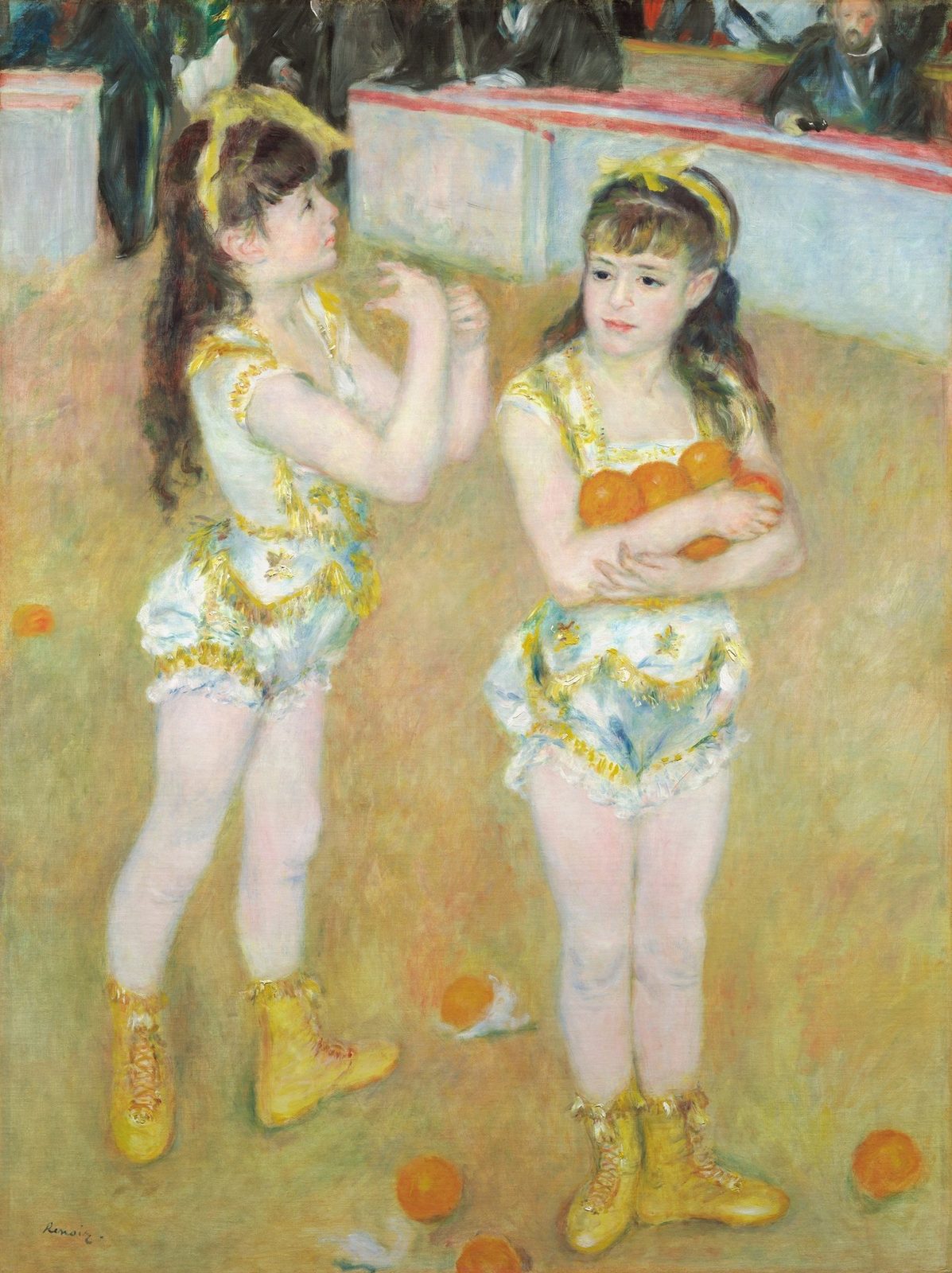
Two girls stand in a circus ring in white and gold costumes. One turns away towards the crowd. The other faces us, her arms full of oranges. The museum explains that audiences threw oranges at performers as a tribute, a rare treat at the time.
Renoir, 1879, oil on canvas
Pierre-Auguste Renoir painted this in 1879. The girls are the sisters Francisca and Angelina Wartenberg, who the museum says were seventeen and fourteen, though they look much younger here. He posed them in costume in his studio, in daylight, because he feared the circus gaslight would turn faces into grimaces.
Looking down on the ring
We look down on the ring from above, so the pale floor fills most of the picture. The adult world is pushed right to the top edge: a strip of dark-suited men behind the barrier, mostly cut off. Everything below belongs to the two girls.
Daylight on a profile
Start with the older sister, Francisca, in profile on the left. The brightest touches sit on her cheekbone and upper forehead, warm peach and pale rose, with cooler pink-tan along the jaw. There's no hard edge between face and background at all.
Hands that moved
Now her hands. The fingers have no outlines. They're made from small shifts of warmth, cooler mauve between them and paler light on the tips. The museum's technical study found Renoir changed the angle of these arms many times, and traces of earlier hands still show through the thin background.
The greedy one
Across to Angelina. In a letter written decades later, she remembered collecting most of the oranges, and called herself the greedy one. The fruit is saturated orange-red, lit with paler yellow touches rather than white. Infrared suggests Renoir first topped the pile with four oranges, not three.
A ribbon left in reserve
Back to Francisca's hair. The yellow bow is a few thick, curving strokes over dark brown hair. The museum says Renoir left a gap for the bow, wiped away some of the hair paint, then laid the heavier yellow on top. That gives it its soft, wispy edge.
Blue inside the white
Look into the shadows of her white costume. They aren't grey. They're pale blue and cool grey, following the folds. Conservators found that Renoir first drew the figures in blue paint, and in places those lines survive as a cool shadow along the edges, especially in the tights.
A ballet position
Down to Angelina's golden boots. The laces are only short, broken strokes of off-white across the yellow. The museum points out that the sisters stand like ballet dancers, not acrobats, and infrared suggests Renoir adjusted her feet until they overlapped slightly, close to ballet's third position.
Oranges on the floor
Between the girls, two fallen oranges lie on the floor. Their edges soften into the greenish tan ground rather than stopping at a line. When the museum analysed a sample from an orange here, it found a surprising mixture, including vermilion, red lake, chrome yellow and even a little cobalt blue.
Look closer
8 details, each checked against a close-up of the picture.
-
Right girl's face and oranges
The oranges are rendered in saturated orange-red, with paler yellow-orange touches serving as highlights rather than crisp white dots.
The crop centers on a young girl's softly modeled face framed by brown hair tied with a yellow ribbon, her white-and-gold costume visible at the shoulders. Below her crossed arms, a cluster of oranges reads as warm orange-red masses, with the upper-left orbs showing slightly paler, yellow-orange touches that function as highlights rather than crisp white specks. Edges throughout are feathered: hair strands blur into the background, the cheek transitions blend into jaw shadow, and the orange contours are broken by surrounding skin tones and skirt whites. Layering is thin and scumbled, with cool blue-grays showing through the background and warm pinks working into the nose and lips.
-
Golden boots
The yellow boots are built from overlapping warm yellows and ochres, with laces suggested by short broken off-white strokes.
The crop shows two golden boots viewed from slightly above, with pale legs disappearing off the top edge. The boot surfaces are built from overlapping warm yellows, ochres, and honey tones, with cooler olive-green notes tucked into the inner edges and shadow pockets. Laces are suggested by short, broken off-white and pale-pink strokes zigzagging across the tongue, never resolved as crisp crossings. A ruffled, fur-like cuff at the top is rendered with feathery pink-cream and yellow dabs that feather into the background. Edges between boot and ground are softened by a halo of warmer brown-orange, and the ground itself dissolves into a mottled olive-khaki wash with no hard contour.
-
Tutu blue-grey shadows
The white fabric of the tutu contains strokes of pale blue and grey in the shadowed folds.
The crop is a close-up of a tutu's bodice and upper skirt rendered in soft, feathery brushwork against a warm yellow-olive background. White fabric is the dominant value, but the shadowed folds clearly carry strokes of pale powder blue and cool grey, which model the volume of the gathered fabric. Warm yellow-gold accents appear along the upper edge and at the neckline, contrasting with the cool shadow tones, while a flush of pink at the bottom indicates bare skin. Edges are deliberately soft, with brush marks bleeding into one another rather than terminating crisply.
-
Left girl's hands
The fingers are softly modeled with blurred edges, blending slightly into the skin tones of the arms.
The crop shows two softly rendered hands and the adjoining forearms in warm pink and golden tones against a mottled olive-green and yellow background. There are no crisp outlines around the fingers; their forms are indicated by a slightly cooler pinkish-grey shadow along one side and a pale luminous highlight along the knuckles and fingertips. Edges visibly melt: the lower hand's contour blends into the arm's flesh tone, and the upper hand's fingertips dissolve into the surrounding ochre background. The surface reads as feathery, directional strokes that follow the curve of the limbs rather than tight contour lines.
-
Face highlights
The left girl's cheek and forehead have bright, peach-toned highlights facing the left.
The crop shows a young girl's face in profile, tilted upward, with the brightest light landing on the left cheekbone and the upper forehead near the hairline. These highlights read as warm peach and pale rose-ivory, set against slightly cooler pink-tan mid-tones along the jaw and the side of the nose. Brushwork is feathery and dry: small, broken strokes of pink, ochre, and cool grey-green are laid side-by-side rather than blended, so the highlight zones are built from many short marks instead of a single wet shape. Edges are dissolved throughout—no firm contour separates cheek from background, and the chin/hair transition is left open, so the highlighted cheek appears to advance while the dark hair recedes.
-
Hair ribbon detail
The yellow hair ribbon is defined by several distinct, thick strokes of bright yellow and gold.
The crop is a tight detail of a child's head dominated by a curved band of yellow and gold at the top, where a hair ribbon is implied rather than drawn with any hard outline. Three or four clearly distinguishable thick yellow strokes run in parallel arcs following the crown of the head: a bright lemon-yellow on the upper left, a warmer mid-gold through the center, and a slightly darker ochre stroke picking up shadow on the right. Below this band, dark reddish-brown hair is laid in with loose, vertical feathery strokes that bleed into the yellow where the two meet, producing soft, broken edges rather than a clean boundary. To the lower right, a sliver of pale pinkish-peach cheek and the curve of an ear emerge through similarly loose, scumbled marks.
-
Scattered oranges on floor
The oranges on the ground are painted with circular strokes of orange and yellow blending into the tan floor.
The crop shows two rounded forms—fully visible upper-left and partially cropped lower-right—rendered in warm orange-red with brighter yellow cores, sitting on a mottled tan-olive ground. The fruit edges are soft and broken, blending into the floor rather than terminating in a hard contour; the floor itself is built from short, scumbled strokes of khaki, ochre, and a greenish shadow tone, with a slightly pinker passage near the center. The orange bodies read as a series of curved, feathery marks that curve around the implied sphere, while the surrounding floor has a drier, more cross-hatched texture. Values stay close together: the oranges are the lightest, most saturated passage, and the floor is mid-value with cool-leaning greenish accents that push the warm fruit forward.
-
Artist signature
The name 'Renoir' is written in a cursive, dark pigment in the bottom-left corner.
The crop shows the cursive word 'Renoir' followed by a small terminal dot, executed in a dark brown-to-black pigment that reads warm rather than neutral. The strokes are thin, fluid, and slightly uneven in pressure, with the downstrokes noticeably heavier than the connecting hairlines. They sit on a mottled yellow-ochre ground that varies from pale buttery yellow on the left to deeper, warmer orange-brown on the right, with faint vertical and diagonal streaks suggesting the weave or aged surface beneath. Edges of the lettering are crisp against the ground in some spots but soften and bleed slightly where the dark ink meets a darker patch of the background.
Acrobats at the Cirque Fernando in context
A family of gymnasts
The sitters' names were long forgotten [2]. Renoir himself described the picture to the dealer Ambroise Vollard only as little girls playing with oranges, and his biographer Georges Rivière called them jugglers in 1921 [2]. Their identity came to light through a letter Angelina Wartenberg wrote in 1938 from London to her niece in California. She described herself and her sister as 'Circus Kids' at the start of their careers [2].
Francisca and Angelina were the eldest children of a Franco-German family of gymnasts [2]. By the mid-1880s there were seven Wartenberg children, who performed together in acts such as a human pyramid, with the two older girls as its base [2]. Angelina had been baptised in Berlin in 1864. She stayed in London after the family became British citizens in 1889, while Francisca performed in the United States and married George Sebastian Miehling, an instructor at the Olympic Club of San Francisco [2].
Which circus
The Cirque Fernando opened its permanent building on 25 June 1875 at the corner of the boulevard de Rochechouart and the rue des Martyrs, on the edge of Montmartre [3]. The catalogue notes that this was a short walk from Renoir's studio in the rue Saint-Georges [2]. Wikipedia says Madame Fernando let painters work freely during rehearsals and watch shows without paying [3]. Still, the catalogue points out that the setting was never named as the Cirque Fernando during Renoir's lifetime, and calls the identification only likely [2]. No notice of the sisters performing has yet been found in the Paris newspapers [2].
A debut among pastels
The painting was first shown in June 1879 at the offices of the magazine La vie moderne, in a small exhibition mostly of pastels [1][2]. The catalogue thinks so large a canvas must have looked out of place there [2]. Renoir's brother Edmond wrote that it had the charm of an authentic scene of modern life, and that it caught the way the two children walked, bowed and smiled in the ring [2]. A second notice, in La presse, suggests the costumes were originally pink [2].
Leaving things out
Douglas Druick has questioned Edmond's claim that the picture lacks artifice [2]. A rare preparatory chalk drawing on canvas includes a clown at lower right, and the catalogue thinks the girls probably shared the ring with other acts [2]. In the painting the clown is gone and the ring wall is raised, leaving one spectator's face and the legs of staff and performers [2]. By the mid-1880s the sisters were robust and muscular, much more developed than they appear here [2].
The catalogue sets this against Fernand Pelez's Grimaces and Misery of 1888, a picture of the hardship many circus children faced [2]. It reads Renoir's choice as a different kind of realism, one that looked for beauty and dignity in popular entertainment [2]. It compares this with Edmond de Goncourt's call for a realist novel of elegance in the preface to Les frères Zemganno of 1879, a book in which a small child gymnast receives a similar ovation [2].
A Chicago picture
Renoir deposited the canvas with Durand-Ruel in April 1881 as Les Petites acrobates and sold it to him in May 1882 for 2,000 francs [1]. It hung in the seventh Impressionist exhibition in March 1882 and was shown in New York in 1886 [1]. Potter Palmer of Chicago bought it on 11 May 1892 for 8,000 francs [1]. The museum says his wife, Bertha Honoré Palmer, was so fond of it that she took it with her on her travels abroad [1]. It was given to the Art Institute in 1922 and carried the title Two Little Circus Girls there for more than fifty years [1][2].
- Pierre-Auguste Renoir, Acrobats at the Cirque Fernando (Francisca and Angelina Wartenberg), 1879 (1922.440): object record, description, provenance and exhibition history . Art Institute of Chicago (public API)
- John Collins and conservation staff, 'Cat. 9, Acrobats at the Cirque Fernando (Francisca and Angelina Wartenberg), 1879', in Renoir Paintings and Drawings at the Art Institute of Chicago . Art Institute of Chicago
- Cirque Medrano . Wikipedia