After the Bullfight — A Cassatt Walkthrough
Tracing the eye from smoke to sequins in Mary Cassatt's 1873 portrait
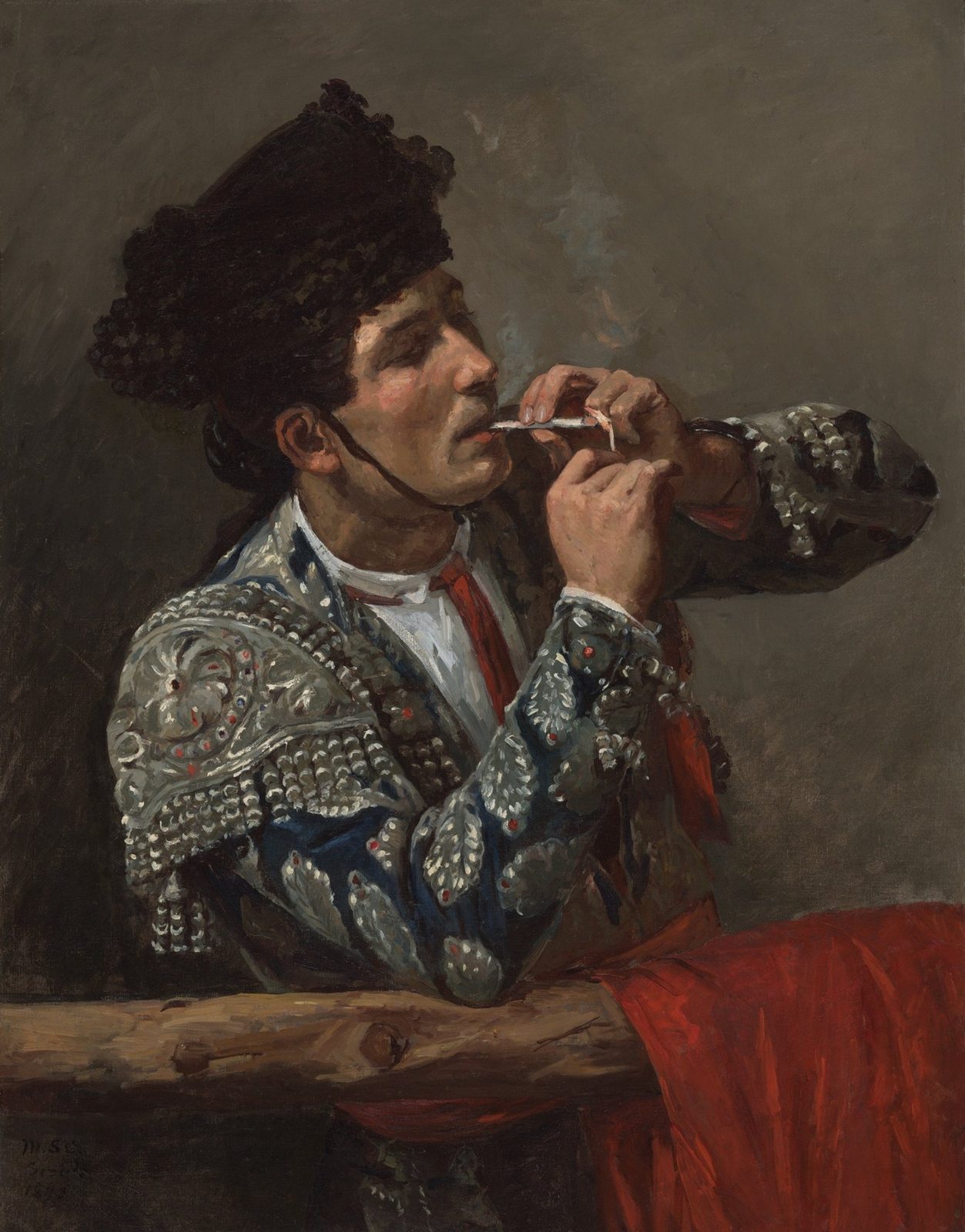
- Artist
- Mary Cassatt
- Title
- After the Bullfight
- Date
- 1873
- Medium
- Oil on canvas
- Museum
- Art Institute of Chicago
- Image
- Public domain (CC0)
Open in Simple Art
Watch this story on iPhone and iPad, with offline downloads and a painting every day.
About 5 minutes of looking, in 10 parts.
A moment of stillness
Before us, in the hush after spectacle, a man in an ornate matador's jacket lifts a cigarette to his lips. Mary Cassatt's After the Bullfight, painted in 1873, drops us into a private breath between performances. The smoke curls upward against a murky background as the camera holds on the whole canvas — a quiet human gesture framed by silver sequins and a deep red drape.
Cassatt's Spanish period
Cassatt was a young American painter working in Spain when she made this, only twenty-five years old. The work belongs to her earliest Spanish-period paintings, executed in oil with the loose, painterly handling of an artist fusing Realist drawing with proto-Impressionist edges. We are looking at a portrait of a single performer, not the corrida itself.
The diagonal sweep
Step back and trace the structure. A strong diagonal runs from the head in the upper left, down through the torso, and out along the red drape to the lower right corner. That line, plus the implied triangle formed by the figure and the wooden barrier, anchors everything. The eye path begins at the upward smoke, drops to the lit face, slides along the arm to the cigarette, and finally rides the red fabric off-frame.
Raking from camera-left
Light enters from the left, raking across the face and front of the body in a soft, diffuse wash. This gives the figure a sculptural, cameo-like relief: the lit cheek and the bridge of the nose are the brightest planes, while the right side of the face drops into warm shadow. The high key value contrast between the illuminated skin and the dark background does most of the storytelling.
Hard edge, soft shadow
Press into the profile. Notice how the lit cheek meets the dark background in a crisp, almost graphic contour — that hard edge was not painted, it was left unpainted where the light stroke stops against untouched dark ground. The shadow side, by contrast, is loosely scumbled, with broken umber strokes that never quite resolve. A single crisp contour can do the work of describing light direction all by itself.
The focal moment
Slide forward to the focal point — the face in profile and the cigarette between the lips. Light strikes the forehead, the nose ridge, and the chin, while the eye socket falls into warm shadow beneath the dark cap. The cigarette is a crisp pale bar with a tiny reddish ember at its tip. The brushwork on the forehead is broken and directional, but the contour of nose and chin is left softer, almost feathered.
Dabs of metal
Now down to the jacket's silver embellishments. These are not painted smoothly — they are built up as clusters of thick, rounded dabs of white and pale grey paint, loaded on a stiff brush or palette knife over a darker base. The dark underlayer shows between the marks, and tiny accents of red and cool blue are dotted in as inset jewels. You can actually see the impasto ridges catching the light.
Fingers at work
Move down to the hands. The fingers curl around the cigarette with a soft, painterly transition between warm peach highlights and cooler rose-brown mid-tones. The lower hand pinches the white tip; the upper hand holds a thin striker. Notice the broken edges where the fingers meet the dark olive background — the silhouette is feathered rather than drawn. This is alla prima: form built by adjacent color notes, not blended gradation.
Crimson to scarlet
Follow the diagonal out into the red drape at the right. Watch the value range: deep crimson-maroon in the shadow folds, warming to saturated scarlet along the ridges catching the left-side light. The edges where the cloth meets the olive background are soft and broken, with dark red strokes dragged upward. Notice how the cool blue jacket and the warm red push against each other to throw the figure forward.
Atmospheric negative space
Rise back up into the upper smoke area. There are no defined shapes here — just curled, comma-shaped gestures of cool blue-grey dragged across a darker warm ground. A few pale cream scumbles lift the value slightly but remain unblended. The smoke is essentially one confident curving stroke rotated through the wrist, laid into the still-damp passage so the edges stay broken.
Look closer
10 details, each checked against a close-up of the picture.
-
Face and Cigarette
The light hits the forehead, nose, and chin while the cigarette is held between the lips and fingertips.
The crop is a tight profile portrait of a man lighting or smoking a cigarette. Light rakes in from the left, striking the forehead, the bridge and tip of the nose, the upper cheek, and the chin as the brightest planes; the eye socket, the side of the face away from us, and the underside of the jaw fall into warm shadow. The dark cap above reads as a near-black mass with minimal internal modeling, setting off the lit skin below it. The cigarette is a crisp white-pale horizontal bar held between the lower lip and the fingertips of the right hand, with a small reddish-orange ember at the lit end. Brushwork is loose and scumbled — you can see broken, directional strokes on the forehead and cheek, while the contour of the nose, lips, and chin is left softer and slightly feathered rather than drawn with a hard line.
-
Silver Jacket Impasto
The silver embellishments are rendered with thick, distinct dabs of white and light grey paint.
This crop isolates a section of the jacket's silver ornamentation, showing clusters of rounded, sequin-like forms built up from thick dabs of white and pale grey paint. The embellishments sit on a darker mid-grey/charcoal ground that reads between the dabs, giving the surface a dense, beaded texture. Small accents of red-orange and cool blue-violet are dotted in among the silvers, suggesting inset jewels. Edges are kept soft and broken rather than hard; the dabs of paint bleed into neighboring strokes, and a deep blue-black drapery in the lower right sets off the brighter silvers. The overall effect is sculptural and tactile, with clear three-dimensionality created by the impasto catching the raking left-side light.
-
Red Drape Transition
The red fabric shifts from deep crimson in the shadows to a bright scarlet highlight.
The crop is dominated by a red drape occupying roughly two-thirds of the right side, set against an olive-brown background in the upper left and a dark brownish ground/wood barrier in the lower left. The red reads across a clear value range: deep maroon-crimson where the cloth folds into shadow (especially along the lower edge and inside creases), warming to a saturated scarlet-orange along the raised ridges that catch the left-side light. Edges between the drape and the background are soft and broken, with a few strokes of darker red dragged upward into the olive area. Paint application is loose and gestural, with long vertical-to-diagonal strokes following the direction of the folds, and thinner, more horizontal scumbles where the cloth meets the barrier.
-
Profile Lighting
There is a sharp value contrast between the illuminated cheek and the dark background.
The crop is a close profile of a man's head, strongly lit from the left. The lit cheek and bridge of the nose are built from warm cream, peach, and rose-pink strokes laid over a slightly cooler ochre underlayer, while the left edge of the face meets a near-black background in a hard, almost graphic contour. The shadow side of the cheek and the right plane of the nose drop into muted umber-browns that read as a clear value step down from the highlights. Brushwork is loose and visible: short, loaded strokes follow the round of the cheekbone and the downward slope of the jaw, and the pink of the nostril is set down in a single thick dab against cooler flesh. Edges are deliberately varied — crisp against the dark ground, softer where the lit cheek turns into the shadow plane.
-
Shoulder Silhouette
The edge of the shoulder against the background is soft and blended, not a hard line.
The crop isolates the upper right shoulder of a figure in an ornamented jacket against a deep, near-black background. The jacket's fabric is built from cool gray, off-white, and muted blue-green strokes with scattered small white dabs for the metallic embellishments. Along the contour where the shoulder meets the dark ground, the boundary is not a drawn line; instead, the lighter strokes taper, overlap the dark, and break up into broken marks that allow the background tone to show through in places. The dark background itself has subtle warm-brown variation, and a few lighter scumbled touches sit just inside its edge, further softening the silhouette. The value jump from light jacket to dark ground is strong, but it is mediated by these intermingled, irregular marks rather than a crisp contour.
-
Lighting Hand
The fingers are curled around the cigarette with a soft, painterly transition between skin tones.
The crop centers on two hands rendered in warm, varied flesh tones set against a dark olive-brown background. The upper hand grips a thin pale striker or match horizontally, while the lower hand pinches a white cigarette tip that glows with a touch of red-orange ember. Fingers are defined by juxtaposed warm peach highlights and cooler rose-brown mid-tones, with shadowed creases loaded in deeper umber. Edges between fingers and background are soft and feathered rather than crisp, and the paint surface shows visible directional brushwork following the cylindrical form of each digit.
-
Collar and Tie
The white shirt collar is painted with broad strokes of off-white and light grey.
The crop centers on a white shirt collar rendered with broad, loaded brushstrokes that leave individual bristles and ridges of paint visible. The collar's lit surface mixes warm off-white with cooler light grey, while the underside carries deeper warm-grey shadows that define its three-dimensional curl. To the right, a saturated red-orange tie is applied with a single decisive vertical stroke that overlaps the collar edge with a hard, slightly broken boundary. Above, a dark brown rounded form (the shadowed chin and neck) is painted with swirling, curvilinear strokes that move in a different rhythm than the linear collar below. In the lower-left, dark blue-grey passages are punctuated by small white and silver dabs, likely the embellished jacket.
-
Wooden Barrier
The wooden beam is rendered with long, horizontal strokes of ochre and brown.
The lower two-thirds of the crop is dominated by a wooden barrier rendered in horizontal, sweeping strokes of ochre, sienna, and burnt umber. The brushwork runs left-to-right, parallel to the implied wood grain, with thicker impasto accents in the lighter passages and thinner, more transparent darks where the board recedes. A darker knot-like mass sits right of center, defined by a few curved, overlapping strokes that break the horizontal rhythm. The upper edge of the beam meets the dark figure and a cluster of white-and-grey highlights (the jacket's silver trim and a glass form) through a soft, broken contour rather than a crisp line.
-
Upper Smoke Area
The background consists of loose, swirled brushstrokes of grey and brown with no defined shapes.
The crop is dominated by a dark, atmospheric field of brown and grey-brown washes with no resolved forms. On the right half, cooler blue-grey strokes curl and loop in loose, comma-shaped gestures that read as drifting smoke, while the left edge carries the dense black-brown mass of the figure's cap/hair. A few pale cream scumbles in the upper-center lift value slightly but remain unblended into the surround. Edges are entirely soft; no shape is closed off, and layering reads as a darker ground partially wiped or thinly scumbled with lighter passages.
-
Black Cap Texture
The cap is painted with a mix of deep black and dark brown to create volume.
The crop isolates the upper half of a dark, domed cap crowned with a small, knobby ornamental tuft. The mass is built almost entirely from very dark values — near-black passages interspersed with slightly warmer umber and chocolate brown strokes that catch a low raking light from the upper left. The decorative tuft at the apex reads as small, scumbled dabs of dark red-brown sitting on top of a denser black core. Edges against the muted olive-grey background are softened in places and crisp in others, particularly along the right silhouette where the dark mass is cut sharply. At the lower right, a sliver of warmer peachy tone (likely forehead/hair) pushes against the cap's lower edge, providing the only real value contrast in the crop.
After the Bullfight in context
From Parma to Seville
Cassatt returned to Europe in the autumn of 1871 with a commission from Bishop Michael Domenec of Pittsburgh to copy paintings by Correggio in Parma [3]. The Salon of 1872 received her Two Women Throwing Flowers During Carnival warmly, and after finishing the commission she went on to Madrid and Seville [3]. The Art Institute describes this as an extended stay in Italy and Spain in 1872 to 1873, made largely on her own [1].
Historian M. Elizabeth Boone writes that Cassatt arrived in Seville in late October 1872 and spent about six months there over the winter [2].
A studio in the House of Pilate
In Seville she found a studio in the Casa de Pilatos, a sixteenth-century palace that belonged in the nineteenth century to the ducal family of Medinaceli [2]. Boone quotes a letter of New Year's Eve 1872 to Emily Sartain in which Cassatt says she worked there daily from mid-morning to five, and that the duke's steward, Manuel Barrera, an amateur painter, had given her the room [2]. In the same correspondence she wrote that what kept her in Spain was 'the odd types and peculiar rich dark colouring of the models' [2].
One of a Seville group
Boone counts After the Bullfight, also known as Toreador, among Cassatt's best-known Seville paintings, with On the Balcony and Offering the Panal to the Bullfighter, and calls them among her first mature works [2]. In Adelyn Breeskin's 1970 catalogue raisonné it appears as cat. 23, Toreador; Boone warns that Breeskin's titles are often descriptive rather than taken from early records [2]. Boone links On the Balcony partly to Cassatt's study of Murillo and Goya, and calls Offering the Panal anecdotal and romantic in theme [2]. In 2018 she published two further Seville paintings that had descended through the Barrera family [2]. In 1874 Cassatt settled in France and opened a studio in Paris [3].
A picture with several names
The canvas measures 110.5 by 93.4 centimetres and is signed at the bottom left 'M.S.C. / Seville / 1873' [1]. Its first recorded showing was at the Pennsylvania Academy of the Fine Arts in Philadelphia in 1878, as Spanish Matador [1]. Frederick Sweet published it in 1967 as Toreador, and the Art Institute showed it in 1976 as Torero [1].
Philadelphia to Chicago
The provenance runs from the artist to H. Teubner of Philadelphia by 1878, then through John Ruderman of Montclair, New Jersey, and Mr and Mrs Lewis Padawar of New York until about 1957 [1]. John Cunningham of New York had it by September 1959 when it passed to Hirschl and Adler Galleries, and Mrs Sterling Morton of Chicago acquired it that October before bequeathing it to the museum in 1969 [1].
Since then it has appeared in the National Gallery of Art's 1970 Cassatt exhibition, in Mary Cassatt: Modern Woman in 1998 to 1999, and in Americans in Spain: Painting and Travel, 1820 to 1920, at Norfolk and Milwaukee in 2021 [1].
- Mary Cassatt, After the Bullfight: collection record . Art Institute of Chicago
- M. Elizabeth Boone, 'The Paintings Left Behind: Two New Paintings by Mary Cassatt from Seville', Panorama 4, no. 2 (Fall 2018) . Association of Historians of American Art
- Mary Cassatt . Wikipedia