Thin darks, thick lights
Rembrandt paints the shadow with almost no paint and the light with an enormous amount
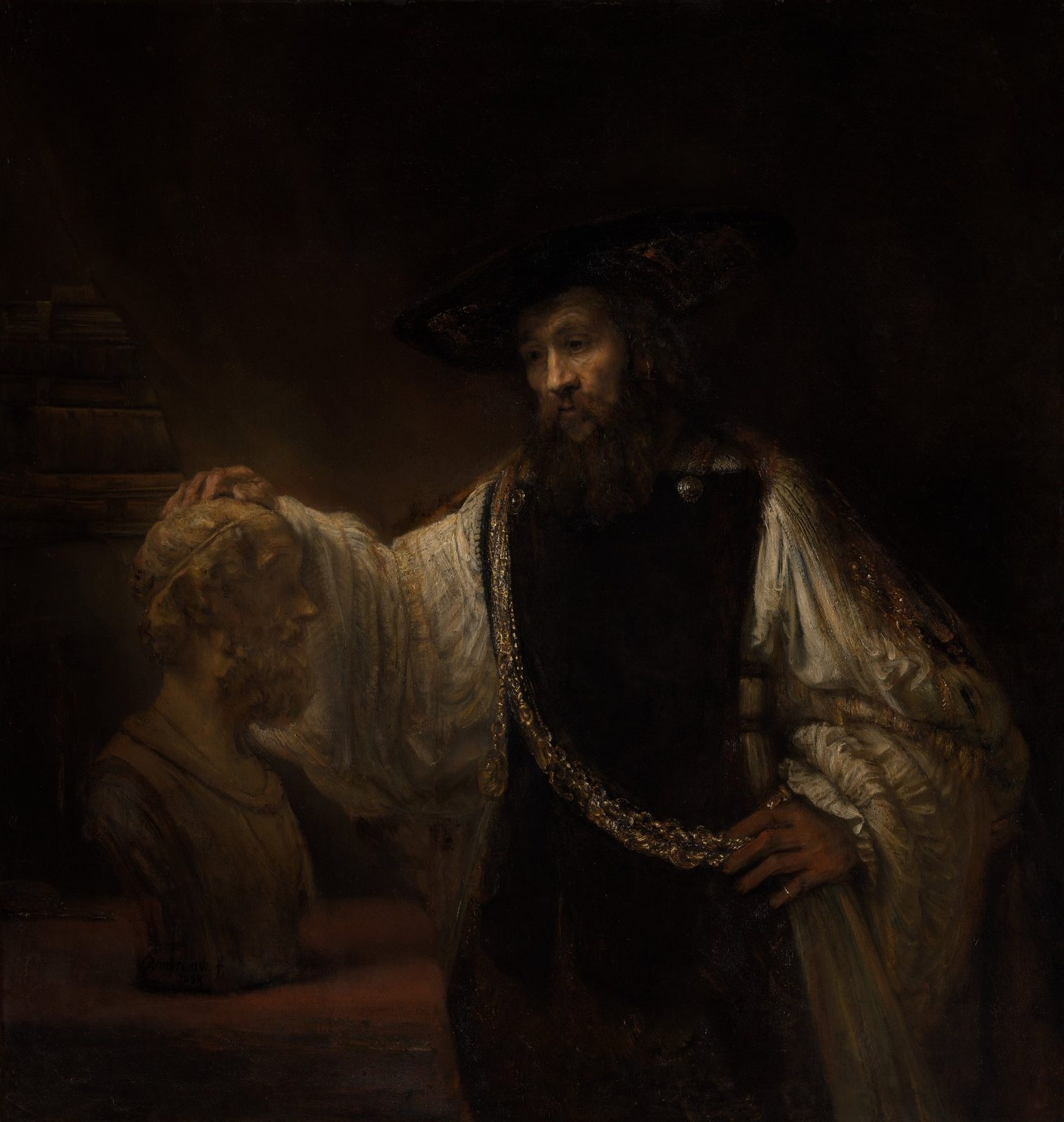
- Artist
- Rembrandt (Rembrandt van Rijn)
- Title
- Aristotle with a Bust of Homer
- Date
- 1653
- Medium
- Oil on canvas
- Image
- Public domain (CC0)
Open in Simple Art
Watch this story on iPhone and iPad, with offline downloads and a painting every day. This one is free in the app.
About 3 minutes of looking, in 10 parts.
Aristotle with a Bust of Homer
Two thirds of this canvas is one dark. Rembrandt spends light in exactly three places, and what separates them is colour and also how much paint is physically there.
Rembrandt, 1653
Painted in Amsterdam in 1653 for a Sicilian collector. A philosopher rests his hand on a bust of a blind poet, wearing a gold chain that probably came from a king. He does not look pleased about any of it.
Three lights in a dark
The design is a triangle. The pale bust holds the lower left, the lit head sits high on the upper third, the hand closes the lower right, and the gold chain is the bright line that connects all three. Your eye goes round and round instead of leaving.
Where the paint is
Forehead, nose and near cheek are loaded on thickly enough to see the ridges. The beard and the whole far side are thin and transparent, more stain than paint. The shadow side never ends anywhere; there is no contour around this head at all.
The chain is not drawn
This is the thickest paint in the picture: a run of separate loaded blobs of yellow, cream and near-white, jostling together, with no links drawn. It reads as heavy gold purely from where the touches sit and how they catch the light. Around it the robe is so thin you can see the canvas weave.
Folds made of direction
The sleeve is broad, loaded strokes with the brush marks left showing, and the folds are described by which way each stroke runs. At the right, gold embroidery in heavy impasto sits straight against the black robe, so the thickest and thinnest paint in the painting touch.
Where the edge disappears
Along this edge the hat stops existing. Hat and background share the same value and the same warm dark, with no boundary between them. Only a scatter of gold ornament tells you anything is still there.
The stone is not white
The bust is warm ochre, barely lighter than the man's own skin and lit from exactly the same direction, nothing like white marble. The eye sockets are soft dark hollows with nothing carved in them, and that is what makes the poet read as blind.
How little a hand needs
The hand on the bust is almost unfinished: broad pink strokes, one knuckle, no nails to speak of. Compare it with the face you just saw. Rembrandt graded his detail by importance and had the nerve to under-describe a hand.
Two precise accents
The other hand is just as loose, except for two things he allows himself: the chain running over the knuckles and a small gold ring. Those two precise accents make the whole hand read sharper than it is.
Look closer
8 details, each checked against a close-up of the picture.
-
the lit head
The forehead and cheek are built in noticeably thicker paint than anything around them, and the shadow side of the face dissolves without a contour.
Two different quantities of paint are doing two different jobs. The forehead, nose bridge and near cheek are loaded on thickly - you can see the ridges - while the beard and the whole far side of the head are thin and transparent, more stain than paint. The shadow side does not end anywhere; it simply runs out into the beard and then into the dark. There is no contour around this head at all.
-
the gold chain
The chain is made of separate loaded touches of yellow and cream standing proud of the surface, not drawn links with detail inside them.
This is the thickest paint in the picture and it is not describing links. It is a run of separate loaded blobs of yellow, cream and near-white, jostling against each other, that read as a heavy gold chain only because of where they sit and how they catch light. Around them the robe is a huge thin transparent brown-black with the canvas weave still showing through. Thickest paint and thinnest paint, side by side.
-
the white sleeve
The sleeve is built from broad loaded strokes of warm cream and grey that describe the folds by direction, with the brush marks left visible.
Broad, confident, loaded strokes of warm cream, grey and ochre, with the brush marks openly visible. The folds are described entirely by which way the stroke runs, not by drawn edges or by careful shading. At the right a strip of gold embroidery is laid on in heavy impasto directly against the black robe, so the two extremes of paint thickness touch each other.
-
the bust of Homer
The bust is painted in pale warm stone colours and is lit from the same direction as the man, with blank carved eyes.
The bust is not white. It is painted in warm ochres and umbers, only a little lighter than the man's own skin, and lit from exactly the same upper left. The eye sockets are left as soft dark hollows with nothing carved into them, which is what makes the poet read as blind. A fillet crosses the brow, painted as one dragged stroke.
-
hand resting on the bust
The hand rests flat on the crown of the bust, painted with reddish flesh tones and much less detail than the face.
The hand lies flat on the crown of the bust and is painted with startlingly little information: broad pink-red strokes, one indication of a knuckle, no nails to speak of. Compared with the face it is almost unfinished. And yet it reads completely, because its shape and placement are exactly right.
-
the left hand and ring
The left hand rests on the hip holding the end of the chain, wearing a ring, and is painted with fewer and broader strokes than the face.
The end of the gold chain runs across the knuckles and a small gold ring sits on the little finger - two of the very few precise details Rembrandt allows himself down here. The hand itself is broad red-brown strokes with little modelling, considerably less described than the face, and behind it a white cuff and a greenish sleeve.
-
hat lost against the background
The black hat's silhouette merges into the dark background with no boundary along part of its edge.
Along its left and upper edge the hat has no boundary whatsoever. Hat and background are the same value and the same warm dark, and the eye simply cannot find where one stops. Only a faint scatter of gold ornament tells you there is still a hat there. The lit face at the right is the only thing in the crop with a real edge.
-
signature on the plinth
The artist's signature and a date are painted onto the plinth of the bust at the lower left.
'Rembrandt f.' with '1653' beneath it, painted in a thin dark brown directly onto the stone plinth of the bust - inside the fiction of the picture rather than on its surface, as though carved or inked onto the actual stone.
Behind Aristotle with a Bust of Homer
Rembrandt in 1653
Rembrandt was born in Leiden in 1606, worked in Amsterdam from 1632, and died there in 1669 [1][2]. He prospered in the 1630s, taking pupils, building an art collection and, in 1639, buying the large house that is now the Rembrandt House Museum [2].
The following years were harder. Walter Liedtke, writing for The Met, links the more contemplative manner of this period, with this painting as a mature example, to changing taste and to events in Rembrandt's life: Saskia's death in 1642, money problems, and his relationships with Geertje Dircks and later Hendrickje Stoffels [2]. He declared insolvency in 1656 [2].
The Met adds that by 1653 his dark palette and almost sculptural build-up of paint were beginning to fall out of fashion in Amsterdam [1].
An order from Sicily
The commission came from a long way off. Don Antonio Ruffo, a Sicilian nobleman and avid collector who rarely left Messina, ordered the picture through an agent, Giacomo di Battista, who did business with the Amsterdam merchant Cornelis Gijsbrechtsz [1]. By his death, Ruffo owned 364 paintings [1].
The canvas is signed and dated 1653 on the pedestal of the bust [1]. A letter of 19 June 1654 records that a crate containing it had been consigned to the ship Bartholomeus, bound for Naples, with 500 florins due for the painting [1].
Ruffo doesn't seem to have asked for any particular subject. His inventory described a half-length philosopher, perhaps Aristotle or Albertus Magnus, and the scholar Giltaij concluded in 1999 that Ruffo had probably asked only for a half-length figure of a certain size [1].
Companions and a lost identity
In 1660 Ruffo asked the Bolognese painter Guercino for a companion piece. Guercino judged Rembrandt's figure to be a "Physiognomist" and proposed a "Cosmographer" to match. His painting is lost, but known from a drawing at Princeton [1].
Ruffo also ordered companions from Rembrandt himself: an Alexander the Great of 1661, now lost, and a Homer dated 1663, which survives as a fragment in the Mauritshuis in The Hague [1]. In 1662 he complained about the Alexander, noting that he had paid more for it than for the Aristotle [1].
Away from Sicily, the subject was forgotten. Until 1917, when Hoogewerff linked newly published Ruffo documents to the painting, the sitter was called Ariosto, Tasso, Virgil or the Dutch writer Pieter Cornelisz Hooft, among others [1]. As early as 1838 Gustav Friedrich Waagen noticed that the picture is dated 1653, while Hooft had died in 1647 [1].
Earthquake, England and Duveen
The painting stayed with Ruffo's heirs in Messina into the eighteenth century, and a 1783 list records it among pictures rescued from the ruins of the family palace after the earthquake of 5 February that year [1].
By 1815 it was in England with Sir Abraham Hume at Ashridge Park, catalogued as a portrait of Cornelius van Hooft, and it descended in his family to the Earls Brownlow [1]. The Paris collector Rodolphe Kann owned it by 1897, and in 1907 the dealer Duveen sold it to Arabella Huntington of New York [1].
Duveen bought it back from her son in 1928 and sold it to Alfred W. Erickson of New York for $750,000. Erickson sold it back in 1930 for $500,000 and bought it again in 1936 for $590,000 [1].
The 1961 sale
After the death of Erickson's widow, the painting was offered at Parke-Bernet in New York on 15 November 1961, and The Met bought it [1]. The price, $2.3 million, was at the time the highest ever paid for a picture at public or private sale, according to Wikipedia, which cites the New York Times report of the auction [3]. It was among the significant works acquired during James Rorimer's directorship, which ran from 1955 to 1966 [4].
The painting has also been known as Aristotle Contemplating a Bust of Homer. It was given its present title in November 2013, during the renovation of The Met's Rembrandt wing [3]. The museum lists it as a work that may not be lent [1]. Julius Held's 1969 reading, still widely upheld according to The Met, sees Aristotle weighing Homer's gravity and humility against the wealth and worldly honour of the chain and its medallion of Alexander [1].
- Aristotle with a Bust of Homer (object record 61.198, catalogue entry adapted from Liedtke 2007) . The Metropolitan Museum of Art
- Rembrandt (1606–1669): Paintings (Walter A. Liedtke, Heilbrunn Timeline of Art History) . The Metropolitan Museum of Art
- Aristotle with a Bust of Homer . Wikipedia
- James Rorimer . Wikipedia