Steam under glass
Monet frames a Paris train shed against the daylight and lets a locomotive's steam fill the roof
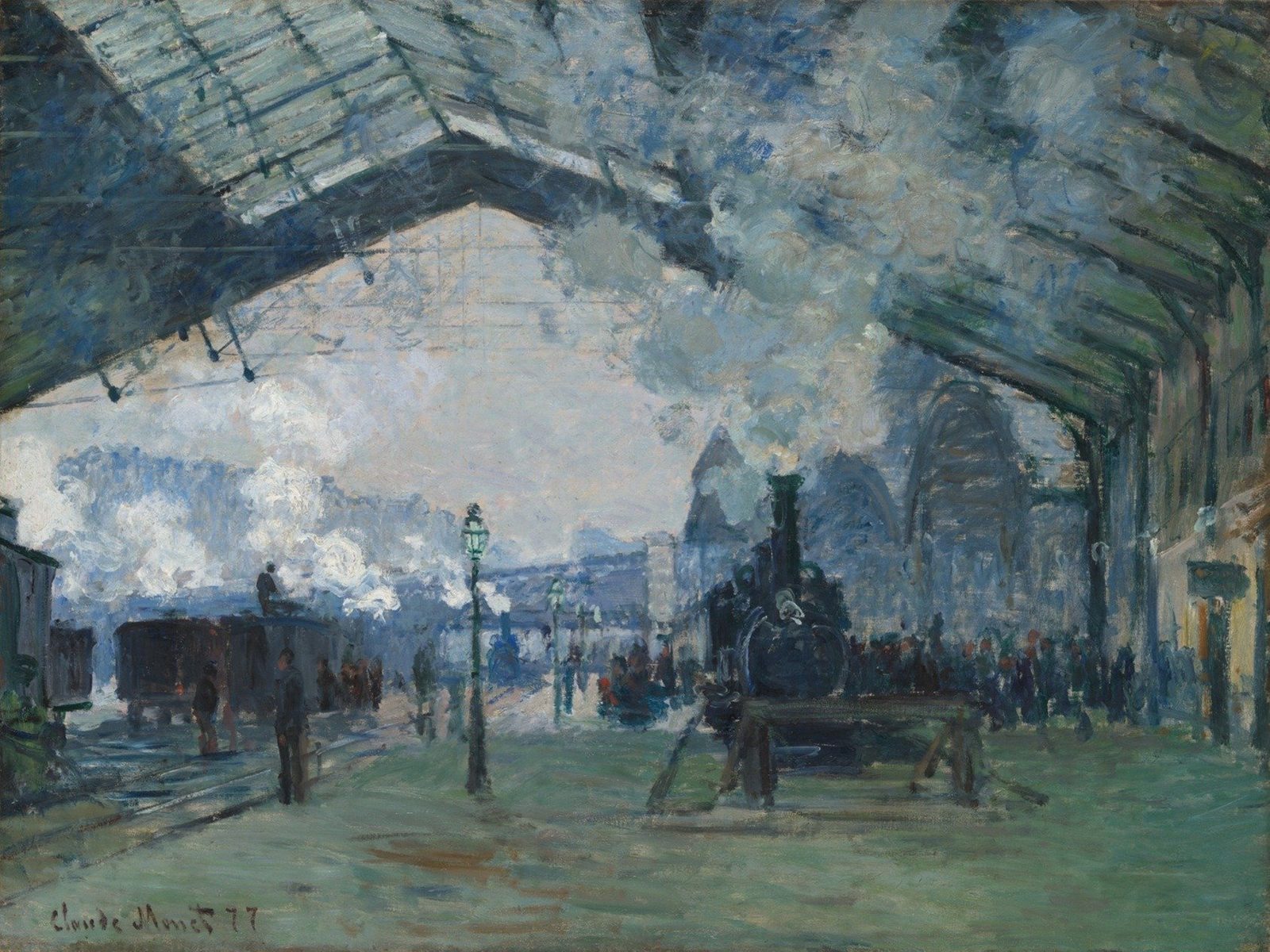
- Artist
- Claude Monet
- Title
- Arrival of the Normandy Train, Gare Saint-Lazare
- Date
- 1877
- Medium
- Oil on canvas
- Museum
- Art Institute of Chicago
- Image
- Public domain (CC0)
Open in Simple Art
Watch this story on iPhone and iPad, with offline downloads and a painting every day.
About 3 minutes of looking, in 9 parts.
Arrival of the Normandy Train
We're inside a Paris railway station. Two great iron-and-glass roofs meet overhead, and beneath them a locomotive pulls in on the right. Its steam rises and spreads under the glass, until it's hard to tell where smoke ends and roof begins.
Claude Monet, 1877, oil on canvas
This is Claude Monet's Arrival of the Normandy Train, Gare Saint-Lazare, painted in oil on canvas and signed Claude Monet 77. The station linked Paris to Normandy. Monet finished eight of his twelve known paintings of it in time for the third Impressionist exhibition, in 1877.
A dark frame of roofs
Look at the big shapes first. The dark undersides of the roofs form a steep triangle across the top of the picture, and through it you see pale daylight and the buildings beyond. The locomotive sits just right of centre, under the place where the steam gathers.
Daylight through the glass
Up under the left-hand roof, a wedge of pale cream and soft yellow reads as daylight. Between the dark beams sit narrow strips of pale blue. The warm strokes look dragged across cooler paint rather than blended, which may be why the light seems to glow.
One warm strip
Almost everything here is blue, grey or green. Now look to the far right edge, where a strip of ochre and yellow marks a lit part of the station wall. It's the one sustained patch of warm colour, and it makes the blues around it feel colder.
An engine half lost in steam
Now the engine. It's a heavy mass of blue-black, but thick strokes of white and pale blue are laid over it, breaking up its outline. The brightest whites seem to stand slightly proud of the canvas. You rebuild the locomotive in your head from whatever the steam leaves visible.
A roof made of diagonal strokes
Lift your eyes to the roof at the top left. The glazing is painted as long, parallel diagonal strokes of pale blue-green, crossed by shorter dark marks that suggest the iron frame. The strokes run with the slope of the roof, so the brushwork itself describes the structure.
A lamppost on the platform
In the middle of the platform stands a lamppost. It's a thin column of broken dark strokes, shifting between near-black, teal and violet, with a small cluster of pale dabs at the top for the lantern. Against all that drifting steam, it's one firm upright.
Travellers as dark upright marks
Then the people. Travellers on the platform are upright dabs of navy, umber and near-black, with no faces at all. The nearest figure is one taller, sustained stroke. Behind him, the crowd breaks into quick marks that soften into the haze.
Look closer
8 details, each checked against a close-up of the picture.
-
Locomotive and Steam
The dark mass of the locomotive is partially obscured by swirling white and pale-blue impasto strokes of steam.
The crop centers on a dark locomotive mass rendered in deep blue-black tones that occupies the middle of the composition, sitting low on a horizontal platform. Above and around the engine, thick impasto strokes of white and pale-blue paint create the illusion of billowing steam, with the brightest highlights concentrated in the upper-center where light catches the vapor and is broken into discrete dabs. The locomotive's edges are deliberately softened by these overlapping steam strokes, demonstrating optical mixing rather than hard contour; the brightest whites sit directly on top of the dark mass, pulling the steam forward. To the right, small dark figure-strokes in browns and reds suggest travelers, while the upper background reveals the curved ironwork of the station's arched roof in muted blue-grays. A small triangular aperture of warmer light appears at upper-left, contrasting with the overall cool palette.
-
Artist's Signature
The text 'Claude Monet 77' is written in dark paint in the lower-left corner.
The crop isolates a handwritten signature reading 'Claude Monet 77' executed in dark, almost black paint against a softly brushed ground of muted teal, sea-green, and pale turquoise. The letterforms vary in weight: the initial 'C' of Claude is a confident loop, the connected script of 'Monet' shows rapid, calligraphic lifts between letters, and the '77' is rendered with two angular, slightly wobbly vertical strokes. Underneath the signature, the background paint is laid in long, mostly horizontal brushstrokes that are scumbled and broken, allowing the underlayer to show through in places. A faint scuff or scrape mark appears just above and left of the 'M', and the signature itself sits in thin paint, revealing lighter ground tones in the negative spaces between strokes.
-
Canopy Trusses
The iron roof supports are rendered as diagonal, calligraphic streaks of blue and gray paint.
The crop shows a field of diagonal, parallel brushstrokes running roughly upper-left to lower-right, with values ranging from pale blue-green highlights to deep navy-black accents. Darker, more linear strokes cross the lighter bands at near-perpendicular angles, suggesting the iron lattice of the roof trusses. The marks are loaded, gestural, and visibly dragged, with broken edges where lighter and darker tones meet wet-into-wet. In the lower half, the strokes turn more vertical and irregular, mixing into warmer cream and ochre passages at the bottom-right.
-
Skylight Aperture
A bright, triangular area of pale white and yellow light creates a highlight in the upper-left roof section.
The crop captures the upper-right junction of a vast glass-and-iron roof, where deep blue-black diagonal girders frame pale blue sky-light gaps above a sweeping triangular wedge of cream and pale yellow highlight in the lower-right quadrant. The brightest band runs along the lower diagonal edge of the roof, where warm cream, butter-yellow, and off-white strokes are laid in short, slightly curved dabs that read optically as a luminous aperture. Above this wedge, narrow strips of cerulean and pale blue sit between the dark beams, built from horizontal and slightly slanted touches that leave raw canvas-toned passages visible. Edges between dark beams and bright openings are softened by adjacent mid-value blue strokes rather than hard contours, and the diagonal beam edges show drips and scumbled overlaps where lighter paint has been dragged across darker underlayers.
-
Station Interior Warmth
Ochre and yellow paint tones are used for the lit interior of the station on the far right.
The crop shows the right-hand portion of the station interior, dominated by a column of warm ochre and yellow vertical strokes that read as a sunlit wall or aperture. A dense, near-black vertical mass occupies the center, its edges broken by short, dry brushmarks where it meets the warm tones on the right. Cool blue-grey and white strokes wash down the left side, and a thick dab of pale paint near the top right suggests a structural highlight catching diffused light. The warm and cool zones are separated by a ragged, soft edge rather than a hard line, with the dark mass acting as the value pivot between them.
-
Station Lamppost
The lamppost is a thin vertical stroke topped with a small, light-colored dot of paint.
A single thin vertical form rises through the center of the crop from bottom to top, painted as a series of short, broken dark strokes that shift between near-black, deep teal, and dusky violet. At the upper end, a small cluster of pale cream and cool white dabs sits inside a faint rectangular cage, reading as the lit lantern. The surrounding field is a loose scumble of cool blue-grays, off-whites, and lavender pinks; the lamppost's edges are never sharp, dissolving where dark vertical strokes meet lighter scumbled passages behind. Values are restrained: the post is the darkest note, the lantern the lightest, with mid-tone atmosphere between.
-
Platform Figures
People on the platform are rendered as vertical dabs of dark color without defined facial features.
The crop centers on a cluster of figures rendered as loose vertical dabs of dark pigment clustered around u=0.30–0.55, v=0.20–0.55. The foremost figure at left (u≈0.20, v≈0.30–0.95) is a taller, more sustained stroke of near-black with a faint warmer head tone, but still shows no facial detail—only a dark head shape against the lighter blue sky. Behind him, the crowd dissolves into quick comma-shaped dabs of navy and umber with soft, bleeding edges where they meet the smoke-washed background. Values stay narrow in the dark-mid range, and edges are kept wet and unblended, letting the eye mix the figures with the surrounding grey-blue atmosphere.
-
Steam and Roof Transition
The boundary between the white steam and the blue roof is a blurred, blended transition of colors.
The crop is dominated by a soft vertical transition where pale, scumbled cream-white on the left dissolves into a field of cool blue-green on the right. Edges between the two zones are not drawn as a contour; instead they are broken by short, overlapping dabs of pink, lilac, and pale ochre scattered across the boundary. The lower-right corner drops into deeper umber and near-navy passages, while the upper-left reads as the thinnest, most translucent area where underlying canvas tone shows through scumbled white. Brushstrokes are short, diagonal, and loosely parallel, with paint applied in varied thicknesses that create a mottled, optical rather than pre-mixed colour field.
Arrival of the Normandy Train, Gare Saint-Lazare in context
A studio near the station
By the end of 1876 Monet had grown restless in Argenteuil, his home since 1871 [2]. With money from his friend Gustave Caillebotte he rented a ground-floor studio at 17, rue Moncey in Paris, a few blocks from the Gare Saint-Lazare, the terminus of the Normandy line that served Argenteuil [2]. The catalogue notes that the station also lay halfway between Argenteuil and the Hoschedé family's château at Montgeron, where Monet was finishing four decorative panels amid money troubles and worry over Camille's health [2].
Saint-Lazare was then the largest and busiest station in Paris; it had opened in 1837 and been enlarged by the Pont de l'Europe, completed in 1868 [2]. Having set up in the studio in January 1877, Monet asked for and received permission from the director of the Western Railway company to paint in the station [2][3]. Unusually for him, he also made pencil sketches in sketchbooks, perhaps to cope with the constant movement [2].
Twelve canvases, seven or eight on show
Twelve paintings of the station are known, all made in 1877 [3]. The museum's collection page says Monet finished eight of them in time for the third Impressionist exhibition in April 1877, probably hanging them in the same room [1]. Its scholarly catalogue and Wikipedia both count seven as identified in the exhibition, so the difference seems to lie between canvases finished and canvases that can be traced in the catalogue [2][3].
This one was number 97, shown as 'Arrivée du train de Normandie, gare St-Lazare' and listed as belonging to 'M. H.', which matches its sale to Ernest Hoschedé in March 1877 [1]. It is the only one of the seven with a title naming both the line and the direction of travel [2]. Caillebotte showed his large Le Pont de l'Europe in the same exhibition [2].
Émile Zola praised the group for conveying the rumble of the trains and the smoke filling the sheds, and one critic singled out the Chicago canvas as excellent and unpretentious [2]. Not everyone agreed. Wikipedia quotes a reviewer who felt Monet had tried to reproduce the unpleasant effect of several locomotives whistling at once [3].
What the steam covers
The catalogue points out that the central lamppost lines up exactly with the apex of the glass roof. It divides the picture much as the street lamp does in Caillebotte's Paris Street; Rainy Day, which Monet probably knew was in progress [2]. Infrared reflectography shows that Monet first painted a grid of iron tie rods under the right side of the roof, matching the left, and later covered it with grey steam from the engine [2]. Painted-over strokes at the lower left may once have been the round front of a locomotive, but the technical report calls the underlying form unclear [2].
The closest version in viewpoint and handling is The Gare St-Lazare in the National Gallery, London, which was not shown in 1877 [2]. Both relate to a drawing in one of the sketchbooks [2].
Hoschedé, de Bellio, Ryerson
Hoschedé bought this and two other station pictures by March 1877 [2]. By 1878 it belonged to the collector Georges de Bellio, and after his death in 1894 it passed to his daughter Victorine and her husband Eugène Donop de Monchy [1]. De Bellio lent it to the Monet and Rodin exhibition at the Galerie Georges Petit in 1889 [1].
Bernheim-Jeune had it by about 1899 and lent it to the centennial exhibition of French art at the 1900 Paris world's fair [1]. Paul Rosenberg sold it to Durand-Ruel in October 1911 for 13,000 francs. On 16 December 1911 Durand-Ruel in New York sold it to Martin A. Ryerson of Chicago for $7,000 [1]. It came to the Art Institute with his bequest in 1933 [1].
The catalogue sees Monet's decision to show the station paintings together as an early form of the group exhibitions he would stage for the Stacks of Wheat in 1891 [2].
- Claude Monet, Arrival of the Normandy Train, Gare Saint-Lazare (1933.1158): collection record with description, provenance and exhibition history (public API) . Art Institute of Chicago
- Gloria Groom, 'Cat. 16, Arrival of the Normandy Train, Gare Saint-Lazare, 1877', with technical report, in Monet Paintings and Drawings at the Art Institute of Chicago (public API) . Art Institute of Chicago
- Gare Saint-Lazare (Monet series) . Wikipedia