Faces under electric light
Toulouse-Lautrec crowds his circle round a café-concert table and lets the glare turn one face green
- Artist
- Henri de Toulouse-Lautrec
- Title
- At the Moulin Rouge
- Date
- 1892–95
- Medium
- Oil on canvas
- Museum
- Art Institute of Chicago
- Image
- Public domain (CC0)
Open in Simple Art
Watch this story on iPhone and iPad, with offline downloads and a painting every day.
About 3 minutes of looking, in 8 parts.
At the Moulin Rouge
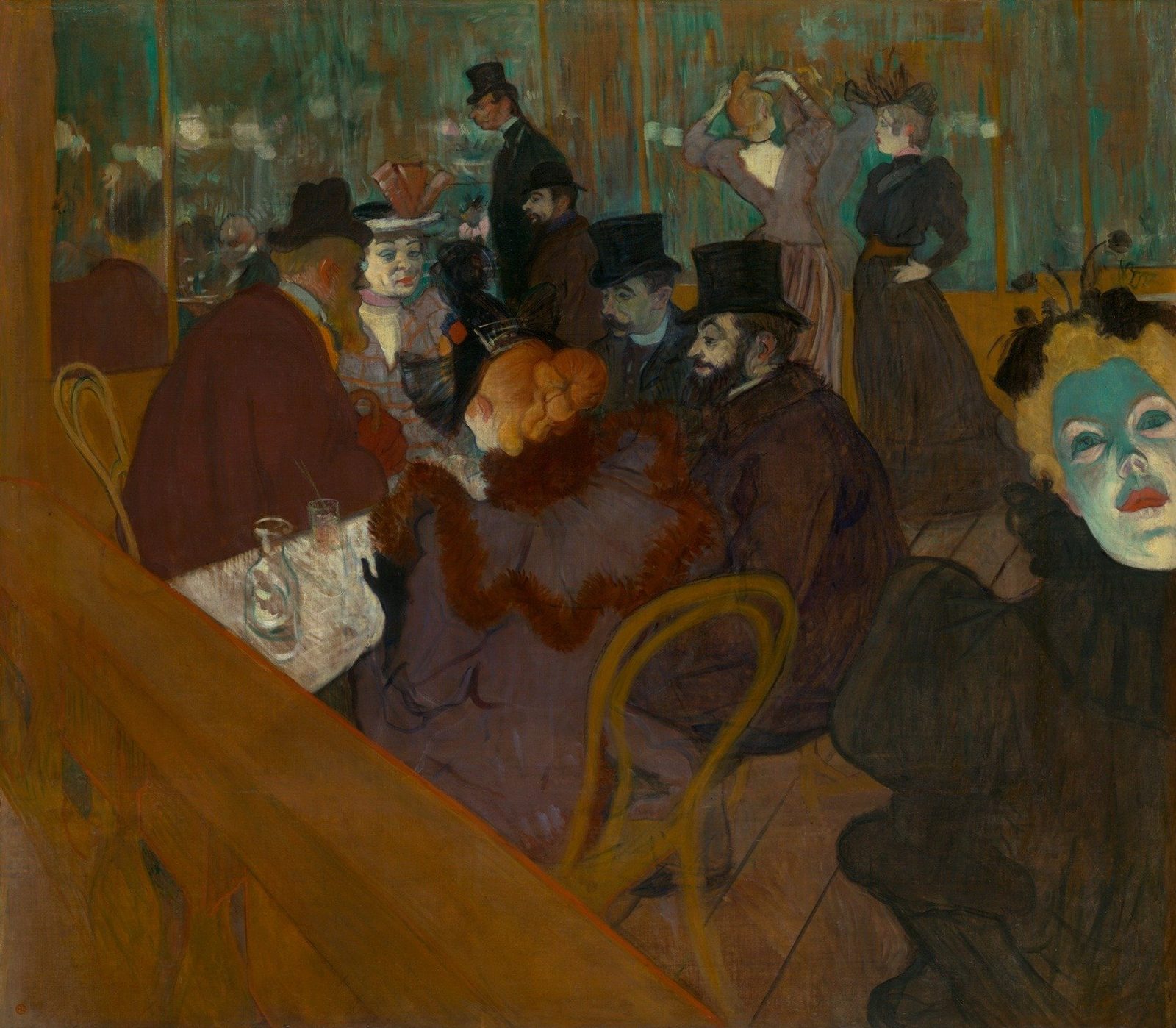
A crowded table in a Paris nightspot. Men in top hats, women in feathers and fur, all talking, none of them looking at us. Then, at the right edge, one face lurches into view, lit a startling green.
Toulouse-Lautrec, 1892 to 1895, oil on canvas
Henri de Toulouse-Lautrec painted At the Moulin Rouge in oil on canvas between 1892 and 1895. The Moulin Rouge opened in 1889 and was the most famous of the Paris café-concerts. The Art Institute of Chicago says he was a regular there, with a table permanently reserved.
A rail into the room
A long ochre rail cuts in from the lower left and runs steeply up into the room. It squeezes the table and its drinkers into a tight wedge, with standing figures and a band of green behind them. Your eye slides along it, straight to the woman with red hair.
Orange against violet
She sits with her back to us. Her hair is a heap of orange and yellow dabs, set right against a flat purple-grey coat, with a rust-brown fur wrap between them. The warm hair glows because so much around it is cool.
The rail, up close
Below her runs the rail. It's a broad, flat plane of ochre, with thinner red-orange strokes dragged along it on the diagonal. They never quite cover the layer beneath, so a plain surface still seems to move.
A face in the glare
Now the face at the right. The museum identifies her as the singer May Milton. Her skin is a harsh turquoise-green, with pinkish highlights and bright red lips. The Moulin Rouge was designed for electric light, and Lautrec seems to relish its glare. Notice how the edge of the canvas slices right through her.
La Goulue
Up in the background, a woman lifts both arms to her head. The museum says this is the dancer La Goulue, arranging her hair. She's set down in a few quick strokes against streaks of green, a sketch beside the more solid figures at the table.
The artist in the crowd
Now look just to her left, among the hats. The museum places Toulouse-Lautrec himself here, a small figure beside his much taller cousin, the physician Gabriel Tapié de Céleyran. Their faces are only a few thin strokes and pale highlights.
Look closer
6 details, each checked against a close-up of the picture.
-
The central red-haired woman
The woman's hair is rendered with bright orange-red strokes against a purple-grey coat.
The crop centers on a woman seen from behind and slightly to the side, her hair a piled red-gold bun built from distinct, rounded dabs of orange and yellow-orange pigment. That warm hair sits in immediate adjacency to a broad, relatively flat field of muted purple-grey coat, with the cool note intensifying the glow of the orange. A thick rust-brown fur stole wraps her shoulders, painted with shorter, multi-directional strokes of deep umber and lighter ochre that fragment the contour where fur meets hair and coat.
-
Green-faced figure
The face at the right edge, identified by the museum as the singer May Milton, is painted a saturated turquoise-green that contrasts with the skin tones of the other figures.
The crop isolates a single face tilted upward and turned slightly to the right, rendered in a saturated turquoise-green across the cheek, jaw, and brow. Pinkish-white passages sit on the forehead, the bridge and tip of the nose, and the chin, functioning as highlights rather than naturalistic skin. The hair is a loose scumble of yellow-ochre strokes against a dark brown-black background, with no tight contour at the silhouette. The lips are blocked in as a flat, opaque vermillion shape, and the eye sockets are deepened with cooler blue-green shadow. Edges between the green flesh and the yellow hair are broken and overlapping, while the contour against the dark ground on the left is comparatively crisp.
-
Rail surface
The broad ochre diagonal in the foreground, a rail running up into the room, is painted as a flat plane with scumbled red-orange strokes dragged along it.
A broad, slab-like plane of warm ochre cuts diagonally across the frame from upper-left to lower-right, occupying roughly two-thirds of the crop. Its dominant hue is a saturated orange-brown, laid down in long, sweeping diagonal sweeps whose direction is reinforced by thinner scumbled strokes of red-orange that sit on top of the underpainting. The upper edge of this plane is bordered by a small cream/ivory area with sketchy greenish marks (the glass carafe region), while the upper-right contains a darker, mauve-lavender mass with loose pink-red accents suggesting a figure's shoulder and head. A sliver of yellow-gold on the far right reads as a chair frame, separated from the table by a soft, brushed edge rather than a hard line.
-
Right image crop
The green-faced figure is cut off by the right edge of the canvas.
The crop isolates the right-hand terminus of the painting, where a face painted in cool teal-green tones is abruptly sliced by the canvas edge: the figure's proper-left cheek, ear, and jaw dissolve into nothing rather than resolving into a contour. The green facial mass sits above a deep umber-black vertical block that reads as clothing and occupies the lower two-thirds of the crop. A vivid orange-red lip is the highest-saturation note in an otherwise muted key, framed by raw umber hair that meets a thin band of mustard-ochre at the top of the head. Brushwork is thin and scumbled over a visible woven ground; facial modeling is built with broad, slightly dragged strokes of lighter green and pale lavender-pink that never fully blend.
-
Standing woman's pose
The woman in the background has her arms raised above her head in a dynamic, sketch-like pose.
The crop centers on a standing woman whose arms are bent upward, hands meeting just above the crown of her head, framing a tilted, pinkish-reddish hair mass. Her bodice is a muted mauve-dusty rose interrupted by a sharply cut cream-yellow V-panel at the chest, with a band of green (scarf or collar) tucked behind the neck. Below, the eye is pulled into a black top hat and a pale face in the lower foreground, which sit loosely against her mauve pleated skirt. The background is built from vertical streaks of moss and viridian green, broken by hints of ochre and pink. Edges between figure and ground are softened in places and left as abrupt, broken contours in others, especially along the right shoulder and skirt folds.
-
Top-hatted figures
The faces of the men in top hats are rendered with minimal detail and pale highlights.
The crop centers on a standing figure in a black top hat and dark coat, with a second man in a brown bowler hat positioned lower right. The top-hatted man's face is reduced to a few thin, calligraphic strokes suggesting a profile: a pale greenish-gray highlight along the cheekbone and nose ridge contrasts with an ochre-warm shadow plane. Edges between hat brim and head are softened by a dark, scumbled halo rather than a hard contour. The bowler-hatted figure shows more developed features, with a pinkish flesh tone on the cheek, a dark stroke defining the mustache, and a blue-tinged shadow under the brim. The background is a single, broadly brushed teal field with vertical striations and a warmer ochre vertical band behind the standing figure's shoulder.
At the Moulin Rouge in context
Portraits at a table
The Art Institute of Chicago dates At the Moulin Rouge to 1892 to 1895. It is oil on canvas, 123 by 141 centimetres, and is stamped with a monogram at lower left rather than signed [1]. The museum calls it a cleverly observed group portrait of customers and entertainers from Lautrec's circle. It names those seated at the table as the dancers La Macarona and Jane Avril, the photographer Paul Sescau, the poet Édouard Dujardin and the vintner Maurice Guibert [1].
The identifications differ in detail between sources. Wikipedia calls Guibert a photographer and identifies the red-haired woman with her back to us as Jane Avril [2]. The museum's text doesn't spell out that reading.
A canvas cut and mended
The museum's collection text, published through Google Arts & Culture, says that at some point the artist or his dealer cut down the canvas to remove May Milton, perhaps because her appearance made the picture hard to sell, and that by 1914 the cut section had been reattached [3]. Who made the cut, and when, remains uncertain; the museum's provenance and exhibition notes rely in part on a 1986 study by Reinhold Heller [1].
The early exhibition record is also unclear. The museum lists a possible showing at Les XX in January 1892 under the title Nocturne, a showing at Boussod et Valadon in Paris in 1893, and one at Le Barc de Boutteville in July 1894 as Un Coin du Moulin Rouge [1]. An 1892 showing, if it happened, would fall at the very start of the date range. In 1902, after Lautrec's death, the painting was at the Salon des Indépendants without appearing in the catalogue [1].
Lautrec and the Moulin Rouge
The Moulin Rouge opened in 1889 and, the museum says, was the most famous of the Paris café-concerts. Lautrec was a regular with a permanently reserved table, and the owner bought his Equestrienne to decorate the lobby [1]. The Moulin Rouge's own history says its director, Joseph Oller, asked him in 1891 for a poster. This became Moulin Rouge: La Goulue [4].
The Metropolitan Museum describes how Lautrec's posters turned Montmartre entertainers into celebrities and drew on Japanese woodblock prints for their flat colour, strong outlines, cropping and oblique angles [5]. The Art Institute notes that the Moulin Rouge was designed for electric light and that Lautrec revelled in the possibilities of its glare [1].
The last years
According to the Met, Lautrec's career lasted only just over a decade, and he died at 36 from complications of alcoholism and syphilis [5]. Wikipedia records that he collapsed in early 1899 and spent three months in a sanatorium at Neuilly, and that he died on 9 September 1901 at his mother's estate, the Château de Malromé [6].
The painting stayed close to his circle. The museum's provenance begins with Maurice Joyant, executor of the artist's estate and co-director of the Galerie Manzi-Joyant, by 1902. It then lists Manzi, Jean Laroche in 1926, Paul Rosenberg and the London dealers Reid & Lefevre in June 1928, before Frederick Clay Bartlett of Chicago gave it to the museum that year [1]. The Musée Toulouse-Lautrec in Albi dates its founding gift to 1922 and credits it to the count and countess. It quotes an offer signed by his mother, Joyant and Gabriel Tapié de Céleyran, the tall cousin in this painting [7]. Wikipedia gives the count's death as 1913 [6], so the museum's wording is hard to square with the dates.
- Henri de Toulouse-Lautrec, At the Moulin Rouge (1928.610): object record, provenance and exhibition history . The Art Institute of Chicago
- At the Moulin Rouge . Wikipedia
- At the Moulin Rouge, Henri de Toulouse-Lautrec: Art Institute of Chicago text . Google Arts & Culture
- Toulouse-Lautrec, emblematic figure of the Moulin Rouge (2021) . Moulin Rouge, Paris
- Cora Michael, Henri de Toulouse-Lautrec (1864-1901), Heilbrunn Timeline of Art History (2010) (Internet Archive copy) . The Metropolitan Museum of Art, New York
- Henri de Toulouse-Lautrec . Wikipedia
- History of the museum . Musée Toulouse-Lautrec, Albi