At the Races — Manet's Snapshot of Speed
A guided walkthrough for painting students
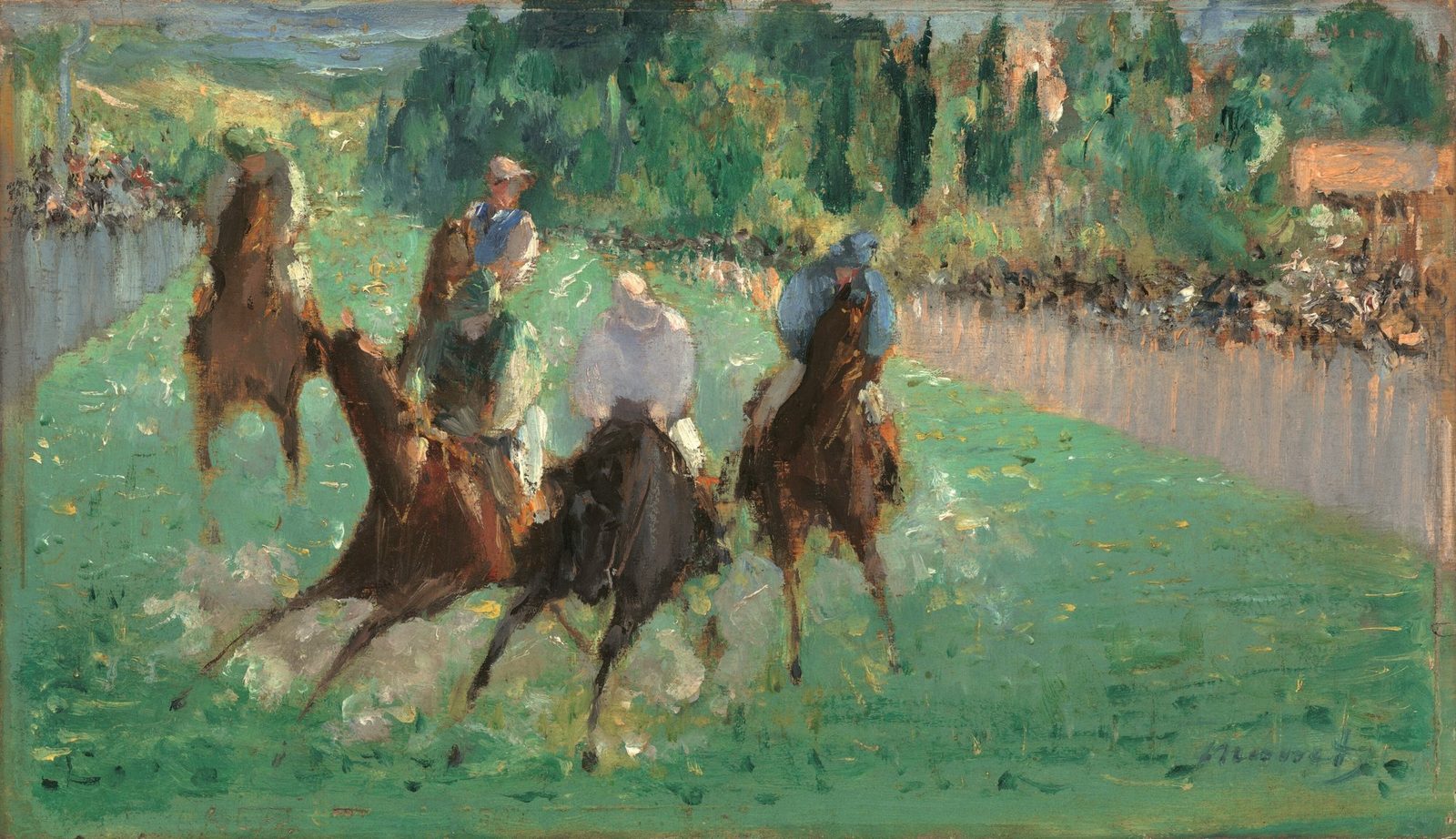
- Artist
- Edouard Manet
- Title
- At the Races
- Date
- c. 1875
- Medium
- oil on wood
- Image
- Public domain (CC0)
Open in Simple Art
Watch this story on iPhone and iPad, with offline downloads and a painting every day.
About 5 minutes of looking, in 12 parts.
A race caught mid-stride
Here is Edouard Manet's At the Races, painted around 1875 in oil on wood. Notice the cropped horse at the left, the rider leaning off the right edge, and the brushwork so loose that the grass seems to move under the hooves. You feel you have stepped into the middle of a race, not staged in front of one.
Oil on wood, c. 1875
This is a small, sketch-like panel handled in a loose, late Impressionist hand. Manet treats the racecourse the way a photographer would — fast, cropped, unresolved — anticipating the modernist easel picture by decades.
A banded layout
Look at the banded layout: a low treeline near the top, a horizontal rail across the middle, and the foreground taken up by horses and grass. Two riders form a soft inverted triangle at the center, and if you drop in thirds the white jacket lands on a powerful intersection.
Diffuse, silvery daylight
The light is diffuse, almost overcast, with no single sun direction. The brightest passages — the white jacket, the pale sky — act as the effective light accents, and the overall key stays high and silvery without ever going chalky.
The brightest passage
Move in on the white jacket. This is the painting's brightest passage — thick, unblended strokes of near-white and cool grey laid side by side. Tiny dark specks survive inside the light shapes, keeping the jacket from feeling chalky.
A light silhouette on a dark mass
Now look at the dark horse below the jacket: a single mixed mass of near-black, umber and deep green, with no internal modelling. The rider's shoulder and back melt into the field through feathered edges, so figure and mount fuse. Drag your eye along the horse's back gesture and you can feel the weight.
One blue mass, one brown wedge
Swing right to the blue rider. The hunched back is one loaded blue mass overlapping a diagonal brown wedge for the horse's neck, with no transitional halftone between them. A single small orange-red fleck near the throat anchors the eye. That is all the racing posture needs.
Sliced by the frame
Back to the left edge. The frame slices a dark horse and rider — only fragments survive: a dab of flesh tone, one bright red cap stroke, a few white jacket highlights. The hard edge of the panel does the cropping that the brushwork refuses to.
A rail made of drips
Follow the dissolving rail across the middle. There is no continuous contour here, only a band of broken greys, mauves and pinks where dark figures melt into pale ground. Watch the long vertical drips below — the panel was tilted while the paint was still wet, letting gravity pull streaks of ochre down over lavender.
Dabs that read as a crowd
Behind the rail on the right, the crowd is just a warm sienna ground dotted with loaded pinks, whites and one near-black fleck per head. The middle values live in the ground; your eye completes the figures.
A wall of dragged greens
Above the crowd, the treeline is built from a handful of long vertical drags in dark and olive green, with one small patch of pale sky and a rust-orange note breaking the mass. No leaf is ever drawn — depth comes from value shifts alone.
No grass blades, only marks
Drop down into the foreground grass. There are no blades here, only short horizontal dabs of yellow-ochre and pale cream sitting on top of a mid sage ground. The illusion of turf comes from the rhythm and count of those marks, not from drawing grass.
Look closer
10 details, each checked against a close-up of the picture.
-
White rider and dark horse
The pale-clad jockey on the dark horse is the brightest passage, painted with thick white and pale-grey strokes that sit atop surrounding loose green and brown marks.
The crop centers on a jockey in pale clothing mounted on a dark horse, rendered in broken, sketch-like strokes against a green field. The white jacket is built from the thickest, most opaque passages in the image — buttery dabs of cool white and pale grey laid wet-into-wet so that green and brown underpainting shows through the gaps. Edges are deliberately unresolved: the rider's shoulder and arm melt into the green background through feathered, dry-brushed transitions, while only the cap and sleeve have crisp, raised ridges of impasto. The horse below is a wet-on-wet mass of near-black, umber and deep green, with no internal modelling, so the figure reads as a light silhouette seated on a dark mass.
-
White jacket highlights
The jockey’s white jacket is painted with thick, light-valued strokes of pure white and pale grey that read as the painting’s highest key.
The crop isolates the central jockey in white, whose jacket is built from broad, unblended strokes of near-white and cool pale grey laid side-by-side over a slightly warmer ground. These light strokes sit against a dense mass of dark brown, near-black and deep teal that forms the horse's body, so the jacket reads as the brightest passage in the frame. To the right, a large expanse of saturated mid-green (the field) is interrupted by thin, broken white flecks that act as the highest-value accents beyond the jacket. Edges between the white jacket and the dark horse are left open and ragged, with green and grey dragged across the boundary so the figure and mount fuse rather than sit on top of one another.
-
Far-left horse from behind
The horse at the far left is seen from behind, a brown mass with the rider in a green cap barely indicated.
The crop isolates the far-left horse and rider, seen from behind beside the rail. Loose, dragged strokes in cool grays and muted blacks suggest the muzzle, neck, and shoulder; only fragments of the rider survive—a dab of pale flesh tone, a bright red cap stroke (c. 0.18, 0.32), and pale jacket highlights (c. 0.08, 0.38). The horse's forelegs descend into a pale blue-gray vertical wash that reads as rail or shadow. Overlying foliage is built from scumbled greens and ochre dragged with directional flicks, leaving ragged, broken edges where figures meet background rather than enclosing contours.
-
Blue rider’s lean
The rider in blue is bent low over the horse’s neck, defined by only a few angled strokes of blue, white, and brown.
The crop centers on a hunched rider in slate-blue tones perched on a dark chestnut neck that sweeps up from lower right to upper center. The figure is built from roughly half a dozen loaded strokes: a broad blue mass for the jacket, a warmer grayish patch for the head/shoulder bend, a single bright orange-red fleck near the throat, and small white/cream accents suggesting sleeve cuff and reflected light. Edges are broken and feathered into the green-yellow background, so the silhouette reads more as a value shape than a drawn contour. The horse's neck is a diagonal wedge of dark brown scumbled with rust-orange and ochre drags, meeting the rider's mass at a soft, unresolved seam.
-
Foreground grass strokes
The grass consists of separate, unblended strokes of pale green, yellow, and white with no drawn blades or contours.
The crop is dominated by a mid sage-green field of paint with discrete, unblended accents. Short horizontal dabs of yellow-ochre and pale cream sit on top of the green without being worked in, and small streaks of near-white appear as quick flicks rather than blended highlights. No leaf shapes, blade contours, or linear grass elements are drawn; the texture is built entirely from the spacing and direction of these small marks. The lower half shows slightly longer, more vertical scratchy strokes in a darker green, suggesting a change in ground plane, while the upper left carries broader, paler passages that read as light reflection rather than foliage.
-
Dissolving rail line
The horizontal rail dissolves into broken grey and lavender strokes, with no continuous contour separating it from the spectators or grass.
The crop shows two zones stacked vertically: above, a dense thicket of dark figures, foliage greens and flesh pinks rendered in short, loaded strokes; below, a broad passage of pale grey-lavender marked by long vertical drips and streaks of raw ochre and orange. There is no unbroken horizontal contour dividing upper and lower halves; instead the boundary is a roughly 0.15-tall band of scrambled, partly-unblended greys, mauves, pinks and blacks where the dark mass above melts into the pale ground below. Drip runs descend through the lower two-thirds of the crop, carrying thin orange-ochre lines over a milky lavender field, and the rail's top edge is implied by where these drips begin rather than by any painted line.
-
Right-side crowd notes
Behind the rail at the right, small dabs of pink, red, and white suggest faces and clothing in the spectator crowd.
The crop is dominated by rapid, scumbled brushwork. Across the upper left, broad strokes of mid-to-dark green (cool and warm variants) read as a mass of foliage or draped cloth, applied wet-into-wet with feathery edges where lighter viridian touches break into the darker passages. The right and lower halves resolve into a dense field of small, broken dabs in pink, salmon, off-white, ochre, and black, sitting atop a warm sienna ground; these dabs have crisp, loaded edges where the bristles deposited thick paint. A loose horizontal band of grey-white dabs near the upper-middle reads as a rail, with the crowd dabs stacked above and below it. Values are compressed: the darkest accents are near-black flecks that pin down the lighter pinks and whites rather than forming a continuous shadow.
-
Treeline mass
The treeline is constructed from broad, dragged strokes of dark green and brown that merge into a continuous wall of foliage without ever depicting a single leaf.
The crop is filled almost edge to edge with foliage rendered as broad, vertical-to-diagonal drags of dark green, olive-green, and earth brown. In the upper right, a small triangular patch of pale grey-blue sky and warm rust-orange marks breaks the green mass. Individual strokes are clearly visible: some are loaded single passes of pigment, others are scumbled or dragged, and many edges stay soft where wet-into-wet mixing has occurred. No leaf shape, branch, or tree outline is delineated; the wall of trees is built entirely from layered, merging strokes that vary in chroma and value to suggest depth rather than form.
-
Left spectator cluster
The left-hand spectators are reduced to a huddle of grey, pink, and ochre strokes pressed against the rail.
The crop centers on a dense knot of spectators pressed against a vertical tree trunk (left, warm brown) and the pale blue-grey rail below. Their bodies are reduced to short, vertical dabs of cool grey, dusty pink, and ochre, with the tallest head at upper left marked by a darker grey-brown stroke. Behind them the background is a scumbled mix of olive, viridian, and pale blue sky tones, applied in horizontal sweeps that contrast with the upright figure strokes. On the right, a jockey in a green cap and dark jacket on a bay horse sits in stronger, more confident strokes, providing a tonal anchor against the broken crowd.
-
Signature mark
A dark, cursive mark near the lower right corner functions as a signature but remains illegible under loose paint handling.
The crop shows a mostly green field of paint with a dark, smeared horizontal mark across the middle that reads as a cursive signature. The strokes are loose loops and short dashes in dark green-black pigment, partially obscured and dragged into by surrounding lighter green brushwork. Edges are soft, broken, and feathered where wet paint has been pulled across the lettering. The value contrast between the dark marks and the mid-green ground is low to moderate, and a few small ochre and pale yellow flecks sit near the top edge.
At the Races in context
Manet at the racecourse
The Art Institute of Chicago, describing Manet's larger Races at Longchamp of 1866, places that scene at the Longchamp course in the Bois de Boulogne, on the western edge of Paris [2]. The museum says Manet broke with the usual way of showing races, from the side with the horses in profile, and instead had the runners gallop towards the viewer [2]. It adds that racing, imported from England, had become a popular entertainment in France, and that the racetrack was a thoroughly modern space [2].
The National Gallery's own description of this panel uses the same head-on idea, with a dusty cluster of horses bearing directly down on us [1]. The Art Institute says that, unlike his friend Edgar Degas, Manet produced only two paintings on the theme, and that he cut the 1866 canvas down from a much larger composition [2]. Its text does not say how small panels such as this one fit into that count.
Close to the Impressionists, but not one of them
The Metropolitan Museum's essay on Manet says he painted alongside Claude Monet and Auguste Renoir at Argenteuil in the summer of 1874, the year that Degas, Monet and Berthe Morisot showed together at what became known as the first Impressionist exhibition [3]. He declined invitations to that show and to all seven later ones, though the essay notes the artists shared an interest in modern subjects, painting outdoors, bright colours and abrupt cropping [3].
Wikipedia gives two reasons for his refusal: he did not want to be seen as the representative of a group, and he preferred to exhibit at the official Salon [4]. It also says that after the early 1870s, under the influence of Monet and Morisot, he used lighter colours and fewer dark backgrounds, while keeping his distinctive black [4]. The Salon was not always welcoming: his Masked Ball at the Opera, painted in 1873 and now also in Washington, was refused by the Salon of 1874 [5].
Shown as Impressionism after all
The panel's exhibition history begins in 1886, three years after Manet's death, when it was number 15 in Works in Oil and Pastel by The Impressionists at the American Art Galleries in New York [1]. Then in 1905 it appeared in London at the Grafton Galleries, in a show of Boudin, Cézanne, Degas, Manet, Monet, Morisot, Pissarro, Renoir and Sisley, under the title Races at Longchamps [1].
In Washington it was included in Manet and Modern Paris from 1982 to 1983, and it later travelled to Rome, San Francisco, San Antonio, Tokyo and Seattle in Intimate Impressionism from the National Gallery of Art between 2013 and 2016 [1]. The museum's bibliography also lists an article by Jean C. Harris, 'Manet's Racetrack Paintings', published in the Art Bulletin in 1966 [1].
From Paris dealers to Lynnewood Hall
The museum records the panel with the Paris dealer Camentron, and it was probably sold from there to Durand-Ruel in New York and Paris from 1899 [1]. Peter A. B. Widener acquired it in 1913 for Lynnewood Hall at Elkins Park, Pennsylvania, and it came to the National Gallery in 1942 as part of the Widener Collection, through Joseph E. Widener [1]. It's currently listed as not on view [1].
- Edouard Manet, At the Races, c. 1875 (1942.9.41): object record, provenance, exhibition history and bibliography (read via an Internet Archive copy) . National Gallery of Art, Washington
- Edouard Manet, The Races at Longchamp, 1866 (object 81533): collection record . Art Institute of Chicago
- Rebecca Rabinow, 'Édouard Manet (1832-1883)', Heilbrunn Timeline of Art History (read via an Internet Archive copy) . The Metropolitan Museum of Art, New York
- Édouard Manet . Wikipedia
- Masked Ball at the Opera House . Wikipedia